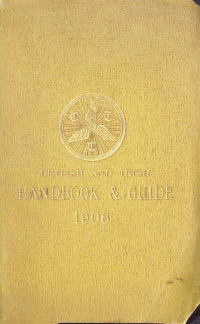
CTC British and Irish Handbook and Guide 1906
Contents
- Explains the Handbook's two-part structure -- the Hotel Directory and the Farm House and Coffee Tavern List, supplied free to members, versus the separately priced Year Book and Diary -- and describes the hotel discount scheme, noting that members should report any tariff dispute directly to Secretary E. R. Shipton at the Club's Victoria Street, Westminster offices.
- Lists the Club's 1906 officers -- Chairman W. Kendall Burnett, Vice-Chairman O. H. Beatty, Honorary Treasurer R. W. B. Gurney, and Honorary Consulting Solicitor W. B. Tanner -- the Trustees of the General Reserve and Life Membership funds, the Representative Councillors for each English, Scottish and Irish division, a directory of Consuls abroad (from Coblenz to Calcutta), and the roll of Honorary Life Members with their length of Club service.
- The registered constitution of the Club: its name and registered office, and the objects for which it exists -- promoting, assisting and protecting the use of bicycles and tricycles on the public roads, providing legal assistance to riders, and supplying members with road books, maps, periodicals, a uniform and badge and hotel arrangements -- with the winding-up provisions that cap each member's liability at ten shillings.
- The Club's governing articles: membership confined strictly to amateurs as defined by the National Cyclists' Union, tickets of membership, Life Membership, the five-shilling subscription with its commuted (one guinea for five years, two for ten) and family rates, expulsion and appeal, the election of Representative Councillors by Division, the officers and powers of the Council, General Meetings and polls of the whole Club, and the Finance Committee and audit.
- The standing Orders the Council makes under the Articles and prints with them: publication of the Gazette, the declaration every candidate must sign, the assignment of each member to a Division, the apportionment of Representative Chief Consuls among the county groups (England subdivided into two nine-Consul halves), postal elections and recounts, the duties of Chief Consuls and Consuls, and notice of General Meetings and polls through the Gazette.
- A short numbered list of road-riding etiquette for members -- keeping to the left, the ban on riding on footpaths, and rules for passing led horses and tram-cars -- with a note that fuller Cycle Laws and By-laws appear in the Year Book and Diary.
- The Club's recruitment prospectus, describing its roughly 40,000-strong international membership, the Touring Bureau's free route and Customs advice, reciprocal membership with touring clubs of Austria-Hungary, Belgium, Canada, Germany, Italy, Switzerland, the United States and elsewhere, the monthly Gazette magazine, and Club campaigns for compulsory cycle lighting and better hotel treatment of wheelmen.
- Instructions and the specimen form for joining the Club, covering ordinary, family and commuted (five- or ten-year) subscription rates, the particulars required of each candidate (name, address, profession, introducer), and the separate application procedure for Life Membership.
- Practical notes for members -- how to reach the Gazette editor and Secretary, the Touring Bureau, the distinction between the Year Book and Diary, the British Handbook and the Foreign Handbook, the six-volume British and Irish Road Book series (Vols. I-IV for England, Wales and Scotland, V-VI for Ireland), Customs cards for touring abroad, and the price list of Club badges, jewellery and Bartholomew's, Johnston's and Gall & Inglis maps.
- Describes the Club's official cycling-suit fabrics supplied through Tranter & Co. of Trowbridge, warns members against spurious imitations, and lists the Official Tailors for Gentlemen by town, from Aberdeen and Bath to Birmingham and Bristol.
- Guidance on planning a UK cycling tour using the Road Book and Handbook together, notes on Continental and foreign touring via the Touring Bureau, a description of Bartholomew's Reduced Survey Maps (two miles to the inch for England and Scotland, four miles for Ireland), and an outline of the six-volume British and Irish Road Book with its key map of the areas each volume covers.
- Sets out the legal Memorandum of Agreement between the Club and appointed hotel proprietors under the discount and net-tariff systems, followed by the fixed net 'Quarters Tariff' prices for breakfast, luncheon, dinner and bed in England and Wales and, separately, in Scotland.
- Introduces the Farm House, Country Lodgings and Coffee Tavern scheme, reproducing the proprietor's signed undertaking to supply members with accommodation at quoted prices and explaining the grade signs (e.g. F.H. for Farm House) used in the tabulated county list that follows later in the book.
- Alphabetical, county-by-county directory of C.T.C.-appointed hotels and inns across England and Wales, from Bedfordshire through the Welsh counties and the Channel Islands, each place listing the hotel name, discount tariff prices for breakfast, luncheon, dinner and bed, the county's Chief Consul, and local cycle repairers.
- Continues the tabulated hotel directory into Scotland, county by county from Aberdeenshire to Wigtownshire, listing appointed hotels, discount tariffs, and each county's Chief Consul and repairers.
- Concludes the tabulated hotel directory with Ireland, county by county from Antrim to Wicklow, listing appointed hotels and inns with discount tariffs, Chief Consuls and repairers.
- Section title page followed by an alphabetical, county-by-county list of C.T.C.-appointed farm houses, boarding houses, country lodgings, cafes and coffee taverns across England and Wales, giving each proprietor's name and address, an accommodation grade code, and net tariff prices.
- Continues the Farm House, Country Lodgings and Coffee Tavern List into Scotland, county by county from Aberdeenshire to Wigtownshire, with proprietor names and addresses, grade codes and net prices.
- Concludes the Farm House, Country Lodgings and Coffee Tavern List with Ireland, county by county from Antrim to Wicklow, listing farm houses, boarding houses and coffee taverns with grade codes and net tariffs.