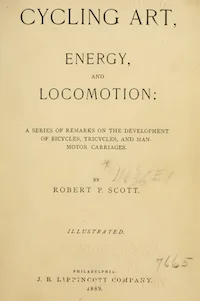
Cycling: Art, Energy and Locomotion
Contents
- Frames cycling as the ideal solution for individual human locomotion, tracing the evolution of transport.
- Argues that cycling constitutes a distinct art form, dispersed across a uniquely varied class of patrons.
- Examines human anatomy and the physiology of leg movement as the model for efficient cycling mechanics.
- Analyses how human muscular power is transmitted to the pedals and through the drivetrain.
- Investigates the mechanical relationship between the human stride and rotary pedalling motion.
- Uses diagrams and kinematics to show how power varies through the crank cycle.
- Explores the physics of bicycle balance and the energy demands of ascending hills.
- Compares how different wheel sizes and saddle positions affect the path traced by the rider.
- Examines how spring systems affect vibration, momentum loss, and rider comfort on rough roads.
- Reviews devices designed to absorb road shock, including spring forks and handlebar dampers.
- Discusses saddle design, spring characteristics, and their effects on rider health and comfort.
- Analyses the causes of over-the-handlebar falls and methods to reduce their frequency and danger.
- Explains gear ratios and how varying the gear affects speed, effort, and suitability for terrain.
- Describes the technical advantages of the rear-drive safety bicycle over the high-wheel ordinary.
- Investigates the causes of sideways skidding on safety bicycles and how design can mitigate it.
- Reviews frame designs and adaptations suited to women riders.
- Examines tandem bicycle designs and the mechanical challenges of coordinating two riders.
- Compares the manufacturing quality and design approaches of British and American cycle makers.
- Reviews crank arm designs, lever systems, and tangent-spoked wheel construction.
- Describes ball and roller bearing technology and its importance in reducing friction in cycles.
- Considers the use of aluminium alloys in frame and tube construction and their structural properties.
- Speculates on military uses of bicycles and the prospect of steam- or electrically-powered cycles.
- Surveys key cycle patents and credits the inventors who shaped the development of the bicycle.
- A light-hearted closing chapter on the cycling enthusiast's broader pastimes and collecting habits.
- Detailed patent abstracts and commentary covering over fifty American, English, French, and German cycle patents.