Cyclist Training
Published by War Office190885 chapters4 images

Contents
- Defines the cyclist battalion (headquarters, eight companies and a machine gun section), the company with its half-companies, sections and squads, and the units of measurement: cycle-length (six feet), cycle-distance, cycle-interval (four feet) and quarter column.
- Specifies a heavy roadster machine geared 68 to 75 and fitted with bell, carrier and straps, two brakes, pump, toolbag and lamp, plus numbered tin plates, coloured flags for commanders, and the carriage of rifle, waterproof cape, blanket, valise and pouch ammunition.
- The first part of the manual, comprising Chapter I on the principles of individual, company and battalion training and Chapter II on squad, company and battalion cyclist drill.
- Covers the general instructions for cyclist battalions of the Territorial Force and the courses of individual, company and battalion training up to the annual camp.
- States that the manual is for the home-defence cyclist battalions of the Territorial Force, and lists the portions of “Infantry Training”, musketry, physical training, map reading and military engineering the cyclist must also know.
- Sets out separate courses for the recruit (squad drill with and without the cycle, mounting and dismounting, attaching the rifle, mending a puncture, truing a wheel, adjusting brakes), the trained cyclist, the non-commissioned officer and section commander, and the officer.
- Company training in musketry and judging distance, marching by day and night, patrolling and scouting, advanced, rear and flank guards, outposts, attack and defence, and bivouac and camp expedients, all worked in the battalion's own home-defence area.
- Battalion training at the annual camp, with tactical exercises on the march to and from camp, communication between columns and laying ambushes, plus an annual mobilization march carrying 24 hours' food and one night billeted.
- The drill chapter, covering the general rules of mounted and dismounted cyclist drill and the squad, company and battalion drill sections.
- Cyclist drill exists only to form column of route in file or single file; cyclists drill dismounted in single rank, movements in file are at cycle distance and in single file at half cycle distance, and any elaboration of mounted drill is forbidden.
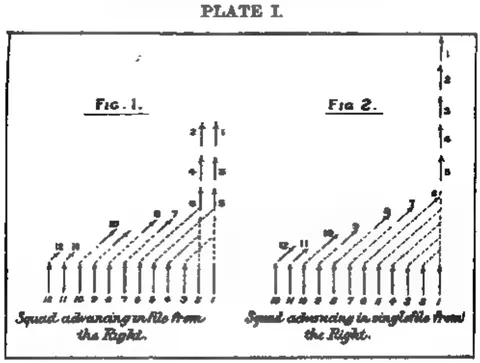
- Formation of a squad at cycle-interval, position at attention, standing at ease, dressing, saluting, turning, grounding and stacking cycles, mounting and dismounting, detaching and returning arms, forming file and single file, dismissing, and the arm signals for increase and decrease of pace, mount, dismount and form file.
- Company organization into half-companies, sections and squads; the marching positions of the captain, half-company and section commanders, signallers and repairers in cycle-lengths; and the inspection of tyres, spokes, brakes, saddle, lamp, pump and toolbag before proving the company.
- The battalion falls in in quarter column or column; drill is confined to moving off in column of route from the place of assembly by successive companies, and to re-forming quarter column from column of route.
- The field-training half of the manual, covering the cyclist's role in war, movements by road and rail, protection, reconnaissance, protection of a coast line and battlefield co-operation with the other arms.
- Sets out the home-defence problem and the cyclist's qualifications, duties and organization against an enemy attempting to land on the British coast.
- The enemy of the cyclist battalions is one who lands or attempts to land on British shores; harbours divide into defended and undefended, and many harbours and long stretches of practicable coast have no stationary garrison.
- In the enclosed country near landing places cyclists cover longer distances more quickly than mounted troops, move more noiselessly with less dust, conceal themselves more easily, are more readily moved by rail or boat, billeted and supplied, and need no horseholders.
- The three duties of watching undefended harbours and beaches, transmitting information on a landing, and preventing or delaying the enemy; battalions are allocated to counties with a seaboard so that peace centres lie within cycling distance of their war stations.
- Requires a means of calling cyclists out from home or work at any hour, and familiarity with the landing places in every kind of weather, with local roads, tracks and paths, and with vessel types, naval signals and possible anchorages.
- Demands close touch with the naval authorities and full knowledge of the district's telegraph and telephone system, with motor cycles or relays of selected riders provided against the enemy cutting communications from the landing point.
- A force is nearly defenceless while disembarking, so a small body of riflemen brought to the threatened point within a few hours of the flotilla appearing may cause the attempt to be abandoned or postponed.
- Cyclists limit the ground the enemy's mobile screen can make good by ambushing and cutting off his patrols and blocking roads, gaining time to concentrate and to remove railway rolling stock, horses, vehicles and supplies.
- Cyclists rally to previously selected rendezvous and fight delaying actions, impeding the enemy by destroying stores, railway and road bridges, breaking up lines, cutting off water, gas and electric light and removing telegraph and telephone instruments.
- Once forced back on the main force the cyclists' duties approximate to those of mounted infantry: protective duties, assisting cavalry or yeomanry against the enemy's flanks and rear, reinforcing weak points, and long detours in the pursuit.
- Sums up the cyclist's role as the first line of mobile defence, to warn of the enemy's approach, meet him on the coast, fasten on to him once landed and gain time for the concentration of the other arms.
- Covers march formation and rates, distances and halts, passing orders, weather and road conditions, straggling, length of marches, march rules, night marching and entraining.
- A cyclist battalion in column of route occupies about four yards of road per man, four times a cavalryman's and eight times an infantryman's space, so columns should be small, use every available road and be led by men who know them.
- File is the ordinary column-of-route formation; marching rate 8 to 10 miles an hour, 100 yards between companies and 50 between sections, distances telescopic with connecting files 60 yards apart, a 15-minute halt after three-quarters of an hour and 10 minutes every hour and a half.
- Orders pass from front to rear by signal on a whistle blast or by orderly and from rear to front by motor cycle; signals are repeated only by section leaders and never passed by word of mouth, and cyclist orderlies wait at the roadside for their addressee.
- Head winds and heavy roads affect cyclists more than any other arm, so halts are increased and riding alternated with pushing; a wide detour to avoid a head wind is worth the extra distance, and columns dismount for long or steep hills.
- Want of skill in mounting is a common cause; the head of a column moves slowly until the whole is mounted, rear units do not try to make up lost distance before the first halt, and men leaving the ranks join the rear of the column.
- A column the size of a battalion should not be expected to cover more than 60 miles a day, while small bodies of selected riders can march 100 miles a day for several consecutive days without undue fatigue.
- Sections or companies lead in turn, changing at the half-way halt; the rule of the road is strictly observed and cyclists clear to the left at halts; machines are washed or wiped after every march to remove grit that would cause punctures.
- Rate not to exceed 7 miles an hour, connecting files not more than 30 yards apart, silence and no smoking, commands by orderly, lamps only on connecting files and the rearmost file of each unit shaded red or green, and luminous paper on each saddle.
- Men always travel in the same train as their cycles; rifles are detached before entraining and cycles packed alternately handle-bar to saddle and as upright as possible, with six men per company detailed to unload and call out the cycle numbers.
- Covers advanced guards, vanguard and main guard, flank guards, delaying action, and day and night outposts for cyclists acting independently.
- The distances in “Combined Training” assume the pace of infantry, whereas small bodies of cyclists move four or five times as fast, so the distances between the parts of a protective body may be four or five times as great.
- To protect the main body from surprise, push back the enemy's advanced patrols and find what is behind them, and once he is located in force to keep touch and hold localities from which his advance can be hampered and delayed.
- Where each column can be allotted a road throughout the march it usually finds its own advanced guard; its strength seldom needs to exceed one-eighth of the force it covers.
- Distribution depends on the number and state of the roads, the weather and the country; a cyclist advanced guard cannot search every wood and enclosure without losing its mobility, and may act boldly against the enemy's scattered advanced patrols.
- Parties of three or four men linked by connecting files at 50 yards envelop hostile patrols by using side roads or dismounting to move across country; in open country cyclists meeting mounted troops dismount and open fire at once.
- Supports the vanguard and, if serious resistance is met, occupies and holds a suitable position until the main body arrives; its commander should not hesitate to engage, since the cyclists' role is to delay the enemy to the utmost.
- Cyclists are well suited as a detached force holding a position on a flank from which a column's line of march might be threatened, because of the speed with which they can rejoin when the duty is done.
- Delaying positions are chosen for the roads running back from them; most of the force deploys in the first line, cycles are grounded rather than stacked with handles pointing the way of retirement, and a cycle guard of one non-commissioned officer and four men per company remains to cover the withdrawal.
- A halted force protects itself by standing patrols on every approach with reconnoitring patrols pushed further forward, so that a hostile force should rarely come within five miles unobserved by day.
- Picquets are posted at or near cross roads and junctions, preferably connected by a lateral road, with one man and his cycle on the nearest road ready to carry a message; rifles are never left with the grounded cycles.
- A non-commissioned officer and three to six men found by each picquet replace sentry groups, posted up to a mile and a half out, relieved every six hours, their cycles grounded with handles pointing towards the picquet.
- Reconnoitring patrols of a non-commissioned officer and three trained scouts go at least five miles to the front and return by a different road, informing standing patrols of their route; visiting patrols work as in “Combined Training”, Sec. 91.
- As by day, except that standing patrols come within half a mile of the picquet, mounted reconnoitring patrols are discontinued, and visiting patrols are increased, sent to the picquets on either flank and always follow the same route.
- With the preceding exceptions, the outpost instructions laid down in “Combined Training” are to be adhered to.
- Covers the method of instruction and the details of reconnaissance, the training of scouts and despatch riders, patrol work and the transmission of information.
- The cyclist reconnoitres silently and swiftly, leaves less conspicuous tracks and has no horse to consider; every cyclist and not merely a few selected scouts must be trained, using his own home area by day and by night.
- Information from personal observation, from questioning inhabitants and prisoners separately, and from tapping telegraph wires, with deduction from tracks, dust, fires, deserted camp-grounds and uniforms, and a table for counting troops passing a point in a minute.
- Each battalion is to hold a scout-leader officer, a serjeant scout, 8 first-class and 16 second-class scouts and two despatch riders per company; the course covers finding the way, map reading and landscape drawing, use of eye and ear, concealment, tracking, identification of shipping from Jane's “Fighting Ships”, use of the telescope, and reporting in telegraphic language.
- Cyclists normally gain information while delaying the enemy, so unlike reconnoitring cavalry they will usually have to fight; when reconnoitring in front of an army it must be clear that information, not delay, is the first object.
- Patrols avoid fighting and work by stratagem; lists the six points a patrol commander must be told before starting, and covers night movement without matches or smoking, scattered bivouacs shifted after a short stay, carrying bogus notes, and approaching woods, ravines and villages that may hide an ambush.
- Negative information is sent back with the hour of the visit; once found the enemy is followed and watched from safe hiding places, patrols let hostile patrols pass rather than fight, and a patrol cut off spreads out and edges away to a pre-arranged rallying point.
- Strategical reconnoitring detachments, usually led by officers, avoid all fighting and act by cunning, are kept small enough to escape observation but strong enough to send back two or three reports, each message carried by two men.
- Use of the civil telegraph and telephone, with each battalion headquarters holding a telephone directory of its area, and an alternative system of motor cycles with petrol dumps and relays of cyclists posted 10 to 15 miles apart at cross roads, churches or inns.
- Covers the battalion's coast-watching organization: look-out stations, supports, reserve, area headquarters, concentration, night patrolling, reliefs, covering positions and delaying action.
- Coast protection depends chiefly on organization, and must give instant warning of the enemy's approach, assemble the largest possible force to oppose him at the moment of landing, and harass and delay him afterwards.
- A battalion watching the coast is organized into look-out stations, supports and reserve; because a few rifles at the moment of landing count for more than many afterwards, the reserve may be reduced and the supports strengthened, or the whole battalion posted on the coast line.
- Each company watches a numbered section of coast with stations of a non-commissioned officer and six to nine men near a telegraph or telephone, each with a distinctive call, their commanders told the landing places, anchorages, neighbouring stations and the position of the support.
- The support is best kept intact at the headquarters of each section, though the roads may force it to be divided or placed on the coast at a possible landing place; the deciding factor is speed in reaching a threatened point.
- The strength and position of the reserve depend on the number of possible landing places, the roads and the facilities for communication, and above all on how quickly any threatened point can be reached.
- Headquarters are established where telegraphic or telephonic communication best allows control of the whole area, for example at the telephone exchange of a centrally situated town, preferably but not necessarily with the reserve.
- A system of warning and concentration signals must be prepared and tested in peace; because the enemy will make feints, look-out stations are for observation and not resistance and stay put until the last possible moment.
- Possible landing places are patrolled at night from right to left between look-out stations and between sections, patrols working in pairs and dismounted where no road is available.
- Men are allotted permanently to look-out stations formed in two reliefs, one at the station and one with the support, each relief on duty for forty-eight hours; a company normally finds four stations of one non-commissioned officer and six men.
- Battalions must know the positions in their area from which an enemy would cover the disembarkation of the remainder of his force, their strong and weak points, and the best way of delaying his advance inland from them.
- Battalions reconnoitre the areas in their district that lend themselves to delaying action, how their defensive capabilities can be improved and what local material is available, and practise rallying to selected rendezvous by day and by night.
- Covers cyclist action through the introductory, preparatory, crisis and pursuit phases of a battle, the defence, and the employment of the machine gun section.
- The two ways cyclists come to join a general engagement, and the five phases into which a modern battle resolves itself: the introductory phase, the preparatory phase, the development of the action, the crisis, and the pursuit or retreat.
- Cyclists need roads and space to use their mobility, so they should be withdrawn from the cramped ground between two armies in contact and concentrated on a flank, possibly beyond the reach of the enemy's cavalry so that they may act by surprise.
- Much is left to the initiative of individual commanders, but enough force must be kept in hand for the later phases; commanders assembled on a flank keep touch with the battle in person and give orders by telephone, telegraph, signal or orderly.
- The crisis offers the greatest opportunity, when a small body of riflemen appearing on a flank or rear seizes a commanding hill, buildings, wood, bridge or defile; cyclist action is offensive in effect but locally defensive, keeping the machines close at hand.
- In pursuit cyclists work on the flanks parallel to the enemy's retreat, attacking his columns repeatedly with the intention of anticipating him on his line of retreat; in retreat they delay the enemy at all costs while the main body reforms.
- Occupying localities for defence with a wide and open field of fire, the minimum number of men engaged at first, a reserve held on a road to strike the enemy's flank or rear, enfilade fire from a flank, and cycles grounded close by on a road.
- Heads the machine gun sections of the chapter, covering the general principles of employment and the guns' use in the attack, in the defence, in pursuit or retreat, and with advanced and rear guards and outposts.
- Seventeen rules on machine gun employment: surprise and concealment, the points to look for in a fire position, effective versus decisive range, avoiding artillery and thin skirmish lines, economy of ammunition, “rapid” fire in series of 25 to 30 rounds, use of a range finder, and the ammunition motor.
- Guns are most valuable bringing sudden fire from positions seized during the crisis, covering the advance of a firing line, protecting it against counter-attack and securing the flanks, but rarely join a general attack on a position.
- Concealment from artillery fire matters more than a long field of fire; guns sweep exposed ground the enemy must cross, flank entrenchments, cover obstacles, deny roads and defiles, or are held as a reserve of fire to meet turning movements and cover the counter-attack.
- In pursuit gun commanders act with great boldness and come into action against the enemy's flanks at decisive range; in retirement they avoid close quarters and take up successive fire positions to protect the rear guard's flanks.
- Guns pushed forward with an advanced guard disperse small hostile bodies and hold important positions until the main body arrives; with outposts they sweep the approaches and dominate points the enemy is likely to pass or occupy.
- Ceremonial drill for a cyclist battalion: review in column or quarter column, receiving the reviewing officer with a salute at sixty paces, inspection, marching past in column and in quarter column, and the positions of officers, signallers, machine guns and the acting sergeant-major.
Images in this book 4 pictures from 93 pages
Diagrams 3
 (opens in a new tab)
 PLATE I - Squad formations advancing from the right 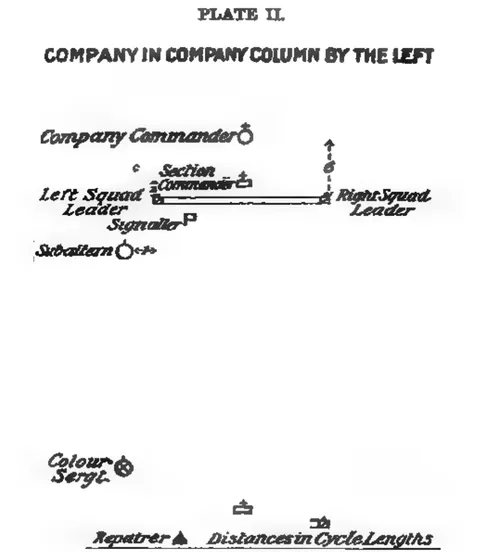 (opens in a new tab)
 Plate II. Company in company column by the left 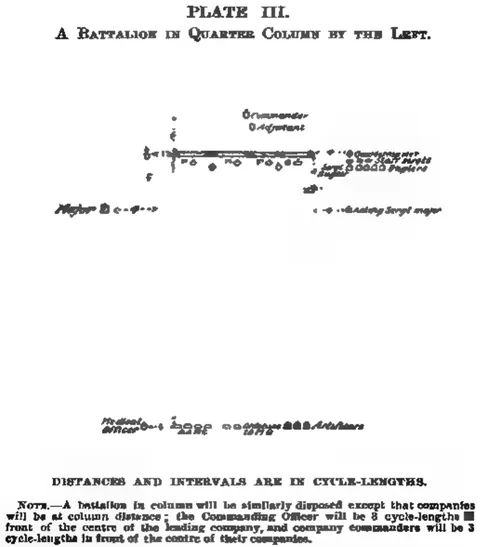 (opens in a new tab)
 Plate III. A battalion in quarter column by the left
Mastheads 1
 (opens in a new tab)
 Royal coat of arms