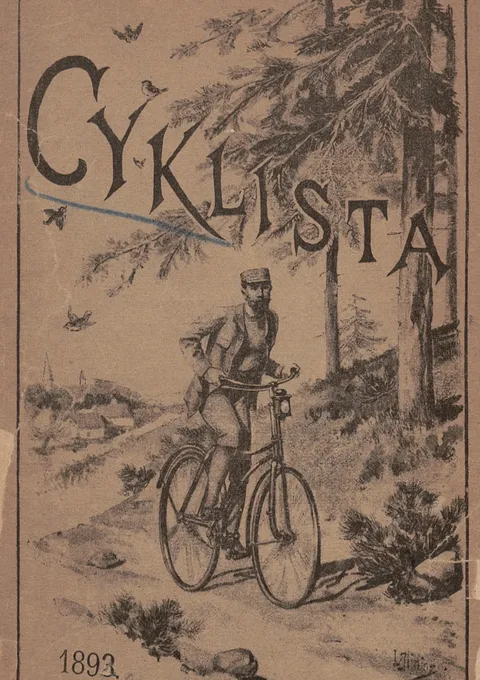
Cyklista (Warsaw, 1892)
Published by W. Czajewski189231 chapters33 imagesPolish
Contents
- Opening poem by Wincenty Skowroński ("Skowronek") addressing the "beloved bicycle of tempered steel", in which every rider races his brisk rivals to the tape for a medal and a flower from a woman's hand.
- Report on the opening of the Warsaw Cyclists' Society's new Dynasy premises on rainy Sunday 18 September: a parade in threes led by captain Stanisław Leppert with Mrs Wurcel, trick riding by Białkowski, Bocquet and Bulikowski, photographs by Kostka and Mulert, a speech by editor St. Lesznowski and the presentation of the "Kurjer Codzienny" cup by Olędzki, with delegates from Łódź and Kalisz and telegrams from Lwów, Kraków, Wrocław and Prague.
- Describes the Warsaw escarpment above the Vistula and the Dynasy hill a few steps from Krakowskie Przedmieście, the Powiśle legend of the golden duck of the royal Oboźna, the name taken from Prince de Nassau-Siegen who built a palace there, and the cyclists' new garden with its 400-metre track, enlarged pond and fountains.
- Mieczysław Horodyński's history of the club from the first Michaux velocipedes imported by the carriage-maker W. Romanowski and the 1869 charity races in the Krasiński garden, through the 1885 races on Plac Ujazdowski, the Koszyki clubhouse built in two months to Edward Goldberg's donated plan, the gymnasium opened 8 December 1888, the delegation to the international cyclists' congress in Vienna, and the first 100-verst road race of 1891 whose winner took the title of champion of the Kingdom of Poland.
- Traces the machine from the clockmaker Stefan Farfler's 1633 Altdorf hand-cart recorded in the Nuremberg chronicle, through Drais of Mannheim's "Laufmaschine" of 1817, Clarkson in the United States, Ludwik Gompertz of Surrey and his toothed lever, Dalssel's pedalled wooden machine, Pierre Lallement and Michaux's pedal velocipede, the English "bone shaker", and the Coventry Machinists' "Gentleman's Bicycle", to metal rims after 1875, pneumatic tyres and London's post-office carrier tricycles.
- A close analysis of the Society's 100-verst road race of 14 August on the Kraków highroad, correcting the newspaper accounts: the lead passed from Stanisław Leppert to Skrodzki at Sękocin, then to Paweł Holtz at Tarczyn and Żemliczek; Ciechomski's 50 versts in 2 h 3 m (2 m 27 s per verst) is claimed as a Polish record, and a table sets 1891 against 1892 times for Horodyński, Tchinkel, Zajdel, Ciechomski, Leppert, Puchalski, Skulski, de Laveaux and Grabowski.
- Signed "St. L.", the opening of a training manual built from the author's own experience and the advice of practised velocipedists, warning that each instruction must be matched to the rider's temperament and that no one should overload himself with training work.
- Ten numbered rules for beginners: speed comes gradually, an intelligent rider often beats a stronger one, start on ordinary road machines before moving to light racers, buy from a factory of established sporting reputation, strip the racing machine of mudguards and brake, drop the handlebar as low as possible, and learn to clean and oil the machine yourself rather than leave it to paid servants.
- Racing and training dress should be entirely of light wool tricot and never an ordinary walking suit; the English club cut of short breeches and a short single-breasted jacket is used worldwide, foreign clubs varying only the colour, dark green or navy, while the Warsaw Cyclists' Society wears ash-grey with a round grey cap instead of a racing kepi.
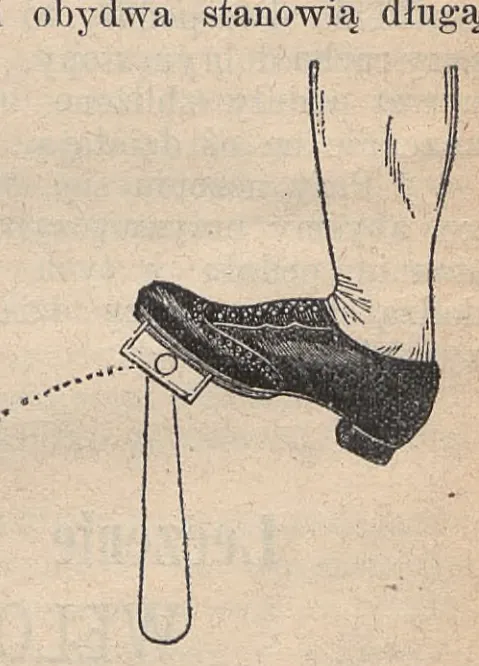
- Footwear should be light, half-deep laced shoes, comfortable and broad in the toe, with a special stitched patch on the sole to keep the foot from slipping off the iron racing pedals; clothing and shoes must be aired after every training ride.
- Rejects the old school's raw meat and systematic doses of Carlsbad salts in favour of moderation: beef in all forms and lean mutton are recommended, veal, pork and cured meats are hard to digest, cooked vegetables and lettuce without vinegar are allowed, tea and coffee should be weak, and thirst may be met with red wine or good Munich and Pilsen beer but never between meals.
- A rider's daily meal timetable: tea, cocoa or milk with soft-boiled eggs before track training, a second breakfast of hot or cold meat, beefsteak or cutlet between ten and eleven, a substantial dinner about four taken with water and red wine, supper between eight and nine, and bed at eleven or twelve with a cup of bouillon; the rider should weigh himself often and eat more if the loss is sudden.
- General rules for the man in training: heavy smokers should cut down gradually rather than stop at once, sexual relations are to be abandoned entirely with cold douches recommended, at least eight hours' sleep is needed and only at night before midnight, strong emotion is to be avoided, and the rider should neither talk nor think too much about the coming races.
- The daily routine, from rising about six and washing the head, face, chest and back in cold water to five or ten minutes of trunk-bending and dumb-bell work; training should last four to six weeks at most, and each rider should find a friend to act as trainer, timing him and counting his revolutions, pacing the last or second-last lap and putting warm clothing on him the moment he finishes.
- Nine rules for sprint training: work daily but for one rest day a week, three-quarters of an hour at a time or twice twenty minutes, courses of no more than 400 metres with at least half of each spurted, a rub-down with spirit or cognac stroked upward from the calves and then a cold shower; in the second half lengthen the courses to 800 and 1,200 metres and spurt 200-250 metres in the evenings, resting completely the day before a race.
- Distance training starts from short courses and lengthens until they equal the intended distance, each finished with a hard spurt under the trainer; long road excursions, long walks and stair-climbing are dropped, though beginners are told to run and to jump for height and distance, and the section closes on race tactics and the maxim that it is better to lose with honour than to win by a trick.
- Signed "Ormond": the first meeting on Kalisz's new 400-metre Noskowo track on 28 August, with nearly a hundred machines riding out from the town park; Skrodzki won the 6,000-metre safety race in 14 m 19 s from Bocquet, Zygmunt Kaczyński, Józef Mentzel and Piotr Markowski took heats, the Łódź rider R. Kühnel won the race without handlebars, and the medals finished eleven to Warsaw, two to Łódź and ten to Kalisz.
- The French long-distance rider Stéphane, who in May covered 582 kilometres in 24 hours between Paris and Brest and, according to "Der Deutsche Radfahrer" No. 14, then raised his own record by a full 75 km to 660 km; his 100-400 km times are tabulated, and No. 37 of "Le Vélocipède Illustré" reports Reboul of Marseilles beating the 100 km mark by nearly 18 minutes in 2 h 53 m 46 s.
- Table of English records made at London and Coventry over distances from 1½ to 99 versts: on ordinaries by F. G. Osmond, W. A. Illston, N. L. Lambley, B. W. Attlee, F. J. B. Archer, J. H. Adams and F. R. Fry (1883-1891), and on safeties by H. C. Tylar, W. Windle, G. F. Taylor, F. J. Osmond, R. K. Ede and L. Newland.
- Table of German road records from 25 to 200 kilometres credited to Bachmann, Kuchler, Hofmann, Friedrich and Fischer, marking the German 100 km record among them.
- Table of Warsaw winning rides from 1887 to 1892 with machine type and average pace per verst: Skorniakow, Magdziński, W. Wyczółkowski, J. Służewski and H. Kręcki on ordinaries, Skorniakow and E. Schultz on a tandem, Chrapowiecki and K. Hiller on tricycles, and latterly M. Horodyński's 97 versts in 1891 and Łabanow's 100 versts at 2 m 54 s per verst in 1892.
- Provincial correspondents' reports: Oswald Hindemith, consul at Kalisz, on the 400-metre Noskowo track built on loan for 1,700 roubles and some forty local riders; Bronisław Dąbrowski on Piotrków's short runs to Polichno, Wolbórz, Sulejów and Bełchatów; Wodziński on a new 375-metre track at Częstochowa; the engineer Zygmunt Młodkowski at Koło, also consul of the London Touring Club; and Kielce, where the Ożdżyński sisters near Suchedniów were the first local women to tour on a tricycle built in their father's works.
- Argues that although the geared safety has pushed the high bicycle aside as heavier and more dangerous, Americans and Englishmen refused to give it up and devised a new geared type; cites a 194½-mile ride in 12 hours and 50 miles in 2 h 35 m, and tabulates M. A. Holbein on a safety against I. E. Bets and Shorland on bicycles at 110-200 miles and over 24 hours.
- Explains how a good rider beats the dead centre by flexing the ankle so the foot drives the pedal forward to the horizontal and then presses it down with full force, even pushing it past the vertical, and urges learners to train the foot to act at every point of the pedal's travel.
- Argues that cycling is accepted by doctors as both hygienic and curative: it is taken in the open air, the effort can be graded by changing speed, and the tricycle suits child and old man alike. Answers the charge that only the legs work, cites Dr Tissié and Dr Jennings, who polled over 300 physicians, and Dr Nussbaum on heart defects, and notes that pneumatic tyres and air-filled saddle cushions remove the objections about vibration and saddle pressure.
- News notes: the silver baroque "Kurjer Codzienny" cup bearing Warsaw's mermaid arms, made at Werner's Warsaw factory to designs by the artist Piątkowski, for members only at the Dynasy track race; official confirmation of the Kalisz cyclists' club; Horodyński's 31-lb Wenham machine; a 2,641-verst tour from Warsaw through Vienna, Salzburg, Munich, Nuremberg, Bamberg, Leipzig, Berlin and Stettin; the Croatian club "Sokol" of Zagreb holding the first inter-Slav race on 26 June 1892; Zimmerman's 100 firsts in 160 races worth some $7,000; and the statistic that France's 177,000 cyclists face 2,788,000 dogs.
- A guide to the foreign cycling press: in Germany "Der Deutsche Radfahrer", organ of the Allgemeine Radfahrer-Union, issued twice a month in 16-page numbers; in Belgium "Le Cycliste Belge"; and in France "Le Vélocipède Illustré" (5 fr. at home, 10 fr. abroad, from Place du Marché St-Honoré in Paris), "Le Cycle", "La Revue du Sport Vélocipédique" of the Union Vélocipédique Française and "Vélocipède Sport".
- The skating competitions held on the club track after it was flooded for skating in 1886 and the general meeting of 16 October 1886 voted them; the first, on 18 February 1888, gave the opening race to Mr Jork, silver medals in the ladies' turn to Ludmiła Bieławicz and Aleksandra Wurster, the figure section (threes off each foot, eights, scissors, screws) to Zdziennicki ahead of Holz, the two-metre jump to Jork and the 75-centimetre jump to Holz, with the 1,400-metre race won by Lehrmann.
- A parallel calendar for 1893 setting the Russian Orthodox saints' days in Cyrillic against the Polish Catholic calendar month by month from January to December, marking Easter, Corpus Christi and the name-days used in Congress Poland.
- An appreciation of the Swift, the make most trusted in Warsaw, from the English Coventry Machinists Co.: ball bearings throughout, a strong frame and stout spokes, several rim patterns and a price range that puts the No. 2 at 160 roubles against the pneumatic No. 1 at 300 and 275 roubles. A. Holbein covered 542 km on one in 24 hours on 20 November 1891, and every Warsaw race up to 1891 was ridden on Swifts.
- The publisher's note closing this first annual: an apology for inaccuracies caused by haste, thanks to those who contributed, a promise to expand the yearbook into a full volume covering the progress of cycling at home and abroad, an invitation to readers to send in accounts of their tours, and an insistence that the publication stands outside all cyclists' associations, Polish or foreign, and is entirely independent.
Images in this book 33 pictures from 100 pages
Illustrations 7
 (opens in a new tab)
 Cykliста - Rocznik I 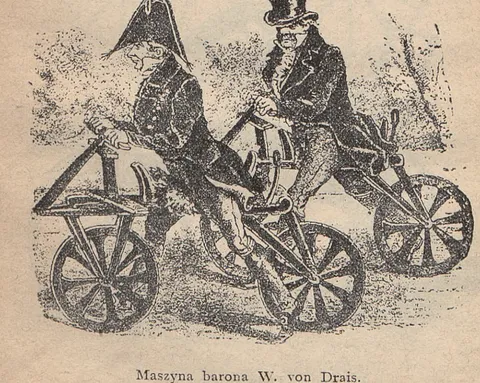 (opens in a new tab)
 Maszyna barona W. von Drais 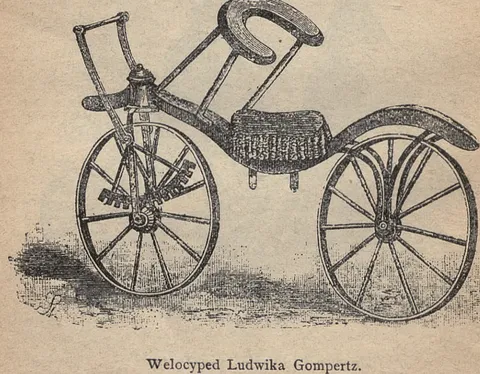 (opens in a new tab)
 Welocyped Ludwika Gompertz 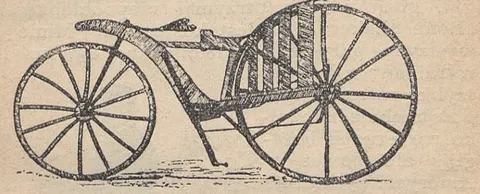 (opens in a new tab)
 Welocyped H. Dalssela 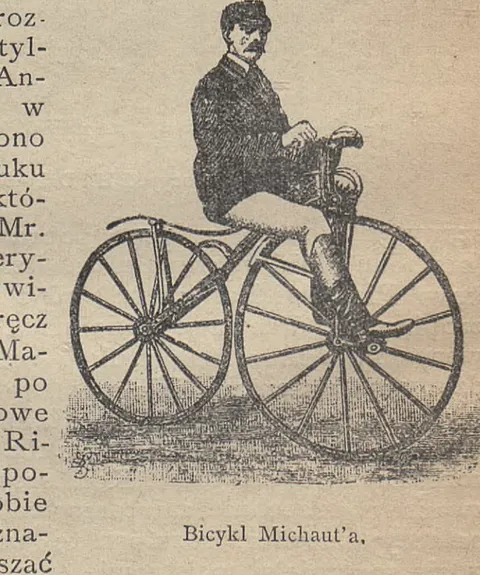 (opens in a new tab)
 Bicykl Michaut'a 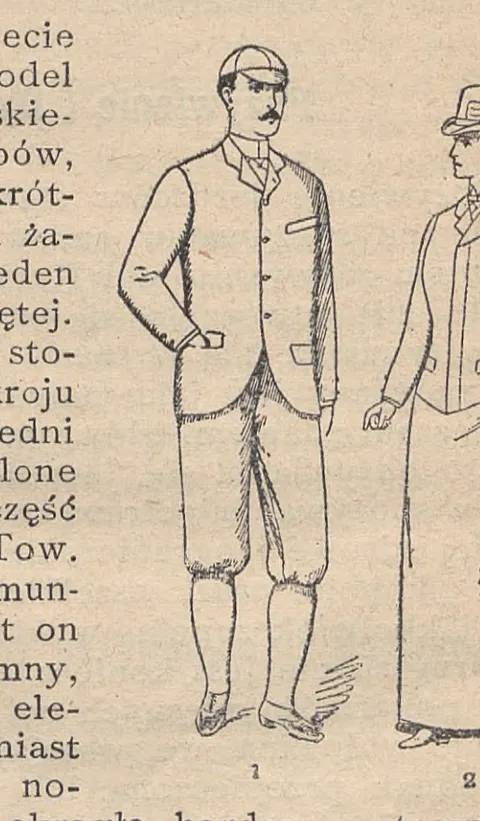 (opens in a new tab)
 Stroje cyklistowskie 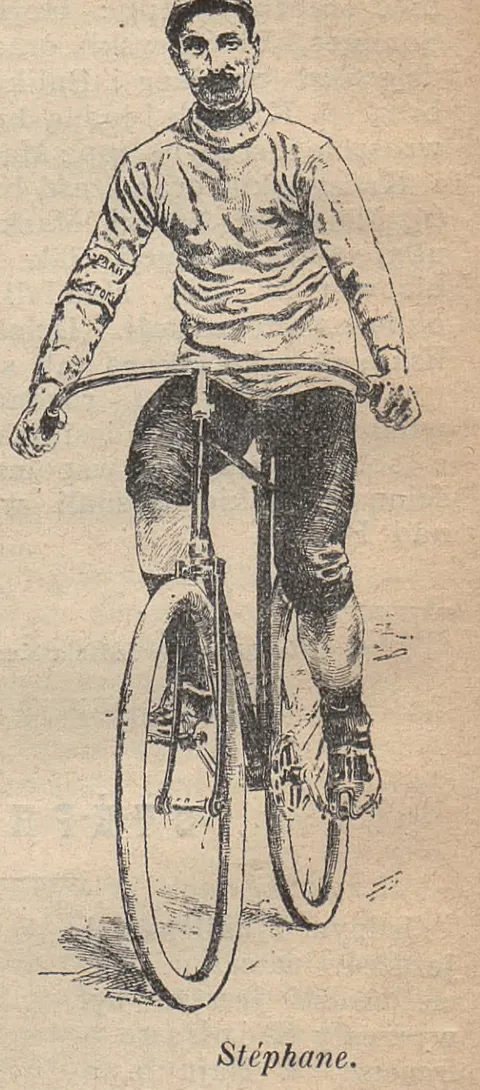 (opens in a new tab)
 Stéphane
Photographs 8
 (opens in a new tab)
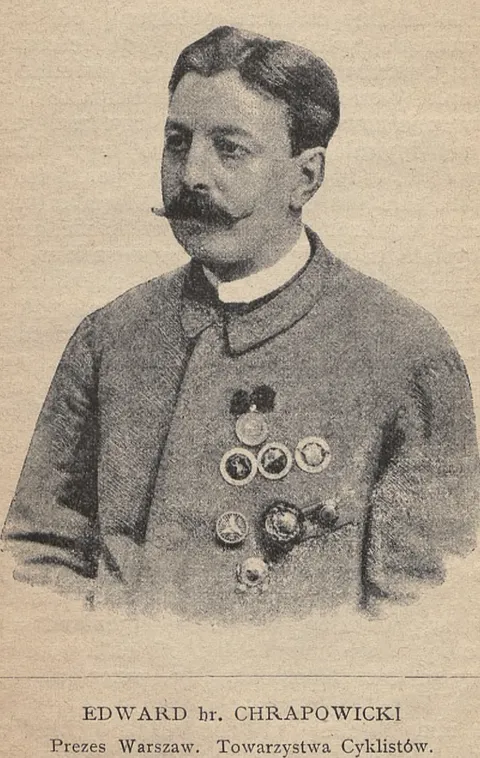
 Edward br. Chrapowicki 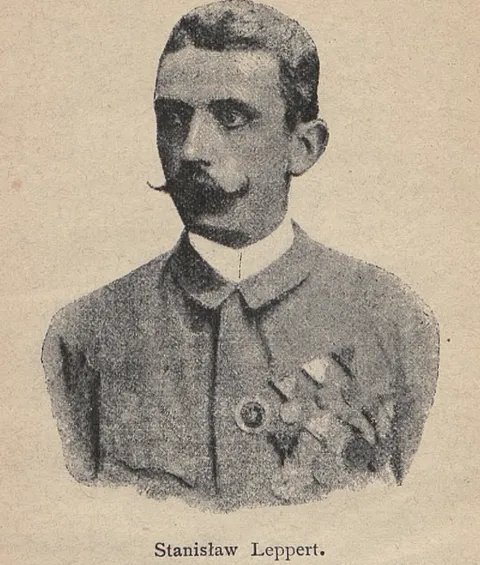 (opens in a new tab)
 Stanislaw Leppert 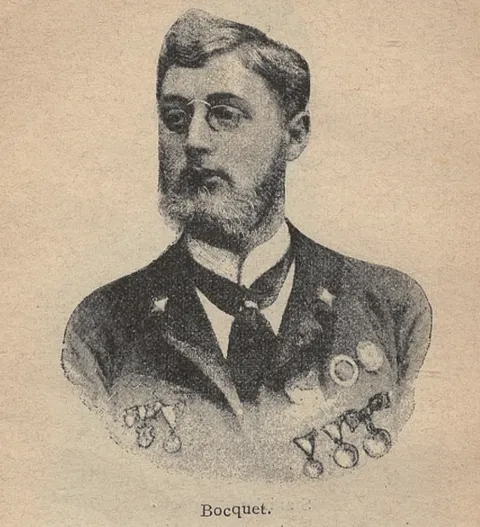 (opens in a new tab)
 Bocquet 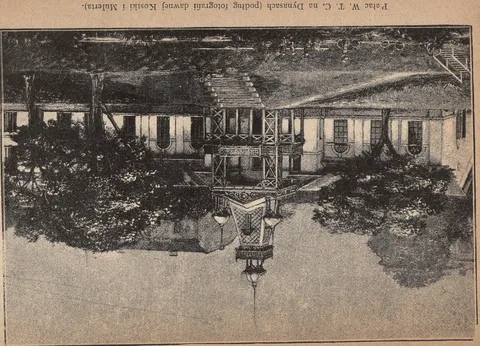 (opens in a new tab)
 Hale W. T. C m Dynasach 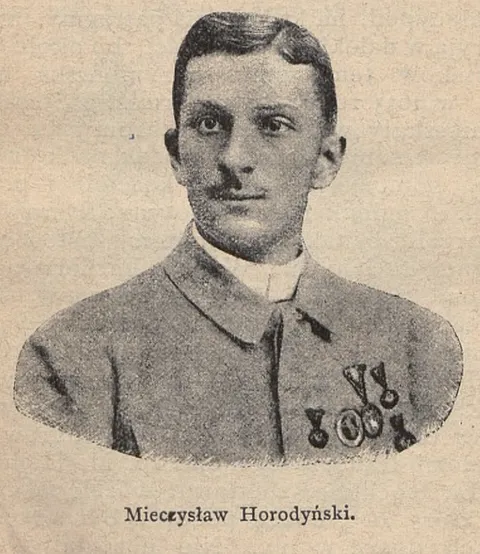 (opens in a new tab)
 Mieczyslaw Horodyński 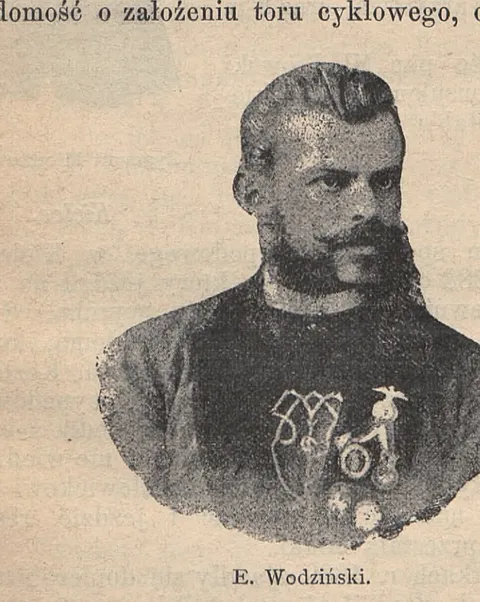 (opens in a new tab)
 E. Wodziński 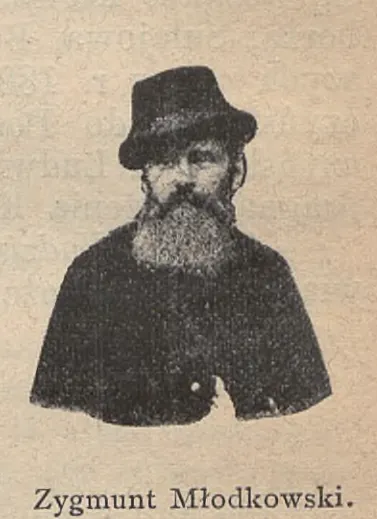 (opens in a new tab)
 Zygmunt Młodkowski 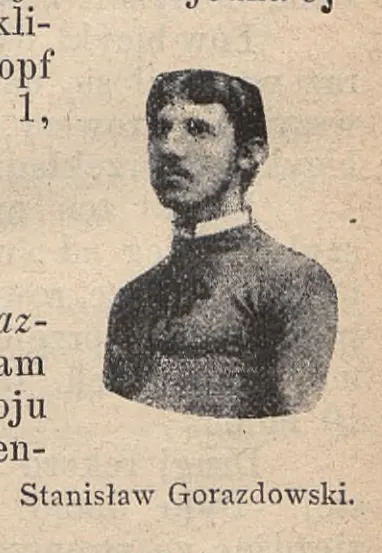 (opens in a new tab)
 Stanisław Gorazdowski
Diagrams 2
 (opens in a new tab)
 Stopa na pedale 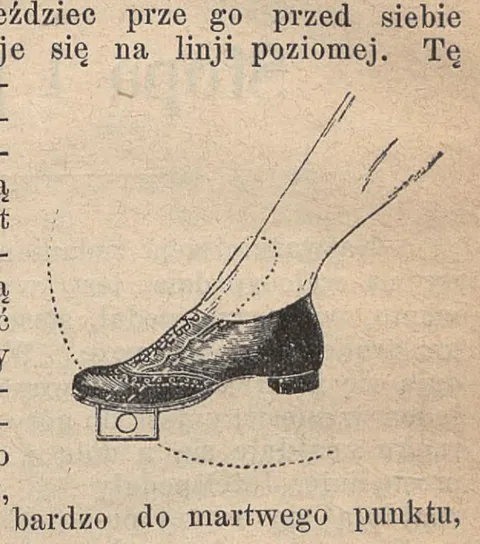 (opens in a new tab)
 Stopa na pedale
16 advertisements
 (opens in a new tab)
 Welocypedy różnych typów najlepszych angielskich i niemieckich fabryk  (opens in a new tab)
 Dyrekcja Towarzystwa Ubezpieczeń "Przezorność" 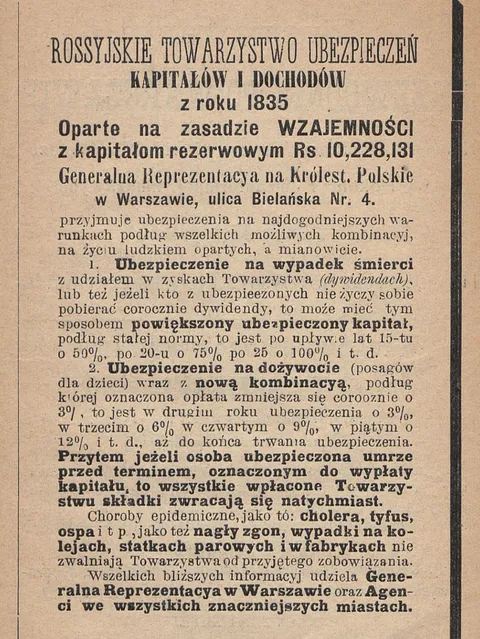 (opens in a new tab)
 Rossyjskie Towarzystwo Ubezpieczeń Kapitałów i Dochodów  (opens in a new tab)
 Illustrowany Przewodnik po Warszawie 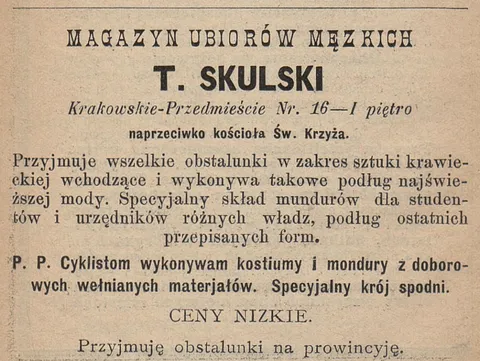 (opens in a new tab)
 Magazyn Ubiorów Męzkich T. Skulski 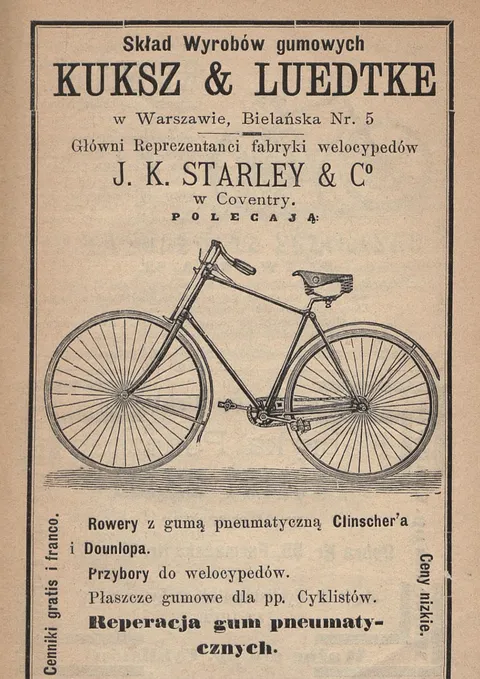 (opens in a new tab)
 Skład Wyrobów Gumowych Kuksz & Luedtke 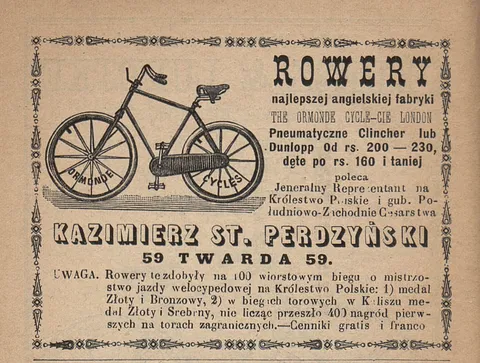 (opens in a new tab)
 Rowery - Kazimierz St. Perdzyński  (opens in a new tab)
 Fabryka Pończoch Pauliny Bilicz 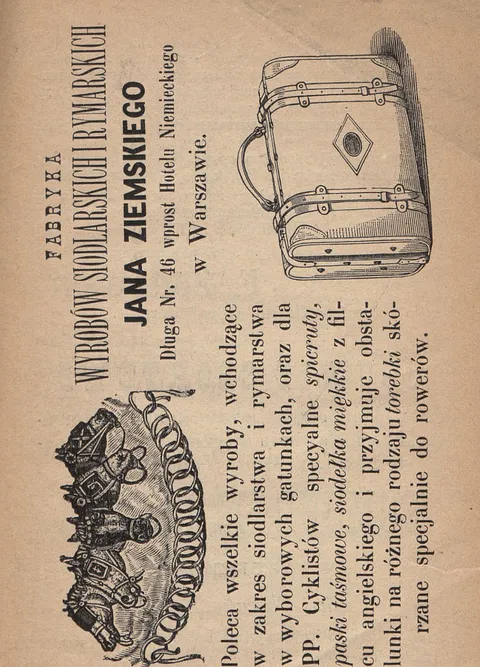 (opens in a new tab)
 Fabryka Wyrobów Siodlarskich i Rymarskich Jana Ziemskiego  (opens in a new tab)
 F. Żółtowski - umundurowanie 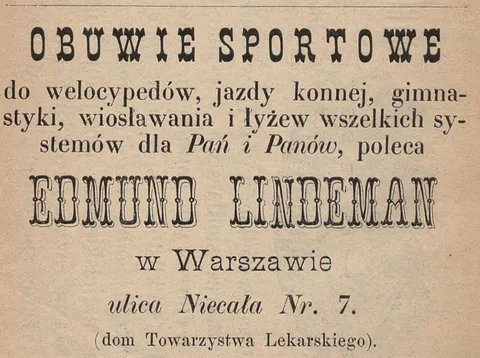 (opens in a new tab)
 Obuwie Sportowe - Edmund Lindeman 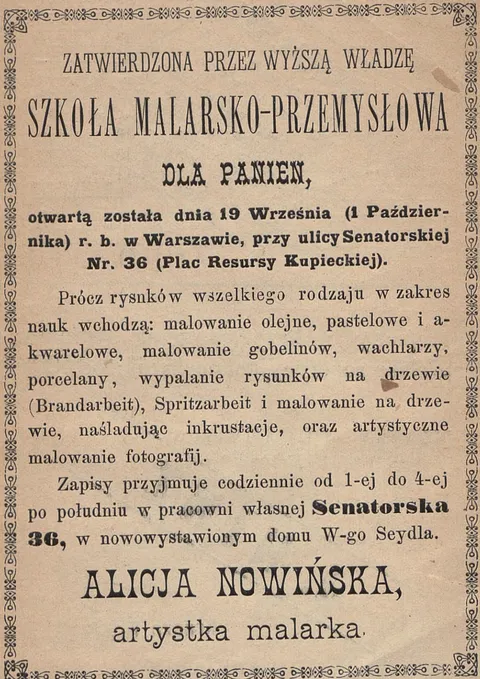 (opens in a new tab)
 Szkoła Malarsko-Przemysłowa dla Panien 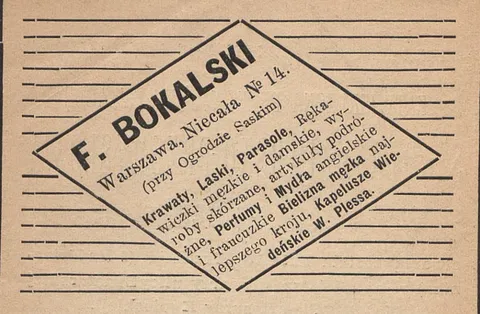 (opens in a new tab)
 F. BOKALSKI 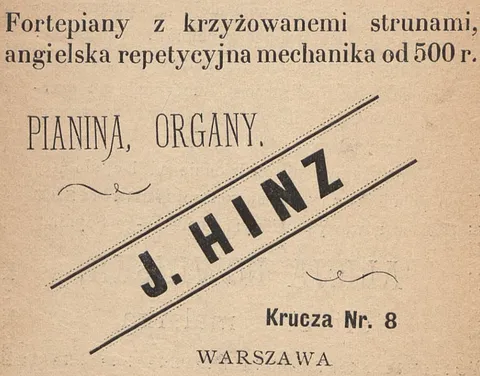 (opens in a new tab)
 PIANINA, ORGANY - J. HINZ 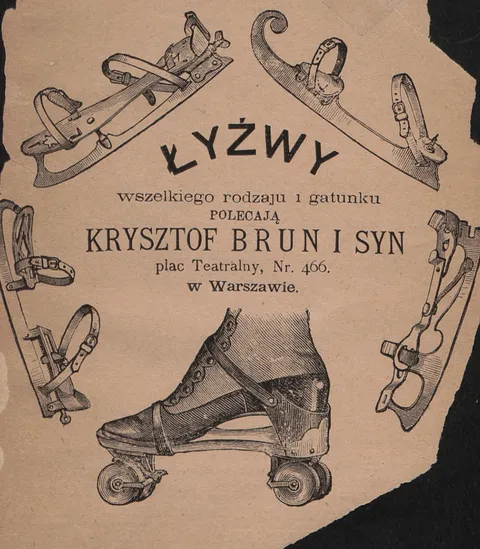 (opens in a new tab)
 ŁYŻWY (Skates) - Krzysztof Brun i Syn 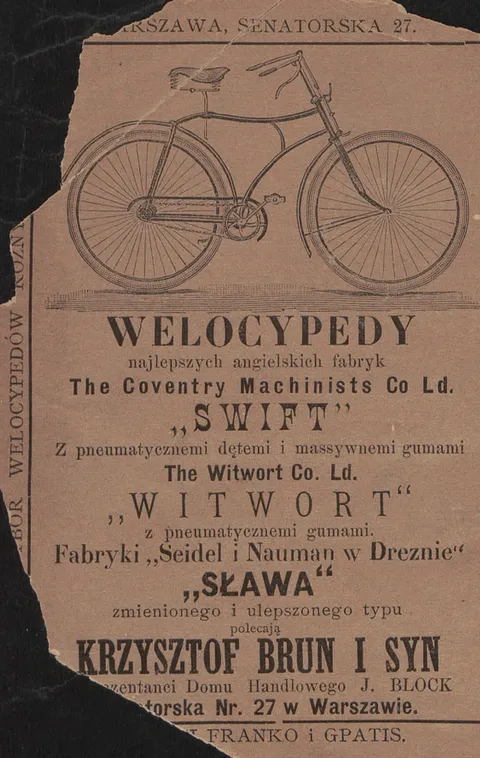 (opens in a new tab)
 WELOCYPEDY - Swift, Witwort, Sława