Illustrated Bicycle Primer
Contents
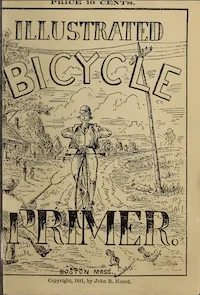
- The illustrated front cover of the book, titled 'Illustrated Bicycle Primer,' copyrighted 1881 by John R. Heard, published in Boston. It features a decorative illustrated scene with a cyclist and large ornate lettering.
- The title page identifies the work as 'Bicycle Primer' by John R. Heard, illustrated by Charles Myron Clarke, printed by Deland & Barta of Boston in 1881. A Bacon epigraph notes that some books are to be 'chewed and digested.'
- A tongue-in-cheek preface, citing De Bouze on the need to explain unintelligible books, confesses that the author wrote the volume to have it printed, the printer printed it to sell, and the publisher sells it to any purchaser credulous enough to pay. Sets the satirical tone for the whole primer.
- Illustrated with a large-wheeled ordinary bicycle being held steady by two helpers while the novice rider attempts to mount. The facing epigraph is 'The attempt, and not the deed, confounds us.'
- Illustrated by a cyclist careering at full speed into a telegraph pole, his hat flying off. The epigraph 'A rolling stone gathers no moss' wryly comments on the unbraked ball-bearing wheel.
- Illustrated with a rider flying headlong over the handlebars in open countryside while his hat sails away. The epigraph 'He that is down needs fear no fall' adds sardonic consolation to the beginner's first spill.
- Illustrated with a pocket watch resting against a bicycle wheel and a map, suggesting measurement of a long tour. The epigraph 'True as the needle to the pole, Or as the dial to the sun' plays on compass and clock as navigation aids.
- Illustrated by a muscular rider powering a large ordinary bicycle uphill along a country road, viewed from behind. The epigraph 'Oh, for a forty-parson power!' humorously invokes clerical horsepower for the steep climb.
- Illustrated by a cyclist collapsed flat on his back in the grass beside his bicycle, arms outstretched in blissful exhaustion at the summit. The epigraph 'I care not for my spirits if my legs were not weary' is the rueful payoff.
- Illustrated with a rider stoically pedalling through a fierce downpour, completely soaked, water flooding the road. The epigraph 'It never rains but it pours' is doubly apt for both road conditions and general misfortune.
- Illustrated by a detailed close-up drawing of a hub-mounted bicycle lamp, presented as a proud piece of cycling equipment. The epigraph 'Twinkle, twinkle, little star' gently mocks the lamp's modest glow.
- Illustrated by a formal committee of gentlemen in heated debate, apparently legislating against cyclists in public parks. The epigraph 'Righteous indignation is not wrath' ironically dignifies the anti-cycling bureaucrats.
- Illustrated by a dashing young man riding an ordinary bicycle past an admiring young woman who watches from a distance. The epigraph 'He's a darling, he's a daisy' captures the social cachet cycling conferred on young men.
- Illustrated with a tailor or shop assistant presenting a large pair of knee-breeches to a cyclist customer. The epigraph 'The fashion wears out more apparel than the man' comments on the rapid wear of cycling attire.
- Illustrated by a weary cyclist collapsed in a chair, his tattered breeches hanging on a line to dry, while a woman looks in through a window. The epigraph 'My breeches, O, my breeches!' laments the toll of the long-distance ride.
- Illustrated with a large travel bag or valise — the cyclist's touring luggage — shown in close-up. The Latin epigraph 'Multum in parvo' (much in little) ironically praises the bag's capacity to hold all necessary kit for a tour.
- Illustrated by two men hosing down a bicycle outside a barn, cleaning its nickel-plated parts. The epigraph 'Man wants but little here below, Nor wants that little long' wryly suggests the cyclist's simple pleasures are equally short-lived.
- Illustrated by a cyclist facing a large bull standing squarely in the road, blocking all progress. The epigraph 'Obstructions never come singly' is a comic inversion of the familiar proverb about misfortune.
- Illustrated by a cyclist riding through town with his feet awkwardly splayed on undersized pedals, passers-by watching. The epigraph 'What a monstrous tail our cat has got!' deflects attention to the absurdity of ill-fitting equipment.
- Illustrated by a cyclist in heavy rain at a signpost pointing to Boston, peering at the distance marker. The epigraph 'A short question may need a long answer' plays on the deceptive distance of a long-distance ride.
- Illustrated by a cyclist straining to outpace a horse-drawn streetcar, both driver and passengers leaning out to watch. The epigraph quotes the pseudo-Shakespearean 'Aldeborontiphoscophornio! Where left thou Chrononhotonthologos?' adding mock-heroic bombast to the contest.
- Illustrated by a cyclist at a soda counter being served a refreshing drink by the innkeeper, with 'SODA' prominently displayed on the counter. The epigraph 'Give me an ounce of civet, good apothecary, to sweeten my imagination' wittily substitutes soda water for Shakespeare's perfume.
- Illustrated by a view down a bumpy cobblestone street in a small town, with a cyclist barely visible navigating the rough surface. The epigraph 'That it should come to this!' expresses the rider's exasperation at poor road conditions.
- Illustrated by a cyclist leaning hard into a powerful headwind on an open road, his hat swept away and papers flying. The epigraph 'Except wind stands as never it stood, It is an ill wind turns none to good' acknowledges that a headwind benefits nobody.
- Illustrated by a confident rider sitting bolt upright on a beautifully finished ordinary bicycle, apparently in full control and immune to a spill. The epigraph 'Wonderful, and yet again, most wonderful!' mock-celebrates the extraordinary feat of staying upright.
- Illustrated by a small boy running in front of a female cyclist, who leans forward trying to warn him to get out of the way. The epigraph 'Take the boy to you; he troubles me so, 'tis past enduring' voices the cyclist's exasperation with pedestrian children.
- Illustrated within a circular vignette showing a cyclist and his bicycle lying in a heap on the ground after a crash, bringing the alphabet primer to its inevitable conclusion. The epigraph 'The end crowns all' delivers the final punchline.