La Bicyclette
By F. X. J. Dorion18984 chapters6 imagesFrench

Contents
- Dr Dorion opens his medical study of the bicycle by answering its detractors, the traditionalists, the hygienists who blame it for abdominal ptosis and depopulation, and the moralists who accuse it of encouraging bad habits in young girls, citing Hammond's thirteen 1892 cases of nervous disease relieved by systematic cycling, Eulenburg on neurasthenic youths and Tiburtius on emphysema in the elderly, while conceding Villaret's 1896 warning to the Berlin internal-medicine society that the cyclist's heart is easily overstrained. He then traces the machine's evolution from the pedal-less velocipede, through the iron-and-wood boneshaker and the large-wheeled ordinary with its ball bearings and rubber tyres, to the chain-geared, pneumatic-tyred modern bicyclette, and asks what qualities make a machine easy to handle and harmless to the rider.
- Pneumatic tyres are likened to rails, and to the bulk of a great liner riding swells that would exhaust a small boat: the inflated tube flattens over small stones and ruts instead of lifting the whole machine over them, and experiments show resistance falling by fifteen to fifty per cent. Dorion argues that the cushion of air is what spares the rider harmful vibration and shields the abdominal and, in women, the pelvic organs, and regrets that the craze for lightness and speed pared the tubes down until riders had to choose between feeling every roughness and inflating them as hard as the old solid tyres.
- The handlebar must both support and steer without forcing a vicious posture; the crouch adopted to cut wind resistance folds the trunk so that lungs, heart, liver, stomach and intestines are compressed against the spine, demonstrated by folding a cut-out paper figure along the lines of fig. 4, producing breathlessness, cardiac intermittence and the lumbago that torments riders long after they dismount. Dorion prefers the double-curved bar, whose longer lever spares the forearm, with thick grips set roughly parallel to the machine's axis and level with the saddle plane or up to two inches above it, and warns that the hand should never clutch the grips convulsively.
- Quoting Captain Guedeville's treatise on horsemanship, Dorion argues that the rider should sit on the ischial tuberosities exactly as on a chair, so that the coccyx, anus, prostate, bulb and vulva bear no pressure. The old sprung leather saddle fails on both counts, under jolts its surface hollows and the pommel strikes the scrotum, while the long slit in the leather closes into a ridge that cuts into the perineum, and he reports resulting haemorrhoids, pruritus ani, clitoral irritation, uterine and bladder congestion, dysuria, congestive prostatic hypertrophy and one young husband's temporary impotence, all cured by a few days' rest; the remedy is the new rigid, short-pommelled saddle with two separated pads under the ischia and a coil or leaf spring beneath to restore the lost elasticity.
Images in this book 6 pictures from 23 pages
Diagrams 6
 (opens in a new tab)
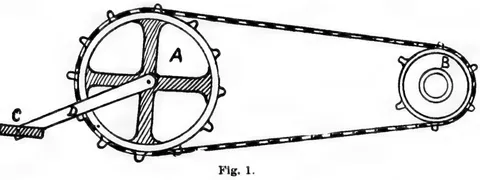
 Fig. 1, pedal, gearing and chain-drive ratio 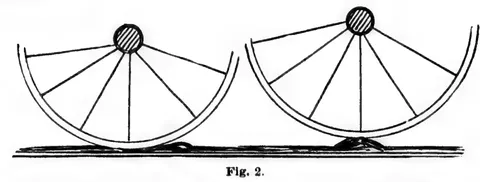 (opens in a new tab)
 Fig. 2, rigid wheel versus pneumatic-tyred wheel over a bump 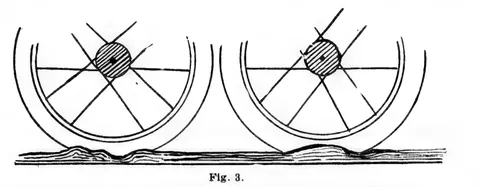 (opens in a new tab)
 Fig. 3, upright versus stooped riding posture 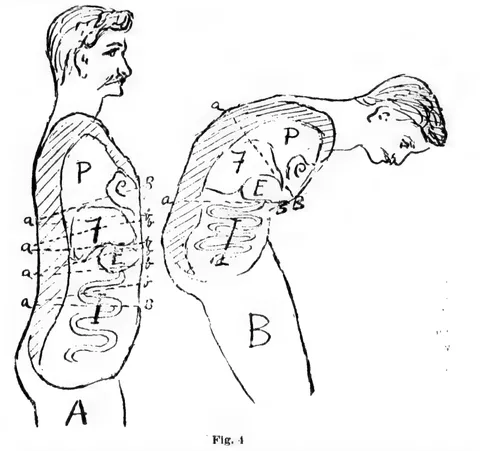 (opens in a new tab)
 Fig. 4, compression of the chest and abdominal organs when leaning forward on a bicycle 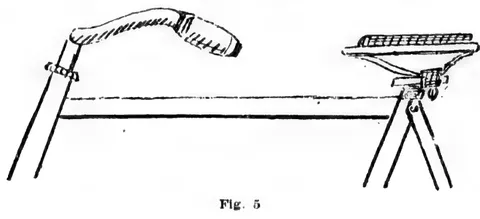 (opens in a new tab)
 Fig. 5, handlebar and saddle mounted for comparison of height and reach 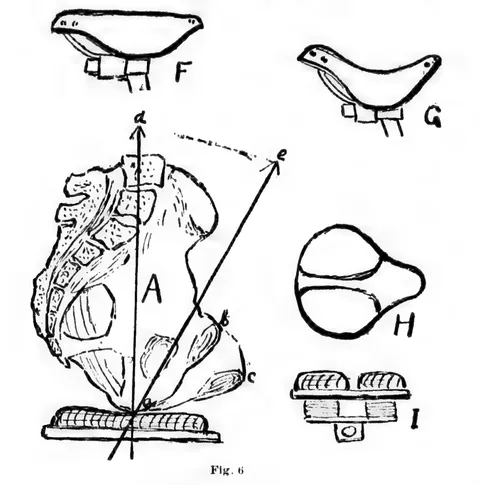 (opens in a new tab)
 Fig. 6, bicycle saddle shapes and the pelvis