La Bicyclette: Sa Construction et Sa Forme
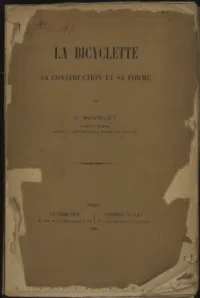
Contents
- Bourlet explains the book substantially reprints a series of articles from Le Génie Civil (vol. XXXIII), written as a sequel to his two-volume Nouveau Traité des Bicycles et Bicyclettes and aimed at ordinary cyclists rather than engineers. He notes he has added, as an appendix, a more technical study on ball bearings reprinted from the same journal. Signed C. Bourlet, Paris, janvier 1899.
- Traces the machine's evolution from Sivrac's 1790 wooden célérifère hobby-horse and the steerable draisienne, through Michaux's pedal-cranked vélocipède, the development of tangent wire spokes credited to Renard, and Truffault's hollow steel rim, up to the high-wheel bicycle's 1884 peak; then follows the 1885 shift to the rear-driven Rover safety and the chain-driven bicyclette, comparing pivot-steered and early diamond frame types.
- Covers frame design in detail: overall shape and tube-stress theory, the bottom-bracket (pédalier) region, brazed tube-to-tube lug joints (raccords), tube sections and materials, multi-seat machines multiples (tandems, triplets and a quintuplet built by Clément, Gladiator, Peugeot and Whitworth), folding frames (Gladiator, Albaret), wooden frames, and ladies' drop frames as made by Columbia, Cleveland, Dunlop, Humber, Premier, Métropole, Raleigh, Rudge and Whitworth.
- Describes the steering assembly formed by the front fork, the steerer tube passing through the frame's head tube, and the handlebar, covering fork-crown and head-tube construction, headset adjustment, and handlebar types including horizontal, raised American and double/racing bars.
- Explains ball-bearing construction (axle cone, ball race and cup) and applies it to the machine's two main bearing points: the bottom-bracket bearings, comparing designs such as the Dayton and Columbia cartridge bottom brackets, and the wheel-hub bearings.
- Compares the two ways of transmitting the rider's pedalling to the rear wheel: roller chain drive, including chainring and sprocket tooth counts, and bevel-gear (engrenages coniques) chainless shaft drive, assessing the execution and efficiency of the bevel gearing.
- Surveys mechanisms for varying the bicycle's gear (développement) to suit hills versus level ground, dividing designs into those that can be shifted while riding and those that cannot, and weighing their mechanical efficiency and losses, citing a tested hub gear whose demultiplicateur absorbed nearly 10% of the rider's work.
- Covers wheel and tyre construction: tangent spoking, solid rubber bandages creux, the development of the pneumatic tyre (citing Michelin), rim design including Truffault's hollow steel rim, and valve types.
- Extends the study to three- and four-wheeled machines: tricycle rear-axle and differential mechanisms (including the Starley bevel differential), side-by-side sociables, and light towed passenger voiturettes such as the wicker-seated Planés.
- Catalogues the bolt-on fittings a rider adds to the machine: brakes (spoon and plunger types such as the Minerve), saddles, pedals, mudguards, lamps, warning bells and horns, pumps, and tool/repair sacoches (saddlebags).
- Gives practical buying and set-up advice aimed at the touring cyclist rather than the racer: frame head-angle and fork rake, wheel diameter, handlebar choice, non-adjustable hub and bottom-bracket bearings, and crank length matched to the rider's build.
- Medical and hygienic advice distinguishing cycling as brief daily exercise from multi-day touring, cautioning women, adolescents and the physically weak to ride with care, and covering diet, clothing and the physical conditioning (adaptation du cycliste à sa machine) needed before an extended tour.
- A more mathematical reprint from Le Génie Civil analysing the rolling and pivoting velocities of a ball rolling without slipping between two bearing surfaces, and the friction produced by the ball's slight elastic deformation into the race under load; flagged in the preface as intended for technically-minded readers.