La Sante par le Tricycle
By Oscar Jennings188812 chapters1 imageFrench

Contents
- Dr Oscar Jennings explains he wrote the book to gather the testimony of patients restored to health and of doctors who have studied the tricycle, regretting he found no French academician who also rides one, unlike England's Drs Lionel Beale and Richardson of the Royal Society.
- Jennings surveys the existing English medical literature on cycling and health, notably Dr Richardson's The Tricycle in Relation to Health and Recreation and Dr Gordon Stables's Health upon Wheels, and sets out his own rules for moderate use, invoking Hippocrates and an inquiry into the later health of Oxford-Cambridge boat-race oarsmen to warn against overtraining.
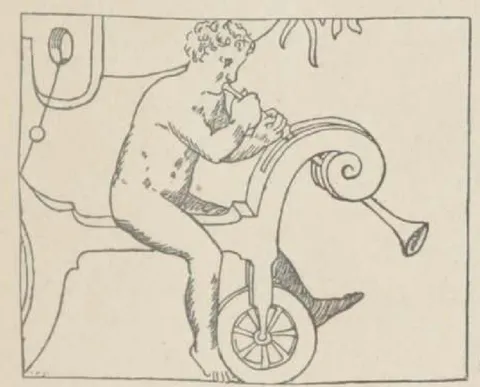
- Traces the velocipede's ancestry from Michaux's machine back to the draisienne, credits the Scottish tinsmith Gavin Dalzell with converting one into an early bicycle in 1836, and describes a 17th-century stained-glass window at St Giles' Church, Stoke Poges, depicting an angel riding a "dandy horse."
- On correct cycling dress: warns against cotton or linen next to the skin, which chills when soaked with sweat or rain and can bring on lumbago or sore throats, recommends all-wool flannel clothing per Lord Bury and Hillier, and cites Miss F. J. Erskine's Tricycling for Ladies.
- Assembles testimony from Dr B. W. Richardson, M. Mahomed writing in the Monthly Gazette, and Lord Bury and Hillier's Touring Club Gazette survey to argue that varicose veins, hernia and haemorrhoids are not caused or worsened by tricycling and are often improved by it, including a nervous woman lent a "cripper" tricycle by Major Knox Holmes.
- Recounts disabled riders taking up the tricycle: a gout sufferer failed by twenty numbered doctors before recovering through cycling, a man amputated at the hip who rode 80 miles overnight from London, and consumption and scarlatina survivors who rebuilt their strength on the machine.
- Collects women's and doctors' testimonials, Dr Frances Hoggan, Mr Morley of the Royal College of Surgeons, "Violet Lorne" of Bicycling News, and Dr J. C. Nevitt, endorsing tricycling for women, including during pregnancy and for uterine complaints, with the case of "Madame X." recovering from post-partum peritonitis and abdominal pain.
- Argues gout and rheumatism arise from incomplete oxidation of waste products (excess urates and uric acid) remedied by exercise, featuring Dr Gordon Stables's own cure and a country clergyman, earning 5,000 francs and covering a hilly parish, whose lumbago and gout cleared after taking up the tricycle.
- Recommends moderate tricycling with restricted alcohol and liquid intake against obesity and constipation, discusses Karl Kron's views on diet, and cites a diabetic cured on the Riviera by vigorous riding, alongside a warning that alcoholic drinks undo the exercise's benefits.
- Distinguishes peripheral neuritis from spinal-cord muscular atrophy in riders, discusses hypochondria, melancholia and fixed ideas (citing Dr Wilks) treated by cycling, and defends against claims that neurasthenia is caused by the tricycle, closing with The Lancet's verdict dismissing "bicycle spine" as unfounded.
- Rebuts social prejudice against cycling, contrasting Ruskin's condemnation of the machine with the Prince of Wales's approval, and argues for its aesthetic and moral benefits for young women, complexion, posture, temperance, and as an aid against morphine addiction, citing Dr Wynter Blyth's address to the Cyclists' Touring Club.
- Prints a correspondent's eighteen-year account of vibration injury to the hands and swollen leg veins from bicycle overuse, then defends moderate riding against claims of spinal damage, condemns unpaced 200-300 km races for young riders, and closes with Dr Wynter Blyth's warning against judging exercise in general by isolated cases of excess.
Images in this book 1 picture from 180 pages
Illustrations 1
 (opens in a new tab)
 Publisher's device