Le Périnée et la Bicyclette
By Eloi Aldhuy189545 chapters4 imagesFrench

Contents
- Explains the thesis originated from Professor Poncet's clinical observation of a patient with a large perineal hematoma from a bicycle fall, and adopts Richet's anatomical definition of the perineum to scope the study.
- Surveys saddle-pressure lesions of the perineal tissues (skin, subcutaneous tissue, blood vessels, nerves), organized by tissue type: erythema, edema, hematoma/abscess, hemorrhoids and anesthesia.
- Dr Regad's case: a 32-year-old woman riding a men's tricycle saddle in 1891 develops painful, swollen labia after her first sessions; symptoms clear within three days of stopping.
- Dr Regad's case: a 27-year-old woman's first bicycle rides in 1893 cause burning vulvar pain spreading to the suprapubic region and thighs, with marked erythema on examination; resolved with cold antiseptic lotions.
- Case from De Pezzer via Dr Déclat: a young woman who had cycled for months develops hardened, thickened labia from saddle friction, cured by rest and local baths.
- A 21-year-old man's 50km ride on a rented bicycle over a very poor road leaves his perineum edematous and scrotum slightly distended; resolves completely within four days.
- Dr Etienne of Toulouse reports a young man with enormous scrotal edema attributed to great fatigue combined with a poorly fitted saddle.
- Dr Etienne's case: a rider on a very poor saddle develops two indurated nodules in the ischio-rectal fossa, resolving with rest and a saddle change.
- Dr Damas's case: a 15-year-old boy develops a perineal hematoma near the bulb after a very long ride; it opens spontaneously and heals within ten days without urinary symptoms.
- De Pezzer (1891) reports a 40-year-old office worker who bleeds from an excoriated varicose vein at the anal margin after a 40km ride from Paris to Versailles; heals completely with rest.
- Deshayes (1894) reports a 40-year-old father who develops a large anal abscess after a long ride and vows to stop cycling.
- Dr Rambaud's case: on a saddle with a sharply raised nose, a rider experiences tingling in the perineum and penis followed by near-complete numbness lasting almost an hour and inability to urinate for ten minutes after dismounting.
- De Pezzer (1894) reports an electrical engineer who must dismount hourly to massage his numb perineum, unable to feel his genitals.
- De Pezzer (1894) reports another cyclist who must periodically dismount or lean back off the saddle to avoid becoming completely numb; printed numeral is garbled to look like a repeated "XI" but context (a third, distinct case) confirms it is the next in sequence.
- Examines saddle pressure's effect on the urethra and bladder neck, treating first a healthy urethra, then a previously diseased one.
- De Pezzer (1894) reports a cyclist riding from Paris toward Mantes with complete urinary retention from the previous afternoon to the next morning; catheterization succeeds and bladder function is normal within 24 hours.
- De Pezzer (1894) reports a 55-year-old merchant with urinary retention the evening after a tiring ride, later found to have a small developing anal abscess; both resolve together.
- Dr Caujole's case: a 21-year-old law student, after riding 70km over rough roads, cannot urinate for half an hour and later feels burning at the meatus; he later contracts gonorrhea.
- Dr Masson's case: a 22-year-old man develops a progressively narrowing urine stream after long rides on a springless saddle, improving with rest and dilation but relapsing whenever he rides that saddle again; recovers after switching to a sprung saddle.
- De Pezzer reports a colleague who feels canal pain and increasingly frequent urination whenever riding on an unfamiliar saddle, with no discharge.
- De Pezzer reports a young woman with painless frequent urination and ecchymotic, swollen labia soon after taking up cycling; cured by rest.
- Sécheyron reports a 35-year-old mother who develops painful cystitis with bloody urine after a cycling apprenticeship spread over several hours across days; recovers with rest, salol, and bicarbonate of soda.
- De Pezzer reports a young woman with frequent urination after three months of cycling, attributed to mild urethritis/cystitis; improves once she stops riding.
- Damain (1894) reports a racing cyclist whose three-month urethritis, resistant to all treatment, clears only six weeks after he stops cycling entirely.
- Professor Rollet's case: a 30-year-old man's chronic gonorrheal urethritis flares to acute inflammation after a forced long ride around Lake Geneva; heals after stopping cycling and potassium-permanganate irrigation.
- Dr Masson's case: a man with recent gonorrhea and blood-tinged urine develops bladder-neck cystitis after long rides in May 1896, treated with rest, abstinence from alcohol and sitz baths, relapsing each time he resumes riding.
- Dr Rafin's case: a 31-year-old chemist with recurrent gonorrhea and a urethral stricture develops a perineal abscess after a 12km ride, treated by internal then external urethrotomy with months of dilation.
- De Pezzer reports a 22-year-old commercial traveler with chronic gonorrhea who develops a urinary abscess and perineal fistula from heavy cycling, cured by external urethrotomy under Dr Guyon at Necker hospital.
- Considers cycling's effect on the external genitalia: notes the testicles are rarely bruised (protected by dartos contraction against the pubis) and turns to the more delicate question of sexual stimulation from saddle contact in men and women.
- A medical student riding 60km on a rented bicycle over a rough road to visit his mistress arrives in a state of complete impotence, cited as evidence that prolonged saddle vibration can suppress rather than provoke sexual function.
- Discusses prevention: individual anatomical variation in perineal compressibility, correct upright riding position versus a forward-leaning posture, and a survey of saddle designs culminating in Bouloumié and Perissé's new hygienic saddle with an independent, notched seat and nose intended to eliminate perineal compression.
- Opens Part Two on acute perineal trauma; notes only nine traumatic cases were found in the literature and none in women, attributing the disparity to women's more cautious riding style, frameless bicycles, and reportedly better balance.
- Examines falls forward onto the saddle nose, as distinct from falls astride the rear wheel, covering two case reports and the mechanism by which a struck obstacle pitches the rider onto the saddle's nose.
- Dr Rubenthaler's case: a cyclist strikes a paving stone at speed, is thrown up and lands astride the saddle nose, developing a walnut-sized perineal hematoma that resolves within ten days.
- Delobel (1893) reports a 17-year-old cyclist who hits a paving stone, feels wet without noticing, and only that night finds blood on his shirt, diagnosed as a mild urethral rupture, resolved with a few days' rest.
- Covers falls astride the rear wheel, the most serious perineal trauma cyclists face, structured through subsections on case observations, mechanism, symptomatology, and prognosis/treatment.
- Professor Poncet's 1888 case: a 24-year-old man suffers a complete rupture of the perineal urethra falling astride his rear wheel; Poncet performs external urethrotomy with end-to-end suture, and the patient is asymptomatic seven years later, married with two children.
- Dr Etienne's case: a 43-year-old man falls astride his rear wheel and develops a traumatic urethral stricture, treated by internal urethrotomy followed by progressive dilation.
- De Pezzer reports, from Dr Guyon's service, a 62-year-old man whose 1892 fall astride the rear wheel caused urethral rupture, stricture, abscess and fistula, resolved by external urethrotomy after prolonged treatment.
- De Pezzer reports, from Dr Guyon's service, a 34-year-old wire-drawer whose 1892 saddle fall caused urethral rupture and stricture requiring two urethrotomy operations before healing.
- De Pezzer reports a 30-year-old man who fell onto the bare metal saddle frame when its springs suddenly broke, causing urethrorrhagia and urinary retention treated by external urethrotomy.
- From Professor Poncet's service: a 25-year-old weaver develops a massive hematoma of the perineum, scrotum and penis after falling astride his rear wheel, requiring emergency surgery to ligate a torn transverse perineal artery, the case the author states prompted the whole thesis. Printed numeral is OCR-garbled to read "XXIV"; later cross-references on pp.74-79 confirm it is XXXIV.
- Dr Perrin's case: a 22-year-old gymnast falls onto the bicycle frame while vaulting onto the saddle, developing a perineal hematoma and mild deferentitis, resolved with rest and massage.
- Summarizes findings: minor saddle-pressure lesions (erythema, abscess, hematoma, anesthesia), functional troubles (retention in men, pollakiuria in women), occasional urethritis, and the rarer but more serious traumatic falls onto the saddle nose or astride the rear wheel, in which the urethra ruptured in 5 of 7 cases but surgical outcomes were generally good.
- Lists the thesis's sources, including De Pezzer's articles in the Annales des maladies génito-urinaires, Poncet's 1871 paper on urethral rupture, Dickinson's articles in the American Journal of Obstetrics, and press coverage of the 1895 Figaro hygienic-saddle competition.
Images in this book 4 pictures from 88 pages
Diagrams 2
 (opens in a new tab)
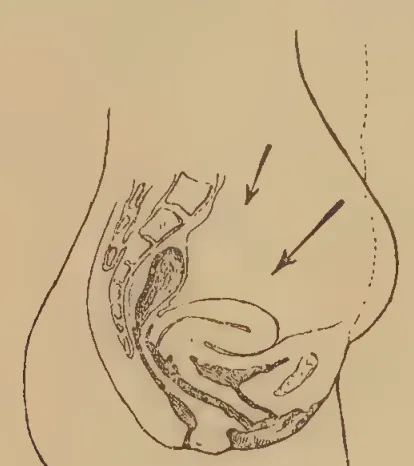
 Diagram of the perineum on the saddle 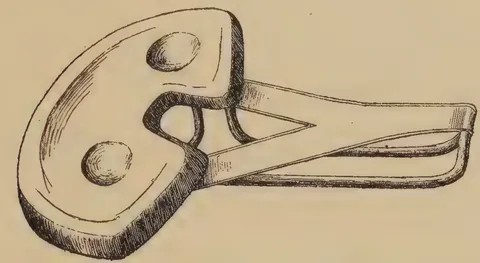 (opens in a new tab)
 Bicycle saddle design
Mastheads 2
 (opens in a new tab)
 Arms of the city of Lyon - (opens in a new tab)
Arms of the city of Lyon