Nauticus on His Hobby Horse
By Nauticus188049 chapters5 images
Contents
- "Nauticus" explains that the contents of the book were written for his private journal and are now published by request, pour encourager les autres. He warns that the distances were obtained from people on the spot and their correctness is not guaranteed.
- Having gone to Liverpool to see a relative off on a long voyage, the author sends his tricycle north by rail and sets out in his oldest clothes with a knapsack of spare clothing, map, guide-book, mackintosh and paper collars. He loses his way in the suburbs and complains bitterly of the rough paving of Lancashire, which nearly shakes out his artificial teeth before he reaches Ormskirk.
- He falls in with another rider mounted on a "Salvo" and they run six miles together, toasting each other in bumpers of soda and milk before parting. Arriving at Preston at 1.30 p.m., he admires the town hall, watches the excursion parties and promenades Miller Park.
- Rain until 10.30 leaves the road like liquid gutta-percha, so he yields to temptation and rides the narrow footpath at speed. He sights Lancaster "on the port bow" at 2 p.m., cleans himself up at the County, and pushes on to Kendal.
- Deciding only to reconnoitre the Lakes for a future visit, he leaves the tricycle behind and goes by train and 'bus to Windermere, Ambleside and Grasmere, passing the former homes of Wordsworth and Coleridge and glimpsing Rydal Water. He visits the poets' tombs and is appalled to find a subscription list for restoring the old country church.
- He is roused out at six for a second view of the lake, only to find that bright sunshine has destroyed the charm of the scene. Returning by coach to Ambleside and by boat to Bowness "just to say I had done Windermere", he remounts at Kendal at 4.30 p.m. and rides as far as the daylight allows.
- A furious north-east gale nearly turns him turtle, then drives him along so fast he must use the brake on level road; he runs via Settle to Skipton and dines with some "commercial gents". The tire of his brake wheel comes adrift on a dangerous hill, he helps right an overturned pony trap near Harrogate, and beds down at Killinghall after mistaking it for Ripley.
- He walks a mile of ornamental gardens to Fountains Abbey and finds the ruins magnificently grand, musing on the jolly time the abbots and monks must have had. A fellow "Unicorn" rider at Ripon assures him the worst roads are behind him, a promise the road to York promptly breaks.
- From the top of the Minster tower he sees the old city's walls, bars, tiled roofs and narrow streets mapped out beneath him. He then trains to Castle Howard, tramps three miles to the mansion to see its pictures, notably the "three Mary's", said to be worth £20,000, and returns through a tropical thunderstorm to visit St. Mary's Abbey and Museum.
- A rest day at York, spent attending the forenoon and afternoon services in the Minster and admiring its music and architecture.
- The suburbs of Leeds turn out en masse to cheer him until a man out of work throws half a brick at his head. He inspects a cloth manufactory where old rags go in one end and new cloth comes out the other, visits St. Peter's Church and the Town Hall, and sees the town's first steam tram running.
- Starting at five when the rain ceases, he finds the road afloat and in places a roaring torrent, his machine showing its "sense of humour" by heaving to in mid-stream. He passes numbers of forlorn tramps who he is sure would have "stuck him up" but for his warlike bearing, and reaches Sheffield filthy with mud.
- He tours Sheffield's cutlery show rooms, Sir John Brown's plate works and Dickson's electro-plating works, where strangers are now excluded because some Yankees had "opened their eyes". Trained on to Chesterfield with its warped wooden spire, he is refused at the park gates for arriving at 4.45 p.m. and hoists his machine over a stile to cut across the park for Derby.
- Delighted to have discovered an unspoilt Elysium, he consults his guide book and finds himself in one of the most frequented watering places in England. He speeds along a tempting asphalt footpath near Derby with a defence of footpath riding, outruns a thunderstorm into Burton in "a regular John Gilpin affair", and is examined for his "bump of beery intelligence" at Bass's brewery; 42 miles.
- Lichfield Cathedral sends him into raptures, the reredos, the painted windows, the chapter-house and the sculpture of the "sleeping children", and he stays for the morning service. Twenty-eight miles of capital road bring him to Coventry, where the machinist company offers to exchange his tricycle for a new machine in a week.
- He returns to Coventry by rail, sees St. Michael's Church and its splendid spire, and rides the twelve very good miles to Warwick via Leamington, taking the best view of the castle from the bridge.
- He goes over Warwick Castle to see the Warwick vase and Guy's armour and punch bowl, amused by the parrot-like patter of the girl at the porter's lodge. Riding on through Stratford-on-Avon in his first wet day, he is sent six miles astray through quagmires by a practical joker and reaches Worcester at 9 p.m. so filthy that the tricycle has to be taken to pieces and cleaned; 44 miles.
- After the newly restored Worcester cathedral he visits a porcelain manufactory and describes the whole process, throwing, the transfer of engraved patterns by heated plate and tissue paper, and the hand painting of dessert services. He then trains to Gloucester for its fan-traced cloisters and Bishop Hooper's martyrdom site, and on to Reading.
- A pleasant ride through the woods to Crowmarsh, where he stays for the regatta, then a capital run to Windsor via Wingfield, 38 miles. On the Long Walk he is much entertained watching a school party play "kiss in the ring".
- Morning service at St. George's Chapel, then the royal apartments, mews, Memorial Chapel and the view of Eton from the Round Tower. In the afternoon he runs through Slough to Stoke Poges churchyard to picture Gray writing his Elegy, and on to Burnham Beeches, where he is besieged by little girls entreating rides; 17 miles.
- After early service at St. George's and an ascent of the Round Tower, he is halted on the Long Walk by a broom-waving official and finds soft sawder will not lubricate him. He then runs via Chertsey, Addlestone, St. George's Hill, Byfleet and Cobham to Leatherhead, 33 miles, regretting that he missed the Crouch tree under which Wycliffe is said to have preached.
- He trains to Wimbledon for the Anglo-American rifle match and camp, thinking the Canadian bears the palm, then drives from Leatherhead through Dorking to the Silent Pool near Albury. The day closes with a defence of the good country inn over the "quasi first class" hotel, where a paper collar is needed before presenting oneself at the bar.
- An old woman on Leith Hill is indignant that his guide book ignores "her" hill and claims thirteen counties can be seen from its tower; he has trouble getting the tricycle, the first ever seen there, back down. After Box Hill, which he judges no match for Leith Hill, he misses his footing on a spurt and goes a header into the middle of the road; 27 miles.
- On "mamma's" recommendation he walks to Reigate park for the view, then gets under weigh for Sevenoaks, but rain stops him at Westerham after 16 miles.
- Taking the landlord's advice he abandons the Sevenoaks route for very rough cross roads to Penshurst, a clean little village of quaint cottages whose castle will not open until three. He runs on via Tunbridge Wells, Frant and Lamberhurst to Yalding, 44 miles, through hop country said to be troubled with mould.
- After looking for fishing at Yalding he rides a very bad track to Maidstone, is refused admission at Leeds Castle, and chats at Charing with young fellows on a pedestrian tour before continuing to Margate to close the first cruise.
- He reckons the trip a most enjoyable one of 689 miles: bad roads in the north as anticipated, excellent ones in the south and particularly in Kent, and one mishap caused by carelessness in missing a pedal. He closes with a comic catalogue of the remarks bystanders shouted at him when going slowly ("Better get off and carry it, guv'ner") and quickly ("Here comes a three-wheeled bicycle").
- Part-title opening the September–October run from Margate through Sussex and Hampshire to Devon, Cornwall and Land's End.
- Better trained, better mounted and knowing every inch of the road, he now flies over hills that once forced him to dismount, reaching Canterbury in far less time than before. His new lamp fails on the hill into Cranbrook, throwing him off, and after tea the landlady sends her little daughter to show him how hops are dried on a horsehair grating over a charcoal fire; 46 miles.
- Clay, sand and a sleepless night make hard work, and no milk is to be had at the country public houses. He anchors at Lewes, rides through Brighton's "peacocking" promenade entirely unnoticed, drinks three tumblers of milk in succession, and runs away down a hill so fast that a terrified old woman is left convinced she has seen the "old gentleman" himself.
- He surveys Arundel's churches and castle, then runs the eleven miles to Chichester in seventy minutes to "do" the cathedral and its curious detached bell-tower. At Havant he gets into very hot water when he throws a flat lemonade out of the inn door and the landlady tells him he is "no proper bicyclist to behave in that way"; 29 miles.
- Having finished his business he extends the trip westward, crossing by the floating bridge to Gosport and running 18 miles to Southampton Ferry in 100 minutes, the last two in the dark. A Dutch lady and gentleman waiting for the boat recommend a small private hotel where he is cordially received.
- He records his hotel bill in full at 3s 9d, then finds Salisbury cathedral's bald nave, unmellowed light and drill-sergeant tombs make him shudder. A twelve-mile detour to Stonehenge (the largest stone said to weigh 45 tons) leaves him benighted beyond Winterbourne Stoke and Wylye on roads running in every direction.
- Seventy-five miles through Mere, Wincanton, Sparkford and Langport into a Somerset he praises for its scenery, tillage and legibly painted guide posts. At Taunton he is charged 6s 9d for a portmanteau and hat box, and later a half-drunk waggon driver, riled at being passed, comes up whip in hand, "Casualty No. 2".
- Warned off the Crediton and Launceston route to Land's End, he goes by Exeter and Plymouth instead, grinding up to a moorland race course and bounding down the far side over loose stones. He calls the road from Ivy Bridge to Plymouth the worst highway in England, and ends the day "making his mate a Mason" with a red-hot poker to re-secure a loosened tire; 73 miles.
- He nearly comes to grief descending from Liskeard into what he thinks the prettiest wooded gorge he has yet seen, and at Bodmin the crowd is so dense that the machine must be carried into a shop for protection. Beyond Truro he takes a howling cropper avoiding a boy, is helped by a blacksmith, and gropes into Penzance late at night in the rain with torn pantaloons.
- With a chance breakfast companion he drives out to the Logan Stone, at first a great disappointment until they scramble up and shake it and see the traces of Lieut. Goldsmith's folly. They go on to Land's End, and he returns to walk round Penzance and admire St. Michael's Mount.
- Having decided to return by rail he watches the deluge with indifference, travels up by the "Flying Dutchman" and argues with his carriage mates over whether Stonehenge is built of constructed stones. Next morning the tricycle is strapped to the top of a four-wheeler and carried across London to Victoria, astonishing the passers-by.
- He accounts for both spills, the first from the fallen lamp striking the small wheel, the second from a worn thread in the steering screw, since remedied by letting in a piece of steel. He judges the spoon brake simple and reliable but not powerful enough when mud acts as a lubricator, preferring the Salvo principle; 442 miles, 51 of them in the dark.
- Part-title for the October run from Margate to Oundle and back by St. Albans, undertaken purely to cover ground, with short days and ignorance of the country as the two drawbacks.
- A 101-mile day begun at 6.35: forty miles to Rainham without a halt but for repeated oiling of a squeak he never identifies and calls his "day mare", then the Tilbury ferry, the dismal marsh road and a wrong turn near Barnston. He arrives at Dunmow at a late hour to a landlady visibly convinced he means to cut her throat or walk off with the plate chest; 28 miles run in the dark.
- Rugged going to Thaxted and drizzle to Saffron Walden, then the heaviest and most monotonous road of the cruise out of Cambridge through Godmanchester and Huntingdon. He finishes by spurting up to two bicyclists and racing them the last two and a half miles into Oundle; 71 miles.
- He describes Oundle's old-fashioned houses, its church tower and spire and its rising school, and rides ten miles with a fellow tricyclist to Deene, Lady Cardigan's seat, to see the Cardigan tomb. Nearby he goes over the ruins of Lord Winchilsea's mansion at Kirby, where ducks and geese promenade the banqueting hall and picnic parties have broken nearly every pane of glass.
- A powdered footman refuses him admission to a great house because he is alone, "there must be two, or no admittance", then, after the card trick, offers to let him in at double fare plus the porter's fee. He rides away in disgust, tips the man a shilling with good grace, and twice nearly comes to "howling grief" riding home unlit; 51 miles about Oundle.
- He observes how a map's straight road twists like an eel and adds a quarter to the distance, makes Bedford and Bunyan's monument in 3 hrs 7 min, and is then sent hither and thither on the way to Dunstable until the mystery is solved by a county map. Two flies blind him in turn on a downhill run, Dunstable Priory looks "more like a brewery than a priory", and he finishes in the dark, dodging a drunk and fighting to relight his lamp in the wind.
- A barometer fallen through the bottom ends his plan to wind up the summer at Winchester. He visits St. Alban's Abbey, three clergymen reading the service to four people, admires its massive Norman pillars and Saxon triforium, fails to reach Bacon's memorial at St. Michael's Church, and trains home to Margate; the three cruises total 1427 miles, 107 of them run in the dark.
- Seven numbered rules of his cruising routine: study the map and note the principal towns, examine and oil the machine and test the nuts before and during the day, go easy for the first mile, gauge every hill before deciding to spring it or walk, dismount the moment distress is felt, never strain the muscles by spurting, and add the weight of the body to the thrust of the leg in a steady pressure.
- After all its rough work his Coventry machinist's rotary tricycle is practically as good as new, simplicity itself, never any trouble, and admirably adapted for ladies. He ends with the tricyclist's undoubted advantage: all the pretty girls run out of doors to see him, whereas they will not cross the room to look at a bicyclist.
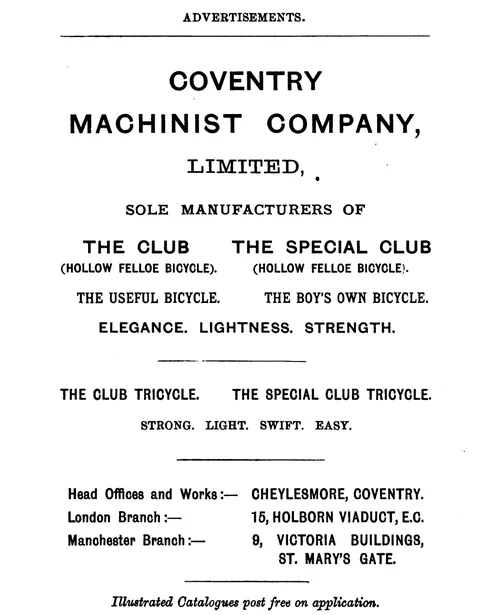
- The publisher's advertisement leaves at the end of the volume, opening with the Coventry Machinist Company's Club and Special Club hollow-felloe bicycles and Club and Special Club tricycles, and continuing with Poole & Lord's "Sans-Pli" shirts and William Ridgway's book list.
Images in this book 5 pictures from 108 pages
Illustrations 1
 (opens in a new tab)
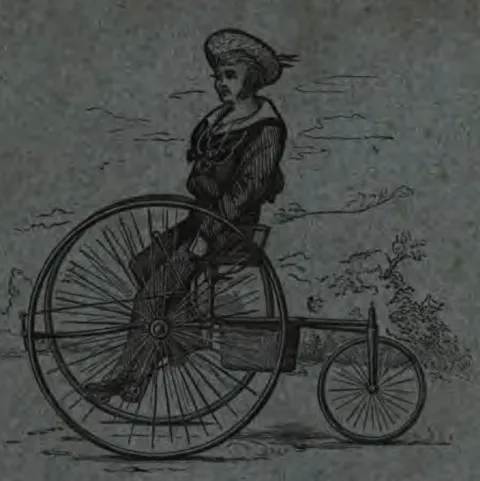
 Sailor on a tricycle, front cover
4 advertisements
 (opens in a new tab)
 Coventry Machinist Company 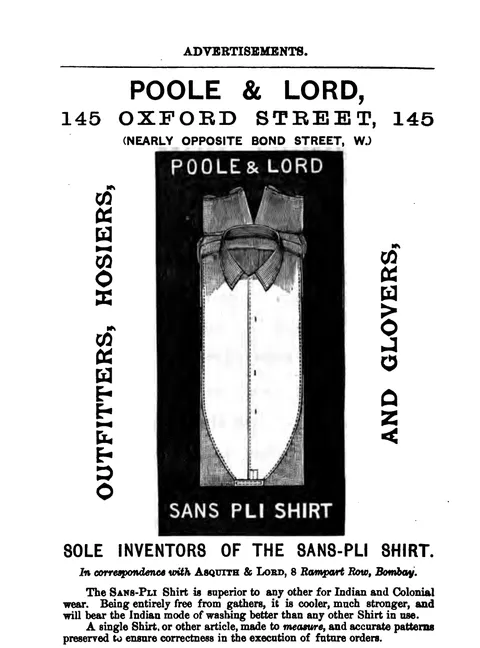 (opens in a new tab)
 Poole & Lord Sans-Pli Shirt 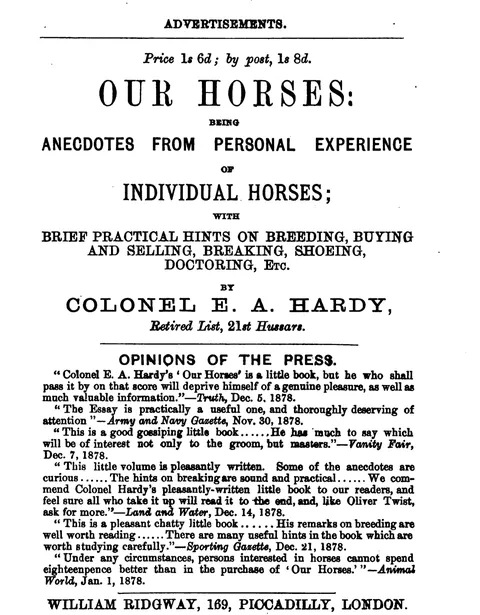 (opens in a new tab)
 Our Horses: Anecdotes from Personal Experience 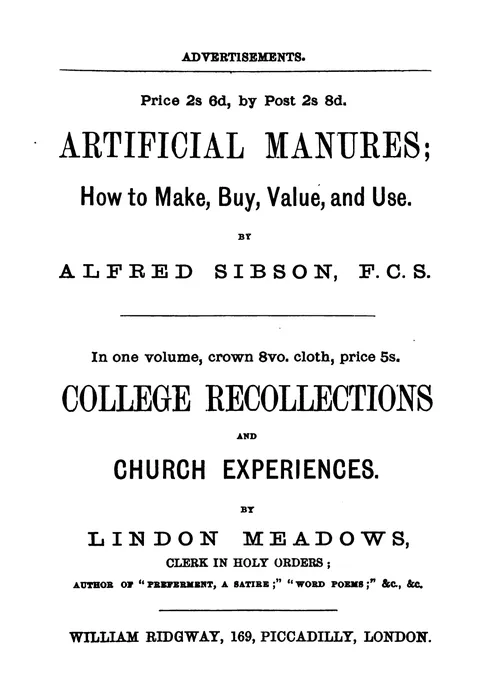 (opens in a new tab)
 Artificial Manures and College Recollections