Official L.A.W. Road Book of Indiana
Contents
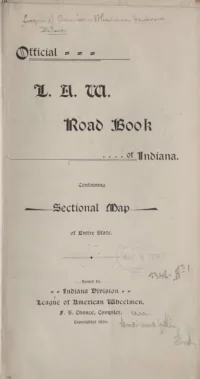
- Title page of the Indiana Division's first road book, containing a sectional map of the entire state, compiled by J. S. Chance and copyrighted 1896 by the Indiana Division, League of American Wheelmen.
- Explains the road book was compiled in under four months starting December 1895 and admits routes could not be finished in time, promising a free supplementary Route Book by July 1, 1896, and asking Indiana Division members to help collect data on points of interest such as resorts, caves and historic sites.
- Compiler's note on the making of the sectional map, thanking cyclists, surveyors and League members statewide and naming dozens of assistant compilers by town, including Ralph R. Rohrer of Bloomington, Harry Curtis of Indianapolis and Chas. B. Atkins of Knox.
- Recounts the League's founding at Newport, Rhode Island on May 31, 1880, and explains that its object is to protect the rights of wheelmen, facilitate touring, secure road improvement and regulate track racing.
- States that the League's court battles have won legal recognition of the bicycle as a carriage nationwide, giving members the right to ride any public thoroughfare with 'their half of the road.'
- Describes the League's Good Roads campaign, crediting it with over $120,000 spent and more than two million pamphlets and magazines circulated advocating for public highway improvement.
- Explains that Local Consuls are appointed in towns statewide to advise touring members on routes, points of interest, other L.A.W. members and League hotels.
- Describes the League's arrangement with hotels in leading Indiana towns to give members reduced rates or special treatment on presentation of an L.A.W. membership ticket.
- Notes that state divisions compile free road books for members and touring visitors, and that the Official L.A.W. Road Book of Indiana is sent free.
- Describes the League's weekly official organ, a thirty-five-page illustrated paper carrying official notices, racing records, a Good Roads department and a ladies' department edited by Ida Trafford Bell, mailed free to members.
- Explains that Indiana Division members may request the names and addresses of fellow members anywhere in the state for touring assistance.
- States that all track racing and record recognition in the United States is controlled by the League through its Racing Board and sanction system, and calls the L.A.W. the world's largest athletic organization.
- Describes the engraved L.A.W. membership ticket bearing the member's name, address and number, used to identify members at hotels, races and gatherings.
- An appeal urging Indiana wheelmen to join the League, citing its drive toward a 300,000-member goal for 1896 and its influence over highway legislation.
- Section heading introducing a series of excerpts from the League's constitution covering eligibility, cost, membership, renewals and related rules.
- States that any amateur white wheelman of good character aged eighteen or over, endorsed by two League members or three other reputable citizens, is eligible for membership.
- Lists membership cost as a $1.00 initiation fee plus $1.00 annual dues, including the L.A.W. Bulletin subscription, for $2.00 total.
- States that memberships expire exactly one year from the date the application is published in the official organ.
- Explains renewal terms: $1.00 within sixty days of expiration, a fifteen-cent-per-month fine after that, and a capped $1.00 fine for members seven to twelve months in arrears.
- Table showing how the $1.00 annual dues and $1.00 initiation fee are divided among the national League, the state Division and the L.A.W. Bulletin.
- Defines an amateur as one who has never raced for a cash prize or gate money, or trained or coached a professional, unless later reinstated by unanimous vote of the National Assembly.
- Sets out how a wheeling club becomes a League Club, requiring a by-law tying active membership to L.A.W. membership, an annual certificate and a $2.00 fee, noting Indiana's own by-law allowing 75%-member clubs.
- States the National Assembly consists of all National Officers and convenes for about four days beginning the second Wednesday of February each year.
- Notes that the time and place of the League's Annual Meet are determined by the National Assembly or the Executive Committee.
- Lists race-meet sanction fees: $25 for National Circuit meets, $5 for open meets plus $2 per extra day, and $2 for athletic meets scheduling two cycling events.
- States the National Racing Board is self-sustaining, funded entirely through revenue from race-meet sanction fees.
- States the League will not sanction Sunday race meets, and that riders competing in unsanctioned meets risk suspension from all track privileges.
- Table listing which state divisions have issued L.A.W. road books and their prices, showing Indiana's 1896 book as free to resident members and 75 cents to outside members or non-members.
- Announces a new arrangement, negotiated by League President Sterling Elliott, offering members bicycle-theft insurance for $1.00 a year through a guarantee policy with the American Wheelmen's Protective Association at half its normal $2.00 rate.
- Describes the League's official road-signal code, including the 'O.K.' direction sign and cautionary and danger arrows for hills, and signs marking League hotels and club rooms, stencilled along routes.
- States that a bicycle is legally a carriage with the same road rights and duties as other vehicles, including keeping to the right and yielding appropriately, quoting court language on a wheelman's proper conduct.
- Sets out six numbered points of case law on bicyclists' legal liabilities, covering municipal responsibility for defective roads, collision damages, riding on the wrong side, and criminal liability for reckless or immoderate speed.
- Describes the League's campaign for 'Bicycle baggage bills' requiring railroads to carry bicycles as ordinary baggage free of charge, arguing it is inequitable to charge for a 25-pound wheel while checking a 150-pound trunk free.
- Directory advising members whom to contact for specific needs, from Chief Consul Maro R. Thompson down to Foreign Marshal Jos. Pennell in London for information on cycling abroad.
- National roster listing the League's 1896-97 officers, led by President Sterling Elliott of Boston, and its standing committees for finance, rights and privileges, highway improvement, touring, transportation and racing.
- Roster of the Indiana Division's 1896 officers and committees, headed by Chief Consul Maro R. Thompson of Indianapolis and Vice-Consul W. L. Krietenstein of Terre Haute.
- Announces that work has begun on a supplementary Indiana Route Book detailing fifty or more popular routes with distances, road conditions and points of interest, expected by mid-June 1896.
- Notice, beneath a photograph of Chief Consul Maro R. Thompson, that League hotel and repair-shop listings are kept current in the weekly Bulletin, and asking members to report any breach of agreed rates to the Chief Consul.
- Table listing Indiana towns with their Local Consul, contracted League hotel and member room rate, running from Albion to Muncie.
- Table of authorized L.A.W. repair shops across Indiana towns, such as E. F. Corbett in Greensburg and Albert Schiffling & Son in Indianapolis, with their member discount rates on repairs.
- Section-title heading introducing the road book's touring-preparation and tourist-tip articles that follow.
- Training advice for riders preparing for a tour, covering diet, early nights, gradually building daily road mileage over about a month, and post-ride rubdowns to prevent stiffness.
- A long list of practical touring tips, including from Secretary-Treasurer Chas. G. Mueller, covering saddle break-in, carrying a cyclometer and Kodak, rubber-band luggage straps, puncture repair, and pacing 40 to 70 miles a day.
- Advises on correct saddle height and handlebar position to distribute a rider's weight between grips, pedals and saddle and reduce air resistance and saddle soreness.
- Vice-Consul W. L. Krietenstein's field-repair tips for a broken saddle, cracked frame, snapped handlebar or split rim, using wire, a wrench and a rolled coat as makeshift fixes.
- Title and legend page for the Section 1 sectional map of Northern Indiana, explaining that gravel roads are shown as red lines, dirt roads as broken red lines and hills as a red X mark, with instructions for cross-referencing the town index.
- Notes that many of the state's hills go unmarked for lack of reports from assistant compilers, and that hilly Section 5 in the south was left without any hill marks at all.
- Title and legend page for the Section 2 sectional map of Northern Central Indiana, repeating the gravel-road, dirt-road and hill-marking key and town-locator instructions.
- Repeats the compiler's caveat that many Indiana hills are unmarked for lack of reports, and that hilly Section 5 in the south was left without any hill marks.
- Title and legend page for the Section 3 sectional map of Central Indiana, with the same gravel-road, dirt-road and hill-marking legend and town-locator instructions.
- Repeats the compiler's caveat that many Indiana hills are unmarked for lack of reports, and that hilly Section 5 in the south was left without any hill marks.
- Title and legend page for the Section 4 sectional map of Southern Central Indiana, with the same gravel-road, dirt-road and hill-marking legend and town-locator instructions.
- Repeats the compiler's caveat that many Indiana hills are unmarked for lack of reports, and that hilly Section 5 in the south was left without any hill marks.