Points for Cyclists with Training
Contents
- A biographical sketch of world champion racing cyclist Arthur Augustus Zimmerman and the secrets behind his remarkable success.
- Short biographical notices of leading racing cyclists from England, Ireland, Scotland, America, and beyond in 1892.
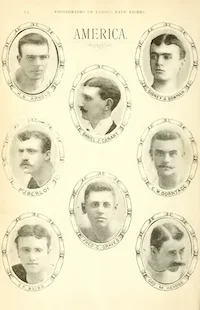
- Presents photographs of leading racing cyclists of the world, grouped by country including America, Canada, South Africa, Italy and Austria, accompanied by biographical notes giving each rider's birth, build, racing career and principal championships and records.
- Sets out tables of cycling records taken from the American Referee of Christmas 1892, covering standing-start records in competition and against time, records paced by running horses, and English and British amateur safety records, with the riders, places, dates and times.
- Zimmerman's personal training system: diet, sleep, rubbing down, track work, sprinting, and avoiding alcohol and tobacco.
- Practical guidance for cyclists on the safety bicycle, its components, maintenance, and correct use on road and track.
- Detailed advice on every aspect of competitive and recreational cycling, from tyres and gear to clothing and race tactics.
- Step-by-step instructions for a beginner learning to balance and mount a safety bicycle or tricycle with a friend's help, including how to start and dismount alone.
- Addresses the social prejudice (invoking 'Mrs. Grundy') facing women who take up cycling, quotes the Gentlewoman on learning to ride a safety, and gives instructions for mounting and dismounting in a skirt.
- Advises buying from a reputable agent or established maker rather than 'catch-penny' cut-price advertisers, mocking sham cheap machines sold by a fictitious 'Bunkum Cycle Company.'
- Warns against cheap mass-produced safety bicycles built from gas-pipe tubing and rough iron balls but sold at inflated prices, contrasting them with genuine first-class machines built by reputable makers.
- Critiques the 'G.F.D.' (Geared Ordinary) and the lever-driven geared facile, noting racer Frank Shorland's mixed results on the machine and arguing the safety remains the better design.
- Recommends the bicycle-steering Cripper-pattern tricycle with 26- or 28-inch wheels as best for less agile riders, and compares solid, cushion, and pneumatic tire options for it.
- Weighs the pleasures and difficulties of tandem riding for couples, describing how the Irish club 'Ohne Hast' tows a tired partner with a rubber-cushioned rope.
- Traces John Boyd Dunlop's 1888 invention of the pneumatic tire and its rapid rise from ridicule as 'German Sausage' or 'Pudding Bag' wheels to universal adoption by 1893.
- Compares handlebar grip materials -- horn, vulcanite, cork, and rubber -- for comfort, weight and durability, recommending cork or Pneumatic Handles.
- Recommends the open-link roller chain for roadsters over the block chain, and explains the lubrication and alignment needed to stop a chain mounting the cogs at speed.
- Describes Harrison Carter's oil-bath gear case and other detachable dust-guard designs, with step-by-step instructions for changing gear and removing the rear wheel.
- Quotes F. T. Bidlake on the aerodynamic drag caused by close-fitting mudguards, and describes lightweight, detachable wire-framed guards with rubber cloth covers.
- Notes that seven-inch cranks suit only very tall riders, recommends shorter cranks for general road work, and describes slotted cranks that can be adjusted to catch a following wind.
- Explains how to calculate a cycle's gear from sprocket and wheel size with a worked example (9:18::28=56 inches), and quotes T. A. Edge of British Sport on Zimmerman's low 64-inch racing gear.
- Reports personal trials of the elliptical sprocket popularised after John S. Johnson's record ride, concluding it disrupts pedalling rhythm and noting it was dropped by Zimmerman after one trial.
- Surveys spoon brakes, rubber-block brakes, and band brakes, warning that a spoon brake jammed on suddenly can tear a pneumatic tire or bend the front forks.
- Instructs readers to flush ball bearings with kerosene to clear grit, and gives a step-by-step procedure for adjusting the driving-wheel cones and crank-axle bearings.
- Recommends Silico enamel and rust preventive to protect a machine's bright parts from rain and mud, with polishing methods using plate paste, whiting, and chamois leather.
- Sets an oiling schedule -- roughly every 100 miles in good conditions, more often in mud or dust -- covering bearings, hubs, pedals, and steering joints.
- Praises the Cyclists' Touring Club (C.T.C.), naming secretary E. R. Shipton and Continental consul T. A. Stead, and describes the club's hotel-tariff discounts and handbooks for touring members.
- Advises all-wool clothing in summer and winter, and lists the kit for a spring or summer tour -- a gossamer waterproof cape, spare underclothing, and celluloid collar and cuffs -- packed in a home-made hold-all.
- Recommends bouillon, lemon squash, ginger beer and milk, tea, or coffee over alcohol while riding, and describes the author's French-style touring diet of rolls, bouillon, and a table d'hote dinner each evening.
- Summarises English cycling law on warning bells, lamps after dark, and footpath riding, contrasting the English rule of the road with American and Continental practice.
- Cites Dr. Oscar Jennings' 'Cycling and Health' and testimonials from several doctors that cycling relieves rheumatism, gout, and varicose veins, prescribing moderate riding for middle-aged and delicate readers.