Sketches Awheel in Modern Iberia
By Fanny Bullock Workman and William Hunter Workman189720 chapters6 images
Contents
- Fanny Bullock Workman and William Hunter Workman explain that the book rests on a bicycle tour of Spain made in the spring and summer of 1895, averaging about seventy-five miles on riding days with twelve to twenty pounds of luggage. They list the route worked through, from Port Bou, Gerona and Barcelona by way of Granada, Seville, Toledo and Burgos to Irun, and disclaim any intention of writing a wearisome itinerary of distances and road conditions.
- A survey of Spanish roads written for cyclists, noting that no useful information could be obtained before setting out and that Richard Ford's optimism would not have survived a bicyclette on some stretches of camino real. It distinguishes the state-maintained arrecifes or caminos reales from the local caminos communales, describes the three-rut mule tracks of Aragon, Valencia and New Castile and the loose broken stone left on roads under repair, and advises that only skilful and determined riders attempt the eastern and southern provinces.
- The Workmans send their trunk by grande vitesse to the Spanish custom-house at Port Bou and write ahead to the Jefe de Aduana, only to find on arrival that neither the trunk nor the papers for the bicycle deposit exist. The courteous jefe pockets a bank-note larger than the sum named and hands over a receipt with no figure on it, an accidental favour since the legal deposit would later have been forfeited when the machines were sold.
- Two gendarmes with shouldered muskets escort the pair on foot out of Figueras, beginning their first Spanish journey under military guard, and children in the villages beyond run after them throwing stones. At Gerona they dine among caballeros at the Fonda de los Italianos, see the cathedral with the widest nave in Europe and its Romanesque cloister, then ride the coast road to Barcelona, where the long-delayed trunk finally arrives minus a new revolver.
- Three punctures in one afternoon delay the climb to Monserrat, whose grey conglomerate peaks the authors rate above Subiaco and Monte Cassino, and they walk the three-hour path to the summit. They retell the legend of the Black Virgin, hidden from the Moors in 717 and found by shepherds in 880, and follow Ignatius Loyola from the altar where he hung up his sword down to his year of penance at Manresa.
- At Villafranca the hostess of the posada invites them onto her balcony to watch the Good-Friday procession pass down the gas-lit street. Beyond Montblanch they reach the Cistercian monastery of Poblet, founded in 1149 by Berenguer IV and once the largest religious house in Europe, gutted in 1835 by a peasant mob during the Carlist agitation and left with its royal tombs stripped of their effigies.
- Easter mass in the Tarragona cathedral, with its Roman remains and cloister, is followed by a tyre repair in a grain and guano loft at the squalid venta of Perello, watched by three men the authors thought looked equally brigandish but who refused any payment. At Tortosa the hostess presents a young Englishman to them as a countryman, and the chapter closes on the mules and cart-drivers of the coast road, one of whom runs at them near Castellon de la Plana with a raised mattock.
- Riding the huerta of Valencia among Moorish irrigation wheels, they are stopped in the Corpus Christi chapel by a sacristan who will not let the Señora see the Ribalta paintings without a mantilla. Jativa's ruined castillo and Torre de Campana delight them, Alcoy is in uproar with its festival, and at the viuda of Jijona the landlady can offer nothing but bread and ten eggs while a night crowd admitted to see the bicicletas twists a handlebar and damages a brake.
- A waggon driver whose mules bolt springs at the male rider with a knife and is caught by the arm at the last moment by one of his own companions. Past Alicante and its Paseo de los Martires the country turns African: Elche rises among thousands of date palms, and the forty miles thence to Murcia, the pearl of its fifteen-mile huerta, is called the most intoxicatingly beautiful ride of the whole tour.
- On 27 April they enter Andalucia by the Puerto de los Perros in the Sierra Morena and are blown into Granada by a dust storm, finding the Alhambra hill and Wellington's elm grove ample compensation. A fortnight is spent among the Court of the Lions, the Sala de los Embajadores and the Mirador de Lindaraja, and a cyclometer chimes a thousand miles from the frontier just as they halt at El Ultimo Suspiro del Moro.
- The road to Malaga, everywhere reported muy pendiente, climbs to heights from which they count ten mountain ranges before a sharp ten-mile descent in the last hour of twilight. From Gobantes they ride to Ronda, where a stout horse-owner who rides bareback insists on paying every bill and accompanies them to the Cueva del Gato and the gorge of the Zumidero, offering them a vermilion garlic preserve on the way.
- Crossing to Morocco, they engage the guide Salem and a mounted government soldier at Tangier and ride the caravan track to Tetuan, the Señora being dragged waist-deep through a slough when her mule founders. In the white city they visit the grain market and the Basha street, are received in the patios of Moorish grandees where slave girls serve café maure, watch the roof-top ladies' hour, and make an excursion to Salem's Source of the Zakkah.
- From Algeciras they ride to Tarifa, where a tower of the alcazar marks the sacrifice of Guzman el Bueno's son, and reach Cadiz along five kilometres of beach because the road is under reconstruction. The peones camineros who keep each five-kilometre section share their water and azucarillos, one wife calling them indoors as sixty fighting bulls fill the road, and beyond Alcala de la Guadaira's cave dwellings lie Seville's Giralda, Alcazar, Murillos and the corridas of Mazantini and Reverte.
- Merida yields Trajan's bridge still in use after nineteen hundred years, the arch of Santiago and an aqueduct colonised by storks, while Carmona's underground necropolis is compared with the rock tombs of Corneto and Sakkara. A machine fitted with the Boudard gear seizes up beyond Ecija and a shopkeeper's inability to open his own bottles helps stretch a hundred and six kilometres into fifteen and a half hours, bringing them into Cordova under a full moon to see the mosque of Abd-el-Rhaman.
- The unreliable Boudard machine is exchanged in Madrid for a new one before they ride to Toledo, arriving the day before Corpus Christi on 13 June. They watch the dance of the Gigantes before the cathedral, the illuminated tower and the sanded, evergreen-hung processional route, then walk the south bank of the Tagus and examine the Puerta del Sol, the vanishing Moorish houses and the whitewashed Jewish synagogues.
- Finding the Toledo–Aranjuez road a mere track in the sand, they obtain tacit official permission to ride the side of the railway roadbed and reach Aranjuez despite two flagmen's warnings. At the fonda of Tarancon the patron and his wife interrogate them about the cyclometer and the Señora's blouses instead of finding a room, until a French quack doctor installs them in his medicine-bottle-filled chamber and pronounces over dinner that the priests rule the women of Spain and through them the family.
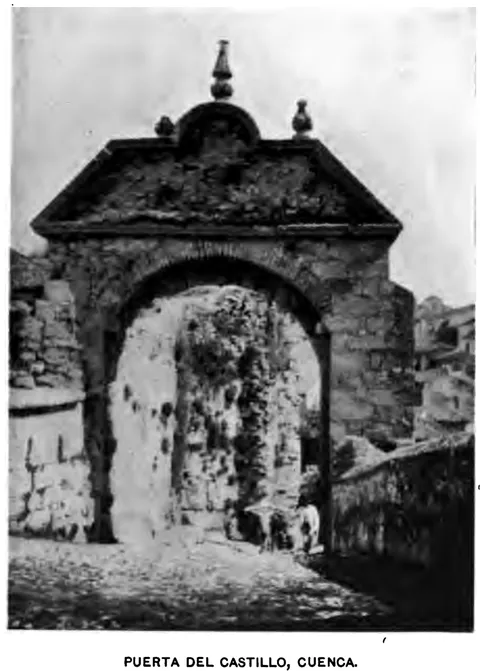
- A June ride of woollen gloves at dawn and insufferable heat by afternoon brings them to Cuenca, girdled by the Huecar and the Jucar and judged the queen of Spain's picturesque cities, though its fonda is among the worst met with and a newspaper interviewer invents their appearance at the local velodrome. The chapter closes in Madrid with the Museum of the Prado, weighing Murillo and the darkened Raphaels against Velasquez, before whom even artists stand dumb.
- Lunching on Madrid jamon dulce near the Escorial, they are taken round the royal mausoleum by the head padre, who has cabinets and mural paintings opened for the matrimonio ingles en viaje con bicicletas and chuckles over a recent Madrid race between a Sevillian horseman and a cyclist. They then cross the 6,065-foot Guadarrama pass to La Granja and Segovia's Trajan aqueduct, and are met on the road by Don A. de la P., who guides them through Avila during its feria to the walls, the sepulchre of Don Juan and the Toros de Guisando.
- Salamanca's plateresque medley is set against its small twelfth-century cathedral, and the president of the velo club shows them the university; at Zamora the university president lectures in the broiling noon sun on Doña Urraca's interview with the Cid. Valladolid is dismissed as one of the dullest cities in Spain, while the Burgos feria supplies a tooth-drawer with a four-piece band and Reverte's cuadrilla lodging at their hotel, before the cathedral, the alabaster tombs at Miraflores and the bones of the Cid and Ximena.
- Turning east from Burgos they cross the watershed into the Ebro basin to Logroño, find no water at all at Alfaro, and shelter with a woman and four frightened children from a thunderstorm on the red plain before Zaragoza. There the Casa Zaporta's patio houses a waggon factory, crowds kiss the pillar of the Pilar all day, and a fine is demanded for riding a badly paved street until bystanders intervene; a peasant near Pamplona offering wine from his mule's flasks supplies the last instance of Spanish courtesy.
Images in this book 6 pictures from 279 pages
Photographs 5
 (opens in a new tab)
 Puerta del Castillo, Cuenca 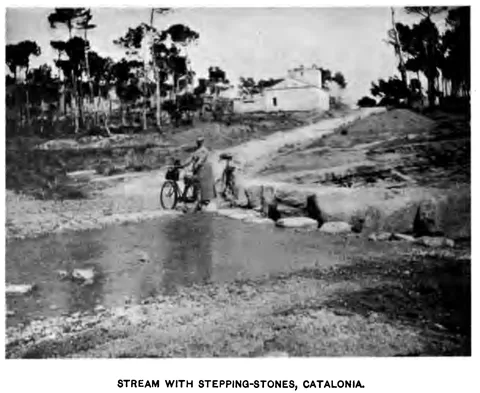 (opens in a new tab)
 Stream with stepping-stones, Catalonia 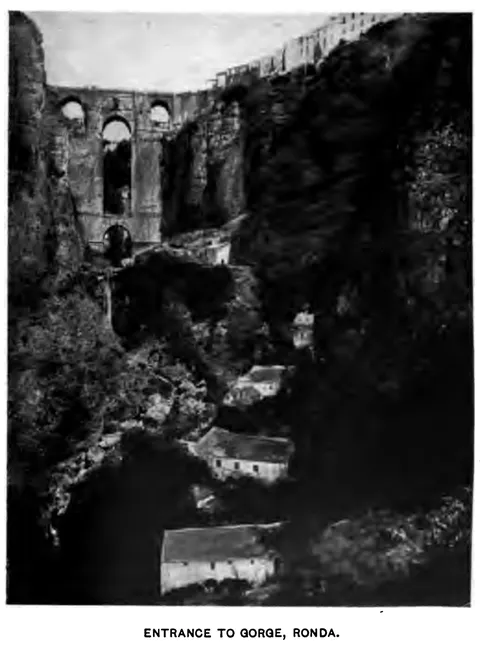 (opens in a new tab)
 Entrance to Gorge, Ronda 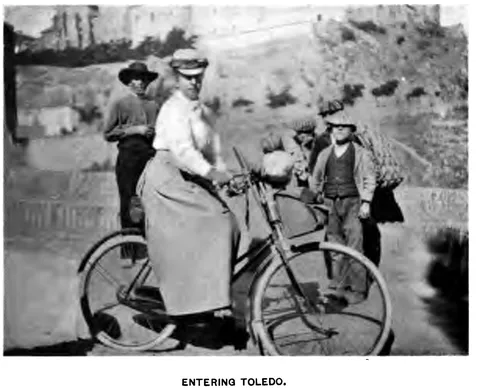 (opens in a new tab)
 Entering Toledo 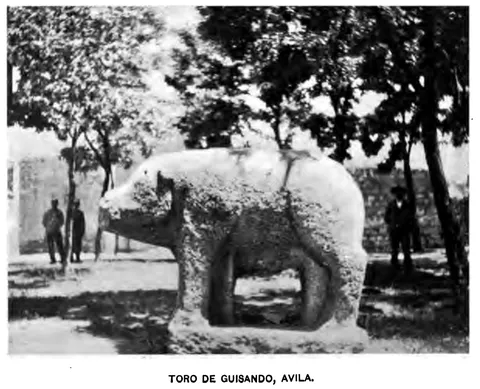 (opens in a new tab)
 Toro de Guisando, Avila
Mastheads 1
 (opens in a new tab)
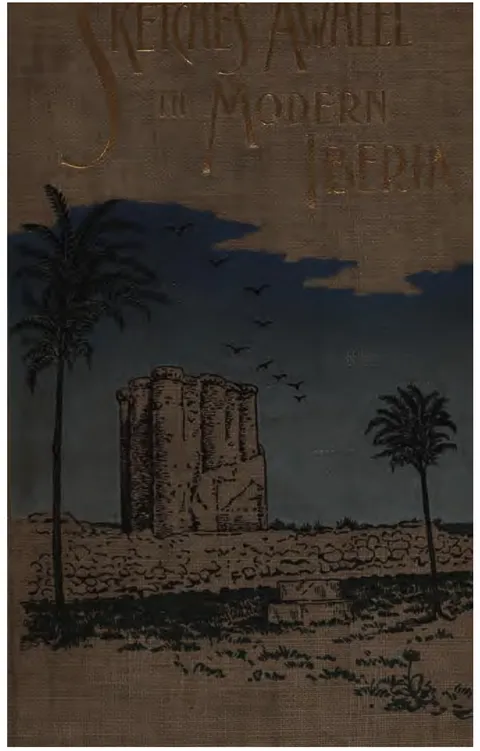
 Front cover: fortress ruin with palm trees