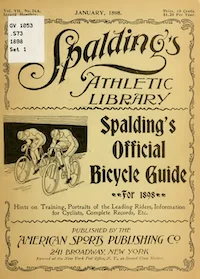
Spalding's Official Bicycle Guide (1898)
Contents
- Reviews the 1897 American racing season, highlighting middle-distance match racing led by Jimmy Michael, the national championships and circuit, and the leading amateur and professional riders.
- F. J. Titus explains the methods of long-distance racing, stressing the importance of skilled multi-cycle pacing and detailing how a rider should train for a record attempt.
- Sets out the principles of training for general health and racing, with detailed rules on rising, bathing, diet, exercise and the avoidance of tobacco and alcohol.
- Describes the bevel-gear chainless bicycle, particularly the Spalding model, explaining its mechanism and arguing for its cleanliness, durability and ease of running over the chain-driven type.
- Advises cyclists on touching up chipped or worn enamel on a machine, noting that original high-class enamel requires heat but several preparations answer for repairs.
- Gives the beginner instruction in learning to ride, recommending first lessons on a tandem under a guide so the novice can master pedalling, then steering and braking, before riding alone.
- Explains the difference between the novice's plunging stroke and the expert's continuous ankle motion, and how the proper saddle height and pedalling technique are acquired by practice.
- Counsels the rider on how far it is wise to travel, advising the absolute novice to limit early rides to a few miles to avoid stiffness and soreness.
- Offers practical advice on dealing with hills, both ascending and descending, which the beginner soon finds more challenging than level roads.
- Discusses the stiffness and soreness common to beginners and at the start of the season, recommending a warm bath and a rubbing-down with an embrocation as remedies.
- Advises that the cyclist not in strict training may eat much as he pleases but should not eat too heavily, and recommends avoiding indigestible pastry before riding.
- Argues that the best cycling work is done on non-alcoholic drinks, warning that even mild alcoholic beverages leave the rider jaded, and that the less one drinks while riding the better.
- Weighs the relative merits of hard and soft tires for speed and comfort and discusses how riders test and judge the proper degree of tire inflation.
- Presents scientific experiments and reasoning to demonstrate that cycling is the easier of the two exercises, so that a trained rider can cover far greater distances than on foot.
- Cautions against lending one's machine, advising that the loan of a bicycle is a serious matter not to be granted unless the borrower is known to be fully competent.
- Addresses lady riders, noting that nearly all the manual's advice applies equally to them, and adds counsel on not riding too fast or far and choosing a suitable machine.
- Dr. Sanger Brown sounds a warning about the health dangers of an unsuitable seat or saddle, explaining the physiology of sitting and the harm that may result to the rider.
- Dr. G. Frank Lydston examines the pathological effects of cycling in relation to saddle form, addressing the genito-urinary disturbances that may arise from the practice.
- Presents tables of bicycle records compiled by Chas. W. Mears, listing world's competition records by distance with riders, tracks, dates and times.