Spalding's Official Bicycle Guide (1899)
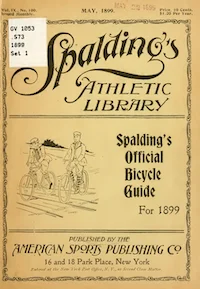
Contents
- G. E. Stackhouse argues that the future of cycle racing depends on the League of American Wheelmen retaining control of the sport, defending the L.A.W.'s honesty and record while dismissing the rival N.C.A. faction as an unstable breakaway. He recounts the League's achievements in securing cyclists' legal rights, road improvements, and the bicycle's popular acceptance.
- A. G. Batchelder makes the case for the newly formed National Cycling Association, contending that track owners, race-promoting clubs, and professional riders should govern racing rather than the annually changing L.A.W. He describes the N.C.A.'s formation after the professionals' breakaway and its planned alliances with regional cycling bodies.
- A short essay asserting that the bicycle is no passing fad but a permanent invention combining business and pleasure, embraced across age, sex, nationality and social class. It notes the machine's rapid mechanical progress and its emerging military uses, and claims it is more popular, cheaper, and better than ever.
- A. G. Batchelder reviews the disputed 1898 professional championship season, weighing the rival claims of Bald, Gardiner, Kimble, Major Taylor, and Tom Butler, and comparing their wins, points, and circuit fortunes. It discusses the effect of the L.A.W. breakaway on the title and the riders' relative standings.
- Miscellaneous counsel for riders, opening with the argument that the heart is uniquely open to examination and that any rider proposing to race for the first time should have a physician listen to his heart before beginning training, and going on to the season's fads and follies.
- Frank M'Collough answers the question of what makes a successful racing cyclist for the thousands who believe they are destined to become a Zimmerman or a Bald, working through the essentials under the headings Strength, Fast Wheel, Training, Confidence and Headwork.
- Defends the chainless bicycle as a new phase in cycling progress whose superiority practical experience has demonstrated, explaining that the costly special machinery, accuracy and skill its building demands account for its apparent excess in price.
- Argues that equalling the long-distance records demands conscientious training under a competent trainer with the sense not to let his charge overwork, and a manageable set of pacemakers trained as thoroughly in pace and pick-ups as the record-breaker himself.
- A treatise on training that distinguishes producing perfect general health from developing special powers in individual organs, then sets out a distinguished physician's numbered rules for a healthy life covering the hour of rising, the cold bath and rub-down, exercise, diet, and the avoidance of tobacco and alcohol.
- Earl W. Peabody, winner of 110 firsts in 1897, advises the candidate for racing honours to seek strength before speed, to start real outdoor training no earlier than the first of April, and warns that too long or too hard training is far more injurious than too little.
- Dr. G. Frank Lydston, professor of surgical diseases of the genito-urinary organs at the University of Illinois, examines saddle design as a medical question, arguing that the profession neglected cycling's importance until the practice became universal. Illustrated with a numbered series of saddle figures.
- Dr. Sarah Hackett Stevenson, a self-described convert from prejudice, argues that cycling is the ideal exercise for women because it works the muscles harmoniously, improves circulation, and clears the blood of waste better than housework or other occupations. She adds testimony that the wheel acts as a sedative for nervous worry and insomnia and benefits chronic congestive conditions.
- Reviews acetylene lighting, noting that kerosene still holds its supremacy as a reliable illuminant but that gas generated from calcium carbide has won favour with cyclists, and compares the makers' different arrangements — the Search-Light, for instance, placing the water below the carbide and feeding it up through a wick.
- A reference compilation of records accepted by the League of American Wheelmen and the International Cyclists' Association, compiled for the American Sports Publishing Co., with a key to the abbreviations for competition, against time, paced, unpaced, amateur, professional, tandem and multi-cycle conditions. Tables run by distance from a quarter-mile to thirty miles and upward, and close with hour records.
- A review of the past season's middle-distance paced racing, which had become immensely popular and drew the most famous foreign riders against the Americans. It profiles the successful "Big Six" — McDuffee, Michael, Linton, Taylore, Elkes and 'Major' Taylor — with individual race-schedule tables of dates, places and distances for riders such as Tom Linton and Edouard Taylore.