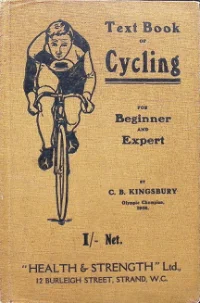
Text Book of Cycling: For Beginner and Expert
Contents
- Kingsbury argues cycling's future is secure despite the rise of motoring, since a man must first learn to cycle before he can motor-cycle, and criticises the National Cyclists' Union and Cyclists' Touring Club for their small, apathetic membership and inadequate central Legal Defence Fund. He contrasts the public abuse once heaped on cyclists as "scorchers" with the leniency shown to motorists, and laments the continuing ban on road cycle racing in England.
- Practical beginner's instruction: acquiring balance before mounting, the correct mounting technique (pushing off, gliding into the saddle) versus the curb-mount, the pedal-dismount and the "flashy" swing-off dismount, and a warning against a novice buying a new machine before he knows the make and riding style that suits him. Closes with the low-saddle trick for curing bad early posture and a section on side-slips, hands-off body-balance practice, and cautious hill-climbing for beginners.
- Argues the track racer, not the tourist, has driven every improvement in the modern bicycle (lighter frames, speed gears, better tyres), then covers race tactics: the Continental "crawl-and-jump" pocketing style versus the long-sprint tactics pioneered by the American Cramer against Ellegaard at Crystal Palace in 1906 and adopted by Kingsbury and V. L. Johnson; starting technique with a pusher-off; and finishing, including Kingsbury's own loss in the 5-mile N.C.U. championship to Harry Payne and A. E. Wills after looking round. Closes with heat-riding strategy and recommended sprint lengths on three- and four-lap tracks.
- Kingsbury sets out his own training routine — teetotal and non-smoking by natural inclination rather than principle, plain diet with buttered toast on race mornings, daily mile sprints, a 20-mile Sunday road ride, and early-season practice paced by a motor — and gives general advice on dumb-bell and barbell exercises for chest, arm and shoulder development, plus track cornering technique, banking practice and the post-training massage and rub-down routine.
- Maintenance advice against leaving machines to track attendants; keeping pedal nuts, bearings and chain correctly adjusted (not too tight, not too loose), flushing dirty bearings with paraffin before re-oiling, cleaning the machine after wet or muddy rides, and storing it for winter with the tyres removed. Closes with a section on the seat and saddle, criticising over-reliance on toe-clips and describing how to find the correct saddle height.
- Covers paced track record attempts, including A. E. Wills's motor-paced hour record of 61 miles 942 yards and the physical strain of hanging on to the pacing roller, and unpaced road records under Roads Record Association rules, notably Fisher's 1,000-mile record of 3 days 19 hours 1 minute on a Rudge-Whitworth "Speediron" and Holbein's walking-based training regime. Closes with cycle touring in England versus abroad and a packing list for the tourist's luggage.
- Tables of National Cyclists' Union and British Empire Championship winners at the quarter-mile, one mile, five, ten, twenty-five and fifty miles from the 1870s to 1908 (naming riders including A. S. Ingram, E. Payne, L. Meredith and Kingsbury himself as 1908 five-mile and one-mile British Empire champion), together with British unpaced road records for distances and routes such as London to Edinburgh, Land's End to John o' Groats, the 1,000 miles and the 12- and 24-hour records held by T. A. Fisher and H. Green.