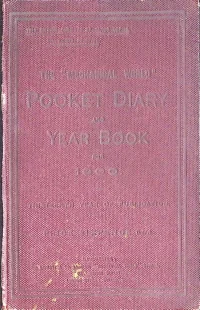
The Mechanical World Pocket Diary Year Book for 1900
Contents
- Brief authorial foreword to the thirteenth annual edition, noting expanded coverage of electrical power transmission and wheel gearing and inviting engineers and draughtsmen to submit tables or data for future editions.
- A quick-reference page of British Post Office rates and services current in 1900, covering postcard and letter postage, registration, book post, parcel post, telegrams, money orders, and Post Office Savings Bank deposit rules.
- Opens the engineering-notes section with fundamental definitions and formulae for horsepower (indicated, brake, nominal), mechanical efficiency, piston speed, typical working steam pressures by engine type, and the expansion of steam.
- Rules and worked tables for sizing steam and exhaust pipes and valve ports for given piston speeds and steam velocities, followed by a graphical method for finding valve travel and point of cut-off from crank-angle diagrams.
- Tables and worked methods for computing cylinder diameters and the mean pressure of steam across the cylinders of compound and triple-expansion engines.
- Describes the construction and use of the steam-engine indicator - drum cords, springs, and diagram-taking practice - and explains how common indicator-diagram faults such as leaky valves, priming, and wire-drawing show up in the card's shape.
- Practical sizing rules for engine components: piston-rod and connecting-rod diameters, locomotive and marine engine shafts, valve-rod stuffing boxes, surface condensers, and air-pump buckets.
- Signed article by Frederick Grover on gas-engine operating principles - the Otto/Beau de Rochas cycle, tube and electric ignition, scavenging, vibration and pre-ignition troubles - plus engine-trial procedure and horsepower calculation methods.
- Continuation of Frederick Grover's article, classifying oil engines by vaporisation method, describing named makers' vaporiser designs (Priestman, Fielding & Platt, Tangye, Hornsby-Akroyd, Daimler), and tabulating fuel-oil properties and engine test results.
- General survey of the boiler types in use for land and marine service and the factors that govern a boiler's evaporative power.
- Covers boiler-shell materials and strength calculations and riveting practice, plus the classification-society rules (Bureau Veritas, Germanischer Lloyd, Longridge) governing safe working pressure.
- Explains the causes of scale formation and internal corrosion from feed-water impurities and treatments such as caustic-lime softening, including tank sizing for a softening plant.
- Discusses the draught and smoke-discharge functions of a boiler chimney and damper control, and the fuel savings achievable with flue-gas economisers such as those made by E. Green and Son.
- States the standard rules for sizing and setting lever-type boiler safety valves.
- Signed article by W. H. Atherton, B.Sc., on the strength and design of beams, joists and lattice girders, covering bending moment and moment-of-inertia calculations with worked floor-loading examples.
- Tables of the safe distributed load and weight of buckled iron floor plates of various gauges, with notes on their comparative stiffness when bolted down versus merely supported.
- Derives and tabulates the torsional strength of round shafting for given working stresses in wrought and cast iron, plus a rule for the maximum spacing of shaft bearings.
- A substantial treatise on toothed-gear design covering diametral pitch, tooth-formation theory, interchangeability, involute and cycloidal tooth curves, odontograph use, helical and worm gearing, and spur-tooth strength.
- Explains how leather, cotton and rubber belts transmit power by frictional contact, compares their relative merits, and works through examples of belt-speed and horsepower calculation.
- Covers cotton and wire rope-drive systems - pulley and groove design and permissible speeds - and gives step-by-step instructions for splicing driving ropes.
- General account of transmitting power electrically, covering the types and operating characteristics of the dynamos and motors used to generate and receive it.
- Short general introduction to transmitting power by hydraulic pressure, comparing it with mechanical and electrical alternatives.
- A quick-reference list of hydraulic conversion factors and rules of thumb, such as gallons-to-cubic-inches and head-of-water-to-pressure equivalents.
- Gives the standard formulae relating velocity, distance and time for a body falling under gravity, followed by tabulated efficiency values for common machines and notes on steam-engine friction losses.
- Presents Mr. D. Adamson's data table on the speeds and power absorbed by electrically-driven overhead travelling cranes, alongside a table of tractive resistance for different road surfaces.
- A Flather-sourced reference table of the horsepower needed to drive named machine tools and woodworking machines, with additional notes on the power to drive cotton-mill and paper-mill machinery and to punch metal plates.