Theory and Practice of Bicycle Race-Track Construction
By Horatio Weber Baker190112 chapters8 images
Contents
- Opening statement of the thesis: the spread of bicycle racing as a recreation and a profession has created a demand for tracks built especially for it. Baker announces that the design of a track will be considered under three heads - first the ground plan, second the banking or superelevation of the outer edge, and third the material used in construction.
- Lays down seven principles for the ground plan: length and form follow the site; large tracks are costly while very small ones force sharp curvature and high banking; the lap should be an aliquot part of a mile measured along the pole line eighteen inches inside the inner edge; the field must not be so wide that spectators lose sight of the race; and the curves must give no lurch, which requires a varying curvature to join the flat tangents to the fully banked curves.
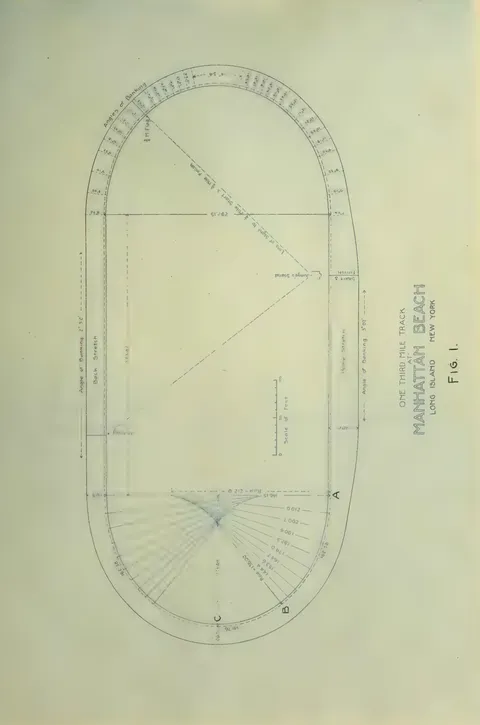
- Surveys the noted American tracks. The earliest were crudely staked out - the half-mile track at Hampden Park, Springfield, Mass. was located by riding a bicycle over the ground - and most were semicircles joined by tangents, as at Waltham, Mass. and Louisville, Ky., each one third of a mile with 150-foot radii and 109-foot tangents. It goes on to C. E. Hawley's 1896 Manhattan Beach track for the Pope Manufacturing Co., the 1897 quarter-mile at Racine, Wis., the Charles River track at Boston, and the half-mile Garfield Park track at Chicago built in 1896 under F. C. Schrader of the West Park Board.
- Full-page measured ground plan of the Manhattan Beach track, drawn to a scale of feet. It shows the two tangents joined by Hawley's "elliptical" curve of nine circular arcs whose radii fall from 212.0 to 136.00 feet, the judges' stand and the line of sight to the quarter-mile flag, and the angles of banking marked round each curve, with 2 degrees 52 minutes on the back stretch and 3 degrees 07 minutes on the home stretch.
- Full-page ground plan of the half-mile Garfield Park track, noted as having all four quadrants symmetrical. The semicircular ends carry a radius of 300.32 feet to the pole line and 298.82 feet to the inner edge of the track, and the banking is lettered as a uniform maximum slope of one to five, changing uniformly from maximum to minimum slope along the tangents.
- Opens Baker's own design. Because the size and shape of the available area vary so greatly from site to site that they cannot be treated in a general design, he assumes the area available is unlimited and works from the requirements alone.
- Cites Mr. Hawley, probably the best authority on bicycle tracks in the country, who states in a private communication that in his opinion the ideal track should be four laps to the mile. On that opinion and on the reduced cost over a larger track, Baker settles his design at one fourth of a mile.
- Table I sets the length and width of field against the length and width of track for Garfield Park, Racine, Hawley's ideal, Waltham and Manhattan, arranged in order of roundness (mean ratios 0.513 and 0.199). Baker concludes that a track meeting the requirements of current practice should have a field about twice as long as it is wide, with a width of field about one fifth of the length of the track.
- Argues from Fig. 3 that a rider leaving a tangent cannot change instantly from an infinite to a finite radius, but involuntarily takes a curvilinear path of uniformly decreasing radius, so semicircles joined by tangents can never be properly superelevated. Baker adopts Professor A. N. Talbot's transition spiral (Technograph No. 5), sets out Talbot's notation, and computes the spiral for a 140-foot circular arc, obtaining D1 = 40.926 degrees and delta1 = 32 degrees 46.7 minutes, tabulated for setting out in Tables II and III.
- Baker's finished quarter-mile design, 25 feet wide except on the home stretch where it widens to 35 feet. The drawing labels the transition spiral and the circular arc of 138.50 feet radius at the inside edge, the 153.20-foot tangent distance to the P.C.C. and the 145.98- and 116.45-foot centre-line dimensions, with the angles of superelevation stepped round both curves.
- Derives the superelevation from mechanics: the force required to deflect a body from a rectilinear path is Mv squared over rho, or Wv squared over g-rho, and since the rider is acted on by gravity and centrifugal force alone, Fig. 6 gives tan theta = v squared over rho-g as the relation between the angle of inclination, the velocity and the radius of curvature. Table IV then lists the speed each existing track was banked for - Waltham and Louisville at 30.53 feet per second (2 min 53 sec to the mile), Manhattan 34.24, Racine 36.17, Garfield Park 44.00 and the Springfield board track 66.00 feet per second (1 min 20 sec), the last banked 48 degrees on the curves and called by racing men the fastest track in the world.
- Compares loam, clay, cinders, wood and cement as track surfaces: the Hampden Park track of clay covered with a thin layer of fine brick dust, the indoor Coliseum board track at Springfield, Mass. of one-inch strips nailed to 2 by 10 timbers, and the cement surfaces of the Waltham, Louisville, Manhattan, Garfield Park and Racine tracks. Fig. 8 details the four-layer embankment - gravel, 8 inches of ash concrete, 3 inches of granite concrete and a 1.5-inch surface of cement mortar - and Baker concludes that a cement surface such as Manhattan's, with its four four-inch black guide lines, gives the best conditions for racing and durability.
Images in this book 8 pictures from 76 pages
Diagrams 8
 (opens in a new tab)
 FIG. 1 -- One-mile track Manhattan Island, New York 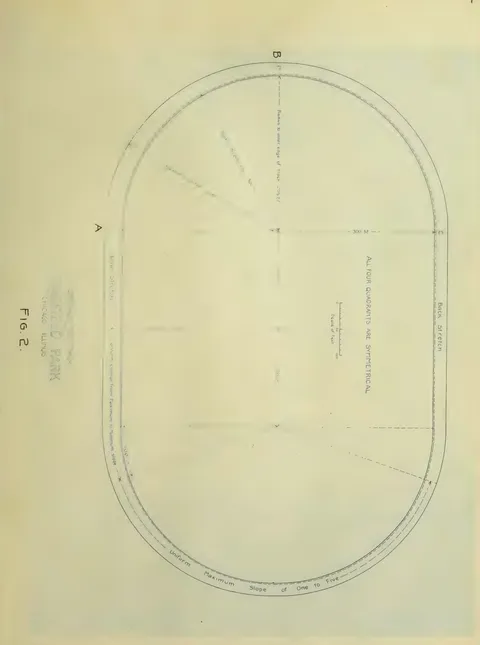 (opens in a new tab)
 FIG. 2 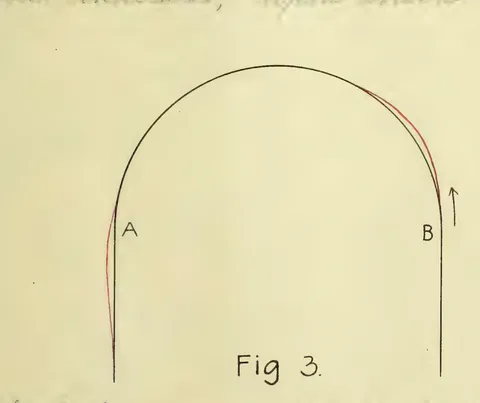 (opens in a new tab)
 FIG. 3 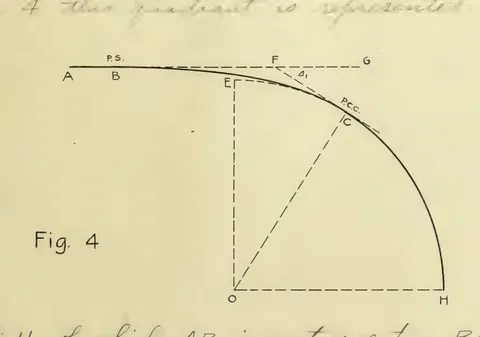 (opens in a new tab)
 FIG. 4 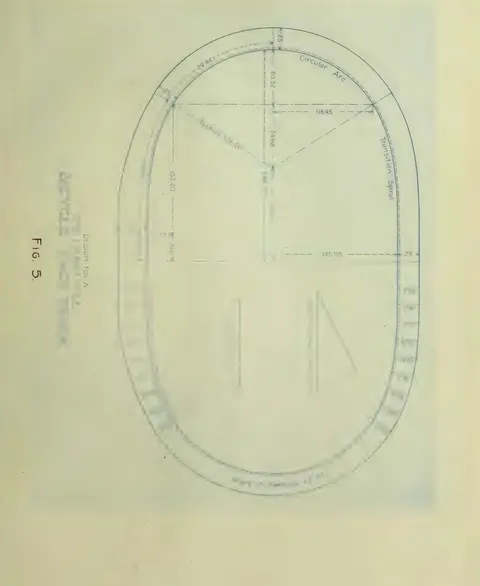 (opens in a new tab)
 FIG. 5 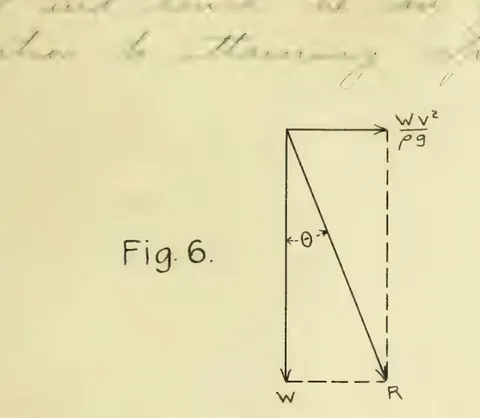 (opens in a new tab)
 FIG. 6  (opens in a new tab)
 FIG. 7 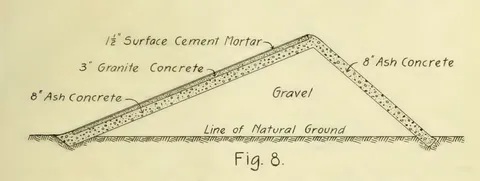 (opens in a new tab)
 FIG. 8