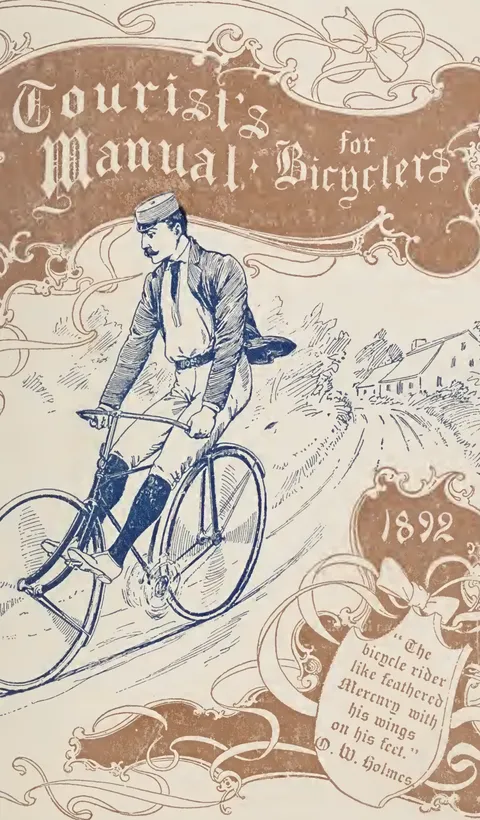
Tourists' Manual for Bicyclers
Published by Pope Manufacturing Co.189226 chapters41 images

Contents
- Frank A. Elwell advises intending tourists to get into fairly good condition beforehand, plan a daily itinerary in advance rather than trust to inclination, and forward a change of citizen's clothes ahead by express for stops in towns. He recommends a touring wheel of forty to fifty pounds from a long-established maker rather than a stripped-down racing machine.
- Sterling Elliott urges riders to overhaul bearings and oiling thoroughly before a long trip, keep chain slack to about half an inch, and carry spare balls, a bearing cone and case, tire tape and cord, a wrench, screwdriver and pocket-knife. He also recommends a waterproof cape, a woolen sweater, and a copy of Elliott's Old Hickory Almanac.
- Mrs. Henrietta Russell describes a chest-lifting breathing exercise -- inhaling slowly through the nostrils, holding the breath against the ribs, then releasing through the lips -- to be practiced each morning while dressing as a cure for nervousness and shyness.
- John Calvin Stevens, Chief Consul of the Maine Division, L.A.W., describes Maine's roads as dirt, sometimes good but often only fair and occasionally unridable, praises the road system on Mount Desert Island, and warns that roads west of Saco toward Portland are very sandy. The Maine Division's own road-book, giving routes and hotel rates, can be had from its Portland secretary.
- Covers New Hampshire's eighteen miles of coast from Hampton through Boar's Head, Little Boar's Head and Rye Beach to New Castle and Portsmouth's Rockingham Hotel, the town of Exeter and Phillips Exeter Academy, and the White Mountains' Flume, Profile Lake and Echo Lake near Lake Winnepesaukee's resort towns of Wolfboro, The Weirs and Tilton. Notes a stretch of disagreeable clay soil on the road from Haverhill, Mass., through Exeter and Epping toward Concord.
- Describes the Green Mountain State's scenery and the historical interest of Bennington and Lake Champlain, along with antiquated fences and covered bridges typical of the state. Roads are in good condition for the most part in the larger towns but rougher and rockier in sparsely settled districts, with many steep hills requiring good judgment.
- Notes Cottage City on Martha's Vineyard as a summer mecca reached by dusty pilgrims awheel, Boston-area runs to the Chestnut Hill Reservoir, Franklin Park and Bailey's at Natick, and historic Lexington, Concord, Bunker Hill and the Wayside Inn. Also mentions the scenic but hilly Berkshire Hills and Springfield's rise as the center of bicycle racing after the world's records made there the previous year.
- Highlights Narragansett Pier and Newport as popular resorts and Block Island, known for its bluefishing, as a typical summer resort reached from the coast. Notes the manufacturing centers of Pawtucket, Woonsocket and Providence set a little back from the shore resorts, with roads generally good apart from some sandy stretches near the beaches.
- Arthur Allen Dean surveys Connecticut's roads by river valley: the bad Housatonic River road running south from Salisbury and Canaan, with an old post road to Hartford via Norfolk and Winsted as a better alternative, and a rough fourteen-mile road along the Thames River from New London to Norwich. He also traces Hartford-to-Boston routes via Manchester, Bolton Notch, Andover, Willimantic, Brooklyn and Danielsonville, noting the Quinnebaug valley's roads improve sixteen miles north of Norwich.
- Advises buyers to choose a Safety over the high-wheel Ordinary and to match tire type to terrain: solid tires for good hard roads, cushion tires for soft or sandy country, and the new Columbia pneumatic tire -- described with its rubber core, double canvas layer and vulcanized outer tube -- for comfort on rough, wet or sandy roads.
- Warns against choosing too light a racing-style machine for road work, recommending a medium-weight machine of about forty to fifty pounds as more durable and satisfactory for most riders.
- Describes the preferred enamel-with-nickel-trimmings finish used on Columbia machines, with the frame, fork and mud guards enameled and the handle-bar, brake connection, cranks, pedal frames and hubs nickeled.
- Instructs riders to wipe finished parts dry with chamois after every ride and keep nickel parts free of moisture, especially salt water, to prevent rust. Recommends stripping and rinsing the bearings' balls, cones and cases in benzine or kerosene two or three times a season, and keeping the chain lubricated with a heavy oil or graphite mixture.
- C. E. Walker gives roadside repair instructions for a bent pedal pin, a loose or broken spoke, a loose or cut solid or cushion tire re-cemented with a hot iron or spirit lamp, a buckled wheel, and a punctured Columbia pneumatic tire patched temporarily with tire tape until a permanent repair can be made.
- W. K. Corey recounts the young rider's saving and longing to own a Columbia bicycle, then details the Pope Manufacturing Company's hundred-dollar reward for the arrest and conviction of bicycle thieves, citing a five-year hard-labor sentence at Auburn, New York, imposed on a thief who stole a Columbia in Rochester.
- Sets out how to organize a road race -- choosing a straightaway course measured accurately by cyclometer, and appointing a referee, judges, timekeepers, a starter, a clerk of the course and checkers -- plus advice for century (hundred-mile) runs, including riding in pairs, staggered checkpoints, and charging a fifty-cent to one-dollar entrance fee toward a finisher's souvenir.
- H. S. Cornish lays out a training regimen beginning with January gymnasium work for the upper body using dumb-bells or chest weights, a track schedule from around May 30 of ten morning miles and five afternoon miles building to sprint finishes, and a sponge-and-alcohol bathing routine. He advises against stimulants and tobacco and against ever riding oneself out at the season's start.
- Tabulates comparative American and English amateur track records as of January 1, 1892, and highlights W. W. Windle's world one-mile record of 2:15 set on a Columbia racing Safety at Springfield on September 17, 1891, and Hoyland Smith's American twenty-five-mile road record of one hour, nineteen minutes, thirteen seconds, also on a Columbia, at the Boston Athletic Association Road Race.
- Describes the rapid growth of women's cycling in Detroit -- over one hundred and fifty riders by 1891, an increase of one hundred and forty over 1890 -- with a Detroit physician's endorsement of cycling as beneficial open-air exercise for women.
- Mary Sargent Hopkins advises a dark cloth skirt about three yards wide lined with cambric at the knees, a wash-silk or cambric shirt waist with a matching jacket, a divided flannel underskirt, cashmere hose and loose gauntlet gloves. She singles out a bottle-green face-cloth costume with a double-breasted habit bodice, bound in black silk braid, as the prettiest cycling dress she has seen.
- Presents testimonials from Dr. T. N. Gray and Dr. F. A. Kinch, Jr. praising cycling as an even, non-injurious exercise that helps weakly boys and girls grow strong, plus a passage from The London Churchman recommending cycling to overworked clergymen for rheumatism, gout and mental fatigue.
- Sets out courtesies of the road -- turning out for loaded teams, dismounting when passing a skittish horse or a lady riding sidesaddle, and speaking or sounding a whistle when approaching crossings or overtaking pedestrians and carriages from behind -- concluding that a bicycler should be, on the road as everywhere else, a gentleman.
- Reprints fourteen numbered road rules -- keep to the right-hand side, pass overtaken riders on the left, signal before passing, take single file on narrow roads, use a lamp at night, and let ladies go ahead in coasting. Despite the heading, the rules govern ordinary road riding rather than racing, and are attributed to the Bicycle Union.
- Lays out the bicycle's legal standing as a carriage entitled to the road and a rider's liability for negligent injury, plus the narrow circumstances -- a street impassable from traffic, repairs or mud -- under which sidewalk riding is permitted. Notes typical city ordinances limiting speed to five to eight miles an hour in business sections and forbidding sidewalk riding.
- A fireside narrator reminisces to his wife Polly about summer touring while shut in by winter weather, recalling encounters with country boys astonished by the bicycle and the guilty pleasure of silently overtaking a horse and carriage on the road.
- Sterling Elliott, writing from Newton, Mass., cautions touring cyclists that every dealer wants their money and urges buying a machine for its intrinsic merit and honest workmanship rather than novelty, offering to give a personal recommendation to anyone who writes to him directly.
Images in this book 41 pictures from 160 pages
Illustrations 13
 (opens in a new tab)
 Tourist's Manual for Bicyclers  (opens in a new tab)
 Touring Awheel 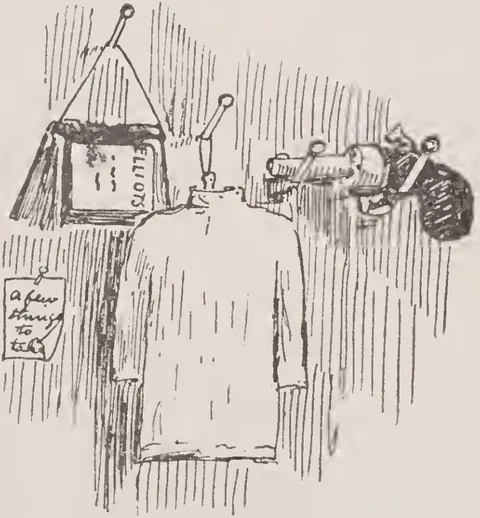 (opens in a new tab)
 Cyclist with Luggage  (opens in a new tab)
 Pictorial initial T (Selection of Machine)  (opens in a new tab)
 Cyclist on Ribbon Banner  (opens in a new tab)
 Pictorial initial I (Training for Bicycle Races)  (opens in a new tab)
 Plants and Flowers  (opens in a new tab)
 Pictorial initial T (Ladies' Riding)  (opens in a new tab)
 Woman's Profile Portrait  (opens in a new tab)
 Birds  (opens in a new tab)
 Pictorial initial A (Rights of Way)  (opens in a new tab)
 The End  (opens in a new tab)
 L.A.W. Badge
Diagrams 2
 (opens in a new tab)
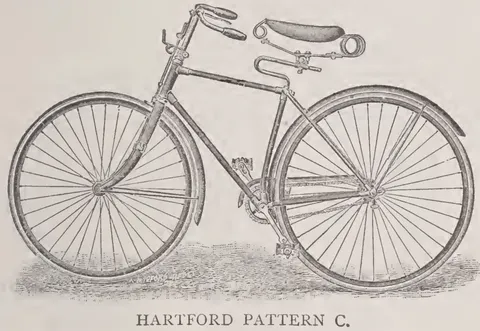
 Hartford Pattern C 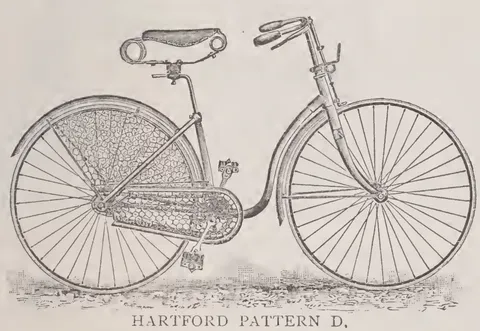 (opens in a new tab)
 Hartford Pattern D
26 advertisements
 (opens in a new tab)
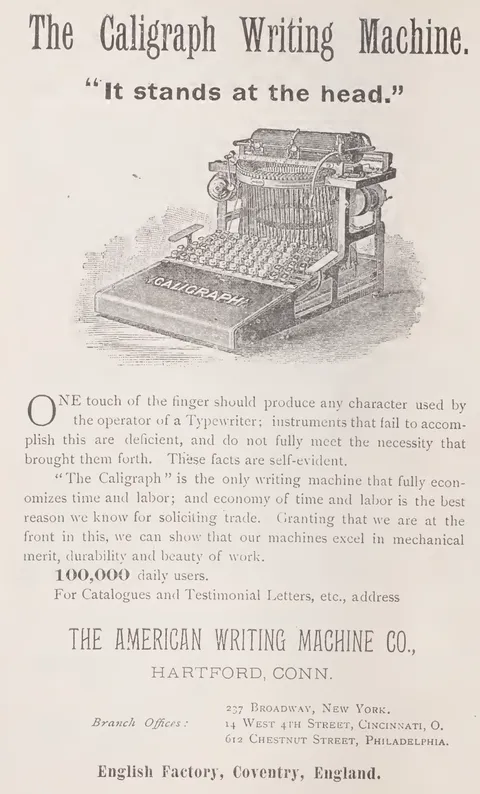
 The Caligraph Writing Machine  (opens in a new tab)
 Redding Baird & Co. 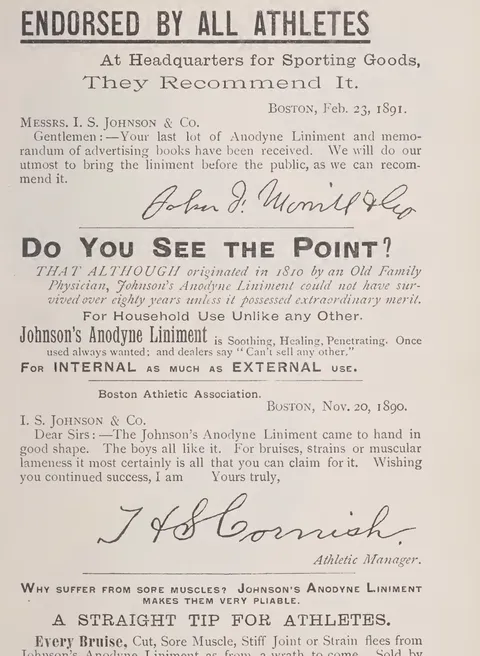 (opens in a new tab)
 Johnson's Anodyne Liniment 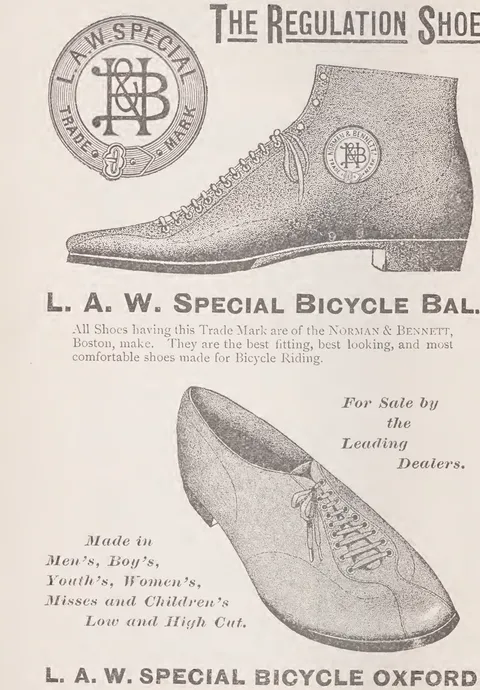 (opens in a new tab)
 The Regulation Shoe and L.A.W. Special Bicycle Oxford 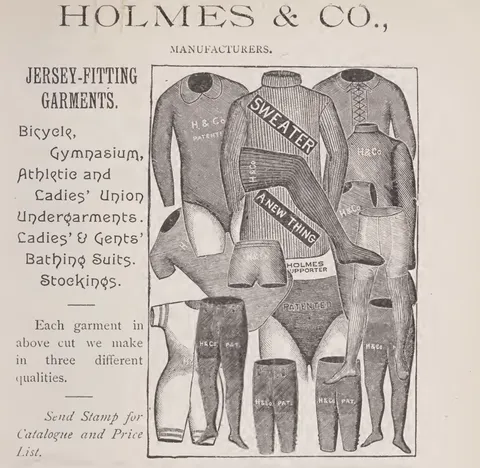 (opens in a new tab)
 Holmes & Co. Jersey-Fitting Garments 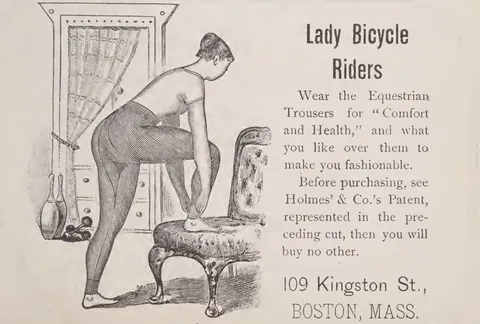 (opens in a new tab)
 Lady Bicycle Riders  (opens in a new tab)
 The New England Magazine  (opens in a new tab)
 Modern Type of ... Business Bringing Power  (opens in a new tab)
 Silver Plated Ware 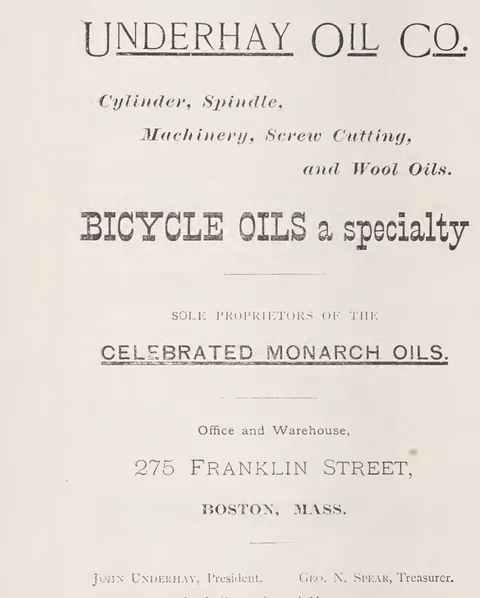 (opens in a new tab)
 Underhay Oil Co. 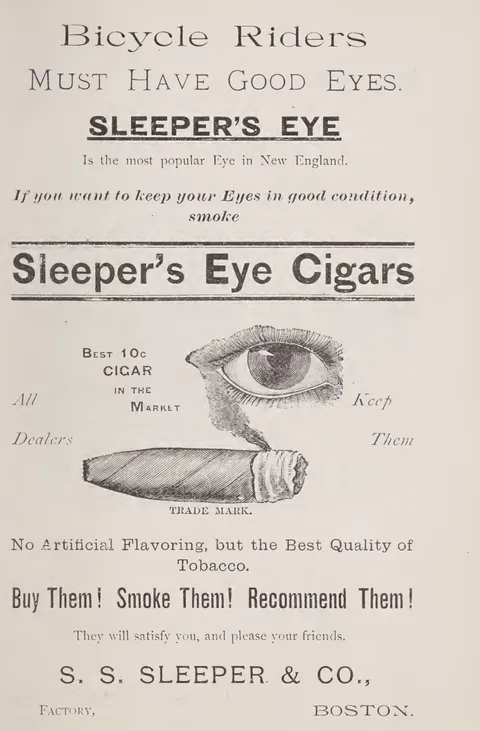 (opens in a new tab)
 Sleeper's Eye Cigars 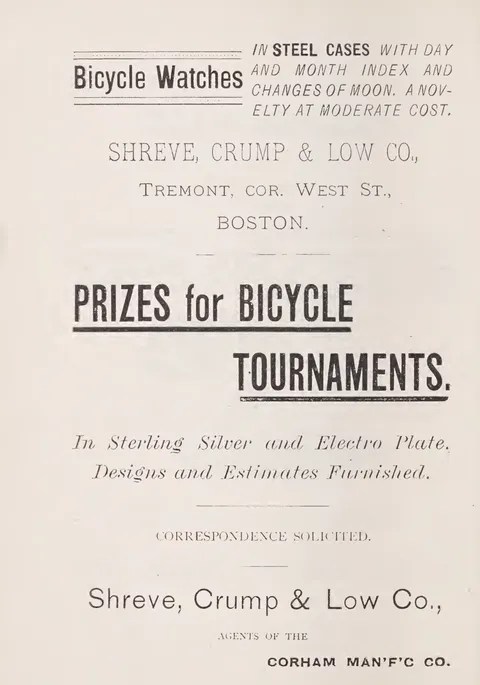 (opens in a new tab)
 Prizes for Bicycle Tournaments 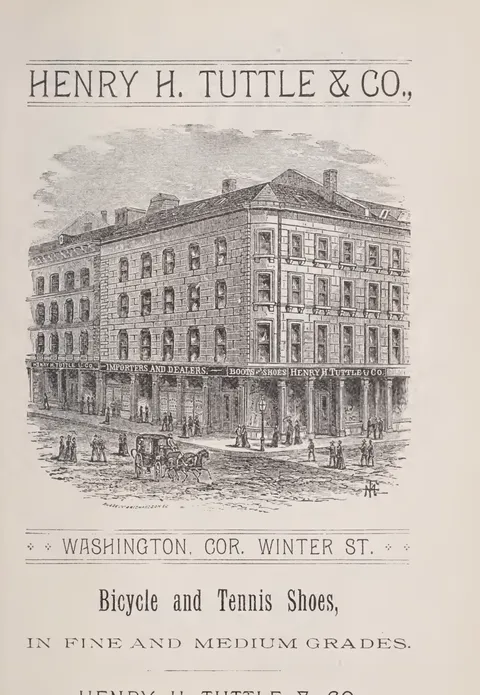 (opens in a new tab)
 Henry H. Tuttle & Co. 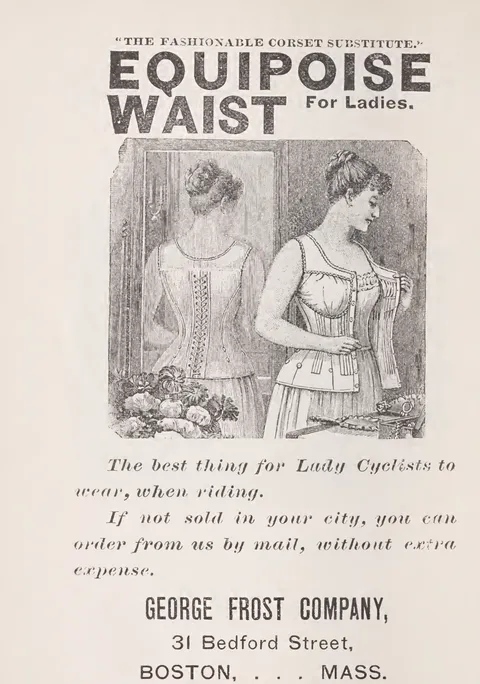 (opens in a new tab)
 Equipoise Waist for Ladies 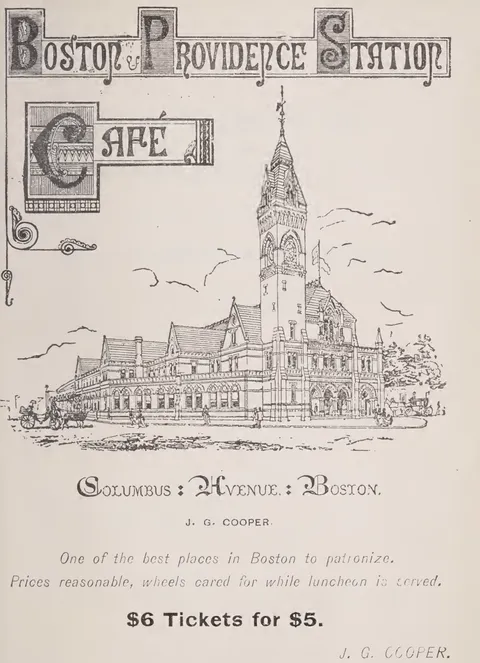 (opens in a new tab)
 Boston & Providence Station Cafe  (opens in a new tab)
 Hotel Ansonia, Mansion House, American House and Woodlawn Park Hotel  (opens in a new tab)
 John C. Paige Insurance  (opens in a new tab)
 Brewer & Stevens Tailors 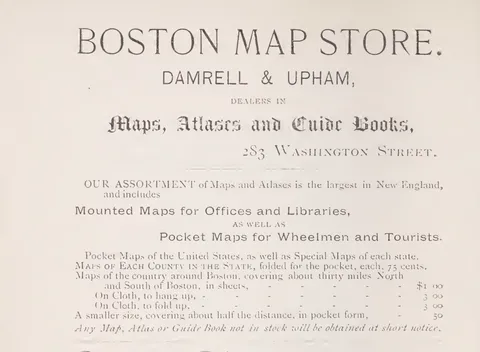 (opens in a new tab)
 Boston Map Store 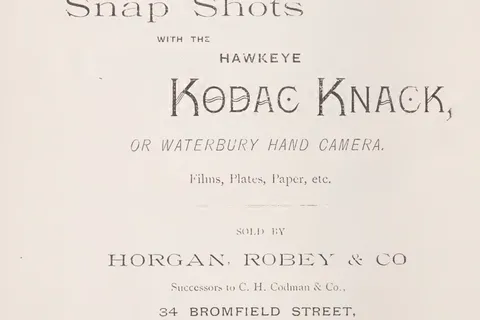 (opens in a new tab)
 Hawkeye Kodac Knack 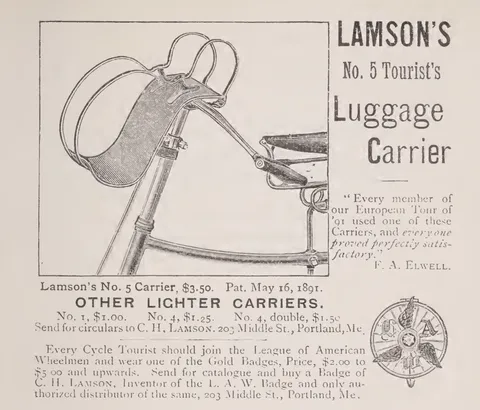 (opens in a new tab)
 Lamson's No. 5 Tourist's Luggage Carrier 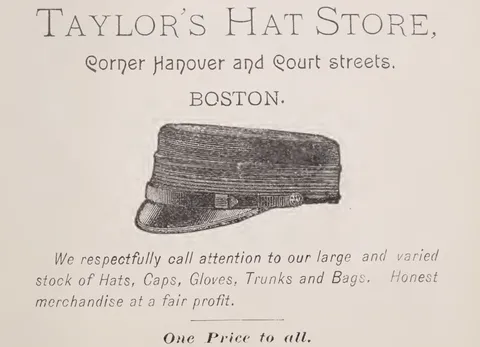 (opens in a new tab)
 Taylor's Hat Store 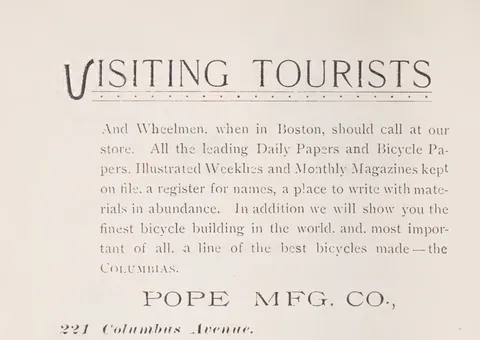 (opens in a new tab)
 Visiting Tourists 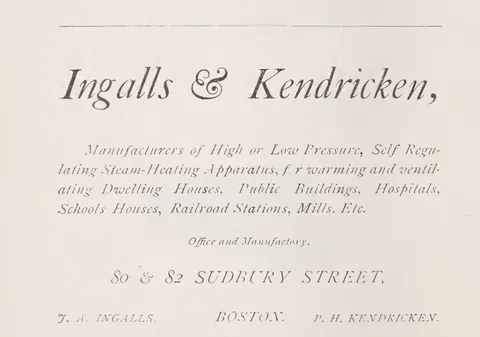 (opens in a new tab)
 Ingalls & Kendricken 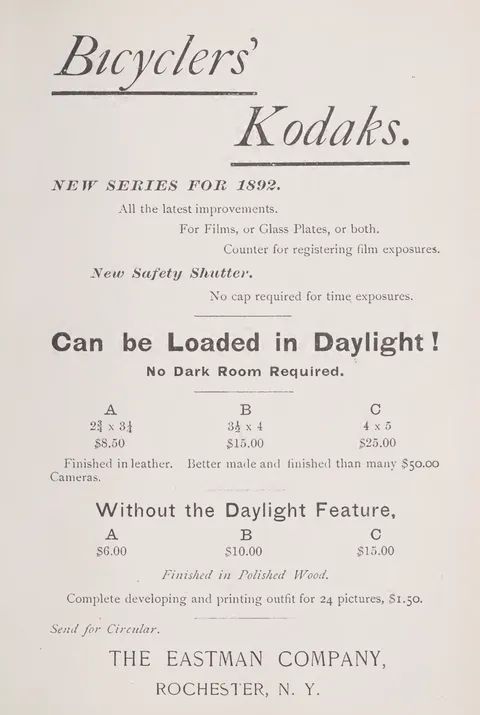 (opens in a new tab)
 Bicyclers' Kodaks 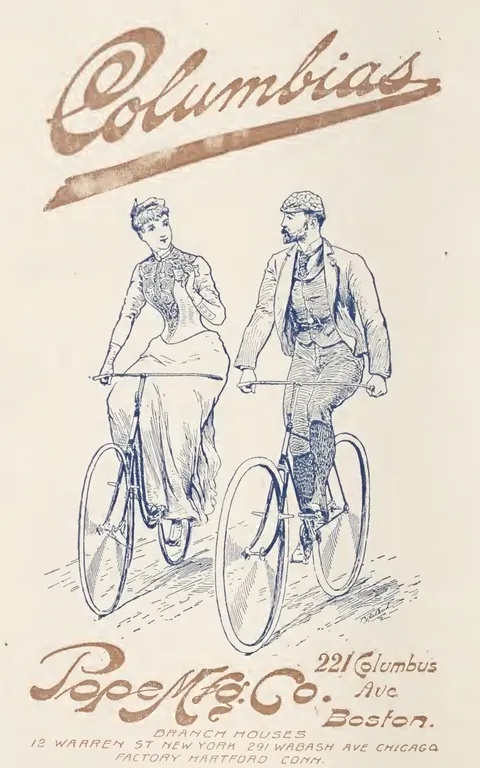 (opens in a new tab)
 Columbia Bicycles