Wie ist Radfahren gesund?
By Martin Siegfried18959 chapters1 imageGerman

Contents
- Preface explaining the author's motive for writing: the growing public debate over whether cycling harms health, and a near-fatal accident of his own two years earlier that convinced him fears of cycling are exaggerated once openly discussed and drawn from years of his own touring experience.
- On touring speed: argues cyclists wrongly imitate racing pace regardless of purpose, warns against overexerting the heart, advises when and how to drink and take hills slowly on tour, and reports measured changes in pulse, breathing and body temperature recorded during rides.
- On road riding: argues for cyclists' full legal freedom on public roads without special restrictions, proposing a bicycle tax (Fahrsteuer) modelled on France and Italy that would give cyclists equal rights and duties with carriage drivers, benefiting sedentary professionals such as teachers, bankers and clerks who commute by bicycle.
- On posture: argues the safety bicycle's low handlebar, unlike the high-wheeler's, has produced a widespread unhealthy forward-hunched riding position, explaining how bending the trunk compresses the liver, stomach, intestines and bladder and how compressing the chest restricts lung expansion, comparing the racing crouch to a consumptive patient's posture.
- On clothing: sets out the requirement for breathable underclothing that wicks perspiration without chilling the rider, credits Prof. Jäger's wool-reform movement and Dr. Lahmann's porous-cotton system, and recommends the Schönherr porous-linen system, long trousers over knee-breeches, and short, sleeveless knitted undervests.
- Introduction to the chapter on bicycle design, stating that the author's purpose is not to compare rival makes but to examine, from a hygienic standpoint, features common to every system.
- On the handlebar: argues the modern safety-bicycle handlebar forces riders into an unhealthy forward lean because its grips sit too far from the saddle, unlike the high-wheeler's handlebar, and proposes relocating steering to a lever near the saddle to restore an upright posture; goes on to discuss braking technique and the dangers of freewheeling downhill.
- On protecting the rider: dismisses exaggerated fears of assault and of dogs, citing the naturalist Brehm's view that no animal, including the dog, is inherently vicious, and argues that riders themselves provoke dogs by arming themselves with whips, cap-pistols and so-called 'dog cannons.'
- On protecting the public: urges courteous, considerate riding to win public sympathy, lists safety rules such as never riding between two moving vehicles and slowing when overtaking or passing through villages, and closes by contrasting cycling's value as healthy exercise, when practised sensibly, against the 'dark side' of racing and endurance riding hinted at by trade papers' euphemism 'Fahrt aufgegeben' (ride abandoned).
Images in this book 1 picture from 77 pages
Illustrations 1
 (opens in a new tab)
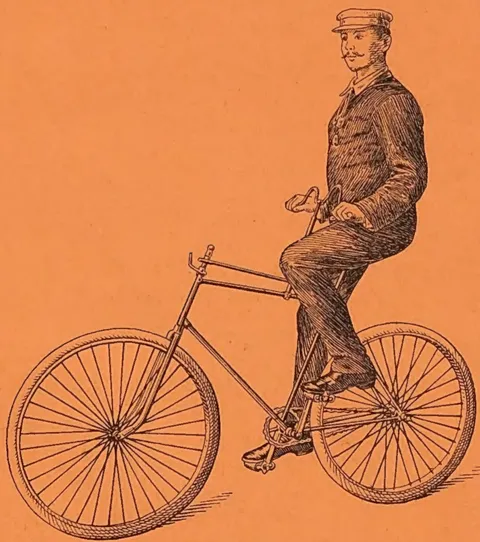
 Wie ist Radfahren gesund?, cover illustration