Bassett's Scrap Book, Vol 10, No 5
Articles in this issue
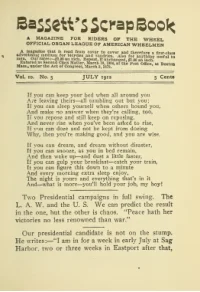
- The July 1912 issue opens with a Kipling "If" parody about staying in bed and a note on the two presidential campaigns then in full swing—the L.A.W. and the U.S.—quoting a letter from the L.A.W. presidential candidate about his summer plans at Sag Harbor, Eastport and the White Mountains.
- A run of unheaded notes: an obituary for Wilbur Wright, the "papa of aviation," who died May 30, 1912 after once keeping a bicycle agency and school at Dayton, Ohio with his brother Orville and belonging to the L.A.W.; a note that Dr. J. P. Thornley's F.A.M. committee has offered "Happy Days" Pitman of New York the honorary refereeship at the July 1912 national meet in Columbus, Ohio; and a reminiscence of how Sterling Elliott, once the leading advocate of the wooden wheel, proposed to Colonel Albert Pope that they simultaneously drop a wooden-wheeled and a wire-wheeled bicycle from opposite sides of Bunker Hill Monument—a wager Pope never accepted.
- A long feature reprints the column of "The Scorcher," who writes a bright comment column in the Irish Cyclist, on learning that the Boston Bicycle Club wishes to entertain him during his planned visit to the States, reflecting at length on the freemasonry and brotherhood of the wheel.
- An account of the June 8, 1912 send-off dinner at the Hotel Sorrento, Boston, for Charles W. Reed—the club's "bugler" who started the first American bicycle club run from Copley Square on March 12, 1878—naming President John B. Kelley, Captain Walter G. Kendall, Secretary Augustus Nickerson and other members present; Captain Kendall's toast discloses that the modest Reed holds the Congressional Medal of Honor, awarded for carrying his fallen, wounded commander out of the firing line at the battle of Gettysburg, a sabre cut to his right hand having later forced the artist Reed to learn to use his left hand.
- Preceded by a note that France's three million cyclists each pay an annual tax of half a crown, a poem in the manner of Kipling's "The Vampire" laments the folly of going away for a summer holiday—packing, dust, hardships and the rest that awaits us at home—followed by a string of "You will generally find" aphorisms.
- A reprinted letter from Charles William Eliot, president-emeritus of Harvard University, explains how at seventy-seven he keeps his health through moderation in eating and drinking and daily exercise, naming walking, rowing, sailing and—after sixty-five—cycling among his sports; it closes with a note that Capt. John B. Kelley of the Boston Bicycle Club is touring English roads on his Humber wheel, having kept his preference for wood rims.