Bassett's Scrap Book, Vol 10, No 6
Articles in this issue
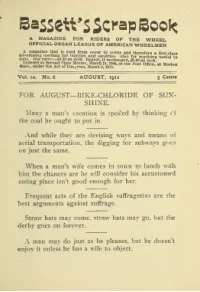
- The issue's seasonal opening column offers a run of one-line quips: a man's vacation spoiled by thinking of the coal he ought to be ordering, aerial-transportation schemes proceeding alongside subway digging, English suffragettes as their own best argument against suffrage, and the derby hat outlasting the straw hat.
- Announces the twenty-third Wheel About the Hub run starting Friday, Sept. 13, and lists the participation figures on the Boston Bi Club souvenir badge, led by Will R. Pitman (21) and W. G. Elendall (20).
- Reports that Charlie Reed, 71, has been made an honorary member of London's Pickwick Club and dined at the Savage Club during his English trip (nicknamed 'the old gentleman'); reminisces about old English wheelmen Sturmey, Hillier, 'Faed,' Wilson and Shipton; and quotes a letter from Lincoln Holland, formerly of Framingham, Mass. and now of Los Angeles, praising Southern California's climate and mentioning E. P. Burnham and Charles H. Lamson of Oxnard.
- Responds to foreign-press complaints that American athletes owed their Stockholm Olympics supremacy to narrow 'specialization,' countering that an American won the decathlon—the most demanding all-around test—with roughly seven-tenths of the U.S. team capable of a strong showing in that event too.
- Profiles Harris L. Gilson of Wakefield, Mass., aged 85, who has covered nearly 32,000 miles by bicycle since turning 70, his banner year being 1899 with 6,184 miles; it is followed by cyclist Jack Fecitt's indignant letter insisting he was 'thrown, chucked, catapulted and fired' from his motor-cycle, not that he 'fell,' as Quin Kilby had reported.
- A dialect poem by Sam Walter Foss in which the narrator tells his friend John that, though he can't say what the world is about, he likes to watch the thing go on.
- Preceded by a discussion of the age at which one should give up cycling, citing the late Major Knox Holmes's handicap race against Lacy Hillier when Holmes was past eighty (which Holmes won) and the Irish Cyclist's advice to take great care with hills after sixty, a light verse asks 'What's the use a-workin'?' and recommends taking one's time and letting others do the fretting in warm weather.
- Notes that Boston Bi Club President Kelley, who sailed for England with a swollen ankle, hopes a long convalescence there will let him resume wheeling at Liverpool; describes Gabriel Poulain's 'Aviette' bicycle-and-flying-machine, which won a world hop-distance contest of eleven feet; and reports the American cycling team's third-place finish, behind Sweden and England, in the 200-mile Stockholm Olympic road race, decided by just over three minutes among the leading teams.
- Reports Gov. Foss appointing Judge Josiah S. Dean—an old wheelman and one of the 'Fortunate Five' who toured England in 1881—to Boston's Licensing Board, an appointment praised by Mayor Fitzgerald; closes with news of the Newton Bicycle Club's 208th meeting at Point Shirley, hosted by President Fuller, with a get-well message sent to Arthur P. Benson at Faulkner Hospital.
- Recounts how Kenneth A. Libby of Winchester, Mass., aged fourteen, lost his way on his bicycle and spent two days and nights wandering before turning up exhausted at Lonsdale, R.I., while Winchester police and citizens searched for him.
- Reports that Alvey A. Adee, second assistant Secretary of State, nearly seventy, has returned from Europe after riding almost 1,800 miles through Germany, accompanied for part of the trip by Consul-General and Mrs. Thackera of Berlin.
- Secretary-Treasurer Abbot Bassett gives notice that the annual L.A.W. National Assembly meeting will be held Sept. 12th at Hotel Dreyfus, 6 Beach St., Boston, at 8 p.m., with a $1.25 dinner beforehand.