Bassett's Scrap Book, Vol 8, No 7
Articles in this issue
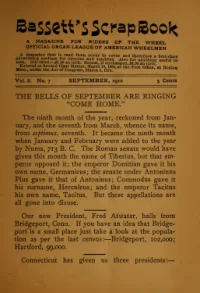
- The issue's opening masthead essay traces the name September to the Latin septimus (seventh) and recounts the Roman senate's failed attempts to rename it after Tiberius, Domitian's "Germanicus," Antoninus, Commodus's "Herculeus" and Tacitus, then introduces newly elected L.A.W. President Fred Atwater of Bridgeport, Conn., noting Connecticut has now supplied three League presidents: Chas. L. Burdett (1892-93), Wm. A. Howell (1902), and Atwater (1910).
- Two unheaded items follow the opening essay: veteran board-track builder Jack Prince announces a new speed bowl at Portland, Ore., due before the Salt Lake season ends in mid-September, to be followed by another at Oakland, Cal., forming with Los Angeles and Salt Lake a year-round racing circuit he is planning; and Postmaster Smith of Middleboro, Mass., riding to Rocky Meadow, has a black snake coil through his bicycle frame and grip his ankle, shaking it loose before killing the 5-foot-8-inch reptile with a club after it attacks again.
- Report of the L.A.W.'s annual National Assembly meeting at Hendrie's Hostelry, Boston, on Sept. 2, with the treasurer's financial statement (receipts of $1,122.98) and state-by-state membership totals (1,240 members, 306 life members); officers elected were President Fred Atwater, 1st Vice-President Quincy Kilby, 2nd Vice-President Jarvis C. Howard, Secretary-Treasurer Abbot Bassett (his twenty-fourth term) and Auditor George W. Nash, and the Assembly passed resolutions of respect for the late ex-president Conway W. Sams.
- The third annual convention of the National Good Roads Association meets at St. Louis, Sept. 26-29, with Secretary-Treasurer Abbot Bassett representing the L.A.W.; a quoted advance press sheet credits the League's early-1880s good-roads campaign and Col. Albert A. Pope, and notes that Walter M. Meserole, described in the piece as the League's president, sits on the convention committee (also noting, in passing, that Akron's population has jumped 61 percent in the past decade). Immediately following, Joseph Noe of the Century Road Club of America, riding with clubmate Gus Wohlrab from City Hall, sets a new club record of 13 hours 58 seconds for the New York-to-Philadelphia-and-return run, beating Jesse R. Pike's 14:27 mark from the previous year; Noe also holds the club's 10:45 New York-to-Albany record, a stunt first popularized in the 1880s by Geo. D. Gideon of Philadelphia.
- William P. Shaw of South Attleboro, Mass., at 80 rides 90 miles a day after taking up physical culture at 65; Berlin's City Hospital now fields bicycle-mounted women nurses, and a C.T.C. Gazette reprint calls cycling's appeal uniquely lasting. Bassett also traces the Wheel About the Hub run from its 1879 origin through the 1892 revival to the 1910 running, the twentieth.
- A C.T.C. Gazette reprint praises the bicycle as the strongest machine for its weight, and a Motor-Bi item credits Stamford's bicycle-mounted policeman with covering thirty miles a day. The Scrap Book also announces the new Motor-Bi monthly, for which Abbot Bassett will be bicycle editor, and notes a Coventry inventor's saddle-bag mirror that reflects an overtaking vehicle's headlight as a warning light.
- Two brief quips open the page -- one noting that the new language of Esperanto sets a good example by omitting profanity, the other a one-liner on not judging others too quickly. Washington, D.C. member Fred G. McKean Sr. then writes enclosing $5 beyond his dues as a token of appreciation for Abbot Bassett's long service to the L.A.W., prompted by a suggestion from older members noted in the Scrap Book. Musing that "crime is the only thing considered to be news," Bassett notes the Scrap Book has run eight volumes without chronicling one, recalls when racing and the amateur question dominated cycling news, and laments that "Honk! Honk!" -- the automobile -- has driven the tourists from the roads (the page also carries a stray note on a Nebraska convict barred from test-flying the aeroplane he built in prison, and a reprinted Persian fable about a scented lump of clay).
- An explanation of the magazine's Periodical Department: with wholesale magazine prices risen and price-cutting forbidden except through clubbing, each magazine carries a class number used to compute a club's price (worked example: McClure, Review of Reviews and Smart Set total $7.50 but club at $4.30); a following list gives class numbers and club prices for titles from the Atlantic and Cosmopolitan to Harper's and Scientific American.
- The standing L.A.W. membership page sets out dues (75 cents a year, $10 for life membership), the application procedure via Secretary-Treasurer Abbot Bassett at 221 Columbus Avenue, Boston, reciprocal touring privileges with the Cyclists' Touring Club of England, and prices for badges, ticket holders and other supplies.