Bassett's Scrap Book, Vol 9, No 9
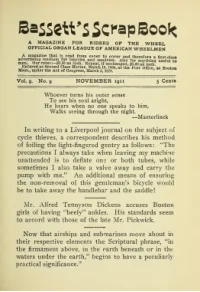
Articles in this issue
- Quips (Lyons' glass sidewalks, a good-roads/church-going jab, the "Belvidere"/"Belva" bicycle-shop joke); then takes up the debate over who was the first lady cyclist -- A. J. Wilson's wife on a wooden tricycle in 1866 vs. the Misses Sparrow and Starley, daughters of well-known cycle inventors, with Miss Sparrow's 1879 ride the clearest documented case.
- Report on the Nylaw's Fall meeting at the Nelson House, Poughkeepsie, where special guest Abbot Bassett of Boston showed seventy-five stereopticon views of old-time cycling (League Meets of 1880-82, 1880s racing, Wheel About the Hub), with more views contributed by Wm. H. Hale of New Haven; then H. G. Wolzendorf of St. Louis begins rebutting J. C. Percy of Dublin's criticism of American bicycles' lack of mudguards and gear cases.
- Wolzendorf continues, recalling his rotten 1891 "Rover" (an English import) and arguing high-grade American makes like the Columbia, Pierce, Stearns and Tribune outlasted English wheels such as the Swift and Premier, with broken frames a rarity among the 25-28 pound American bicycles St. Louis riders used in the 1890s.
- A poem cycle reprinting successive stanzas on things Adam was spared, credited in turn to Success Magazine, the Detroit Free Press, the New York Tribune, the Binghamton Press, the Schenectady Union, the Brattleboro Reformer, the Houston Post, the Scranton Tribune-Republican and the Boston Herald, joking that Adam never emptied an icebox pan, fixed a flat auto tire, hooked up Eve's gown, or flew a bi-plane.
- Edward Young, a workman at the Standard lumber mill in Austin, Pa., hears the dam break and speeds home by bicycle to warn his family and the town of Costello, three miles down the valley.
- Young reaches Costello two minutes ahead of the flood, warning residents, then saves his own wife and children; an obituary follows for Karl Kron (real name Lyman Hotchkiss Bagg), who died Oct. 23 at West Springfield, Mass., aged sixty-five -- a Yale class of 1869 graduate, editor of the Yale Literary Magazine and College Courant, and author of "Ten Thousand Miles on a Bicycle."
- Kron never married; recalled as a unique cycling personality who insisted on using his pen name, was present at Newport when the League was organized (appearing in the famous group photo), rode his nickel-plated No. 234 Columbia high wheel in white flannel, and never joined the L.A.W. or any club, despite his book's reputation as a comprehensive history of early cycling.
- Profile of Thomas W. Davis of Peoria, Ill., who took up cycling at sixty-one and by eighty-three had logged more than 137,892 miles, keeps a noted library of bird literature and a flock of rare pigeons, and still rides three to four thousand miles a year, mostly on a tricycle; then J. C. Percy, writing as "The Tramp" for the Irish Cyclist, begins describing his confusion over competing solar and standard clock times on his American travels.
- Percy recalls a member at the Detroit Meet asking the hotel clerk what time it was at half-past eight, and his own slip misspelling "cheque" as "check" once back in Ireland; then a dispute begins between the Massachusetts Highway Commission and the state's automobilists, who complain road repairs are needlessly dragged out at their busiest season.
- The Commission counters that drivers knock down warning barriers, disregard notices and endanger road crews, threatening to exclude automobilists from repaired highways if they don't reform; and a note welcomes New York State's new law letting anyone tear down illegal roadside advertising signs, which motorists have begun enforcing themselves.
- A page of short jokes and squibs, including a jab at a Brooklyn preacher who claimed St. Peter would be a baseball "fan," a crack at Dr. Wiley's campaign against public smoking, and an old Dutchman's refusal to pay for lightning rods on his new church.
- A column of proverbs and puns framed as sayings "the wheel spoke through the hub," among them "who masters his tongue saves his head," "there are no joy riders on the water wagon," and "a running account should not be left standing."
- A physician argues that most modern diseases stem from lack of exercise and prescribes cycling in particular, including as a defense against tuberculosis, since riding a wheel expands the lungs' air vesicles far more than the sedentary habits, or half-hearted running and wood-sawing regimens, most patients won't stick to.
- A tongue-in-cheek piece consoles the man who can't afford an automobile by recommending the wheelbarrow as a slower, cheaper vehicle, noting a tax assessor is likelier to go easy on a man pushing a barrow than one speeding by in a motor car, and that thrift with the barrow might eventually fund the auto after all.
- A dialect humor poem by J. M. Lewis celebrating a life of eating, fishing and sleeping over work.