CTC Gazette, Vol 1911, No 9
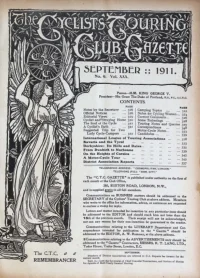
Articles in this issue
- The Club announces it will appeal the County Court ruling against a tandem crew injured by a straying cart-horse, challenging the precedent that farmers owe no duty to keep animals off the highway.
- A report on the activities of the international touring body to which the CTC belongs, covering recent conferences and the development of reciprocal arrangements between member organisations.
- A reflective essay on the relationship between cyclist and machine, arguing that each bicycle develops a character of its own through years of touring and becomes in some sense a companion.
- A follow-up article on the portable bath device, responding to reader enquiries with additional practical details about construction and use during cycle camping expeditions.
- A practical touring itinerary designed specifically for two women cycling campers, describing a suitable route and the particular considerations of women travelling independently under canvas.
- A continuation of the cycling tour through Bavaria and the Tyrol, covering the higher Alpine roads and the dramatic mountain passes of the Austrian border country.
- An ambitious long-distance cycling journey from the Channel port of Dunkirk to Narbonne on the Mediterranean, following the length of France and describing the varied landscapes traversed.
- A cycling tour through the Peak District, describing the limestone dales, the gritstone edges, the market towns, and the challenging hill roads of this accessible and rewarding cycling country.
- A high-level cycling account of the mountain roads of Corsica, describing the passes above the tree line, the views over the Mediterranean, and the wild character of the island's interior.
- An account of a motor-cycle touring expedition by a CTC member, describing the roads covered, the experiences encountered, and comparisons with travelling by pedal cycle.