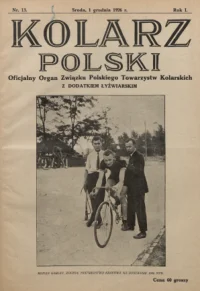
Kolarz Polski, Vol 1, No 13

Articles in this issue

  • Official communiqué of the Polish Skating Union: the board will now meet every Tuesday evening at the Warsaw Skating Society's rooms, and the 1926/7 calendar is fixed — schools' and district meetings in figure, speed and pair skating at the Dolina rink, and the Polish Championship on 30 January on the Dynasy track, organised by the Warsaw Cyclists' Society's skating section. It also lists the International Skating Union's programme: European figure championship in Vienna, world figure for men in Davos, European speed in Stockholm, world ladies' figure in Oslo and world speed in Tammerfors.
  • Editorial note introducing the paper's new skating department and appealing to every skating society, club and section to send news, reports and photographs of their activities. Copy is to reach the editors by the 10th and 25th of each month at the new address, Żórawia 9, Warsaw.
  • The publishers explain the paper's six-month suspension: although the Z.P.T.K. general meeting had adopted "Kolarz" as its official organ and recommended subscriptions, the societies did not support it and some 80 per cent of cycling clubs took the paper without ever paying. They relaunch it with a reorganised financial footing, add the skating department, and thank the Warsaw Cyclists' Society in particular for its help.
  • Signed "Pomian", an attack on the incompetence of Poland's sporting press ahead of the IX Olympiad. It rebuts S. J. M. in Przegląd Sportowy, who hinted at a "combination" in Lange's defeat by Erxleben and criticised the pacer Hartwig's build, explaining that leaders' clothing is regulation-sized and sealed in Germany; ridicules Kurjer Czerwony for calling Szymczyk's rivals Podgórski and "Stef" no competition and for doubting the Bjurberg brothers; and mocks Głos Prawdy's slang in its pieces on Dempsey, Freyer, Łukaszewicz, Szelestowski and Baran.
  • A serialised story by Wiktor Junosza (to be continued): cousins Jerzy Walski and Kazik Konic, opposite in temperament and rivals in everything, both fall for Marychna Tańska and turn the contest to cycling. Walski buys a bicycle and fails in the Stadjon "Pierwszy Krok"; Konic follows him, trains with him on the suburban roads, and after a month they enter a beginners' race with Marychna expected at the finish.
  • Signed "Sław.", an argument that skating — the most sociable and hygienic of winter sports — lags far behind Poland's other sports because of the short unreliable winter, too thin a network of skating societies, and the lack of a single artificial rink anywhere in the country. It names the models of the older and younger schools (Noskiewicz, Dr Weryho, the Goebel brothers, Lindeman; Jankowski, Wyczałkowski and the Przedrzymirski couple), the speed skaters Karol Bewense, Habich, Ludwik Kamiński and Jucewicz, Poland's only Olympic skater, and proposes Wacław Kuchar as the next Olympic representative.
  • Report on the racing at the Warsaw Cyclists' Society's fortieth-anniversary celebration, with prizes given by President Mościcki and Marshal Piłsudski. Podgórski unexpectedly took the President's cup from Łazarski by a length, Majewski won the Marshal's military prize from Haselbusch, Materski the bronze statuette given by W.T.C. president Czetwertyński and J. Lange the silver cup of vice-president Nakoniecznikoff in the motor-paced race; the Italian Vertua beat the hitherto unbeaten Choiński before crashing.
  • Foreign chronicle as the open-air season closes and the winter tracks open: the Ghent six-day won by the Belgian pair Debaets–Thollembeck with 2,967 km and 487 points; the sprint rivalry of Kaufman and Moeskops with the new professional world amateur champion Martinetti against Michard, Faucheux and Poulain; the "Toussaint" international grand prix in Paris with the American champion Willi Spencer, won in the finals by Michard, Martinetti and Spencer; the Chicago six-day taken by the little-known Laus–Petri pair; and the rebuilt Berlin "Sportpalast" track, whose over-steep bankings put out Kaufmann, Tonani and Spear.
  • Home chronicle from Warsaw and the provinces: the W.T.C. touring competition won by captain Kurzawiński (32 outings, 1,694 km) ahead of the veteran B. Paszkowski; the VI "Stadjon" races at Jabłonna, won by Konopczyński over 25 km and Kalinowski over 50; Duszyński's win in the Warsaw Starosta's 84 km Warsaw–Otwock race; the "Rzeczpospolita" cyclo-cross won by Głowacki from Radwan and Michalak; Eugenjusz Michalak's Warsaw "Sokół" district championship over 107 km; the first scouting races (19 W.D.H. and the 1 Piastowska P.D.H. match won by the 17-year-old Blicharski); and reports from Mińsk Mazowiecki ("Mazowia", Jensen and Biedakowski), Pakość, Ciechanów, Poznań, Gniezno (Pydde) and Sosnowiec (Zenon Salski, and the motorcyclist Max Smuda).
  • Kraków district chronicle edited by "Alcho": the Trzebinia club's second road meeting on the Trzebinia–Krzeszowice road, with 50 starters and Zieliński club champion; the Borek Fałęcki workers' club races won by Kołek, Ullrich and Łaptaś with Dąbrowska of Legja taking the ladies' race; and the K.K.C.M.'s three-stage, 564 km Tour of the Kraków province, won by Duszyński in 29h 30m from Serbeński and Krobot, in which the towns along the route fed the riders while Nowy Targ lodged them in an almshouse. Also the Cracovia track meetings (Stef's hour race for Dr Hładij's cup, Garley's Kraków championship) and the Legja armband race won by Pachel.
  • A three-panel cartoon feature imagining the Greek runner who carried the news of Marathon if he had had a bicycle — on a modern machine he could have covered the forty-two kilometres in under two hours with a smile, and a third drawing puts him on an ordinary.
  • A letter from J. Wissmüller on behalf of the Lwów Society of Cyclists and Motorcyclists, denying that it ever wrote or inspired the press attacks on the Warsaw Cyclists' Society for which the W.T.C. had asked the P.Z.T.K. to impose an exemplary punishment. The editors append a note wondering why the L.T.K. i M. president spoke only after the Warsaw society protested.