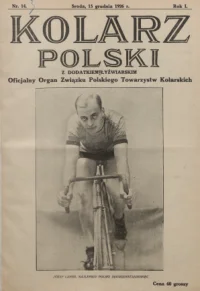
Kolarz Polski, Vol 1, No 14

Articles in this issue
- Official communiqué of the Polish Skating Union board meeting of 7 December: a model statute is to be drafted for newly joining societies, sections and clubs and made binding in outline on all P.Z.Ł. members; the skating section of the Bydgoskie Towarzystwo Wioślarskie is admitted; and the new board of the Lwów Skating Society is noted, with Dr Zbigniew Barth as president, Lt Alfred Theuer vice-president, Franciszek Fuchs secretary, Roman Kikiewicz track director and Roman Stahl, Kazimierz Gergowicz and Władysław Kuchar among the members.
- Notice from the business office. With No. 13 the paper wrote to every cycling society and subscriber demanding payment of arrears; because No. 13 itself went out several days late, No. 14 is sent to all subscribers as an exception. Unless subscriptions to 1 March 1927 (through No. 18) are settled by the New Year, the paper — which runs at a deficit — will have to suspend publication again, this time with no hope of revival.
- The editors' Christmas Eve address to Polish cyclists: good results for the officials at the helm, and for the organisations the wish that they become centres of health earning the country's gratitude. The Tatra peaks, the Baltic shore and the wooded roads are held up as the touring cyclist's dream, and the young riders are wished Olympic laurels under the white-and-red colours. The page also carries a photograph of the initiators and builders of the now-completed Kalisz track.
- A long review of Poland's 1926 racing season, blaming the organisers in Warsaw, Łódź, Kraków and Upper Silesia for abandoning the 400 m time trial that W.T.C. captain A. Jabłczyński had introduced in 1921, for "Union" failing to run the Naramiennik Polski at Helenów, for the W.T.C. forgetting its own Naramiennik prize, and for scheduling the lost 4 km team race on the final day. Rider-by-rider verdicts follow on Jan Łazarski, Franciszek Szymczyk, Stanisław Podgórski, "Stef", Roman Garley and Artur Szmidt, their Milan world-championship rides against Martinetti, Jensen, Abegglen and Engel, and Józef Lange's motor-paced records; with a statistical table of starts and placings and photographs of Łazarski and Szymczyk. Signed Pomian, continued to p.6.
- A warning against amateurs designing Poland's costly new concrete tracks. The finished Kraków track's exit from the banking is botched, and at Kalisz the municipal engineers only rescued a scheme calling for 45-degree bankings on a 500 m track of 49.9 m radius by laying the concrete at 37 degrees. Poland needs velodromes like Paris (Vincennes), Berlin (Olimpiabahn) or Zurich (Oerlikon), not motordromes advertising Indian, Harley, Benz or Fiat; with new tracks planned for Łódź, Lublin, Warsaw and Lwów the paper promises to call bad designers to public account. Photo of the Kalisz Cyclists' Society members and riders with vice-president Gałkowski.
- First part of a skating tuition series signed "Sław.": the beginner's real obstacle is shifting the body's centre of gravity to pass from straight lines to curves, since nearly all figure skating is built on the edge and its combinations. It advises working from a textbook, watching accomplished skaters, mastering the difficult back-inside edge before attempting tricks, the rule of "little but well", and spending three quarters of one's ice time practising alone.
- Signed "Fes.", a reply (subtitled "Odpowiedź na list »Miłośnika sportu kolarskiego«") defending the claim that short-distance racing shows the maximum of human efficiency. Its evidence: Z. Gędziorowski's Polish 10 and 20 km motor-paced records set against the stayer J. Lange; Łazarski's 200 km road time; the sprinter Garley beating Bartodziejski, Ziembicki, Lange and Gronczewski on the 230 km first stage of the race around Warsaw province; Szymczyk's kilometre and 3 km records; the sprinters Moeskops, Cugnot, Faucheux, Goullet and Van Kempen dominating six-day races; and Gertrude Ederle's Channel swim. Continued on p.9.
- Instalment of Wiktor Junosza's serial. Racing for Marychna Tańska's regard, Kazik Konic abandons his cousin Jerzy Walski when Walski's chain comes off and finishes eleventh to Walski's thirty-eighth, but is ashamed of the trick; he then talks Walski into a 20 km race for unattached riders in which his over-large sprinter's gear tells against him, and plots to break away past the crowd and stage a fall into the ditch out of sight. Continued on p.9.
- Signed "Rdzawiec", a report of a visit on Wednesday 9 December to Fort Szczęśliwicki, some 6 km south-west of Warsaw, where the Bractwo Strzelców Kurkowych is building a municipal stadium under engineer Suszyński: a football and rugby pitch, a 500 m athletics track nearly 8 m wide, a 666.67 m concrete cycling track forming a 10 m wide frame around it, stands for 25,000, an Olympic-size pool, tennis courts, a riding ground and a shooting range. The party included Col. Bobkowski of the Union of Sports Associations, Gędziorowski of the Cycling Union and Fr. Szymczyk.
- A three-drawing cartoon feature asking laymen whether cycling's slang is to be understood literally — "usiadł na kółko" (sat on the wheel), "wlazł na słup" (climbed the pole) and "kicha nawaliła" (the tube gave out).
- Signed "R.", welcoming the Warsaw club Polonia's published protest at being named among the organisers of a football "league" linked to the introduction of professionalism, and its declaration that it stands and will stand for pure amateurism. The paper repeats its challenge for any reply to its own article "Zawodowstwo" in No. 3 of Kolarza Polskiego. The page carries a photograph of Łazarski, Martinetti, Szymczyk and Boyocchi lining up for the "match of speed".
- Foreign chronicle: the December six-day on the newly built Madison Square track in New York, 13 pairs headed by the Berlin winners Wambst–Lacquehay, with Mac Namara–Linari leading after 50 hours and Giorgetti–Belloni attacking on the fourth day; the Australian H. Oppermann's new 100-mile record of 4h 36m 4s; W. Spencer beating Martinetti, Knappe and Van Kempen at Wrocław; Kaufmann's surprise defeat at Milan; Catudal's motor-paced record attempts at the Montlhéry autodrome; and the young Pole Henryk Szamota's season on the Buffalo track in Paris, including his win in the international Prix de Septembre over Mirante, Monnout and Mange. Continued on p.12.
- Home chronicle: winter training on the wooden indoor track at Dynasy announced by the Warsaw Cyclists' Society; Radom's cash-starved cyclists' and motorcyclists' section, Piotr Janowicz's surprise track championship and Fundowicz's win in the 165 km "Dookoła ziemi Radomskiej"; the full 1926 report of the Gniezno Cyclists' and Motorists' Society, dominated by champion Erwin Pydde; the Z.K.S. "Hakoach" races on the Mogilany road (Świstek, Rosenstrauch, Stepanowa, Krobot, Zieliński); Kalisz's finished concrete track, due to open in May 1927, with Koszutski the rider to watch; and the Kraków close of season on p.14 — R.K.S. Legja's championship to Kołek, Makkabi's to the promising Hilfstein over Stieglitz, and the meeting Cracovia's own riders staged on 21 November after a season without expenses paid.
- The Polish Eugenic Society has opened free medical advice for sportsmen at its clinic at Żórawia 28 between 2 and 3 p.m., with paid consultations at 2 zł between 5 and 6. The paper urges every cycling society and club to require a health card of each rider and to base his further training on it, since only a doctor can judge when an athlete chasing better results has had enough.
- A letter from the Warsaw Cyclists' Society, signed by vice-president M. Nakoniecznikoff and secretary W. Zagoździński, protesting at the unsigned report "Echa 40-letniego Jubileuszu w Warszawskiem Tow. Cyklistów" in No. 13, which said Podgórski took the President's Cup from Łazarski "in an unchivalrous fight" and "by riding up" — wording that impugns both the Warsaw champion and the judges. The editors reply that "unexpectedly" was justified, withdraw the other phrases in the light of the judges' decision, but maintain that Podgórski caused the collision the judges found unintentional. Continued on p.15.