Vol 1, No 3
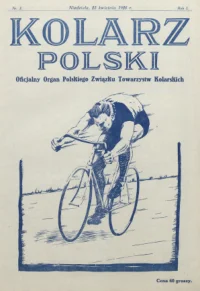
Articles in this issue
- Leading editorial on how Polish sport overcame decades of public prejudice, closing with a warning against overtraining young cyclists and a prescribed two-year build-up starting with easy 10 km rides.
- Reviews the 1925 Polish road season ahead of 1926: Gronczewski won the Warsaw provincial title and Ziembicki won Polesie in 3h 16m, while Mieczysław Lange took the 206 km Polish road championship in 7h 25m before crashing 12 km from the finish of the Amsterdam world championship.
- Table of the nine 1925 Polish provincial championships, giving the top three finishers and 100 km time for each, from Ziembicki's 3h 16m 2s in Polesie to Dibowski's 4h 2m in Pomerania.
- Signed Fes, touring advice recommending a raised handlebar, a gear no higher than 64-68 and a rear carrier over rucksacks, with a packing list for a multi-day tour including a rubber cape, spare stockings and a tyre repair kit.
- Signed Fes, an eyewitness account of the tenth Paris six-day at the Vélodrome d'Hiver naming all fifteen pairs and following the 144 hours to victory for the young French pair Wambst-Lacquehay with 3,325 km and 548 points.
- Signed Pomian, argues Poland must legalise open professionalism to achieve world championship or Olympic results, warning that clubs which pay riders and then let them be struck from the amateur list leave them with no real livelihood.
- Signed J. W., the paper's own enquiry finds Poland's bicycle industry near collapse because importers exploit a duty loophole, 30 zł per complete machine versus 1.20 zł per kilo of parts, by shipping bicycles dismantled and clearing them as "parts" for 10-12 zł each.
- Late March-April 1926 foreign results: Martinetti won the Buffalo velodrome handicap in Paris, Huschke won the 250 km Berlin-Kottbus-Berlin after a pile-up felled 40 of 117 starters, and Sergent-Lonet won the second Berlin six-day with 3,667 km.
- Polish news: licences must be exchanged by 1 May or fees treble, with cycling relays from five provinces carrying congratulatory telegrams to the President on 3 May, plus season-opening reports from Warsaw, Lwów, Łódź, Pabjanice and the Sokół cyclists' jubilee in Żywiec.
- Continues the directory of affiliated clubs, covering Kraków province (entries 38-45) including the Sokół, Makkabi and Hakoah sections in Kraków and clubs in Żywiec, Trzebinia, Wieliczka and Kęty.