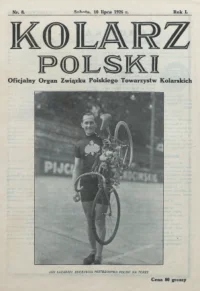
Kolarz Polski, Vol 1, No 8

Articles in this issue

  • Official communiqué of the Polish Cycling Union board: women taking part in races need no Z.P.T.K. licence, and Antoni Gabrych of W.T.C. Łódź has his suspension lifted from 1 July. It names the team for the world championships at Milan and Turin — on the track Łazarski (Cracovia), Franciszek Szymczyk (W.T.C.), Roman Garley (Cracovia), Stanisław Podgórski (W.T.C.) and Artur Szmidt ("Union" Łódź), on the road Ignatowicz and Serbeński of L.T.K. i M. — with the first three funded by the union, and appoints Artur Thiele, union captain and president of S.S. "Union" in Łódź, as delegate to the international cycling congress.
  • The eleven standing rules the Z.P.T.K. now imposes on club rallies: the host society must draw up the whole day's programme (a tour of the town, its art and monuments, a talk on local institutions and the society's own history), arrange and price breakfast, dinner and supper, secure lodgings on request, issue meal coupons and rally cockades from an information bureau, and attach one of its members to every visiting group as guide. Clubs must give seven days' written notice of numbers, travel plans and meal requirements, and any that arrives over- or under-strength must cover the hosts' losses.
  • Editorial arguing that Polish cycling's weakness is a lack of will: in six years there were only three attempts on old records, because riders prefer the easy laurels of "Otwarcia", qualifying and demi-fond races where nothing is needed but a short finish. It proposes a proper structure of records — track paced and unpaced, standing and flying start, plus road records for societies without a track — split into national and club classes, with challenge badges of honour awarded by the Z.P.T.K. or the clubs and lists of record-holders with their portraits hung in club rooms.
  • Signed "Sportowiec", a round-by-round report of the Polish track championship on the Dynasy track in Warsaw, where eighteen riders went through seven heats, five repechages, six intermediate rounds, quarter- and semi-finals — Szmidt, Garley, Turowski, Placek, Zybert, Majewski, Malicki and Berghauzen of Częstochowa among them. Jan Łazarski (Cracovia) beat Franciszek Szymczyk (W.T.C.) by half a machine in 12.8 sec for his third successive title and was given the amaranth jersey with the state emblem by Major Fyda, adjutant to the President; Garley beat Podgórski in the second final, before boxes filled by generals Tokarzewski and Składkowski and mayor Jabłoński.
  • Report on the 214 km Polish road championship of 29 June, run over seven laps of the Jabłonna–Czarna Struga road by the Porębskie woods before some 2000 spectators, started by W.T.C. president Nakoniecznikoff with numbers handed out by union captain Wojtkiewicz and Trippenbach. Kazimierz Duszyński (W.T.C.) won from clubmate Tadeusz Bartodziejski by three-quarters of a length despite six punctures — one of them 7 km from the line — with Ziembicki of Brześć nad Bugiem third and M. Lange (P.T.C.) fourth; the writer attacks the touring pace after Salski withdrew and mocks Ziembicki for never leading 100 metres.
  • Own correspondence from Paris by W. Junosza on the Grand Prix at the Vincennes municipal track, first run in 1894 and split into amateur and professional editions since 1898, whose roll of winners runs from Ellegaard, Meyers, Kramer, Hourlier and Friol to Spears, Ernest Kaufmann and Maurice Schilles, holder of the 200 m record at 11.4. In 1926 the German Engel took the amateur race from Oszmella and Galvaing in 12.8, while Faucheux beat the 1924 Olympic champion Michard twice in the professional final, both in 12, after eliminating Schilles and Moeskops; ticket sales passed 257,000 francs and President Doumergue attended.
  • Home news: the third day of Warsaw's track meeting (wins for Kędzierski, Makowski, Brejnak, Skrzypkowski, A. Karle, Popończyk, Majewski off scratch in the handicap, the W.T.C. quartet of Szymczyk, Lange, Materski and Janociński over 4000 m, and J. Lange behind motors), the W.T.C.'s coming 40th jubilee, the Starostwo prize and the Warszawa–Lublin–Warszawa race of 18 July, and the Milan/Turin world-championship programme with the Polish team named. Then the provinces — Żyrardów's newly opened 333 m track, Łódź (Artur Gietzel's "Rekord" championship and the "Union" meeting at Helenów), Piotrków's "Siła" meeting, Sosnowiec T.C. under Janusz Fliski with Zenon Salski taking the Kielce province title, and the Kraków, Poznań (Malicki), Katowice (Wiktor Dawid) and Lwów (Stanisław Ignatowicz) provincial championships — closing with "Anomalje" on Warsaw police driving cyclists off the paths beside the Grójec light railway.
  • Boxed editorial notice asking all the paper's provincial correspondents to send topical manuscripts by registered post no later than five days before the number appears, so that reports and communiqués from the provinces stop being printed late.
  • Foreign chronicle led by the 20th Tour de France, 6000 km with 103 starters headed by the two-time winner Bottecchia, with stage wins to Jules Buysse (Evian–Mulhouse), Aimé Dossche (Mulhouse–Metz), Van Slembroeck (Metz–Dunkirk), Félix Sellier (Dunkirk–Le Havre), Adelin Benoit (Le Havre–Cherbourg), Van Dam (Cherbourg–Brest) and Nicolas Frantz (Brest–Les Sables), Van Slembroeck leading on time after a third of the distance. Also the Dutch amateur and professional titles to the Leene brothers at Amsterdam, the Italian road championship to Grandi Allegro at 30 km/h, the Grand Prix of Saxony to Meyer, Falkhausen at Ordrup, Oscar Rütt's 1000 m international scratch win in Paris, the seven qualifying series of the professional Grand Prix, and Martinett's Grand Prix of Europe at Cologne.
  • On 9 July A. Sienkiewicz, sports reporter of "Czaty" — a paper devoted to frontier defence — set out to ride round Poland by way of Warsaw, Kraków, Zakopane, Przemyśl, Lwów, Stanisławów, Zaleszczyki, Tarnopol, Łuck, Pińsk, Nowogródek, Wilno, Grodno, Białystok, Łomża, Przasnysz, Ciechanów, Mława, Grudziądz, Tczew, Gdańsk, Hel, Poznań and Katowice back to Kraków. He travels without money, living on the promotional sale of "Kolarz Polski" and "Czaty" along the way.