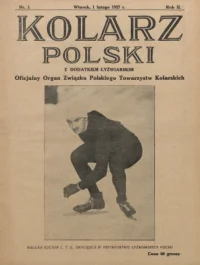
Kolarz Polski, Vol 2, No 3

Articles in this issue

  • Notice that half-hour records will be ridden on the wooden track in the Dynasy sports hall on 12 and 13 February with the best W. T. C. riders, followed on the 13th by an Akademja at which the tokens won in the 1926 season will be presented, with a roll of some 120 award-winning riders from Bartodziejski, Duszyński and Gronczewski to Szenrok of Pabjanice and Ziembicki of Brześć.
  • Editor's answers to correspondents, opening with Zenon Biechoński's rejoinder to St. Rudnicki's article "Niepożądany sport" (No. 1) that France's hundreds of thousands of organised tourists enjoy a public support Polish cyclists lack. Further replies tell Mr Ptaszyński that the world 100 and 200 m standing-start records belong to the Frenchman Morel who raced in Warsaw, assure Mr Zagórski of Poznań that the bicycle firms advertising in "Kolarz" are among the oldest in Poland, and list for Mr Zamojski Poland's four concrete tracks (Warsaw, Kraków, Łódź, Kalisz) and a dozen-odd earth ones (Włocławek, Częstochowa, Radom, Żyrardów, Mińsk Mazowiecki).
  • Editorial signed "Rdzawiec" attacking the mania for founding ever more small cycling clubs — 10, 12 or 14 in a single town — on the footballers' logic that more clubs mean more competition; it argues that cycling is contested by the individual, that the splintering sets clubs poaching each other's riders and wastes on club offices the money that should go on races, prizes and sending riders to the capital or abroad, and that strength lies in large, financially sound organisations. Printed beneath a photograph captioned "Wycieczka turystyczna W. T. C."
  • M. Bodalski argues that well-understood touring, not a mere section of a club, is the foundation of all cycling work: he blames the state of the roads and the peasantry's destruction of the roadside paths the Union petitioned the authorities to preserve, and calls for programmes of one-day social runs and longer sightseeing tours — taking the short Warsaw run to Bielany (the church and its architecture, the Camaldolese, Staszic, the geology of the Vistula bluff) as a model — so that club excursions are not called "a cycling dance from café to café".
  • Report signed "Sław." on the Polish skating championship, staged for the Skating Union by the Warszawskie Tow. Cyklistów: only four of the 17 affiliated societies entered the races and two the figure skating. Wacław Kuchar (L. T. Ł.) took the title with 369.2 points from Ludwik Kamiński and Jerzy Dembowski (both W. T. C.) and Tadeusz Wójcik of Pogoń, Kikiewicz of L. T. Ł. was the only figure-skating candidate, and in the pairs the Lwów couple Billerówna and Kowalski beat Dr Szweicerówna and Pełczyński; full results table on page 6.
  • "Łyżwiarz" holds that Polish skating is neither organised nor led: the Union issues no guidance and supervises nothing, so results depend on two societies alone. The impoverished Lwowskie Towarzystwo Łyżwiarskie still produces skaters near international standard, while the wealthy Warszawskie Towarzystwo Łyżwiarskie — whose "golden age" under Russian rule brought international meetings and skaters such as Göbel and Werycho — now has not one skater fit to represent Poland, its board seats being inherited or filled by tradition, and its intake of young "sporting members" left without coaching.
  • Account signed M. B. of the Pabianice Cyclists' Society's twentieth anniversary on 31 October and the consecration of its new banner: mass at the church of the Blessed Virgin Mary and a blessing from pastor Szmidt at the evangelical church, godparents Janowa Jankowska, Erna Hadrianowa, Artur Fulde and founder Jan Ebenrytter, president Antoni Leon Jankowski handing the banner to standard-bearers Ryszard Szenrok, Bolesław Trzepadłek and Franciszek Jędrysiak, and speeches by Fr Dr Szulc, Follak, Z. P. T. K. delegate M. Bodalski and delegates of some 30 societies from Warsaw, Łódź, Kalisz, Włocławek and Pakość. With a portrait of Jankowski and the society's founders and full board.
  • Opening article of the new department "Kolarstwo i przysposobienie wojskowe" edited by Wiktor Junosza: the school is the largest youth milieu, physical training is neglected, and the bicycle should be offered to work-shy youngsters as an agreeable toy and means of transport rather than as exercise. It promises a series on forming cycling patrols in the scouts, signals detachments among the "strzelcy" and cross-country work for the "sokoły", touring use in rural youth unions and school circles, and reproaches "Ciocia Y. M. C. A." for leaving cycling out of its sports programme.
  • Note in the military-training department correcting the belief that the bicycle as a weapon is a recent invention: the French first used it in war in 1870 at the defence of Belfort, with seven to nine cyclists carrying dispatches; Italy, short of horses but with good roads, ran largely successful trials in 1875; and in 1888 the French "Union vélocipédique" supplied eight volunteer cyclists to the great state manoeuvres, after which military cycling won its place in every army of the world.
  • Opening instalment of Jacek Orlicz's story: on a fine autumn day crowds stream to the cyclists' ground at Dynasy for the "Bieg o mistrzostwo Warszawy", with the leading matadors of European cycling come to meet the Warsaw stars. The favourite is Włady, a modest young technician and chairman of the "Koło wyścigowe", though his friends fear the Dutchman Elessmar; the meeting opens with the handicap race before the qualifying heats. Continued on page 11.
  • J. Koszutski, leading rider of the Kaliskie Towarzystwo Cyklistów, answers the paper's questionnaire "Jak zostałem kolarzem": given a touring bicycle as a Christmas present he taught himself to ride indoors, at sixteen was entered for a road race as a joke by older friends and won it on the same machine, took his city championship a year later and joined the K. T. C. under vice-president Gałkowski and captain Hoffman. He counts among his best rides a 50 km race at Poznań won in 1h 27m 4s, first place in the 50 km opening race in Warsaw and three Kalisz city championships, 26 road wins in all. With a portrait of Koszutski with his machine.
  • Foreign chronicle. Cycling: Faudet-Choury win the four-hour American race on Berlin's Kaiserdamm track from Knool-Maerenberg; Oskar Rütt doubles at Münster in the Omnium and the 50 km; Sawall takes the Wrocław Grand Prix for stayers behind the pacer Pasquier; and a long report on the second Berlin six-day at the Sport Palast, whose neutralised morning hours and management-imposed pairings were widely criticised, won by the Italo-German pair Tonani-Lorenz with 3,604 km 580 m and 170 points after Mac Namara lost Tietz and Van Kempen was let down by Bauer; plus Letourneur-Rouyer's record-breaking two-hour American race on the Paris winter track. Skating: the district championship at Oslo's Bislet track (Ballangrud, Engnostangen, Pedersen), the 1500 m at Budapest won by Eötvös, and the Norwegian national meeting at Oslo with Evensen, Ballangrud and Moen. Continues on page 13.
  • Home chronicle opening from Radom with the general meeting of 23 January of the Cyclists' and Motorists' Section of the Radomskie Koło Sportowe: a minute for the late excursion captain Henryk Wierciński, a new board elected almost unanimously under A. Przybytniewski with Przedworski as racing captain, R. Fundowicz as excursion captain and K. Trębala as secretary, and resolutions to press the authorities for club premises, to get the local school board to lift its ban on pupils joining sports clubs, and to open the season on 10 April with 30 km and 16 km road races and a 25 km cross-country on 24 April, funded by a carnival dance.
  • Kraków district section edited by "Alcho", reporting from Borek Fałęcki the "Czarna kawa" gathering of 22 January attended by invited guests and delegates of the cycling societies, at which — after speeches by president Markowski and the delegates — discussion of current Kraków cycling affairs ran on until late in the evening and was followed by dancing.
  • Survey of the Kraków clubs' 1926 season: Cracovia, roused from a two-year lethargy, finished its concrete track in July, where Barzycki now laps under 14 seconds though the meetings exposed organisational and technical shortcomings; the Krakowski Klub Cyklistów i Motorzystów under Feliks Tyrkalski ran the three-stage 564 km race round the Kraków province under governor Darowski's patronage and counts Z. P. T. K. captain Stanisław Rudnicki among its oldest members; R. K. S. Legja held its Cyclopedestre, the 100 km Kraków-Wadowice race and a club championship but now faces dissolution of its cycling branch; and Makkabi, celebrating its fifth jubilee, staged the classic 110 km Kraków-Zakopane mountain race on 11 July, which drew 42 starters from all Poland in rain. To be continued.
  • Critical report on the first large-scale Warsaw district skating championship, run by the Warszawskie Tow. Łyżwiarzy: some 1,200 spectators were kept waiting an hour and a half, the judges arrived piecemeal, and two men were started together on a 175 m circuit instead of the regulation 400 m, so that Kamiński fell on a bend in the 1500 m. Kamiński won overall with 263 points from Dembowski and Doley — whose 3m 5.6s in the 1500 m beat both — J. Wyczałkowski was the sole figure skater with 184 of 276 points, and Dr J. Schweicerówna and N. Pełczyński the only dance pair; results table on page 15.
  • Prize crossword set by Ign. Smorliński: 79 words, with the crossed squares to spell the surnames and one pseudonym of seven well-known racing cyclists. Solutions with the printed coupon go to "Kolarz Polski", Żórawia 9, Warsaw by 14 February 1927; the prize, a 30-złoty voucher for the "Dom i Sport" store at Al. Jerozolimska 16, is to be drawn at the editorial office on 22 February and the correct solvers listed in No. 4.