Vol 2, No 4
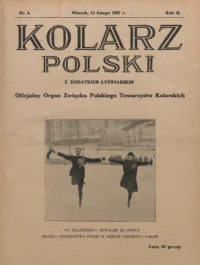
Articles in this issue
- The Polish Skating Union announces its general meeting for 13 March 1927 in Warsaw, with a thirteen-point agenda including decorations for sportsmen and a proposal to build an artificial ice track.
- The Z.P.T.K. publishes its 1927 sporting calendar, including the „Express Poranny” Warsaw circuit race on 29 May and provincial championships assigned to named clubs, closing with a note suspending W.T.C., Union and L.T.K. i M. riders over unpaid licence fees.
- Editorial arguing Polish track sprinters need regular 200m/400m record attempts to close the gap on foreign visitors, citing Łazarski's win over world champion Meyer and the approaching Olympiad.
- M. Bodalski's touring sketch of rides from the Baltic at Połąga to Zakopane's Morskie Oko and Czarny Staw, ending in a snowstorm crossing of the Zawrat pass where a rider and guide Gąsienica fell and had to be rescued.
- A satirical account by "Fes." of Warsaw cyclists on pre-war machines riding out to the new Żoliborz district, mocking its mismatched architecture.
- Concluding instalment of "Sław"'s long-blade speed-skating training course, giving a second-season schedule over 500–10,000m plus summer conditioning.
- J. Jankowski surveys skate design and care, highlighting the Salchow figure-skate model and racing blades, with skates lent by the firm "Olimpjada".
- Paris-based rider Henryk Szamota reports on the winter training of French professionals including Henri Pélissier, Jean Alavoine and Lacquehay, concluding riders over thirty cannot afford a long winter break.
- Report on the Vienna figure-skating championships: Jaross-Szabo/Wrede won the world pairs title, Böckl the European men's title, and Burger the Gurschnerpreis, with Poland represented only in the audience.
- Second instalment on the bicycle's role in the Polish Scouting Association: forming cyclist patrols, using scouts as despatch riders, and running 20–80km scout road races under medical supervision.
- Veteran roadman Stanisław Gronczewski of W.T.C. recounts becoming a cyclist, including sixth place in the 1906 Kingdom of Poland 100-verst championship and his own 100-verst title in 1907.
- Foreign chronicle: Kaufmann beats Michard in Paris internationals; Moeskops wins the U.C.I. Winter Grand Prix at the Vél' d'Hiv; and Russians sweep the Oslo skating meeting.
- Home chronicle: Józef Oksiutycz sets 17.925km in W.T.C.'s half-hour record attempt (short of Duszyński's standing record), plus licence-renewal reminders and Ł.S. "Rapid" Łódź's banner-consecration festivities.
- Kraków district page: the province's cycling societies agree a joint 1927 calendar including the Kraków–Zakopane hill climb and a 560km provincial tour, and elect a five-man committee.
- Solution to crossword No. 1, naming readers who answered correctly and announcing the draw for a 30-złoty voucher.