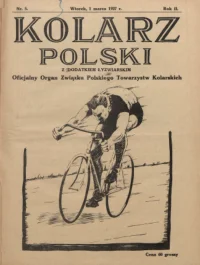
Kolarz Polski, Vol 2, No 5

Articles in this issue
- Union notice listing racing licences Nos. 1–71 issued for 1927, from Franciszek Szymczyk and Henryk Szamota of the Warszawskie Tow. Cyklistów through the Ż.K.S. Makkabi contingent (Stieglitz, Hilfstein, Sterngast, the Früks brothers) to riders of K.S. Cracovia, "Sokół" and Tow. Sp. "Olimpia" in Grudziądz, followed by the names suspended until the 9-złoty licence fee is paid, among them the Niciński brothers, Szpądrowski and Kostrzębski of L.T.K. i M.
- Report on the Scientific Council for Physical Education, opened on 15 February in the war ministry conference hall under Marshal Józef Piłsudski, quoting at length his attack on sports councils staffed by men who never practise physical education and his explanation of why the ministries of war, education and the interior have been joined in the work. Illustrated with a photograph of the seated Marshal with General Zaruski, Dr Wroczyński, Senator Dobrucki, General Sławoj-Składkowski and Colonels Rupert, Osmólski and Bobkowski.
- M. Bodalski argues that the officers and racing captains of Poland's proliferating cycling societies must know something of anatomy, the mechanics of a cyclist's movement, fatigue and psychology, instead of being chosen for ambition or organising skill alone, and cites a promising young rider repeatedly entered for three-finish races who won the first sprint, weakened in the second and fainted after the third.
- E. Nehring on Poland's lack of a proper speed-skating track: Vienna's artificial ice produced Pollacek, European 10,000 m champion in 1926, and Jungblutt, while Polish records have all been set abroad at Budapest and Chamonix on rinks of 180 or 280 m. He specifies the regulation 500 m (minimum 400 m) circuit with a 24–26 m curve radius and 70 m crossing straight, and urges an open-air artificial rink combining racing track, hockey rink and figure-skating area, its plant selling ice in summer.
- Ludwik Turowski answers the paper's questionnaire "Jak zostałem kolarzem": drawn into the sport at eight by his three brothers and father, worshipping Ellegard, Friol, Kudela, Schilles, Poulain, Bodalski and Tkaczyk at the Dynasy track, he debuted there in 1919, won the Citadel boxing championship as a 1920 volunteer, broke the same leg three times in 1921, returned in 1925 to beat the English sprinter Sibbit while still second class, and was promoted to first class in 1926, losing his Polish championship quarter-final to Podgórski.
- Opening article of Wiktor Junosza's military-preparedness department, holding that the sociable club outings now organised are far from real touring: societies should run tours of several days and 1,000 km or more, taking riders from the central provinces to the eastern borderlands unknown to 90 per cent of cyclists, and should require a young member to complete one such tour before his club lets him race.
- Second instalment of Jacek Orlicz's serial: in the fourth heat Elessmar, Petrow, Wiljams and Włady ride slowly until the field closes on Włady, who breaks clear with one of his finest "demarages" only for Elessmar to take his wheel and snatch the win by the thickness of a tyre. In the interval the pacers offer Włady a touring motorcycle with short bars because the track is damp, and his leader Heniu guarantees him for what is said to be his farewell day on the track.
- Kpt. Kurletto on the bicycle's value to the Związek Strzelecki, whose members are workers and peasants: a quarter-hour ride to work would replace the crowded suburban trains, Sunday rides would empty the town taverns, cycle despatch companies proved themselves in the world war, and mounted village members could reach Sunday assembly points within a 20 km radius. A plan for the union's cycling centres is promised for the next number.
- Foreign chronicle: Dewolf, paced by the young Hellebaut, wins the second Ghent six-day with Dhaemers-A. Maes the surprise second; Wrocław's crash-ridden six-day, blamed on a short track with excessive banking, goes to the French pair Wambst-Lacquehay with 791 points and 5,859 km 440 m after Knappe breaks his collarbone and Tonani abandons; from Paris, Faucheux takes the international professional criterium from Michard, Spencer and Martinetti, Brunnhes the amateurs' handicap from Abegglen, and Girardengo-Linari beat Souchard-Sergent in the Omnium match; Rütt, Poulain and Kaufmann share the Wrocław sprint prize; Grauer beats Engel; P. Dejoux wins the Paris cyclo-cross championship over 19 km in 52 m 18 3/5 s from 55 finishers; the Arab Alli Neffatti, still troubled by his 1926 paced-racing crash, is winning in North Africa behind Benitah; and Band wins the 1,940 km "Naokoło Maroka".
- Home chronicle: the Warszawskie Tow. Cyklistów's prize-giving academy for 115 track and road competitors, with vice-president Nakoniecznikoff, Capt. Wojtkiewicz on the Paris Olympiad and Polish hopes for Amsterdam, editor Bodalski on amateurism, and tribute to the donors starostowie Okulicz and club president Prince Czetwertyński; training on the Dynasy wooden track on 25 February (Duszyński, Tschirschnitz, L. Turowski, Włodarczyk, Skrzypkowski, Szpądrowski, Szymczyk, Podgórski, Sadcza, Haselbusch), with skaters Kamiński, Dembowski, Doley, Oksiutycz and "Grot"; a plea to reopen the drained road in Skaryszewski Park for spring training; the founding of the LKS Pogoń cycling section in Lwów on 17 February under Lang, prof. R. Wacek and St. Ignatowicz; from Poznań the track-building committee of the Poznańskie Tow. Cyklistów i Motorzystów under Stanisław Spieszalski, whose stadium plan with a 500 m concrete track is illustrated; a skating rink opened by the Gniezno society; and, from Upper Silesia, Skiba's 1926 Polish championships in cycle-ball, won a second time by Klub Cyklistów 05 Katowice with the Jelinek brothers, and in figure riding, won by Tow. Cykl. "Szarotka" of Mała Dąbrówka.
- Kraków district report edited by "Alcho": the Krakowski Klub Cyklistów i Motorzystów's general meeting of 10 February, which honoured the late Gawor, thanked the organisers of the race round the Kraków province, planned its repeat on 13–15 August and the club's fifteenth jubilee, and elected St. Rudnicki president for the ninth time with Zygmunt Domaradek as captain; notes on Markowski's Borkowski Klub Cyklistów at Borek Fałęcki, the Sokół cycling section whose Figuła won a gold plaque for 3,540 km, Ż.K.S. Hakoah, the Wieliczka club whose president Władysław Gargul plans a national rally to visit the salt mines, and Trzebinia, where Bogacki means to build a track; and an interview in which Jan Łazarski, champion of Poland, explains his withdrawal from Cracovia and from active sport, being owed some thirty prizes and left undefended in the President's Cup race won by Podgórski.
- Obituary of Henryk Wierciński, board member of the Radomskie Koło Sportowe and excursion captain of its cyclists' and motorists' section, who died on 25 December 1926 aged 26 and was carried to the grave by his colleagues at the head of a large funeral procession.
- Wystawa sportowa przybiera ogólnopaństwowy charakter pod opieką władz rządowych (opens in a new tab)The All-Polish Sports Exhibition at Lwów, 3–13 June, gains government backing: the foreign ministry will support the international football, cycling, fencing, tennis and athletics contests, Col. S. G. Ulrich pledges army participation and a Border Protection Corps police-dog display, the Związek Polskich Związków Sportowych will hold an Olympic week and organise four sections on Dr Mieczysław Orłowicz's initiative, the Związek Strzelecki will stage a "Defence of Lwów" show with gas attack and aerial manoeuvres, and the Polish Hunting Society will build a 50 m range with the "Pocisk" ammunition works.
- The executive committee of the Związek Związków resolved on 21 January to move the exhibits of the sports exhibition attached to the II Sports Congress of 9–10 April to the Lwów exhibition on the Eastern Fair ground, and to give the "Olympic Week" the character of selection trials for the 1928 Amsterdam Games in football, athletics, swimming, gymnastics, equestrianism, fencing, road cycling, boxing, wrestling and weightlifting.
- Administration notice that in the draw of 22 February 1927 the prize for a correct solution of crossword No. 1 fell to Mr W. Hauge of Warsaw, with readers asked to collect their coupon at the "Kolarz" office between 9 and 3.