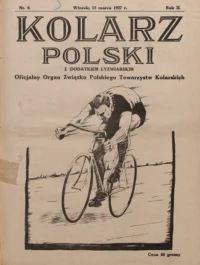
Kolarz Polski, Vol 2, No 6

Articles in this issue

  • The Union board circulates the amendments its member clubs have proposed to the draft Z.P.T.K. statute ahead of the next general meeting: S.S. "Union" of Łódź would raise the entrance fee from 10 to 50 or 100 zł, extend the Union's remit from track to road events and bar racers from board office; Sosnowieckie Towarzystwo Cyklistów would exclude social institutions from membership; and Towarzystwo Cyklistów "Wir" of Rawa Mazowiecka would keep politics out of the Union, require medical certificates and racing licences with every race protocol, and grade annual subscriptions in five classes by club size. Continued on p. 14.
  • Editorial welcoming the Council of Ministers' resolution of 11 November on physical education and military preparation, and the scientific council of physical education opened by Marshal Piłsudski, and supporting the Związek Związków Sportowych's application for state orders to honour the men who have spent decades organising and propagandising Polish sport.
  • "S. R." recalls a Whitsun 1922 tour by some twenty-six men and women cyclists from Nowy Targ through Dębno with its old wooden church, Maniowy, the ruins of Czorsztyn, Niedzica castle, Czerwony Klasztor and the Dunajec gorge in the Pieniny to Szczawnica, then over the Obidza to Piwniczna, Stary Sącz and Nowy Sącz and back to Kraków — 215 km in all — urging riders from the Wielkopolska and Mazovian plains to see the Carpathians now that frontier formalities have closed the route.
  • "Pomian" complains that Polish sporting papers are almost unobtainable in Upper Silesian kiosks while German ones from "Illustrierte Zeitung" to "Rad Welt" circulate freely, recalls how Bodalski's and Szymczyk's journeys to Katowice brought the Upper Silesian cycling union into the Polish parent body, and regrets that the cycle-ball and figure-riding demonstrations staged by the W.T.C. at Dynasy never produced any Warsaw teams to play the Silesians, who now meet German sides instead.
  • Note on cycling for small children: the Fr. Zawadzki bicycle firm has solved the construction and price difficulties, so three-year-olds can now be seen riding tiny machines in parks (young Wojtuś Zawadzki is pictured on his). The writer approves the light gearing and free position as harmless exercise but rejects the French practice of holding races for five-year-olds.
  • "Rdzawiec" prints the circular that Baron de Coubertin and Count de Penha Garcia sent to national sporting federations through the International Olympic Committee, urging propaganda for probity, discipline and chivalry and calling every athlete an "ambassador of sport" before the unsporting crowd, then attacks Polish track riders who count boxing-in, cutting up and jostling a rival as cycling "technique", and demands that judges stamp it out with the severest penalties.
  • Jan Łazarski, Poland's track champion, answers the paper's questionnaire "How I became a cyclist": his first fall aged eleven, internment in Paris in 1914 as an Austrian subject and the natural training of riding 18 km four times a day to his Geneva workshop, beating Höchsman for the Żywiec district championship and the Archduke Karol Stefan cup, a rifle bullet lodged in his knee that nearly cost him the leg but for Dr Michał Hladij, third place in the 1922 Kraków–Pilzno 200 km championship, second to the world champion Michard in a Paris handicap, wins over the world champions Meyer and Martinetti, and two Polish track records at 200 m and 400 m.
  • Opening article of the new department "Kolarstwo i przysposobienie wojskowe" edited by Wiktor Junosza, reviewing cyclist troops in the World War through the verdicts of Majors Brettschneider and Kobzbeck and General Balck: Germany's 18 cyclist companies covering 125 km a day through Belgium and northern France and growing to 200 companies by the end of 1916, the 2nd cyclist brigade on the Romanian front and the seizure of the Moonsund causeway after the landing on Ösel; Austria's 11 companies, France's 10 groups with the cavalry on the Marne, Italy's 12 (later 15) battalions on folding solid-tyred Melli-Rossi machines, Britain's battalion of 230 men per corps and Russia's 7 battalions, 39 companies by late 1916.
  • Foreign chronicle: the American Jaeger wins the annual international motor-paced 100 km Critérium in Paris in 1h 26m 48⅘s ahead of Grassin, Miquel and Linart, who punctured; Michard takes the international speed meeting from Moeskops, Kaufmann and Faucheux with a last lap of 14⅗s, Abegglen wins the amateurs' race from Taffanel and Brunner, and the Pole Szamota is knocked out in his heat by Brunner; and at Dortmund the six-day goes for the second time that season to Tonani-Lorenz with 2,195 km, from Kroll-Miethe and Rielens-Thollembeck.
  • Home chronicle: at the Warszawskie Towarzystwo Cyklistów's general meeting of 5 March, Henryk Nakoniecznikoff is elected president and Prince Seweryn Czetwertyński made honorary president after twenty years in the chair, the accounts reflect the rebuilding of the track and the jubilee, and the city's grant of a 17,000 m² site for a new headquarters and track is credited to Nakoniecznikoff. Also the Sokół gymnastic society's cycling section (Eugenjusz Michalak's 107 km in 4h 12m 30s for the 1926 Warsaw district Sokół championship), cycling proficiency examinations at Dynasy from 19 March, new boards at Łódź, Borek Fałęcki and Mińsk Mazowiecki — where "Mazovia"'s cycling section became the Mazowieckie T-wo Kolarskie under Colonel Michał Krubukowski — and captain B. Knapski's report on the Łódź Warsaw-Cyclists' 1926 touring season, in which A. Lancenderfer covered 1,694 km in 21 excursions.
  • Kraków district notes edited by "Alcho": R.K.S. Legja opens its season on 24 April with a 25 km Cyclopedestre and holds the annual Kraków–Wadowice 100 km on 31 July under the patronage of the city president, and joins Skra and Sarmata of Warsaw in a Kraków–Katowice–Częstochowa–Łódź–Warszawa relay on 5 June; Ż.K.S. Makkabi runs a club race and consecrates its cycling standard on 8 May, films its third annual Kraków–Zakopane mountain race on 10 July and holds club championships on 18 September; and the provincial clubs of Trzebinia, Wieliczka, Żywiec, Biała, Kęty and Chrzanów each plan several road events.
  • Miscellaneous notes: Fryderyk Adler and Antoni Panowski resigned from the Lwowskie Towarzystwo Kolarzy i Motorzystów on 15 February, and Wacław Kwieciński of the Warszawskie Towarzystwo Cyklistów, badly hurt in a training crash on the track the previous summer, has resumed spring training and will ride mainly long-distance events, in which he had previously finished second to Lange.
  • The Polish Skating Union's general meeting of 13 March at the Warsaw Skating Society, with 16 club delegates, opened by president Józef Szwejcer and chaired by Dr Zbigniew Barth of the Lwów society: resolutions to draw up championship rules, translate and publish the International Skating Union's regulations, appoint judges for the figure-skating championship, and press for an artificial rink in Warsaw. Szwejcer was re-elected president, with Jan Jankowski vice-president, Przetocki treasurer and Franciszek Szymczyk secretary.
  • Editor's replies to correspondents: an apology to Mr M. Karpiński of Łódź for an oversight, with thanks for his subscription and the back numbers sent at the same time, and a promise to print Mr E. Lindeman's remarks in the next number.