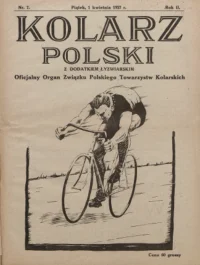
Kolarz Polski, Vol 2, No 7

Articles in this issue

  • The Z.P.T.K. board summons its member societies, clubs and cycling sections to an Extraordinary General Meeting of delegates at 10 a.m. on 24 April and the annual reporting General Meeting at 3 p.m. the same day, both at the Towarzystwo Cyklistów headquarters on Dynasy, ul. Oboźna 3 in Warsaw. The agendas cover the reading of the new Union statute, the board's general, sporting and financial reports and elections; signed by president Pawiński and secretary Fr. Szymczyk.
  • A survey of the Polish bicycle industry, which began with repair shops and brokerage between foreign makers and home buyers for some fifteen years before local assembly and then real manufacture took hold. Poland's annual demand runs at 30,000–40,000 machines, of which home production covers 25 per cent, and everything is now made in the country except tyres, chains and ball bearings.
  • M. Bodalski on the Warszawskie Towarzystwo Cyklistów's plan for a roughly 1,600 km "Dookoła Polski" race running from Warsaw through Poznań, Kraków, Lwów and Lublin. He traces it to the Union's own 650 km three-stage Bieg dookoła województwa warszawskiego, started by some 50 riders and won by the long-distance man Józef Lange, and to the Kraków club's race won by the Polish champion Kazimierz Duszyński, setting both against the 6,000 km, 20-stage Tour de France won by Lucien Buysse.
  • Feliks Wojtkiewicz reviews the six years of official Polish track records: Fr. Szymczyk's successive 200 m marks, Leonard Harkiewicz's breaking of 13 seconds in May 1922 and J. Łazarski's standing 12 2/5 sec.; Łazarski's 25 3/5 sec. for 400 m, J. Grochowski's 300 m, Józef Lange's 1 m 13 4/5 sec. for 1,000 m and Szymczyk's 3,000 m. He closes with the Szymczyk–Lange–Podgórski–Oksiutycz world record of 5 m 9 s for the 4 km team race, set two months after the Olympic Games, and argues record-holders should carry a state decoration.
  • Signed "B. W.", an engineering argument that a military bicycle and a sporting-touring one cannot be the same machine, the army needing durability, simplicity and standardisation while the sportsman needs lightness, comfort and looks. The specification that follows calls for seamless drawn steel tube of 1.1–1.3 mm wall brazed individually into external lugs (not autogenous welding or dip-brazing, which Polish roads punish), a low 22–23 in. frame, black stove enamel, 28 x 1½ in. steel rims, a 74 in. gear and a Bowden cable rim brake in place of the heavy German coaster hub.
  • Signed "Pomian", a history of the bicycle from the Parisian Livrac's vélocifère of about 1790 and the aeronaut Blanchard's pedal-driven cart, through Baron Drais von Sauerbronn's steerable draisine of 1817, Ernest Michaux's and Pierre Lallement's cranked front wheel, Dalzell's rear-driven model shown in London in 1843, the Coventry Machinists' "Gentlemans Bicycle" and the dangerous high ordinary, to the English "Safety" and Dunlop's pneumatic tyre.
  • E. Lindeman defends the Warszawskie Towarzystwo Łyżwiarskie against the paper's criticism: the meeting began only half an hour late, the international rules the reporter objects to cannot be altered by the society, and figure skating is so demanding that even the jubilee international competition in Vienna drew barely fifteen skaters. The editors reply point by point, insisting the provincial championship did start 90 minutes late because Mr Nering released the first pair at 11.30 instead of 10, while praising the club's new hockey team and its youth competitions.
  • Signed "Łyżwiarz", turning the Warsaw Skating Society's 1926 balance sheet against its own board: 53,755 zł 12 gr spent building a terrace and 24,155 zł 55 gr rebuilding the lavatories against only 5,742 zł 82 gr on sport. The terrace was put up only because a tenant made it a condition of his lease, and the tenant then failed to pay and had to be evicted from the Dolina through the courts.
  • Foreign chronicle: a 20 km military cyclo-cross at Strasbourg won in 59 minutes by the French officer Schoering from 57 soldiers and 17 civilians; the New York six-day taken by the Australian–Italian pair Mac Namara–Giorgetti over 3,767 km 255 m from Walthour–Spencer, with Bossi, Zucchetti, Choury and Dinale also riding; a three-hour madison in Paris to Wambst–Lacquehay; and winter and open-air sprint meetings at Dortmund and Paris featuring Moeskops, Kaufmann, Spears, Michard and Spencer, plus the Revelly–Abegglen match in which the Pole Szamota rode.
  • Home chronicle: the Warszawskie Towarzystwo Cyklistów's 1927 programme drawn up by sporting captain Wojtkiewicz — 21 track days including the Mistrzostwo Polski on 26 June, 12 road days and 34 tours; the II Polski Kongres Sportowy of 9–10 April under President Mościcki's patronage; the Związek Polskich Związków Sportowych meeting on the Amsterdam Olympiad and the threat to Sobieski Park; Mińsk Mazowiecki's fixtures; the Łódź society's renaming as Łódzkie Tow. Kolarskie; Cracovia's new cycling-section board; a Kraków court acquitting Stanisław Gregorczyk and establishing that riding two-up on a motorcycle is not forbidden; the Silesian Cyclists' Union elections under Augustyn Skiba; and thanks from the new Pogoń Lwów section.
  • Miscellany: Zygmunt Kalinowski, proprietor of the "Impet" firm, has brought back from Paris the newest cycling accessories and track and road tyres, shown to the paper's representatives; and Józef Grochowski, former champion of Warsaw province, has recovered from a long illness and returns to the track this season, with his twenty-year jubilee due in 1928.
  • Publishing notes on the March issue of "Przegląd Strzelecki i Łuczniczy", with its leader "Koleżeństwo Broni", programmes for the Toruń national and Rome international shooting matches, technical articles by Podoski and Felsztyn and a preface by the French captain Leon Johnson; and on the enlarged second edition of H. Jeziorowski and Wiktor Junosza's "Walka wręcz" (2.50 zł), a jiu-jitsu self-defence manual illustrated with 60 photographs.
  • Opening banner of the paper's industrial department, given over to illustrated profiles of the Polish bicycle and motorcycle manufacturers — Fr. Zawadzki, Eugenjusz Kluska i S-ka, W. Sierpiński and B. Wahren.
  • Profile of the Warsaw works founded in 1917. When the German occupiers requisitioned rubber, Zawadzki built a device to make corded singletube tyres — six days' work a pair at first, later twelve hours — which the occupiers accepted as an ersatz, so that track racing continued and the first post-war road championship of Poland in 1919 was ridden almost entirely on "Fr. Zawadzki" machines. He went on to invent rim-making tools, patent a handlebar known in Germany, France and Austria as the Zawadzki model and eccentric chain adjusters, was first in Poland to make pedals, cranks, sprockets, hubs and saddles, and has lately begun two-wheelers for children of three.
  • Profile of the Kraków firm at Grodzka 63, agents for the Fabrique Nationale d'armes de guerre of Herstal in Belgium — 6,000 workers and over 6,500 machines on 22 hectares, turning out 5 cars, 50 motorcycles and 100 bicycles a day besides firearms. The partners, cyclists themselves, brought the F.N. mark to Poland to counter the cheap foreign rubbish flooding the market; two years' guarantee has so far cost them only the odd small part, and the F.N. is now the cheapest motorcycle in Poland.
  • Profile of Poland's oldest bicycle firm, trading at Kilińskiego 96 in Łódź since 1891 and still in its original owner's hands, honoured by Łódź cyclists the previous year. Since 1910 it has made every component of the bicycle itself; its touring-road and racing types under the "Wicher" mark now run to several hundred machines a year and compete on price with the best on the world market.
  • Profile of the Warsaw firm founded in 1893, with office and store at Świętokrzyska 23 and its own factory at Leszczyńska 3, set up to fight imported machines unsuited to Polish roads. Its seven departments include the only plant in Poland making spokes, nipples and rims, and it is now the country's sole maker of complete aeroplane wheels for military and private aviation; output is 3,000–5,000 cycles a year against a pre-war 15,000 for the Russian market, with mass production of components and a motorcycle design in hand, and first prize in the 650 km Bieg dookoła województwa warszawskiego was won on a Wahren machine.
  • An advertorial arguing that the sportsman, whose whole concern is fitness and form, must avoid ordinary coffee because caffeine harms the nerves and wears out the heart, and should drink the aromatic caffeine-free Kawa Hag instead — harmless even under heavy training and used, it claims, by many sporting champions.