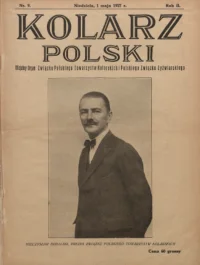
Kolarz Polski, Vol 2, No 9

Articles in this issue

  • Continuation of the union's list of riders granted racing licences, numbers 147 to 249. Entries name clubs including R. K. S. "Legja" Kraków, K. S. "Cracovia", W. T. C., Ł. T. C. Łódź, L. K. S. "Pogoń" Lwów, T. S. "Hejnał" Łódź, Brzeskie Towarzystwo Kolarzy and the Polish emigrant Zw. S. P. we Francji.
  • Leading article calling on Polish cycling to prepare for the coming Olympiad, with coaches charged to find and protect young talent and riders to follow their advice. Provincial clubs are urged to follow the example of Warsaw, Kraków, Łódź, Brześć and Poznań and contest the voivodeship and national championships, especially on the road.
  • Signed "Rdzawiec", a survey of inter-club rivalry since 1921 — W. T. C. with Szymczyk, Józef Lange, Duszyński and Bartodziejski; Krakowski Klub Cyklistów i Motorzystów with Heksman; "Cracovia" with the three-times champion Łazarski; Poznań with Mieczysław Lange; "Union" Łódź with Miller — and a preview of the 1927 season for Kalisz, Pogoń Lwów and Brzeskie T. K.-S. with Ziembicki and Więcek.
  • Fourth and final instalment of Jacek Orlicz's serial story. At the Dynasy track in Warsaw, Włady finds a gap while passing three lapped riders, beats the foreign champion Elessmar in the motor-paced final and, sashed as champion, announces his retirement from racing.
  • Argues that cycling is healthy for children provided the gear is kept low, using pedal-revolution figures (30 to 35 turns in 12 seconds against the 30 a racer needs on a 92in gear for 200 m). Illustrated by six-year-old Jerzyk Nakoniecznikoff, son of the W. T. C. president, who rode over 16 km to meet his father's train and was fresh the next morning.
  • Notice that from 1 May the editorial office and administration of "Kolarz Polski" have moved to ul. Mokotowska 8 in Warsaw, telephone 109-71.
  • Minutes of the extraordinary general meeting of delegates of cycling societies affiliated to the Z. P. T. K., held on 24 April 1927 at the Towarzystwo Cyklistów premises on the Dynasy in Warsaw, with 26 societies holding 118 votes. Chaired by Pawiński with Bodalski as statute rapporteur, it worked through amendments to the union's statute and heard W. T. C. president Nakoniecznikoff offer reconciliation to the Lwów society after the 1926 road championship dispute.
  • Minutes of the ordinary general meeting of Z. P. T. K. delegates on 24 April 1927, listing the 28 clubs present with 123 votes between them (Cracovia, Union and Rekord Łódź, Śląski Związek Cyklistów with 21, W. T. C. with 20 and others). The 1926 accounts were passed, the outgoing board discharged, Mieczysław Bodalski elected president with a fifteen-man board, and the subscription raised to 75 groszy per member.
  • First communiqué of the newly elected Z. P. T. K. board, meeting on 25 April 1927, allotting offices: Bodalski president, Nakoniecznikoff and Thiele vice-presidents, Wojtkiewicz, Maternowski and Skiba captains, Szymczyk and others secretaries, Wadowski treasurer, Jankowski book-keeper and Wacek press officer. Board meetings are fixed for the Saturday after the 1st and 15th of each month at the W. T. C. premises on the Dynasy.
  • Stanisław Podgórski answers the paper's questionnaire "How I became a cyclist": a road bike given by his sister in 1920, early track wins on steel rims, a return in 1925 against Koroś, Lindeman and Duma, an unexpected win over champion Stankiewicz, two Warsaw championships and the President of the Republic's prize, taken by beating champion Łazarski twice.
  • On the six-day racing boom, with the Australian Mac Namara as "king of the six-days" for three years and Van Kempen chasing primes instead of victory — 32,500 of the 208,000 francs offered at the last Paris six-day. A table gives the placings of all eleven six-days of the season at Chicago, Ghent, New York, Brussels, Berlin, Breslau, Dortmund and Paris, with portraits of Mac Namara, Emil Aerts and Van Kempen.
  • Foreign chronicle: Giorgetti and Stockholm win the second Chicago six-day; Georges Ronsse takes Paris–Roubaix over 260 km in 8h 32m 20s from Curtel and Pélissier; the season opens at Herne Hill in London and at the rebuilt Parc des Princes, where Michard, Arnoux and Meyer win the sprint finals; Linart covers 100 km motor-paced at the Buffalo track; Linari wins around Frankfurt; Aumerle beats 250 rivals in Paris–Evreux and Moineau wins Paris–Le Havre.
  • Henryk Szamota argues that the usual 10 km ride plus one sprint is a poor method and that training should prepare a rider for effort rather than be maximal effort. He cites Friol, who rode up to 15 km alone with a light burst and a true finish only three times a week, and Poulain, who enters distance races to regain form, and recommends 20 km at 40 km/h over 10 km at 45.
  • Home chronicle led by the W. T. C.'s full 1927 programme of road and track races and club runs from the 1 May season opening to the closing meeting of 30 October, including the "Express Poranny" road race, the Polish championships and the "Dookoła Polski" tour. Also the Chorzów–Warszawa–Zamek relay carrying a message to President Mościcki on 3 May, new officers of the Amatorski K. S. cycling section, Ł. K. S. Łódź's 21-tour touring programme (928 km to Gdynia), "Olimpia" Grudziądz's first run to Łasin, and the Częstochowa Towarzystwo Cyklistów programme and board.
  • Kraków district notes edited by "Alcho": the "Cracovia" track meeting of 10 July is dropped because the third annual Kraków–Zakopane hill race, run by the Ż. K. S. "Makkabi" cyclists' section, falls on the same day; and a report of R. K. S. "Legja"'s 23 km cyclo-cross at Wola Justowska won by Głowacki of A. K. S. Warszawa in 52m 22s from Pachel ("Garbarnia") and Hilfstejn ("Makkabi"). Followed by club election reports from Biała, Kęty and Żywiec and Lwów correspondence on Hasmonea, Jutrzenka and Pogoń.