Vol 31, No 1
190059 articles50 images
Articles in this issue
- The standing editorial review of the month that opens the first number of the L. A. W. Magazine (June 1900), running from the Massachusetts baggage victory and side-path progress through the Milwaukee national meet, the break-up of the International Cyclists' Association and the American Bicycle Company's bottom-bracket patent suits.
- After years of sturdy railroad opposition the Massachusetts division carried the State Bicycle Baggage Bill through the Boston legislature, a League success the editors call a new recruiting weapon worth the price it cost in Bay State membership.
- The new Massachusetts law gives free carriage of one bicycle only when the traveller's fare exceeds ten cents for a single trip, a limit that protects the roads from Boston suburbanites presenting wheels in numbers enough to stagnate traffic.
- With the national conventions of both big parties five weeks off, the League means to secure a good roads plank in the Republican and Democratic platforms, arguing that no national party can afford to go before the people on a bad roads platform.
- President McKinley appoints Hon. Martin Dodge of Cleveland, an Ohio state senator and author of the Ohio good roads law, director of the Office of Road Inquiry; Dodge writes that an additional $6,000 appropriation will let him divide the country into four sub-districts, each with a resident representative.
- Director Dodge writes that there has not been sufficient communication between representatives of the League of American Wheelmen and state and national government officers; the magazine urges Chairman Fullerton of the national highway improvement committee to get into close touch with him.
- Ohio becomes the latest state to win a side-path law, the DeKan measure modelled on New York's: wheelmen petition a county judge, who appoints an unpaid board of commissioners, and licence tags never dearer than $1 pay entirely for construction and maintenance of the cinder paths.
- Four projected inter-state paths are mapped out, New York to Chicago via Buffalo and Cleveland, Chicago to Minneapolis via Milwaukee, Minneapolis to Denver via Omaha, and Denver to the Golden Gate, which together would let a wheelman ride from New York City to San Francisco without a mile of bad riding.
- President Sams appoints a new national committee on side-paths under Dr. C. H. Hunter of Minneapolis, with H. V. Casey of Baltimore, E. S. Thomas of Fremont, J. G. Lee of Trenton, M. D. Fletcher of Springfield, A. P. Dare of Harrisburg and F. P. Magargle of Rochester.
- Under the international touring agreement now existing between the League, the Cyclists' Touring Club of England and the Canadian Wheelmen's Association, an L. A. W. member may tour any part of the old world or Canada with as little inconvenience as an afternoon's spin from Central Park to Harlem.
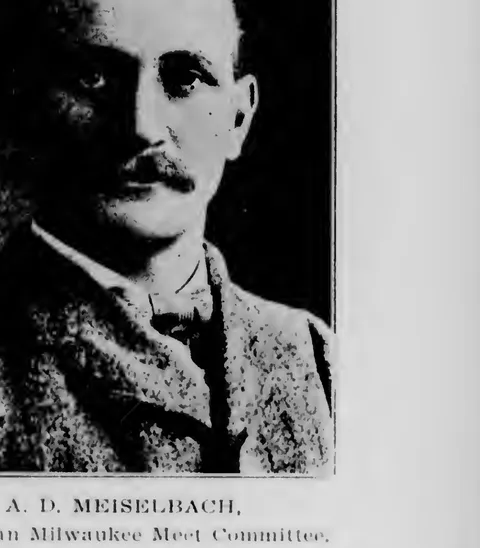
- The League's annual gathering will be held at Milwaukee July 10-15, with the Citizens' Business League in charge of the programme under A. D. Meiselbach, formerly a prominent bicycle manufacturer; the races include a multiplet contest on the road and fifteen track events at the Exposition building.
- Chief Consul Earle's Port Huron state meeting pairs a good roads congress and a mile of macadam road construction with band concerts, an all-night smoker, a horseless carriage parade, fireworks, an electrical spin wheel and races.
- The season witnessed the downfall of the International Cyclists' Association and the inception of the International Cyclists' Union, after the French body's February resolution at Paris to limit congress voting to "national" bodies, which would have disfranchised Ireland and Scotland and eclipsed England's power, failed to prevail.
- At the adjourned I. C. A. congress in Paris on April 14th the proposition was presented again, long arguments availed nothing, and the meeting adjourned without a single practical step having been taken.
- The new I. C. U. will conduct world's championship races in Paris during the summer with grand prizes, assured of support from the German union and from the Canadian Cyclists' Association newly organised at Montreal by the Queen's Park track owner to secure American racing men.
- Since the L. A. W. dropped racing the N. C. A. has been the race controlling body of the United States, governed through a six-member board of control chaired by veteran League member A. G. Batchelder, with a board of appeals of George A. Needham, Abbot Bassett, W. B. Curtis, Horace S. Fogel and S. A. Miles.
- W. S. Bull, once chief consul of the New York division, resigns its secretary-treasurership after the division cut the salary; John F. Clark, known in League circles as author of the Junior Membership plan, succeeds him and will serve without compensation.
- John A. Blaurock resigns the presidency of the N. C. A. under press of business after being urged to reconsider; Geo. J. Cooke of the Harlem Wheelmen, New York City, is chosen to fill the vacancy.
- The American Bicycle Company's suits against the Eagle Bicycle Manufacturing Company and the H. P. Snyder Manufacturing Company over the Smith or Owen bottom bracket patent; Eagle pleads the patent was ante-dated and left non-operative, Snyder that A. B. C. has conspired to monopolise the trade, and the Cycle Trades Protective Association is defending both.
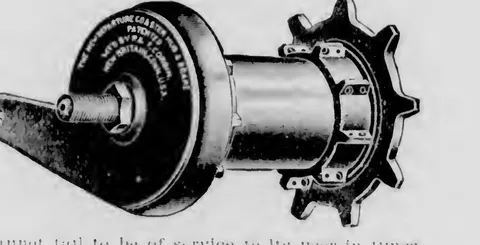
- No device in recent years has gained such wide-spread popularity in so short a time as the coaster-brake, now selling rapidly in various models; cushion frame bicycles are also coming into fresh favour and more people are riding this year than at any time since '96.
- David J. Hill, assistant secretary of state, writes to President Sams that the claim against Turkey growing out of the killing of Frank Lenz has been presented to the Turkish government and that the department has urged action upon it.
- A dated chronological epitome of April and May 1900: Bouhours' and Edward Taylor's paced records at Paris, McFarland's 16-hour six-day win at Los Angeles, the founding of the International Cyclists' Union and the Canadian Cyclists' Association at Montreal, the Massachusetts bicycle baggage bill becoming law on May 7, and Frank Kramer's professional debut at Vailsburg.
- A guide to the Milwaukee meet of July 10-15, 1900, with the St. Charles Hotel on Market Square as official headquarters, Juneau Park, the Layton Art Gallery and Schlitz Park among the sights, a multiplet race down Grand avenue, a lake cruise and a "Hot Time" smoker; Gerhard Aussem's night racing programme at the Exposition building is printed in full and the executive committee headed by A. D. Meiselbach with T. J. Sullivan of the Citizens' Business League.
- A full-page appeal from The L. A. W. Meet Committee likening the League's coming-of-age to a boy's 21st birthday and urging every member to spend his or her vacation at Milwaukee, July 10 to 15, where all League entertainment is free to members and railroad rates are greatly reduced.
- H. S. Earle, chief consul of the Michigan division, previews the Port Huron congress of July 2-5, 1900, where a sample mile of road will be built under United States road expert E. G. Harrison and representatives of every class of citizen will be asked to confess where they stand on the change from bad roads to good.
- Quoting the Rochester Democrat and Chronicle against the street railway company's proposed penal ordinance forbidding riding between the outside rails, arguing that in winter or heavy traffic there is often no alternative and that bicycles have as good a right to the street as street cars.
- President Conway W. Sams sets out League policy: the Philadelphia assembly's committee of five to revise the constitution, incorporation under the act drawn by John B. Uhle of New York, Dixie Hines' proposal for cycling accident insurance, the new national side-path committee, and the touring department's $300 loss to the Canadian customs through members ignoring the border rules.
- Hon. Martin Dodge, director of the Office of Road Inquiry, argues that the federal internal-improvement policy of Clay and Calhoun, abandoned when railroads took over the long haul, should be revived on the scale of the River and Harbor Bill now that the bicycle, automobile and suburban street car have made light highway traffic important again.
- H. B. Fullerton, chairman of the L. A. W. National Committee on Highway Improvement, urges wheelmen to write their national convention delegates for a binding good roads plank, contrasting the absurd $25,000 a year voted to the Road Inquiry Office with the billions spent on river and harbour work, and insisting the farmer is now the movement's strongest backer.
- A four-stanza poem urging the rider to spring into the saddle with feverish haste and get away from the smoky town and narrow streets to the rural road and the open air.
- Reprinted from The Cyclist of England: no one has ever seen a lady making her first attempt at free-wheeling because women sensibly practise on some secluded bit of road, whereas men flounder about the high roads, and a woman free-wheeling looks far more graceful than a man.
- Michigan chief consul H. S. Earle, with Mrs. Earle and their youngest son George L., will sail from Halifax for a six weeks' European tour as soon as the Port Huron L. A. W. festival and good roads congress close, taking the shortest water route out of pity for his fellow passengers.
- The publishers' untitled opening editorial beneath the L. A. W. Magazine and Good Roads masthead, promising a monthly of the standing the Cycling Gazette and Motor Vehicle Review won in their fields, built around an unprejudiced editorial narration of the month's events, a chronological epitome and contributions from League officers, with membership application lists relegated to the Cycling Gazette.
- A New Zealand writer answers a woman a little beyond the pale of youth who said she would ride if she were only younger, arguing that cycling is the one exercise open to young and old alike and that more middle-aged women awheel would mean less imaginary illness and semi-invalidism.
- The banner opening the League's own department, which runs to page 15 and carries the statement of objects, the officers and national committees, the division and foreign consul lists, Secretary Bassett's editorial column, the C. T. C. alliance and literature, the touring department and the state division reports.
- The League's statement of objects and member benefits: the hotel, consul and repair-shop systems, road books and maps compiled by members, C. T. C. and Canadian Wheelmen's Association tickets, wheels taken into Canada without the $25 deposit, and free carriage of wheels as baggage, for two dollars the first year and one dollar thereafter.
- President Conway W. Sams of the Bank of Baltimore Building, First Vice-President Robert T. Kingsbury of Keene, Second Vice-President A. B. Choate of Minneapolis, Treasurer J. C. Tattersall of Trenton, and Secretary Abbot Bassett of 530 Atlantic Avenue, Boston.
- The League's standing committees on membership (W. A. Howell, chairman), rights and privileges, rules and regulations (Albert Mott, chairman), improvement of highways (H. B. Fullerton), transportation (Frank P. Van Valkenburgh), touring (Geo. M. Schell) and press (Geo. L. McCarthy).
- Chief consuls and secretary-treasurers of every state division from Colorado to Wisconsin, with post office addresses, so consuls and agents can draw supplies of application and renewal blanks and League literature.
- The League's consuls abroad, among them Joseph Pennell and Dr. E. B. Turner in London, racing representative James M. Erwin in Paris, Ercole Abrate in Turin, Felix Rohl in Berlin, Otto Mayer in Vienna, Alfred F. Terry at Cienfuegos, Cuba, and Raisa Fari in Tokio.
- Secretary Abbot Bassett welcomes the new magazine and traces every official organ the League has had since The Bicycling World was named at Newport in May 1880, The Wheel under Frederick Jenkins, The Amateur Athlete under Eugene M. Aaron, and the L. A. W. Bulletin and Good Roads. He also notes Massachusetts' baggage and wide-tire bills, Pennsylvania's road book, Chicago's projected forty-mile path beside the drainage canal, and the danger of carbide thrown away where animals can eat it.
- The text of the 1899 reciprocal agreement between the League and the Cyclists' Touring Club of Great Britain, under which members of either body become temporary members of the other with hotel, repair-shop and consul privileges, and may buy each other's road books, itineraries, handbooks and maps at member prices.
- Secretary Bassett's price list of Cyclists' Touring Club publications held in stock for League members: the British and Irish Handbook with the Farm House and Country Lodgings List, the Foreign Handbook, the five volumes of the C. T. C. Road Book of England, Wales, Scotland and Ireland, the three-volume Continental Road Book, and Bartholomew, Gall and Inglis and Johnston maps.
- Practical advice for riding abroad, gear in moderation (seventy is high, sixty comfortable), carry duplicate chain links and spokes, expect $2.50 ocean freight for a boxed wheel and $2.50 to $3.00 a day in England, followed by the customs position in England, the French duty and cycle-tax rules with the government's seven-article cycling edict, the German traveller's-effects exemption, and the C. T. C. contract hotels in Paris for the exhibition year.
- F. A. Elwell of "The Columbia," Portland, Maine reports a large response to the prospectus published in the April Bulletin and confirms the League's European tour will start September 8 for France, Switzerland and Holland, with a five-day stop at the Paris Exposition, at a cost of $250.
- Chairman George M. Schell assigns each of the seven national touring committee members a territory, Alonzo D. Peck for New England, W. S. Bull for New York State, C. H. Vanderhoof for the north-west and others, and lists the through routes already prepared, from New York to Chicago via Albany, Buffalo and Cleveland to Boston to Portland, for riders bound for the Milwaukee meet.
- The Canadian Customs Department circular (Memorandum No. 822 B, signed F. E. Kilvert, Acting Commissioner) allowing bona fide League members to bring their bicycles into Canada without the usual money deposit on producing their membership ticket and filing a Collector's permission in triplicate describing the wheel.
- Chief Consul F. W. Starr's letter to Connecticut members: Veeder cyclometers secured cheaply to verify distances on guide boards, a hotel and repair shop list for the state's principal places, road information wanted by the touring committee, and preparation for a side-path bill at the next legislature.
- Some thirty newly appointed local consuls across the state, from Frank Church at Allington and Herbert Lake at Brookfield Center to Edward Toelle at Wallingford, with T. E. Fowler of Berlin removed.
- Chief Consul Thomas H. Gist announces prizes for membership applications, a Tribune Blue Streak, Barnes White Flyer, Crescent chainless or Racycle for 60, down to a White Star acetylene lamp for five, and reports the new Arapahoe County Good Roads Association and a boulevard from South Broadway toward Colorado Springs promised by the county commissioners.
- President Sams has a limited number of the Maryland Geological Survey's report on the highways of Maryland at his command and will send copies to members of national committees and to chief consuls, asking that division highway committee chairmen get the book.
- The programme of the L. A. W. state meet and side-path carnival held June 15-17 under the auspices of the Kanaweola Cycle Club, with an address of welcome by Mayor Frank H. Flood, runs to Clark's Glen, Eldridge Park and Horseheads, and an illustrated lecture, "The Wheelmen's Paradise," by H. B. Fullerton.
- The Pennsylvania division is having the entire state re-mapped after the complicated and unsatisfactory maps covering its eastern end in the last road book; the first edition will cover about two-thirds of the state and go free to every member living in the territory it covers.
- The Pennsylvania division's road bill, providing an improved system of road building and maintenance throughout the state, is to be presented early in the coming session of the legislature after preliminary work by Mr. Worrell, chairman of the division's highway improvement committee.
- The Pennsylvania division offers a $25 reward for the arrest and conviction of anyone stealing a member's wheel, advertised by a neat aluminium plate attached to the frame; a number of thieves have been apprehended as a result, but a wheel bearing the plate has never been stolen.
- Secretary-Treasurer J. Roy Collins reports a decided increase of interest since the division gave up racing control, asks members to name the hotel in their town worth a League appointment as he revises Virginia's list, and repeats the prize offers running from a 1900 or 1901 Columbia chainless for 75 applications down to 40 cents for one.
- A state-by-state table of 382 applications and 3,434 renewals for the month, followed by total membership on May 25, 1900 of 32,419, led by Pennsylvania with 7,851, New York 6,869, Massachusetts 6,667, New Jersey 1,983 and Ohio 1,471.
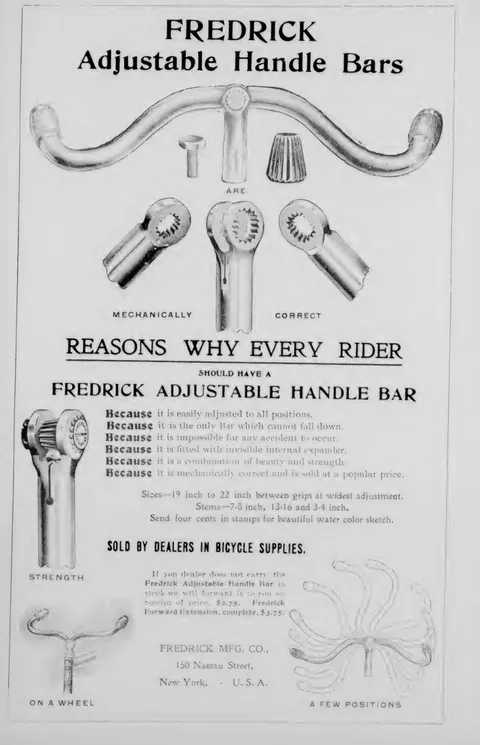
- Trade notes on the Kelly forward-extension handle bar of Cleveland, the Hygienic Wheel Company's cushion frames as fitted to Pierce, Frontenac, Yale, Outing, Stearns, Barnes, Olive, Reading Standard and Iver Johnson machines, the A. J. Kapp Sons' Ivory Co. Expansion Jack, the Fredrick adjustable bar, John Harriott's prize medals, the G. W. Cole Van repair kit, the Ramsay swinging pedal, the Safety Oiler, the Electro and Badger Brass Solar lamps, Lamson's luggage carriers of Portland and the New Departure coaster-brake.
- A column of short cycling jokes and riding cautions clipped from the Nauvoo Rustler and the Philadelphia Bulletin, warning riders not to try their speed against a horseman in the park and not to pull up suddenly in a crowded thoroughfare without signalling.
Images in this issue 50 pictures from 22 pages
Photographs 14
 (opens in a new tab)
 A. D. Meiselbach, Chairman Milwaukee Meet Committee 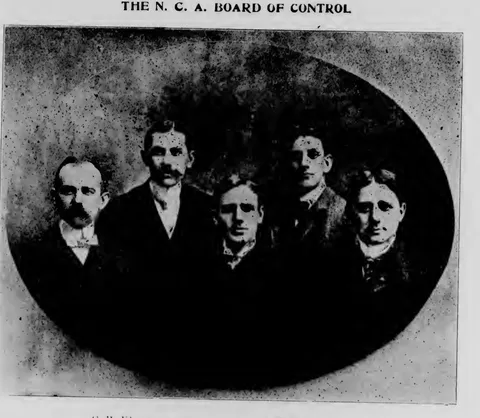 (opens in a new tab)
 The N.C.A. Board of Control 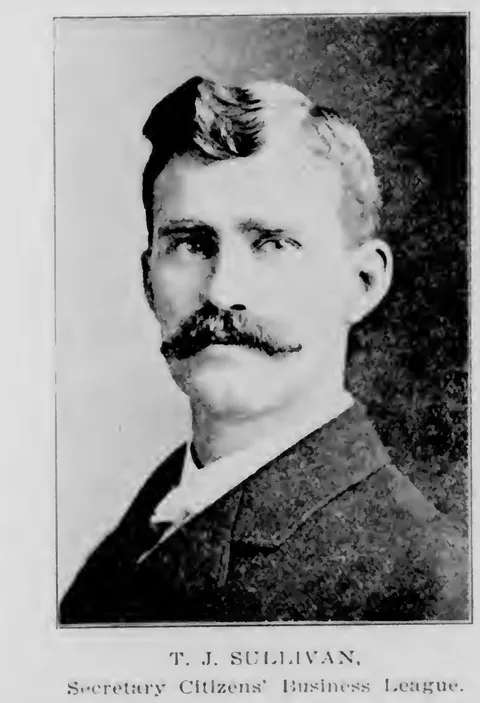 (opens in a new tab)
 T. J. Sullivan, Secretary Citizens' Business League 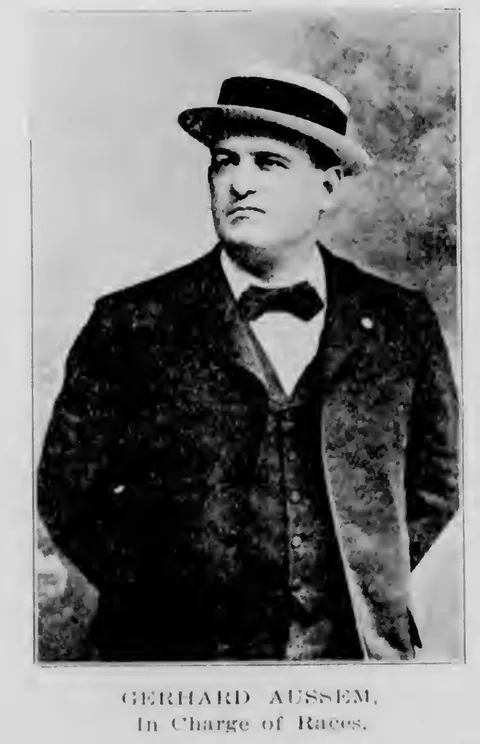 (opens in a new tab)
 Gerhard Aussem, in charge of Races 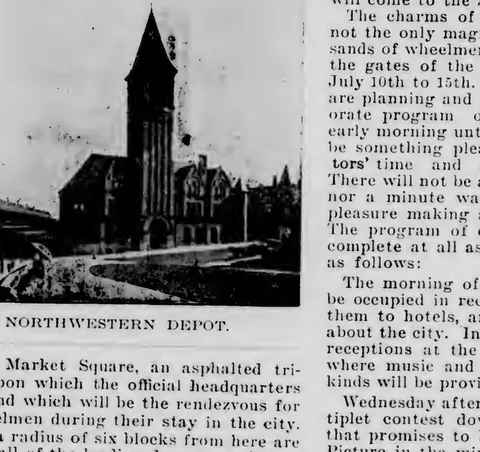 (opens in a new tab)
 Northwestern Depot, Milwaukee 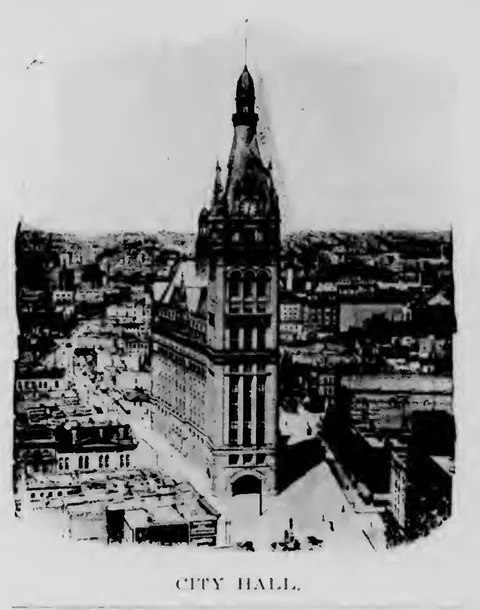 (opens in a new tab)
 City Hall, Milwaukee 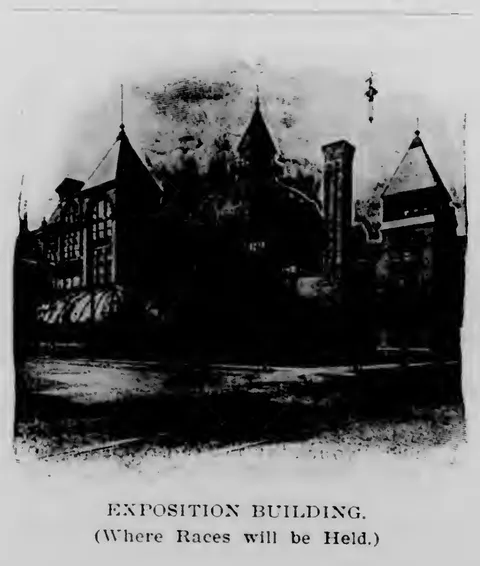 (opens in a new tab)
 Exposition Building, Milwaukee (where races will be held) 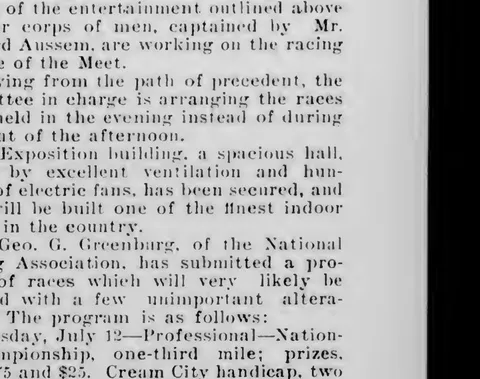 (opens in a new tab)
 St. Charles Hotel, Milwaukee (Official Headquarters) 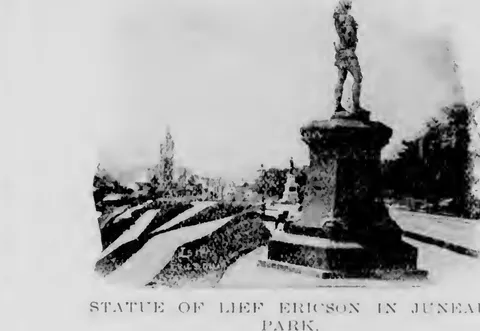 (opens in a new tab)
 Statue of Lief Ericson in Juneau Park 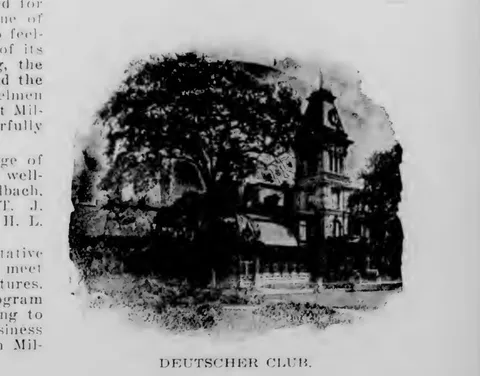 (opens in a new tab)
 Deutscher Club, Milwaukee 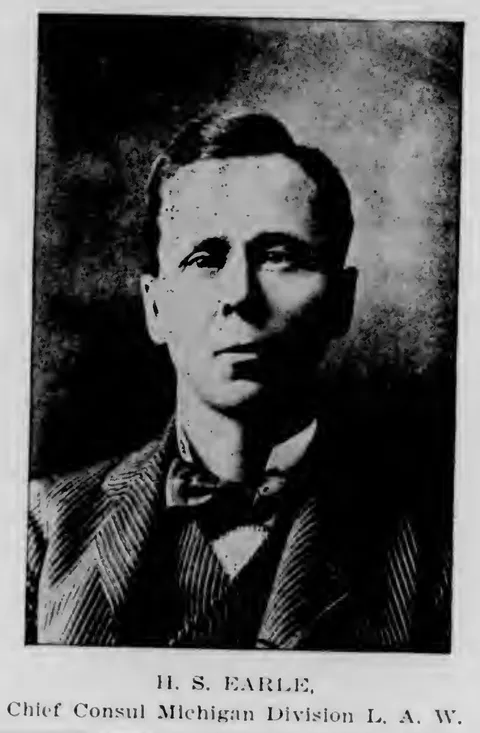 (opens in a new tab)
 H. S. Earle, Chief Consul Michigan Division L.A.W. 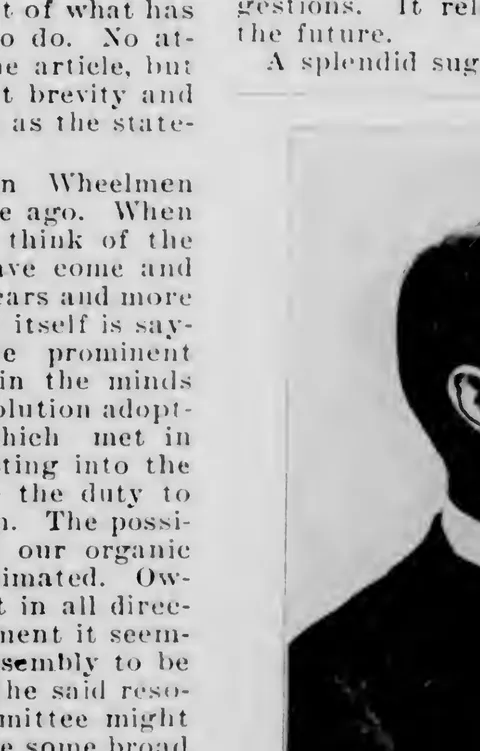 (opens in a new tab)
 Conway W. Sams, President L.A.W. 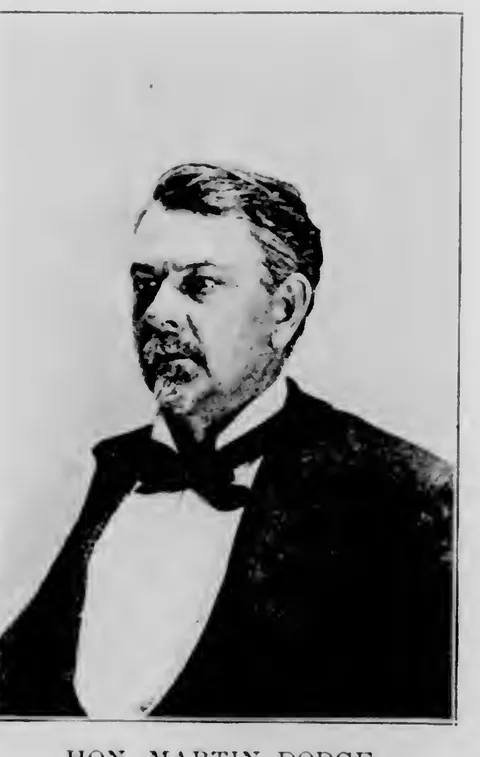 (opens in a new tab)
 Hon. Martin Dodge 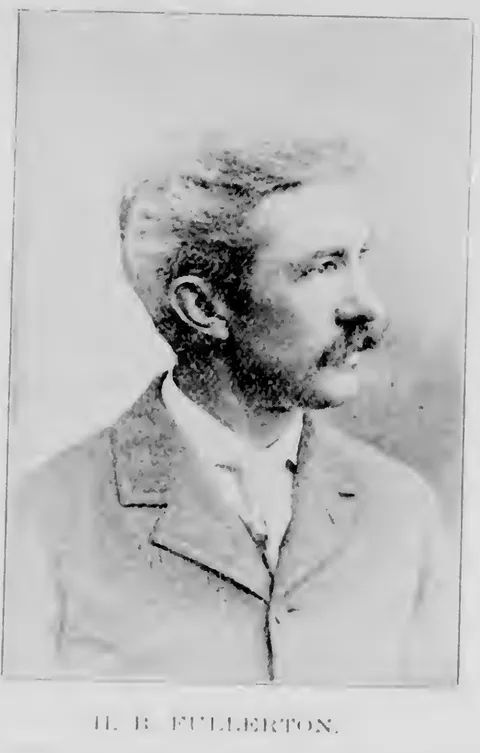 (opens in a new tab)
 H. B. Fullerton
Diagrams 2
 (opens in a new tab)
 Coaster-brake hub mechanism 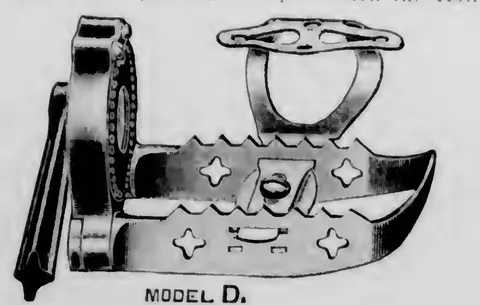 (opens in a new tab)
 Model D swinging pedal with toe clip
Mastheads 2
 (opens in a new tab)
 L.A.W. Magazine cover masthead  (opens in a new tab)
 L.A.W. Magazine interior nameplate
32 advertisements
 (opens in a new tab)
 Fredrick Adjustable Handle Bars advertisement 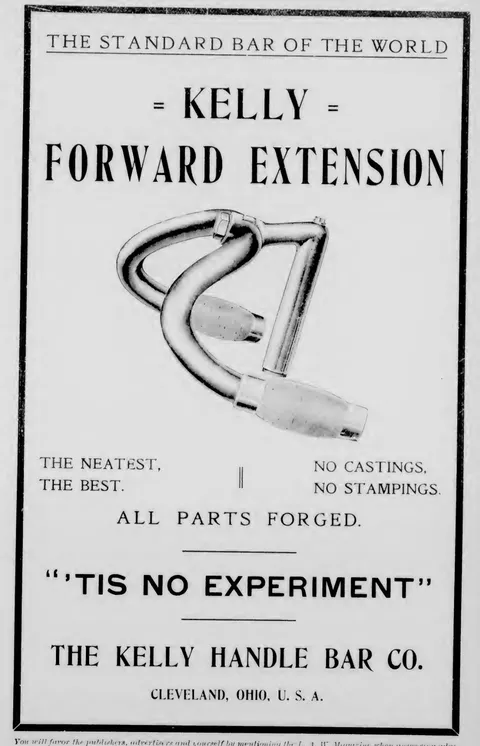 (opens in a new tab)
 Kelly Forward Extension handlebar advertisement 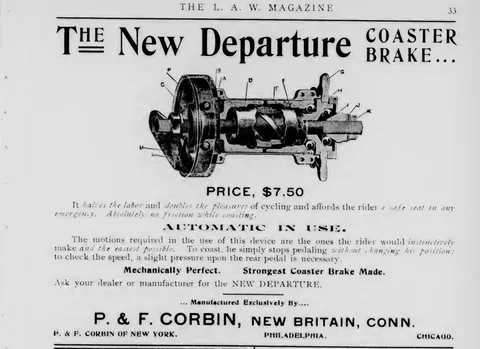 (opens in a new tab)
 The New Departure Coaster Brake advertisement 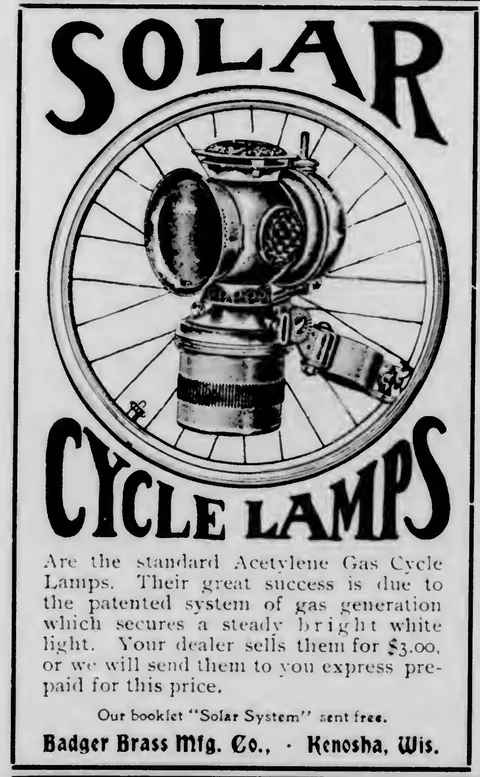 (opens in a new tab)
 Solar Cycle Lamps advertisement 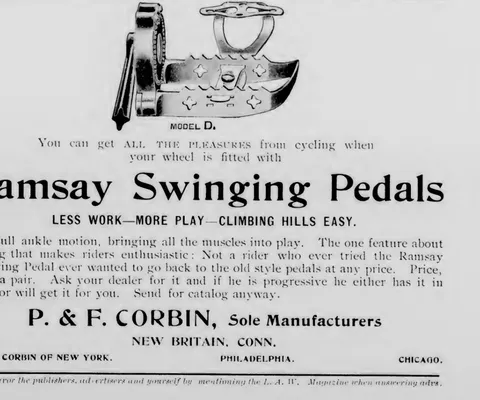 (opens in a new tab)
 Ramsay Swinging Pedals advertisement (Model D)  (opens in a new tab)
 A. G. Spaulding & Bros. Wool Soap advertisement  (opens in a new tab)
 Harrington & Richardson revolver advertisement  (opens in a new tab)
 Continuous Ringing Push Button bell advertisement 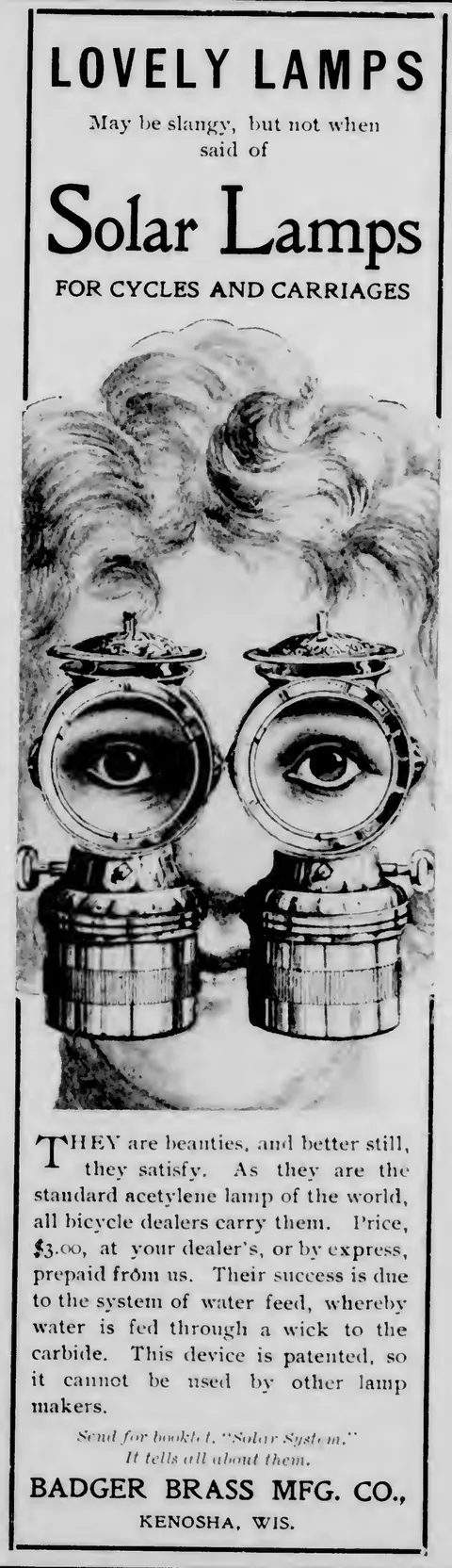 (opens in a new tab)
 Solar Lamps advertisement (Badger Brass Mfg. Co.) 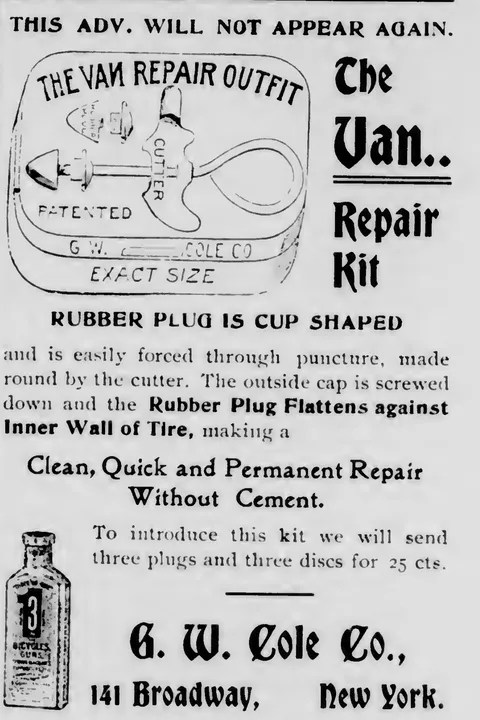 (opens in a new tab)
 The Van Repair Kit advertisement 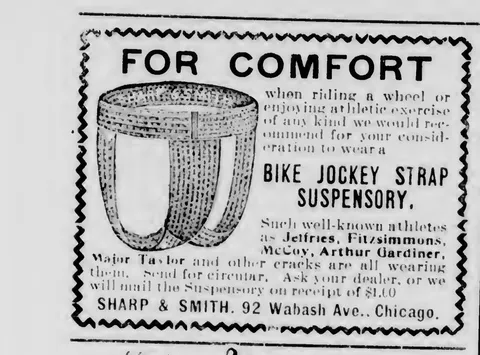 (opens in a new tab)
 Bike Jockey Strap Suspensory advertisement 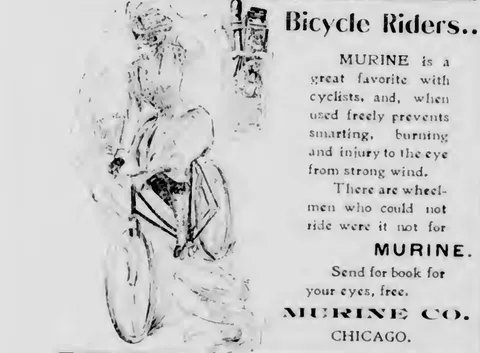 (opens in a new tab)
 Murine eye remedy advertisement 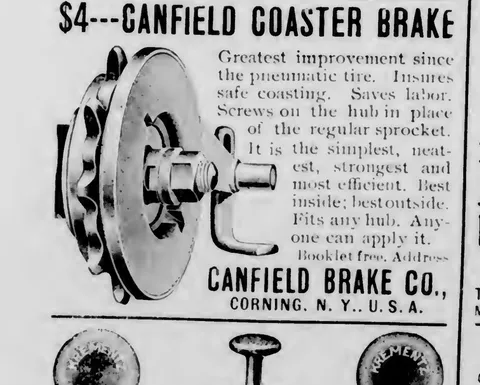 (opens in a new tab)
 $4 Canfield Coaster Brake advertisement  (opens in a new tab)
 Krementz One-Piece Collar Button advertisement  (opens in a new tab)
 D. & J. Hangers advertisement  (opens in a new tab)
 American Ring Co. Bachelor buttons advertisement  (opens in a new tab)
 Jar Absorber spring seat post advertisement  (opens in a new tab)
 Lamson's Luggage Carrier advertisement 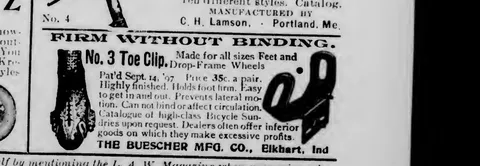 (opens in a new tab)
 No. 3 Toe Clip advertisement (Firm Without Binding) 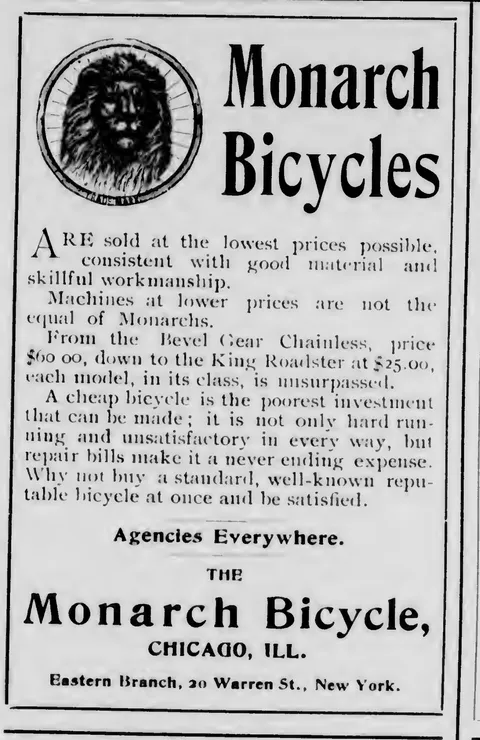 (opens in a new tab)
 Monarch Bicycles advertisement 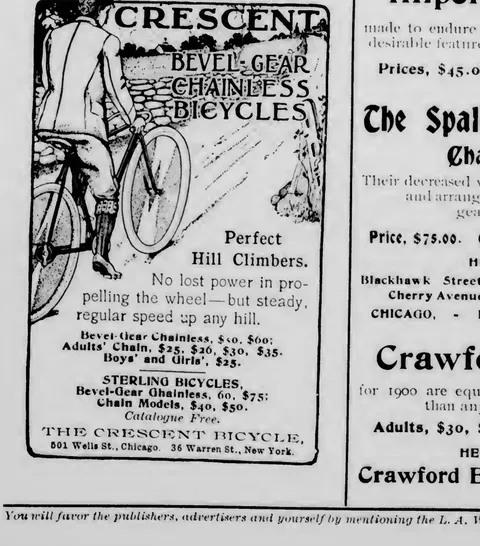 (opens in a new tab)
 Crescent Bevel-Gear Chainless Bicycles advertisement 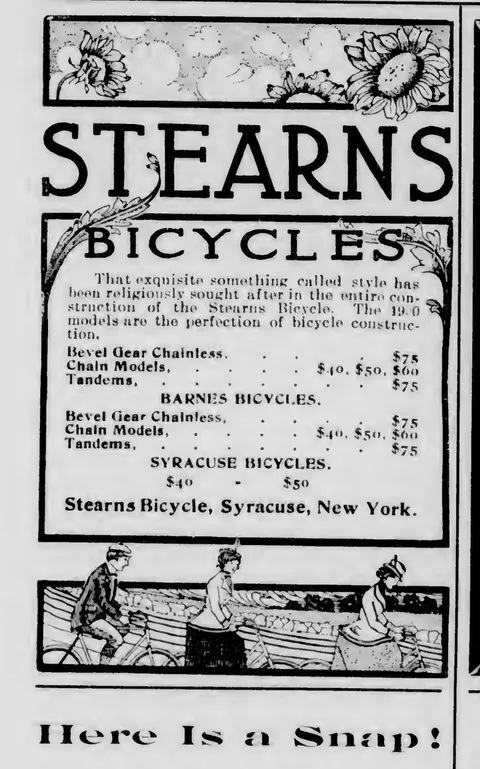 (opens in a new tab)
 Stearns Bicycles advertisement 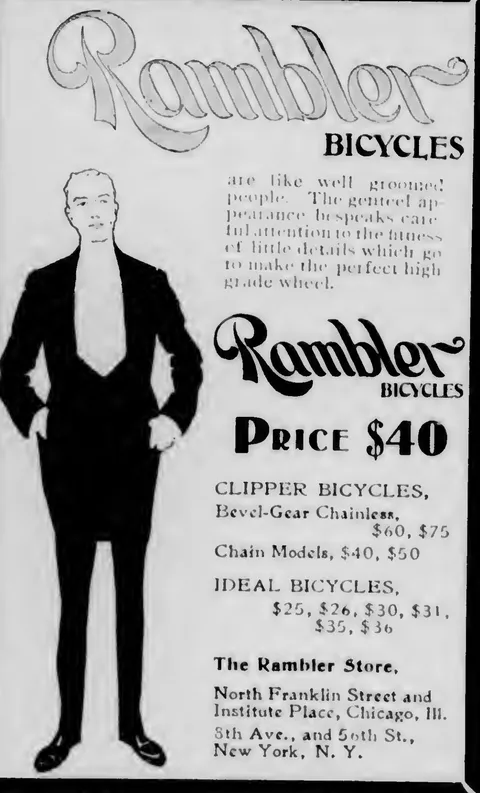 (opens in a new tab)
 Rambler Bicycles advertisement 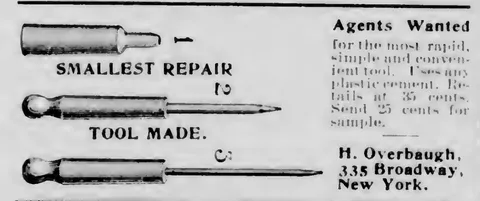 (opens in a new tab)
 Smallest Repair tool advertisement 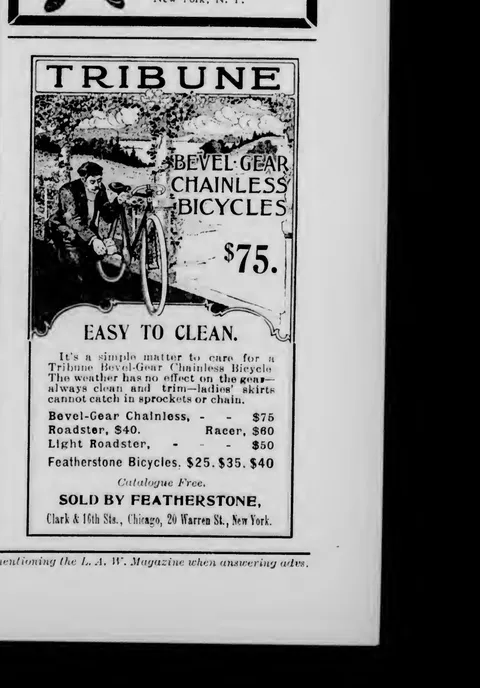 (opens in a new tab)
 Tribune Bevel-Gear Chainless Bicycles advertisement  (opens in a new tab)
 Hayner's Pure Rye Whiskey advertisement 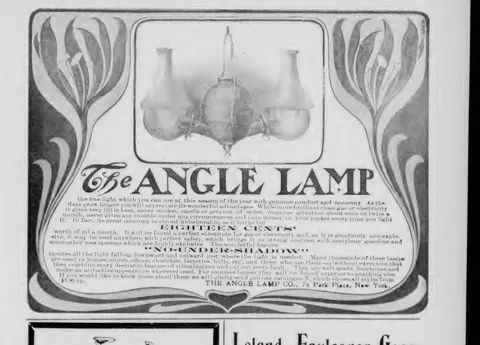 (opens in a new tab)
 The Angle Lamp advertisement 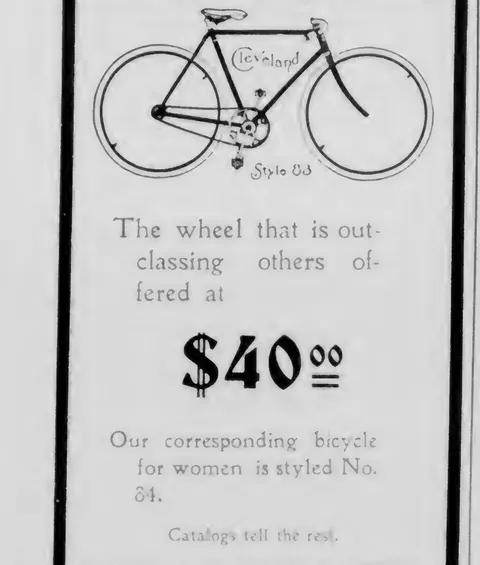 (opens in a new tab)
 Cleveland Bicycle advertisement 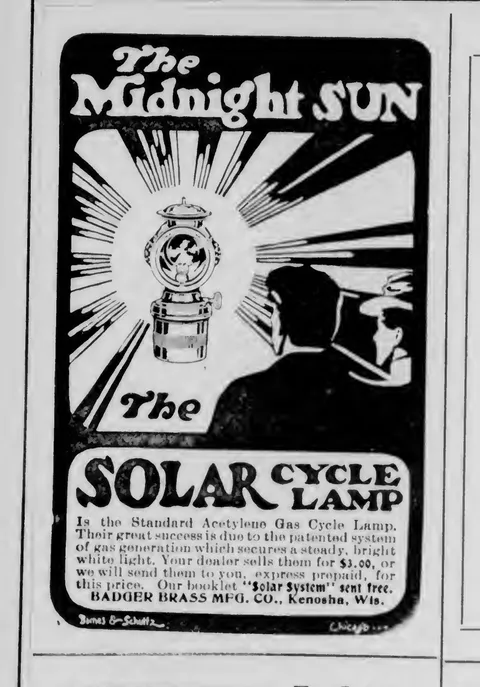 (opens in a new tab)
 The Midnight Sun Solar Cycle Lamp advertisement  (opens in a new tab)
 G & J Tire Co. advertisement  (opens in a new tab)
 A. W. Faber pencils advertisement  (opens in a new tab)
 Columbia Chainless Bicycle advertisement