Vol 31, No 10
190182 articles40 images
Articles in this issue
- The magazine's monthly news-and-comment department for March 1901, opening with the L. A. W. National Assembly held at Philadelphia in February and running on through cycle-path and good-roads legislation, trade movements and racing.
- The 1901 National Assembly finished its work in a single day. The Revision Committee's proposal to broaden the League's objects to "all who use the highways" was defeated after Potter, Seward and other veterans objected, while the "wheelman" requirement and the eighteen-year age limit were dropped and junior membership erased.
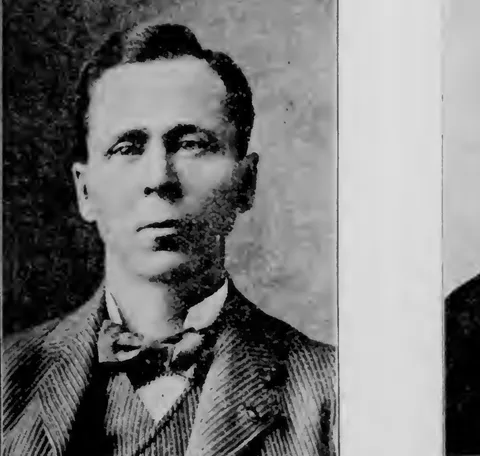
- Senator H. S. Earle of Michigan was elected president, George C. Pennell of New York first vice-president, W. A. Howell of Connecticut second vice-president and J. C. Tattersall of New Jersey treasurer, with Secretary Abbot Bassett left undisturbed.
- Potter and Cahill's argument for putting local organizations on a firm financial basis was adopted without dissent, giving local bodies the League's strength behind them and money in their own treasuries.
- A step-by-step review of the Assembly's business: officers elected without opposition, the new wording of the League's objects ("to defend the rights of cyclists... and to secure the construction and maintenance of good roads and cycle paths"), and the abolition of the age limit and junior membership.
- The secretary's bond was cut from $10,000 to $5,000 and the treasurer's from $15,000 to $5,000, the secretary's salary fixed at $2,000, Small of Maine, Kerrison of Massachusetts and Van Nort of Pennsylvania elected to the auditing committee, and proxy voting limited to one proxy from outside a delegate's own state.
- The Potter-Cahill resolution passed with eclat, rebating to a new local organization the surplus over that city's previous largest remittance, an Oswego body of 100 members sending $100 would recover $75.
- The Oregon Supreme Court struck down Multnomah county's bicycle sidepath tax on four constitutional grounds in J. A. Ellis's replevin suit against the sheriff. Sidepath bills are pending in Minnesota, where the Associated Wheelmen of St. Paul propose a fifty-cent annual tax, and in Wisconsin.
- Pennsylvania's State Highway Commission reports the present road system inadequate and offers three bills, including a $1,000,000 appropriation to the Department of Agriculture; two good-roads bills at Albany would put $5,000,000 to a popular vote and abolish the "working out" tax.
- A bill sought by the Somerville Cycle Club would make a bicycle a "carriage" in Massachusetts law after a Supreme Court ruling barred a cyclist from recovering damages for highway defects; Representative Lawrence of Alboite would require lighted lamps on Indiana highways at night.
- Assemblyman Dooling of New York City would compel Hudson river boats to carry passengers' bicycles free as baggage, while Assemblyman Fowler's bill to fine footpath riding $25 conflicts with the Collins law of 1899.
- The publishers of the L. A. W. Magazine offer $500, prizes of $250, $150 and $100, for the best bicycle stories published in American daily papers, graded by the population of the city of publication, with no entrance fee and open to any writer.
- Hon. Martin Dodge, director of the office of public road inquiries in the Department of Agriculture at Washington, has issued his annual report dealing with the office's work during 1900.
- The Automobile & Cycle Parts Co. was organised at Cleveland with $5,000,000 capital by A. L. Garford, Windsor T. White, F. N. Smith and others, buying from the American Bicycle Company the saddle works at Elyria and Westboro, stamping plants at Milwaukee and Chicago, the Indianapolis chain factory and Cleveland ball and pedal plants.
- A cycle and motor show at Philadelphia and the Paris Salon du Cycle; Frank T. Fowler enters the Chicago mayoralty race; manufacturer J. H. Thomas dies at Springfield, O.; Col. Geo. T. Perkins of B. F. Goodrich promises Akron a $50,000 library; a receiver is appointed for the March-Davis Cycle Company.
- Prof. W. O. Atwater's calorimeter trials at Wesleyan College put a cyclist on a dynamo-coupled bicycle for twelve hours a day over eight days, comparing carbohydrates against fats as fuel for hard muscular work; all home training records were broken again and again.
- The Cycling Gazette's annual compilation puts Orlando L. Stevens first among individual performers with 123 points, Iver G. Lawson second; active racing is confined to the Pacific Coast, with weekly meets at Los Angeles and Jack Prince's new velodrome at Fresno drawing Cooper, Kiser, Nelson, Lake and McFarland.
- The National Cycling Association met in New York in early February with a bank balance of $2,155.89, re-elected its officers but for vice-president (Geo. M. Hendee of Springfield), made the suspensions of Orlando L. Stevens and Jay Eaton permanent, and voted unpaced championships at 25, 50 and 100 miles.
- A dated diary of cycling events for January and February 1901, from the closing of the Paris Hippovelodrome and the burning of the Pope branch at Washington to the National Assembly at Philadelphia and the death of former racing man Clinton R. Coulter in a Nevada railroad wreck.
- G. A. Boettner, a Brooklyn repairer styling himself "Cycle Doctor and Machinist", advertises as a "Cycleologist" with pharmacy, surgery and free hospital removal for sick mounts, his licence to practise being his L. A. W. diploma.
- The Leland & Faulconer Manufacturing Company of Detroit contributes the equation X = (A/B) x (C/D) x E for finding the gear of a bevel-gear chainless, worked through for a 40, 15, 23 and 20-tooth train on a 28-inch wheel to give 85 13-15.
- T. Phillip Terry, reprinted from Outing for October 1900, rides the Tokaido and the country roads around Kobe and Yokohama, contrasting the hospitality of the interior with the mercenary treaty ports and recalling the Daimyo trains of the Shogunate.
- Frank H. Vizetelly in St. Nicholas traces "The Story of the Wheel" from Baron Drais von Sauerbronn's draisine through Dennis Johnson's 1818 elbow and body rest and Louis Gompertz's 1821 hand lever to the iron machine popularised by the English contractor Knight.
- A standing department covering the sports beyond cycling that League members follow, golf, base ball, lawn tennis, rowing and game protection.
- Harper's Golf Guide for 1901 counts 1,037 golf courses in the United States, New York leading with 164 clubs and Massachusetts second with 158; Pennsylvania and New Jersey each lost five, while Montana grew from one club to five.
- A quiet movement to send a team of American amateurs to the British championships, the amateur at St Andrews on May 7 and the open at Muirfield a month later, is to be brought before the United States Golf Association's annual meeting.
- Chicago agitation for an official ball draws scorn from the Brooklyn Eagle; John Reid of the St. Andrew's Golf Club of New York and an English enthusiast both argue that players' attachment to particular balls and makes of club is largely superstition.
- Caspar Whitney in Outing urges the golf association to rank players as the National Lawn Tennis Association does, placing Walter J. Travis, Findlay S. Douglas and R. C. Watson, Jr. first and bunching the rest, with a parallel list of women headed by champion Miss Frances Griscom.
- The New York Sun on the passing of the freak club: aluminium putters and plated irons aside, the best players in Great Britain and America are now practically of one mind on club heads, and the 1896-7 craze for new shapes has died out.
- The magazine holds that the American Association will never play a game, while the American League is firmly ensconced in its new territory; the Players' Protective Association met at Cleveland and its demands now look likely to be met by the National League.
- At the Eastern League meeting Springfield was dropped and Buffalo admitted, with President Powers re-elected; the American League at Chicago adopted a constitution, confirmed Ban Johnson as president and fixed a circuit of Baltimore, Washington, Philadelphia, Boston, Chicago, Cleveland, Detroit and Milwaukee.
- The Pittsburg National League club's internal difficulties were settled by the sale of stock to W. K. Schoepf of the Consolidated Traction Company, Barney Dreyfuss, O. S. Hershman of the Pittsburg Press and Harry P. C. Pulliam, closing the opening the American League might have used.
- President Johnson withheld the figures until mid-February for diplomatic reasons. Kansas City leads team batting at .274 and Milwaukee team fielding at .947, with Ganzel of Kansas City heading the batters and Waddell of Milwaukee the leading winning pitcher.
- The National Lawn Tennis Association met at the Hotel Waldorf, New York, on February 7, enlarged its executive committee, referred the "foot fault" rule to a joint committee with an English committee, and cut rests between sets to a single seven-minute break.
- The League of American Sportsmen met in New York City on February 13; President G. O. Shields reported membership up from 2,527 to 5,110, thirty-five state divisions and game wardens grown from 82 to 122, with Theodore Roosevelt and Levi P. Morton among the year's new members.
- Rowing news for the coming season, covering the Yale-Harvard arrangements at New London, an approach to Oxford and Cambridge, and plans for an American Henley.
- Yale and Harvard will row at New London on June 27, 'varsity four-oar, freshman eight and 'varsity eight, and will enter neither the Poughkeepsie intercollegiate regatta nor admit a third college for at least another year.
- The Intercollegiate Rowing Association, through R. C. Cornell of New York and Rudolph C. Lehmann of Cambridge, is negotiating to bring an Oxford or Cambridge crew to row Cornell, Pennsylvania, Columbia and Wisconsin at Poughkeepsie on July 3.
- Boston rowing men, aided by Walter Camp, plan a week's racing over the Thames course at New London in late June, inviting the New York A. C., Boston A. A., the rowing colleges and clubs such as the Union Boat Club and the Philadelphia Barge Club.
- A reprint department of "Events of Other Days As Related When They Occurred", drawn from the L. A. W. Bulletin and Sporting Life of 1885 to 1891.
- From the L. A. W. Bulletin of July 11, 1890: the first Poorman handicap road race over 17.2 miles, in which N. H. Van Sicklen of Chicago took the time medal from scratch, Hubert O. Baumann of Dayton finished first, and J. E. Miley of Lockland was kicked from his wheel by a frightened horse.
- Sterling Elliott in the L. A. W. Bulletin of April 17, 1891, on Secretary Abbot Bassett's new gloves, the undecided dollar bet over the blacking of his shoes refereed by W. W. Stall, and Bassett's remark at the Niagara meet that "thirty-five years ago the falls were right here".
- James H. Shipley climbs to Trient on the road from Chamonix to Martigny only to be told the descent is too steep to ride; his hub brake generates enough friction to burn the oil out of the hub, while his companion rigs a forked branch against the tire and both walk down.
- Dr. E. B. Turner closes his series in the Cyclists' Touring Club Gazette with eight recapitulated rules on the hygiene of cycling, from wool next the skin and moderation for the novice to the warning that no untrained person should ever race.
- An address by Hon. Wm. W. Armstrong on the New York state-aid highway law that took effect on March 24, 1898, the five principles it was built on, the machinery of town boards, boards of supervisors and the state engineer, and the division of cost between state, county and town. To be continued.
- A year-by-year list from 1880 to 1901 of the League's presidents, vice-presidents, secretaries and treasurers with the national meet city, from Chas. E. Pratt and Newport, R. I. through Abbot Bassett's long secretaryship to H. S. Earle and the Buffalo meet.
- The editorial page on the $500 story prizes, the fitness of new president Horatio S. Earle, the hastily drafted Potter-Cahill local organization plan, the Jeffersonville wheelmen's argument against lamps, the Oregon sidepath decision, and the rising merit of the motor bicycle with cushion-frame and coaster-brake.
- Secretary Abbot Bassett's official section, carrying his own comment, the rosters of national, division and foreign officers, the minutes and committee reports of the national assembly, the touring routes and division news.
- Bassett's review of the assembly: he welcomes Earle's good-roads campaign but regrets that no system of consulates, no national election of officers by individual members and no weekly paper were adopted, that the title "L. A. W. Bulletin" has gone, and that expirations are still not notified from headquarters.
- Addresses for President Horatio S. Earle of Detroit, First Vice-President George C. Pennell of New York, Second Vice-President W. A. Howell of Rockville, Treasurer J. C. Tattersall of Trenton and Secretary Abbot Bassett at 221 Columbus avenue, Boston.
- Postoffice addresses of the chief consuls and secretary-treasurers of every state division from Colorado to Wisconsin, on whom consuls and agents should draw for application and renewal blanks and League literature.
- League consuls abroad, among them Joseph Pennell in London, Paul Oeker in Paris, Friedrich Schleicher in Berlin, Abrate at Turin, Otto Mayer in Vienna, Raisa Earl at Tokio and Alfred F. Terry at Cienfuegos, Cuba.
- Minutes of the meeting in the India Room of Hotel Lafayette, Philadelphia, on February 14: Buffalo accepted for the annual meet on Mayor Conrad Diehl's invitation, committee reports received, and Earle, Pennell, Howell and Tattersall elected unanimously; the afternoon session took up the revision committee's amendments, the four-hour dispute over Bassett's proxies and the secretary's salary.
- Retiring president Conway W. Sams's report to the assembly, arranged under sections on the official organ, the Canadian agreement, the loan account, the Curtis monument, the national meet, the future of the organization, insurance, reorganization, racing and his farewell.
- Sams recounts the award of the printing contract to Emil Grossman & Brother of Cleveland for a monthly official organ, and the $1,000 the Grossmans deposited with the American Trust Company as security when a suitable bond could not be procured.
- The agreement admitting members' wheels into Canada free of duty has been greatly abused; the League has paid one bill of $110.80 with about $250 more outstanding, and Sams recommends withdrawal unless a bonding system can protect it.
- Of $10,278.30 lent to the divisions in the days of prosperity, $6,008.01 is still due; the executive committee has eased repayments through a hard year, and Sams notes that the divisions which have worked hardest are the ones in debt, Pennsylvania excepted.
- Sams declines to bind the incoming administration to any definite sum for the Curtis monument, holding it a commendable work to be taken up in order and treated as liberally as the League's finances permit.
- Sams refuses to comment on the 1900 national meet at Milwaukee, preferring in view of the situation there and the memory of one now dead "to let the dead past bury its dead".
- Sams blames the year's great decline in cycling and the collapse of the earlier prize-driven "hot house" membership growth; headquarters expenses at Boston were halved and appropriations to the press, highway, sidepath and touring committees cut off entirely.
- The members' insurance plan adopted after last year's assembly sold its first policies at almost actual cost, but the varying insurance laws of the different states and members' unwillingness to use the privilege have halted its development.
- Sams argues that road improvement, cycle paths and touring are national questions requiring a small, inexpensive national body resting on strong local organizations, and commends a Cycling Gazette editorial of February 7, 1901 on replacing state divisions with sectional ones.
- Sams advises strongly against the League re-entering race control, noting it never derived a cent of profit from racing and that the N. C. A. should be left to prosper in its chosen field without interference.
- Sams closes on a year of great disappointment begun in the slump in wheeling, says the League needs at its head someone who can give it his entire time, and retires "from labor to rest and from troubles to peace".
- Abbot Bassett reports membership down from 50,572 to 24,326, cycling papers from 58 to five and forty-five manufacturing concerns merged into one; society has left the wheel for golf, and he argues the consulate rather than the division is the League's salvation.
- State-by-state membership totalling 24,328, from Alabama's 11 and Nevada's single member to New York 5,351, Massachusetts 5,173, Pennsylvania 5,034 and New Jersey 1,434.
- George M. Schell reports a system of printed through-routes devised for the large eastern cities, negotiations with the German and Italian touring organizations stalled on free customs entry of wheels, and route data supplied to the Pan-American exposition's department of publicity for riders bound to Buffalo.
- H. B. Fullerton reports that only $39 of the $500 appropriation was drawn, the rest of his expenses paid from his own pocket, and warns that the newly banded automobile clubs are now the most powerful good-roads force; he also complains that the committee's records, negatives and slides were never handed over to him.
- Herbert W. Knight reports no matters of importance during the year; a projected L. A. W. pamphlet on the rights of wheelmen was not published, though a great deal of data was collected from the division committees on rights and privileges.
- Geo. L. McCarthy reports a press bulletin issued weekly to 600 leading dailies until October, when the executive committee stopped expenditure, plus syndicate plate matter for smaller papers, and credits the committee with suggesting the good-roads planks to President Sams.
- Chas. W. Mears reports the briefest record in the committee's history, one protested application, dismissed after nearly three months, and recommends provision against members entering false charges; appeals to incorporate the League and to strike "white" from the constitution were left untouched.
- A membership appeal setting out what the League gives its members: road books and maps, the hotel, consul and repair-shop systems, free carriage of wheels as baggage, a Cyclists' Touring Club ticket for Britain and the Continent, and the Canadian free-entry arrangement, two dollars the first year, one thereafter.
- George M. Schell reprints the department's records as through routes to the Pan-American exposition: New York to Albany by Yonkers, Peekskill and Poughkeepsie, Boston to Albany by Concord, Fitchburg and the Hoosac Tunnel, and Albany to Buffalo by Schenectady, Utica, Syracuse and Rochester.
- Chief Consul M. M. Belding, Jr. writes to the local consuls on recruiting, urging personal solicitation for renewals and citing the Liberty Bill, the Bicycle Baggage Bill, the State Sidepath Law and the fifty-cent New Amsterdam Casualty accident policy as arguments for membership.
- Belding gives notice that F. T. Cahill of Oswego, N. Y. has been appointed chairman of the division's highway improvement committee, to whom all such matters should now be addressed.
- H. B. Worrell and P. S. Collins urge every Pennsylvania member to write his senator and representative about House Bills Nos. 74 and 75, held up in the road committee, which would make operative the Hamilton bill's million-dollar appropriation; the members of the house and senate road committees are named county by county.
- The division's accounts from November 1, 1899 to November 1, 1900, covering office rent, clerk hire, postage, the road book committee, the 1899 annual meeting and rebates to League clubs, certified by Secretary-Treasurer P. S. Collins and auditors W. R. Tucker and Wm. Friedgen, Jr.
- Chief Consul Chas. W. Mears of Cleveland lists the consuls appointed for the year in every Ohio town from Ada and Akron through Cincinnati, Cleveland, Columbus, Dayton, Springfield and Toledo to Yellow Springs and Zanesville.
- On enforcement of the guideboard law and Pawtucket's consulate, which enrolled the late superintendent of street signs James M. Crawford and had substantial guideboards and L. A. W. danger signs placed on every important thoroughfare; the consulate is now collecting other states' road laws with a view to legislation.
- Two letters: one from Morristown, N. Y. proposing that every club keep wheels for the use of visiting members on a traveling card, and one from J. F. Small, Jr. of Sebois, Maine defending the publisher against W. F. Selle's criticism of the political advertising in the November issue.
- F. A. Elwell of the Hotel Columbia, Portland, Me. gives League members 7 per cent off his three 1901 European tours, leaving New York on May 25, June 22 and August 17 for Holland, England, France, Switzerland, Germany and Scotland.
- Trade notes on the G. & J. Tire Company's new 28x1 3/8-inch tire, the Esmond pensile-frame saddle, the Latina Cellular tire, the Reeves Ideal spring seatpost, Geo. N. Pierce's chainless "Pan-American Special", Goodyear's detachable clincher, the Morrow coaster-brake, and the 1901 Columbia, Rambler, Barnes, Tribune, Spalding and Cleveland chainless models.
Images in this issue 40 pictures from 26 pages
Photographs 11
 (opens in a new tab)
 H. S. Earle, the New President 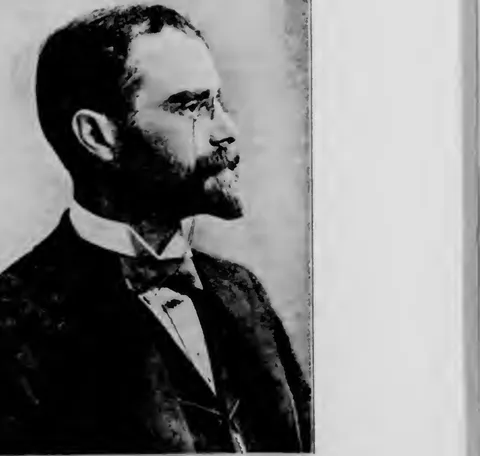 (opens in a new tab)
 Conway W. Sams, the Retiring President 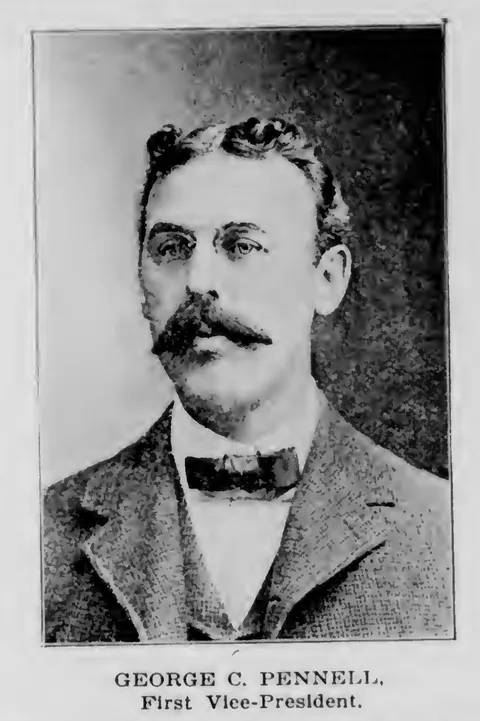 (opens in a new tab)
 George C. Pennell, First Vice-President 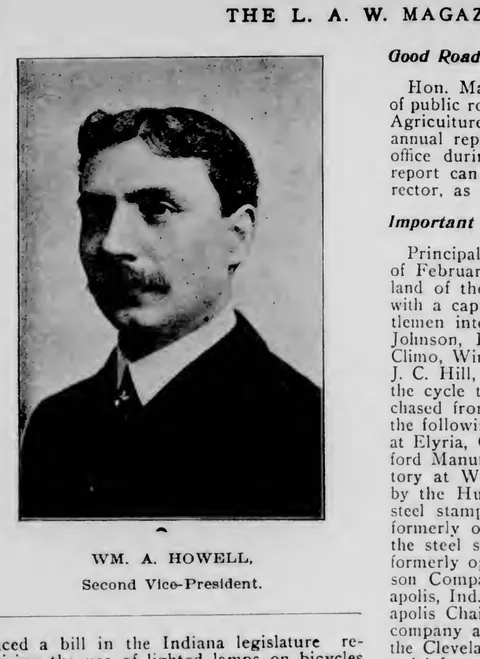 (opens in a new tab)
 Wm. A. Howell, Second Vice-President 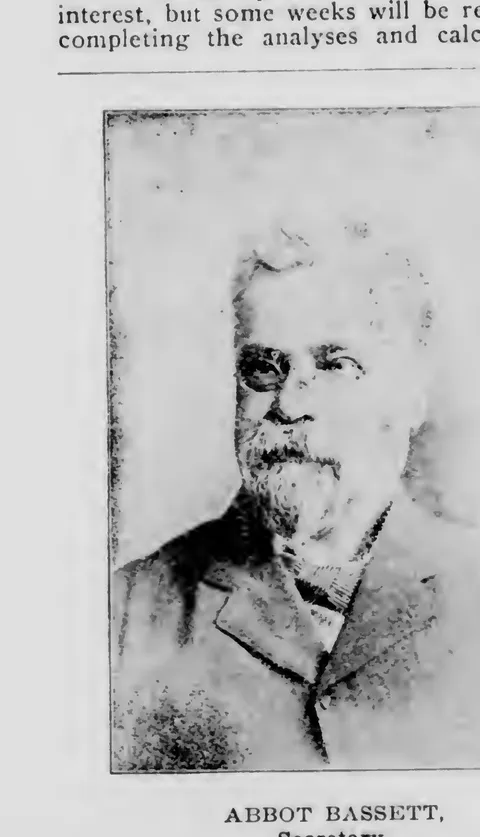 (opens in a new tab)
 Abbot Bassett, Secretary 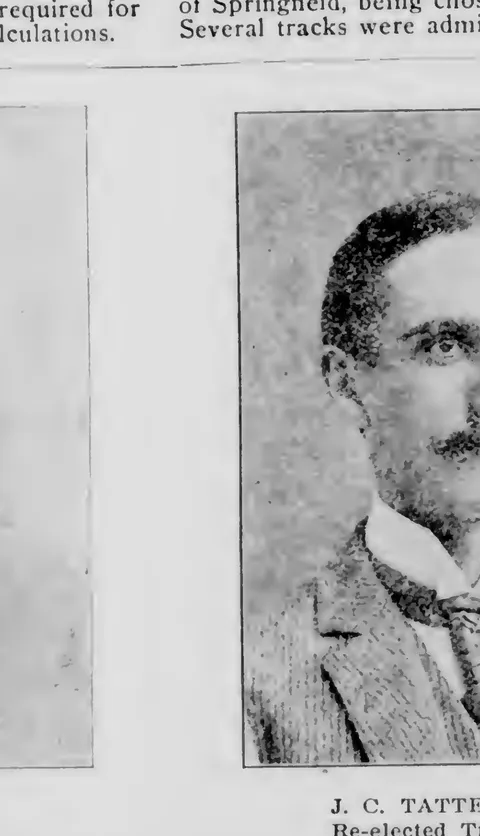 (opens in a new tab)
 J. C. Tattersall, Re-elected Treasurer 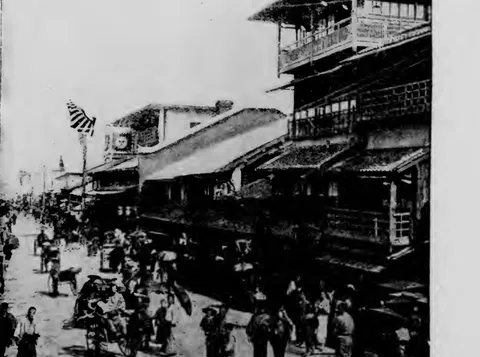 (opens in a new tab)
 Awheel in the Heart of Old Japan 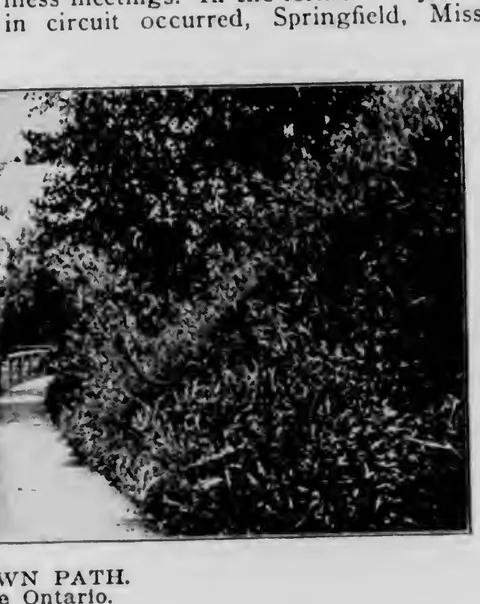 (opens in a new tab)
 Forest Lawn Path, Along Lake Ontario 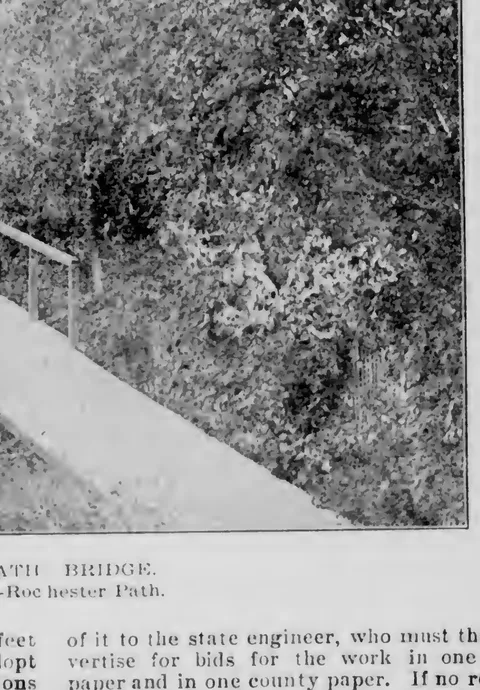 (opens in a new tab)
 Sidepath Bridge, Batavia-Rochester Path 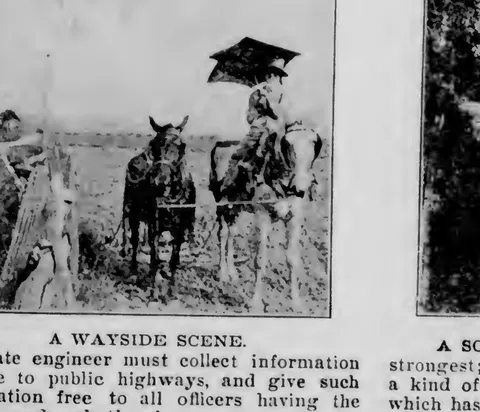 (opens in a new tab)
 A Wayside Scene 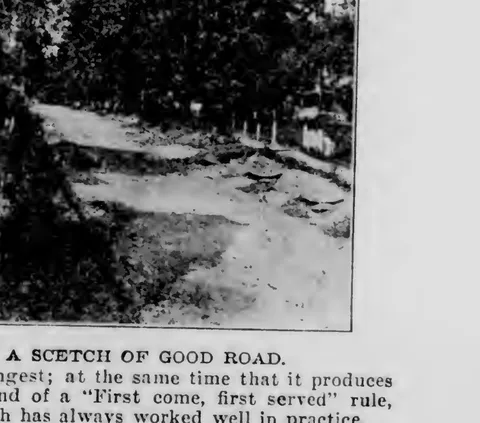 (opens in a new tab)
 A Sketch of Good Road
Mastheads 2
 (opens in a new tab)
 L.A.W. Magazine, March 1901  (opens in a new tab)
 L.A.W. Magazine department masthead, March 1901
27 advertisements
 (opens in a new tab)
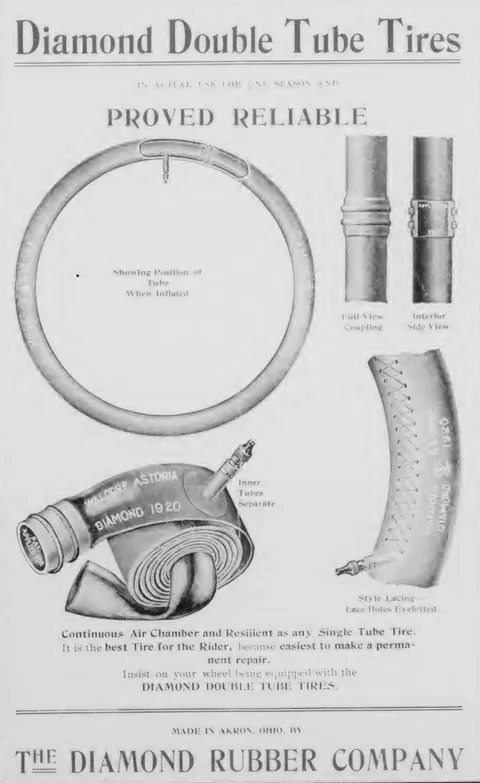
 Diamond Double Tube Tires (Diamond Rubber Company)  (opens in a new tab)
 20th Century Head-Lights and Calcium Carbide 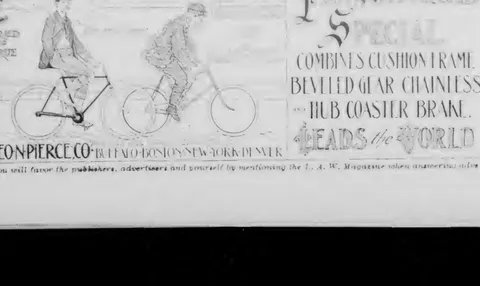 (opens in a new tab)
 Pierce Cycles, Pan-American Special 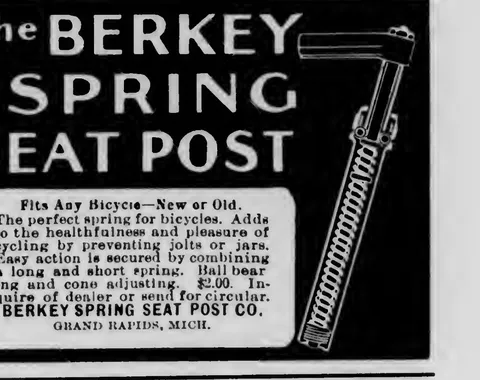 (opens in a new tab)
 Berkey Spring Seat Post 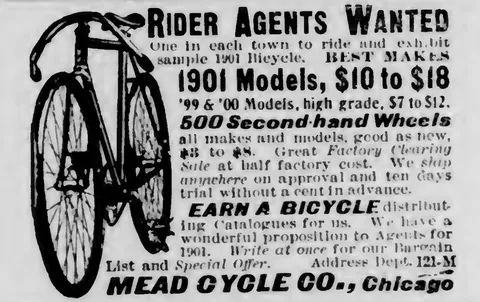 (opens in a new tab)
 Mead Cycle Co., Rider Agents Wanted  (opens in a new tab)
 Canfield Coaster Brake 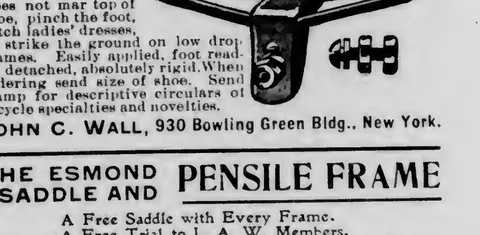 (opens in a new tab)
 A Sole Clip toe clip 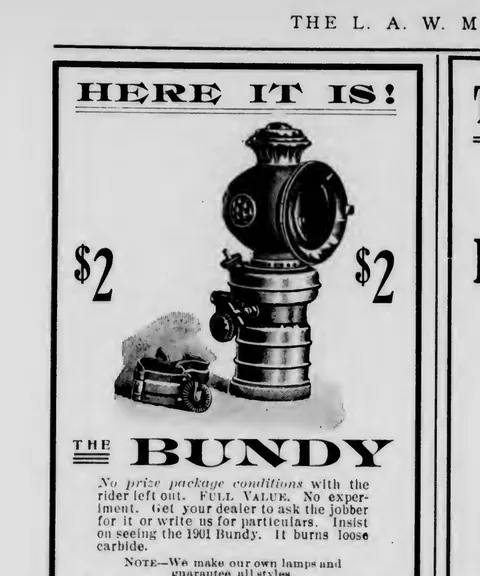 (opens in a new tab)
 The Bundy acetylene bicycle lamp 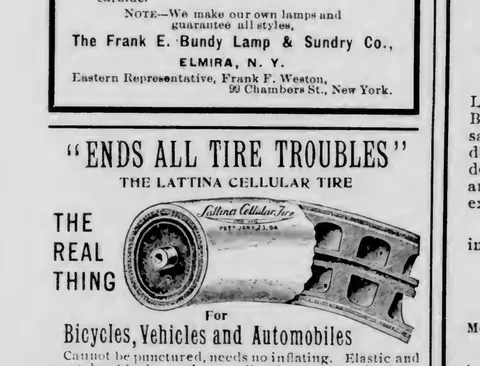 (opens in a new tab)
 Lattina Cellular Tire 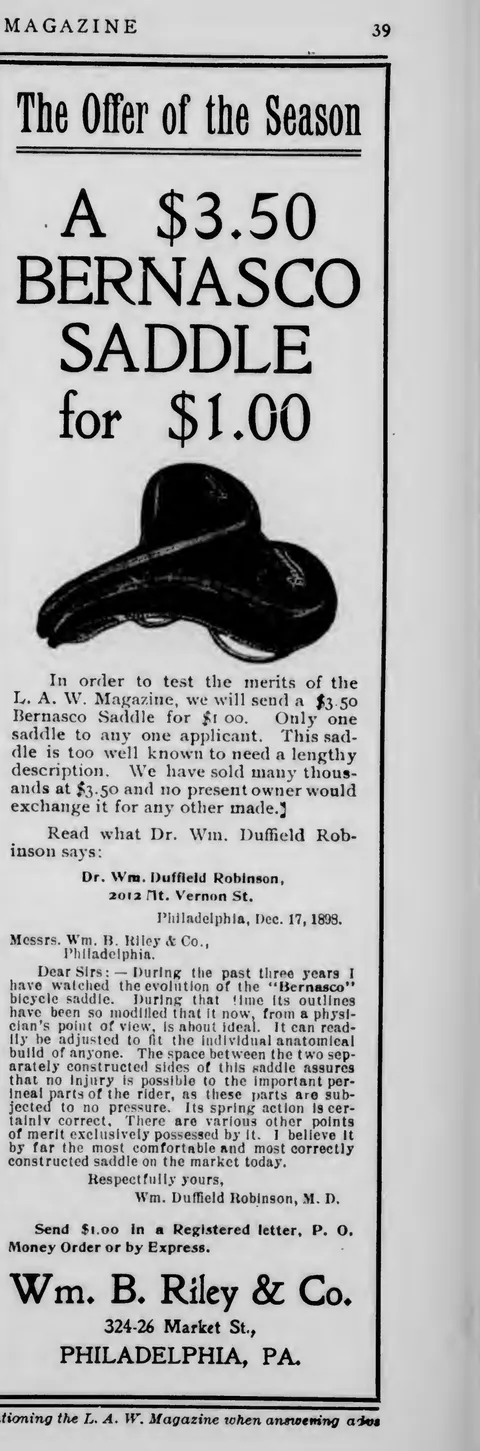 (opens in a new tab)
 Bernasco Saddle offer 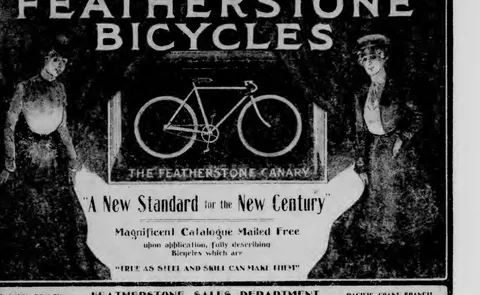 (opens in a new tab)
 Featherstone Bicycles, The Featherstone Canary 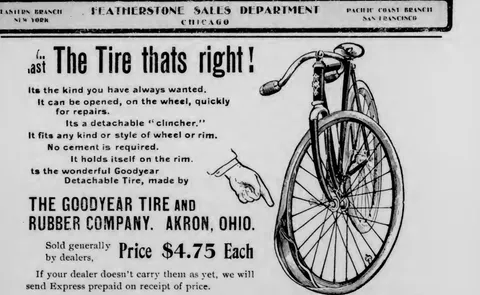 (opens in a new tab)
 Goodyear detachable clincher tire 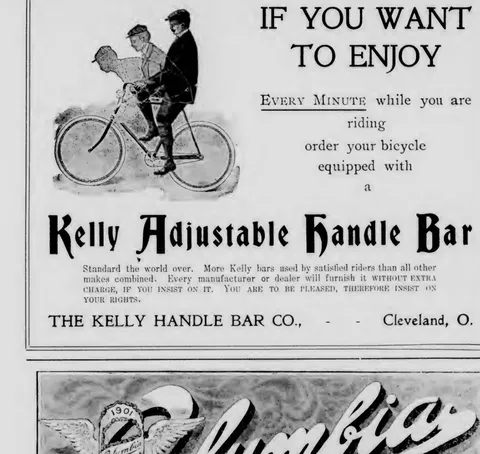 (opens in a new tab)
 Kelly Adjustable Handle Bar 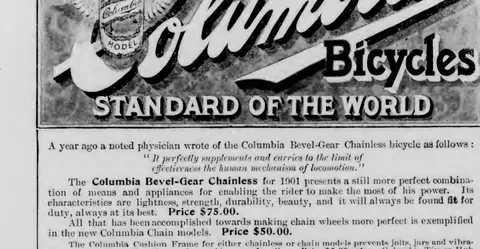 (opens in a new tab)
 Columbia Bicycles, Standard of the World 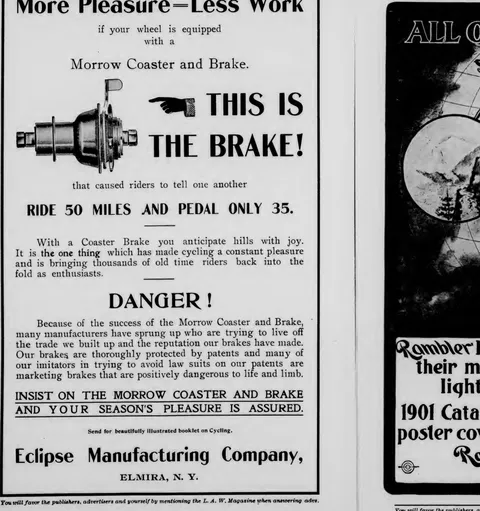 (opens in a new tab)
 Morrow Coaster and Brake, This is the Brake! 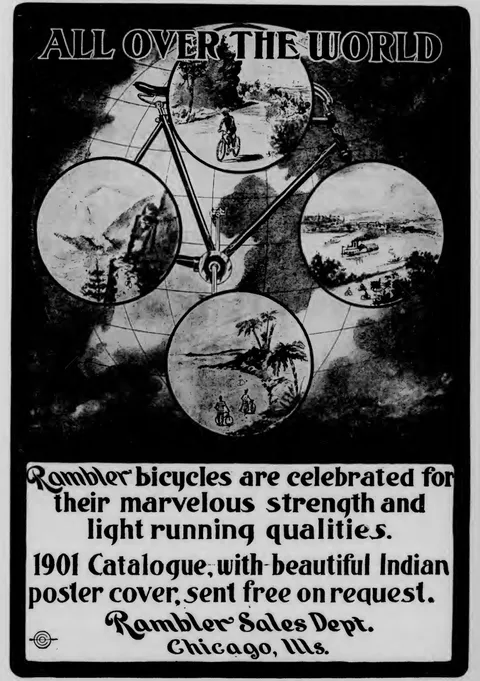 (opens in a new tab)
 Rambler Bicycles, All Over the World 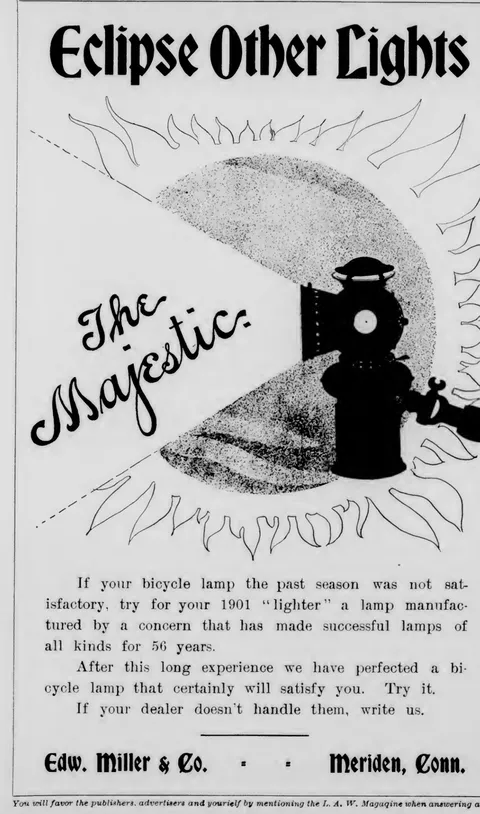 (opens in a new tab)
 The Majestic bicycle lamp, Eclipse Other Lights  (opens in a new tab)
 White Flyers, Barnes Bicycles 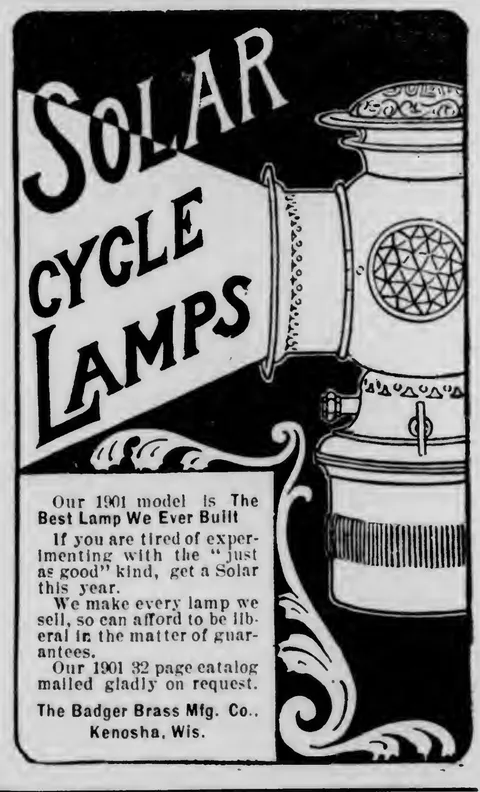 (opens in a new tab)
 Solar Cycle Lamps  (opens in a new tab)
 Robinson's Bath Cabinet  (opens in a new tab)
 Adams' Pepsin Tutti Frutti, Euchre 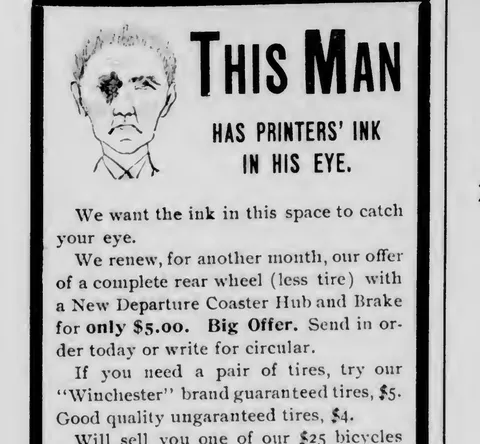 (opens in a new tab)
 This Man Has Printers' Ink in His Eye 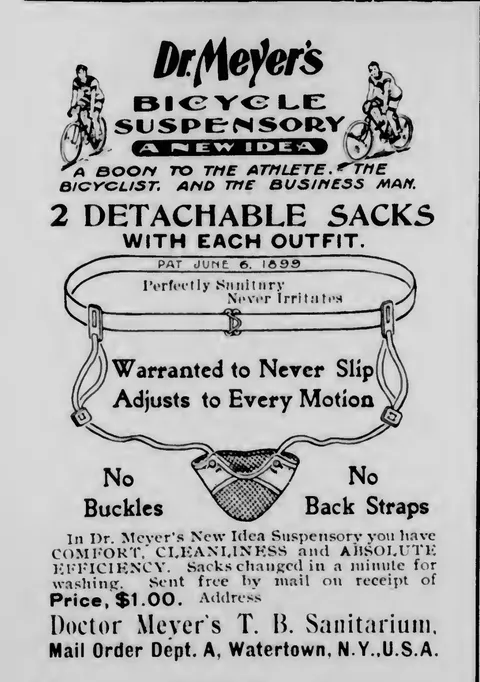 (opens in a new tab)
 Dr. Meyer's Bicycle Suspensory Remedy 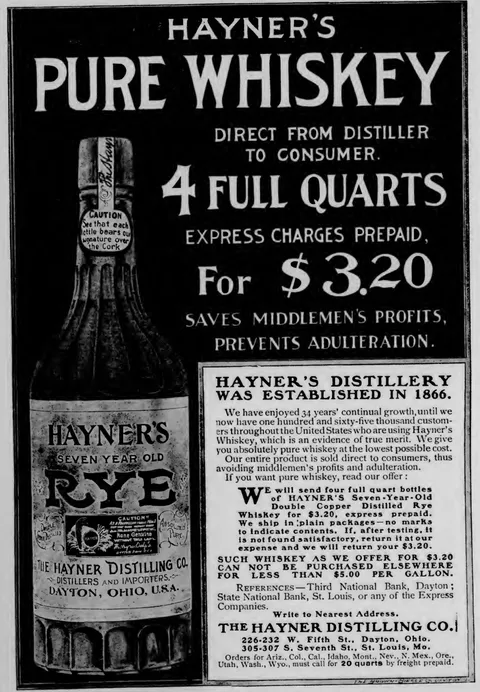 (opens in a new tab)
 Hayner's Pure Whiskey 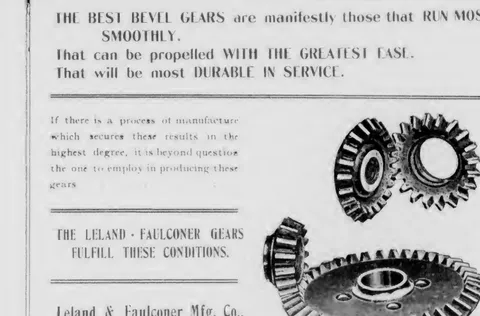 (opens in a new tab)
 Leland-Faulconer bevel gears  (opens in a new tab)
 G. & J. Tires, The End in View  (opens in a new tab)
 Champion Hubs, Pleasure or Cussing?