Vol 31, No 11
190157 articles42 images
Articles in this issue
- The magazine's monthly news-and-comment department for April 1901, running from the new $10 life membership and President Earle's national committee appointments through sidepath and good roads legislation to international racing and the month's trade news.
- Earle, Pennell and Howell, the new executive committee, called a special National Assembly at Detroit Wheelmen Hall on March 29, 1901, and by March 11 fully 90 per cent of the vote favoured life membership; $10 buys a leather-bound card and a winged "L. M." button, the fee split 35 per cent national per capita, 10 per cent special expenses and 55 per cent to the member's state division.
- Opponents argue $10 is too small a sum to carry a member through life, but President Earle maintains the receipts would clear the League and its divisions of debt and fund recruiting, even if it means collecting ten years' revenue in advance.
- President Earle appoints ten national committees: C. Lee Abell of Buffalo chairs the Pan-American Exposition meet committee, Chas. T. Harrison of the Office of Public Road Inquiries takes highway improvement from H. B. Fullerton, and Herbert W. Knight, Dr. C. H. Hunter, George M. Schell and Geo. L. McCarthy continue, with new chairmen F. T. Cahill, Thos. L. Pogue, Edw. N. Hines and Burley B. Ayres.
- Entries in the L. A. W. Magazine's $500 prize story competition are now with judges Sams, Dodge and Mears, with a decision expected for the May number; the award turns on Condition No. 4, that the story emphasise the advantages and pleasures of bicycle riding rather than rhetoric.
- The Indiana legislature amends the state highway law so commissioners may on petition route an improvement over land not before used for the purpose, and makes it unlawful to haul heavy loads on narrow tires over turnpike, gravel or macadam roads during a thaw.
- H. B. Donly of Simcoe, Ont., for eighteen years an officer of the Canadian Wheelmen's Association, resigns the secretaryship because the office must be located in Toronto and he cannot give up his newspaper business.
- Stiles of Lehigh introduces a Pennsylvania sidepath bill electing three commissioners per county and assessing a tax on every bicycle owned; Oregon's new cycle path law, effective February 20, lets county courts build paths and levy a $1 rider licence, with the sheriff empowered to seize and sell a bicycle for the tax.
- H. S. Earle, League president and Michigan state senator, expects to start his good roads train from Chicago on June 15; the National Good Roads Association will run a similar three-month train over the Illinois Central from New Orleans to Chicago, building mile-long sample roads at twenty or more stops with machinery loaned by makers.
- The American Bicycle Company will employ a track racing team this year, with A. G. Batchelder engaging foreign cracks; those slated include Jacquelin, Edouard Taylor, Ellegaard, Robl, Fischer, Tom Linton, Major Taylor, Harry Elkes, Jimmy Michael, Archie McEachern, Tom Cooper, Frank Kramer, Johnny Nelson and W. C. Stinson, with Momo and Eros possibly signed.
- Doubt is raised over the legality of New York City's ordinance requiring bells, since the state law demands uniform city legislation and only requires an alarm by bell, whistle or otherwise audible 100 feet away.
- King Edward VII, an enthusiastic cyclist as Prince of Wales until a knee injury, has resumed wheeling with all his old ardour according to a recent cablegram, and has also taken up fencing.
- Chairman Batchelder of the National Cycling Association's racing board sailed March 13 for the International Cyclists' Union meeting at Alessandria, Italy, then to Paris to engage Taylor, Chase, Walters, Ellegaard, Arend, Momo and Jacquelin for the Buffalo national meet; the French U. V. F. protests world's championships spread over three Sundays in July.
- Store openings in New York, Boston and Cleveland; fire at the Drake Manufacturing wood rim factory in Milwaukee; Arnold, Schwinn & Co. buy the defunct March-Davis plant; deaths of John J. Davis of Davis, Hunt & Collister, Wm. H. Henderson of the White Sewing Machine Company and Thomas Sparrow, who introduced the bicycle into London; and Morgan & Ball's Springfield stock destroyed by fire.
- Sergeant Fred Huntoon (L. A. W. No. 30,449) sends a Manila Times clipping of February 11 describing races and a Cavite-to-Manila run, the only unridable stretch lying between Novalite and San Roque, with natives puzzled chiefly by a coaster-brake wheel.
- An address by Hon. Wm. W. Armstrong working the New York state-aid highway law's 50/35/15 division through Monroe County, comparing the poorest, average and richest towns of Clarkson, Chili and Greece, the town of Riga and cityless Orleans County, to show the poorest town receives the greatest contribution from state and county.
- F. T. Cahill, chairman of the L. A. W. National Local Organization Committee, argues that membership will only grow if local consulates are established and funded to deal with bad pavements, unrailed culverts and petty municipal ordinances that no state or national board can reach.
- The magazine's general sporting department for April 1901, covering the America's Cup defenders, base ball, golf and miscellaneous athletics from the Olympian games to intercollegiate cycling.
- W. P. Stephens on the two 90-ft cutters: the unnamed Herreshoff boat with web frames every fourth space and continuous longitudinals, and Crowninshield's Independence for T. W. Lawson, whose bronze trough keel is packed with lead pigs and shot, with Capt. Hank Haff in sole command; also Shamrock II, Columbia's refit and Defender's likely breaking up.
- The issue's base ball department, reporting the National League's rule changes, the American League's 1901 schedule and a reported scheme for a base ball trust.
- Changes adopted at the New York meeting: the first two foul balls now count as strikes, the catcher must stand within 10 feet of the plate, the pitcher is penalised a ball for delay beyond 20 seconds, umpires may remove abusive players, and forfeited-game penalties go to the board of directors.
- At Philadelphia on March 20 and 21 the American League adopted a 140-game schedule with 19 Chicago, 25 Boston and 21 Philadelphia dates clashing with National League home games; President Johnson withheld the promised list of signed National League players.
- The Pittsburg Leader reports a scheme, fathered by a National League magnate, to capitalize every club, band all leagues under one head, pool receipts pro rata and grade players into fixed salary classes.
- The issue's golf department, covering the Florida tournaments, the United States Golf Association elections, Price Collier on etiquette and notes from the links.
- An open tournament at Tampa Bay for the Gulf Coast Challenge Medal, where A. G. Lockwood of Boston made 74 and 75 for a record 149 and took both the Tampa Bay Cup and the A. E. Dick Handicap Cup from J. Frank Turner; Miss Alice F. Walton of Pittsburg beat Miss Mary Warren at Palm Beach, 2 up and 1 to play.
- At the United States Golf Association's annual meeting in New York, Robert H. Robertson of St. Andrews succeeded W. B. Thomas as president, with John Reid and Hobart Chatfield-Chatfield Taylor as vice-presidents; the championships went to Atlantic City, Baltusrol and the Myopia Hunt Club.
- Price Collier, in the Review of Reviews, denounces the semi-professional mug-hunter and men "liable to sudden attacks of arithmetical paresis," arguing that the manners of the bumpkin make golf as unlike golf as thunder makes milk unlike milk.
- The St. Andrews Golf Club of New York open all winter; a Dallas, Waco and Austin team competition followed on horseback; date changes for the Bellair and Ocala tournaments; Manchester's clubs grown from nine to about fifty in ten years; and S. D. Powers's record 77 over the 5,640-yard Tacoma links.
- A round-up of other sport: the Olympian games site contest, the Pan-American calendar, shot-putting, rowing, intercollegiate cycling, cable chess and indoor skating.
- A meeting at Prague will select the site of the 1904 Olympian games, with Berlin, Copenhagen, New York and Buffalo prominent aspirants; a Chicago committee including Henry J. Furber, Volney W. Foster, John Barton Payne, Alonzo A. Stagg and George E. Vincent proposes a $200,000 stock company against estimated revenues of $375,000.
- The sporting calendar announced for the Buffalo exposition, from the Cornell-Michigan baseball game on May 17 through the national amateur bicycle championships August 5 and 6, bicycle races August 7 to 10 and the L. A. W. national meet August 12 to 17, to the autumn football games.
- William W. Coe, Jr., of Boston broke the English university shot-put record at London on March 14 with 43 feet 4 inches, beating Cambridge champion Leeke's 34 feet; the London Athletic Club has invited him to meet Dennis Horgan.
- The National Association of Amateur Oarsmen, meeting in New York on March 16, disqualified John A. Rumohr of the Harlem Rowing Club as an amateur; action on Edward H. Ten Eyck, who refused to go to Paris, was deferred.
- The Intercollegiate Bicycle Racing Association will hold its annual championship races on May 30 at a place not yet selected; there will be no Pan-American intercollegiate cycle races because the Stadium will not be ready until August.
- The Great Britain versus America cable match will be played on ten boards April 19 and 20 between the British chess club in London and the Brooklyn chess club at the Brooklyn Academy of Music, with Oxford and Cambridge meeting Columbia, Harvard, Yale and Princeton a week later.
- A. L. Jones of the Heffley School Athletic Club skated a half mile in 1:24 flat at the Clermont rink, New York, on March 16, an indoor world's record beating Le Roy See's Pittsburg mark by two and two-fifths seconds.
- Pennsylvania's rowing committee has forwarded the entry of its varsity eight for Henley, expenses guaranteed by the fraternities and New York alumni, with about $3,300 reported pledged.
- If international college track games are held in this country this year the date will probably fall in September, an earlier meeting not being satisfactory to Oxford.
- Dated diary of February and March 1901: professional races at Los Angeles won by Staver, Nelson, Downing and Cooper; Donly's resignation and J. J. Davis's death; the Fresno riot after Lawson beat Nelson; Locke's mayoral nomination at Jerseyville; Vailsburg's Sunday racing vote; Earle's committee appointments; King Edward's return to cycling; and the life membership vote at Detroit.
- Editorials rebutting an exchange's claim that the League's work is done, citing western railroads banding together to charge 25 cents for wheels in baggage cars and the gutting of Wisconsin's sidepath bill by telephone men and farmers; also the Copenhagen wheelman who collided with King Christian, the theft of Major Taylor's diamond-studded medal from Chairman Batchelder's office, and Governor La Follette on wasted road money.
- The League's official pages, edited by Secretary Abbot Bassett, carrying his monthly notes, the roster of national and division officers, standing committees, the touring department and its routes, and division business.
- Secretary Bassett's renewal appeal and notes: the life membership scheme is taking well and the numbers are going fast; the Torrington, Conn., club's banquet for two hundred with the governor, Senator Platt, Congressman Hill and Chief Justice Andrews; New Bedford's wish for a working consulate; Secretary Barnum's good roads department in the Los Angeles Sunday Herald; and the League's twenty-first birthday on May 31.
- The national officers: President H. S. Earle of Detroit, First Vice-President George C. Pennell of New York, Second Vice-President V. A. Howell of Rockville, Conn., Treasurer J. C. Tattersall of Trenton and Secretary Abbot Bassett of Boston.
- Post-office addresses of the chief consuls and secretary-treasurers of every state division from Colorado to Wisconsin, upon whom consuls and agents should draw for application and renewal blanks and League literature; Illinois renewals go direct to Bassett in Boston.
- The League's consuls abroad, including Joseph Pennell in London, Paul Ocker and J. M. Erwin in Paris, Friedrich Schleicher and Felix Rohl in Berlin, Ercole Abrate in Turin, Otto Mayer in Vienna, Raisa Eari in Tokio and Alfred F. Terry at Cienfuegos, Cuba.
- Statement of the League's objects and member benefits: legislation and good roads agitation, road books and maps compiled by members, hotel and repair shop discounts, the consul system, free carriage of wheels as baggage, a Cyclists' Touring Club ticket and free entry of cycles into Canada.
- Full membership of the executive and finance, membership, rights and privileges, rules and regulations, highway improvement, transportation, auditing, local organization and touring committees, together with the special press, side path and Pan-American Exposition committees.
- Club rates on periodicals ordered through Secretary Bassett, from Ainslee's, the Atlantic Monthly and the Century to Bicycling World, Cycle Age, the Cycling Gazette, Outing and Scribner's, with a note of titles such as Bassett's Scrap Book on which cut prices may not be advertised.
- The seven national touring committeemen and their assigned territories, from George M. Schell of Philadelphia to A. M. Welles of Minneapolis, with thirteen prepared through routes including New York to Chicago, Boston to Montreal and Chicago to Salt Lake City.
- A turn-by-turn route reprinted from the touring department's records, running from New York City by ferry to Jersey City, then Elizabeth, Plainfield, Delaware Water Gap, Scranton, Binghamton, Elmira, Corning, Warsaw and Lancaster to Buffalo, with a connecting route from Washington through Baltimore and Philadelphia.
- Terms of the $1,000 accident coupon-contract sold to League members for fifty cents, paying $5 a week for disablement for up to five weeks, and covering a cyclist injured in collision with any conveyance except another bicycle; policies are placed with a company licensed in the member's own state.
- Chief Consul Thomas H. Gist reports the resignation of Frank Roberton as secretary-treasurer and the appointment of Dr. A. C. Stewart of 632 17th street, Denver, to fill the unexpired term.
- Notice of F. A. Elwell's illustrated handbook for touring cyclists, sent to any League member for five cents postage, listing famous tours in England, Ireland, France, Switzerland, Germany and Holland with each day's stopping-place, fares, costs and luggage hints.
- Gen. Miles's proposed transoceanic military road recalls the old national road from Washington over the Alleghenies to Vandalia, surveyed under Jefferson in 1806 and built from 1814; its engineers carried it over the highest Ohio hills, making it useless for artillery, and it survives as Washington street in Indianapolis and Main street in Terre Haute.
- Trade notes: John C. Wall's bent-wire sole clip for women riders; twenty-one makers, including Columbia, Cleveland, Crescent, Monarch, Rambler and Stearns, adopting the Hygienic Wheel Company's cushion frame; Goodyear detachable tires at $4.75 each with a 5,000-pair export order; the Hine-Watt Columbia automatic gas lamp; Moxon's liniment; and Badger Brass Solar lamps.
- A letter from Mariott C. Morris, L. A. W. No. 189, answering the chief consul of Missouri: the League's silver map badge designed by Joseph Pennell was replaced by C. H. Lamson's present design, patented in America but not in England, which the Cyclists' Touring Club afterwards copied with its own letters.
- Otto Dorner of Milwaukee, Wis., has declined the appointment as a member of the League's highway improvement committee.
Images in this issue 42 pictures from 22 pages
Photographs 7
 (opens in a new tab)
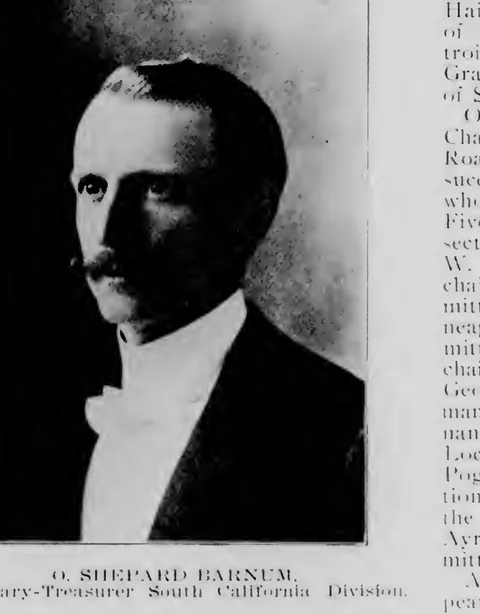
 O. Shepard Barnum portrait 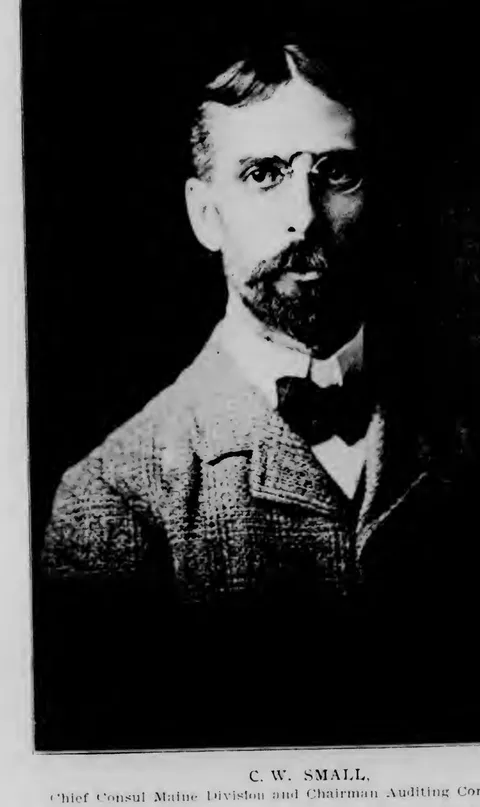 (opens in a new tab)
 C. W. Small portrait 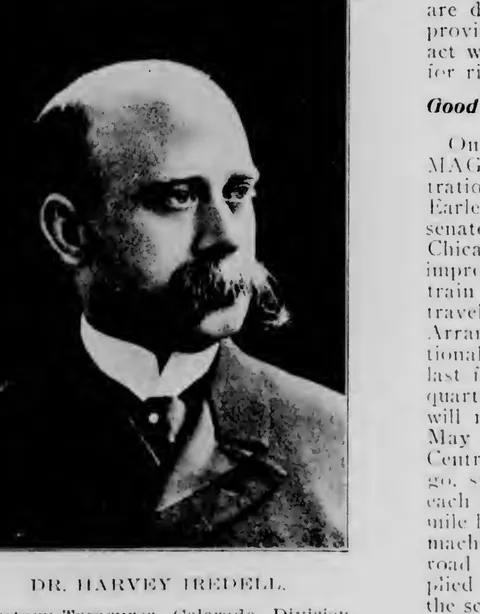 (opens in a new tab)
 Dr. Harvey Iredell portrait 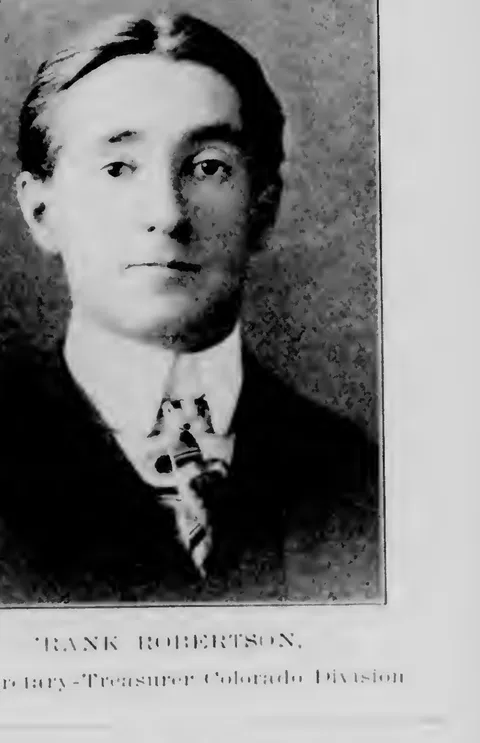 (opens in a new tab)
 Frank Robertson portrait 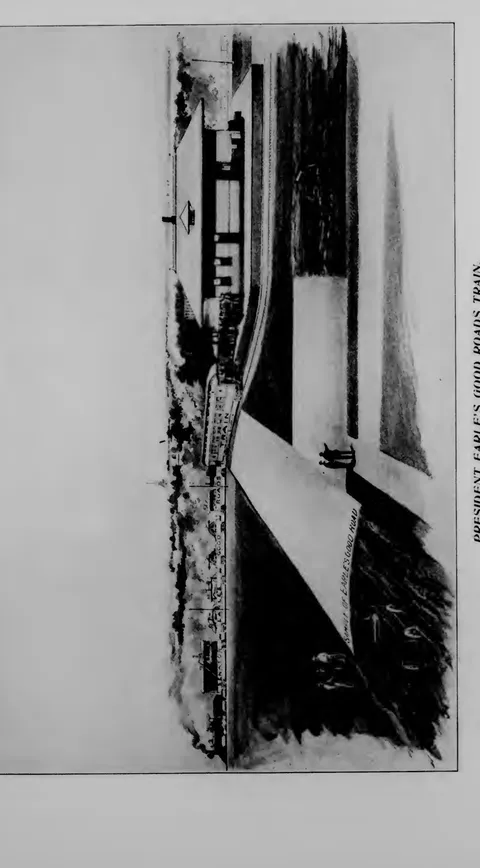 (opens in a new tab)
 President Earle's Good Roads Train 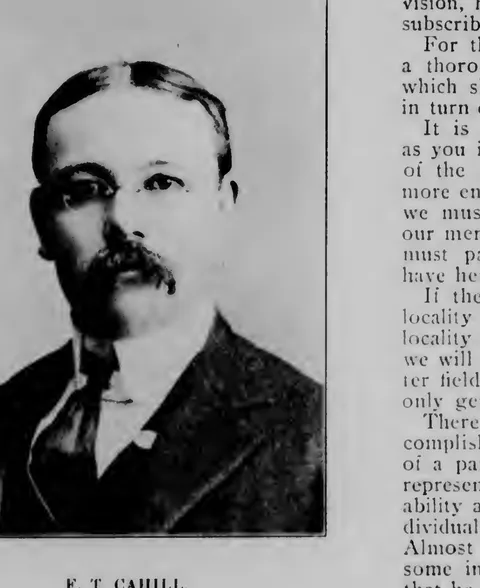 (opens in a new tab)
 F. T. Cahill portrait  (opens in a new tab)
 Making Maple Sugar at Town Line, Oswego Co., N.Y.
Mastheads 1
 (opens in a new tab)
 L.A.W. Magazine masthead, April 1901
34 advertisements
 (opens in a new tab)
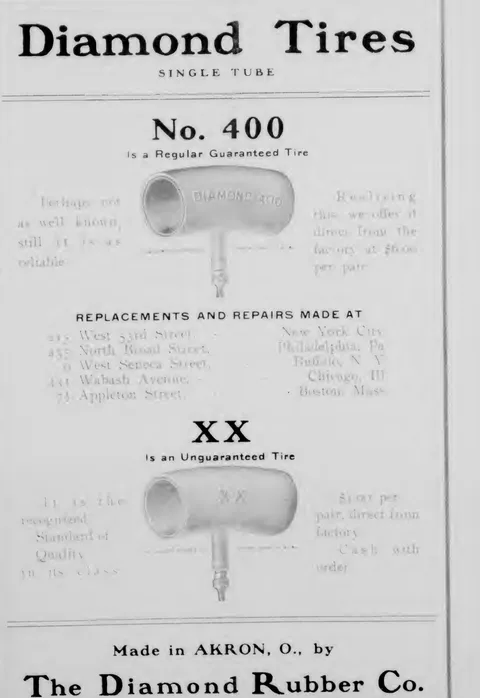
 Diamond Tires advertisement 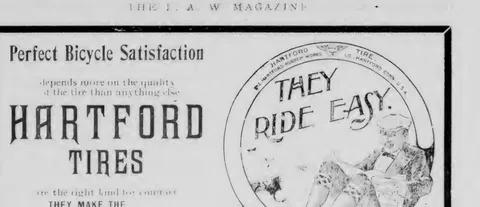 (opens in a new tab)
 Hartford Tires advertisement  (opens in a new tab)
 20th Century Head-Lights advertisement 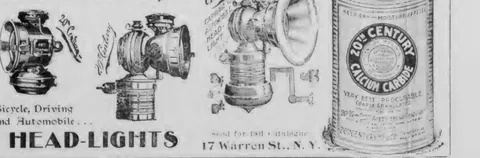 (opens in a new tab)
 Pierce Cycles Pan-American Special advertisement 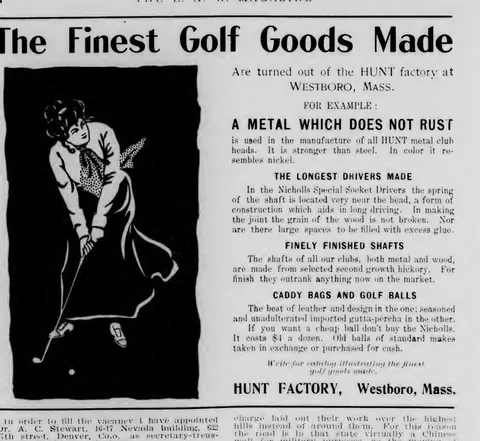 (opens in a new tab)
 The Finest Golf Goods Made advertisement 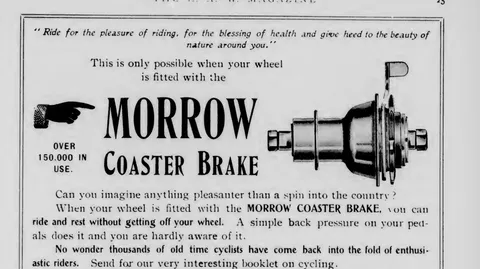 (opens in a new tab)
 Morrow Coaster Brake advertisement 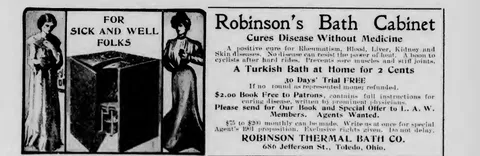 (opens in a new tab)
 Robinson's Bath Cabinet advertisement 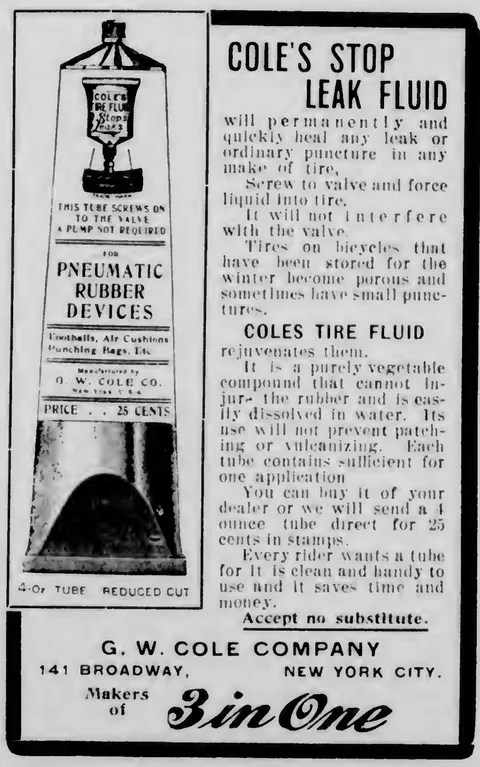 (opens in a new tab)
 Pneumatic Rubber Devices and Cole's Stop Leak Fluid advertisement 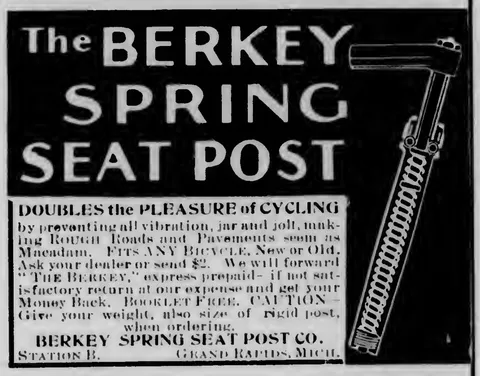 (opens in a new tab)
 The Berkey Spring Seat Post advertisement 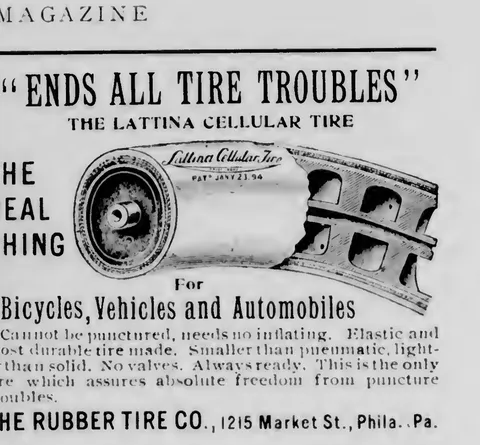 (opens in a new tab)
 Lattina Cellular Tire advertisement 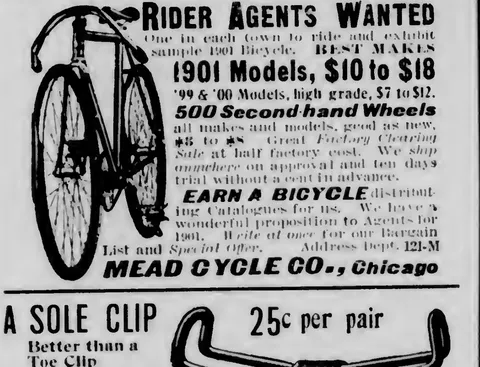 (opens in a new tab)
 Rider Agents Wanted advertisement 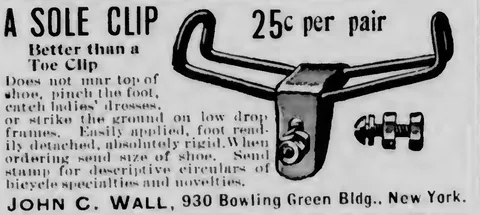 (opens in a new tab)
 A Sole Clip advertisement  (opens in a new tab)
 Adams' Pepsin Tutti Frutti gum advertisement 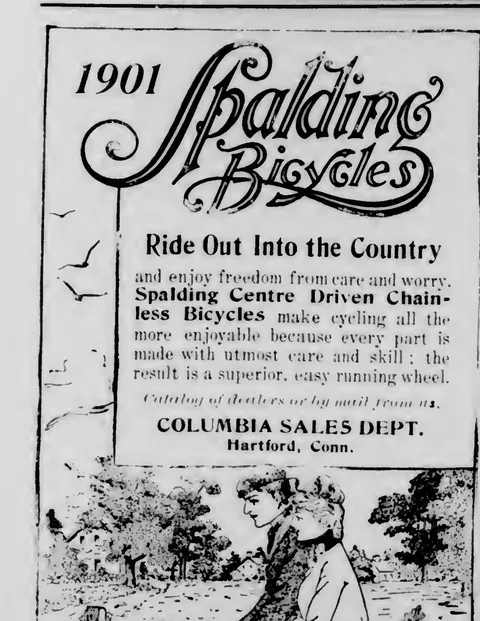 (opens in a new tab)
 1901 Spalding Bicycles advertisement 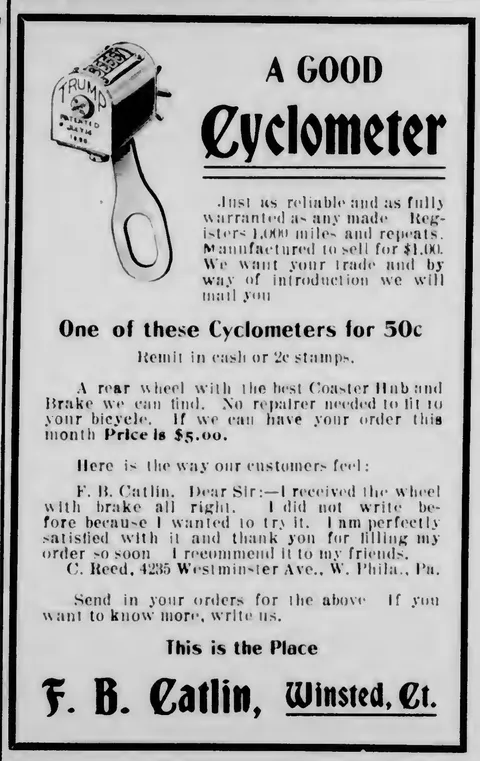 (opens in a new tab)
 A Good Cyclometer advertisement 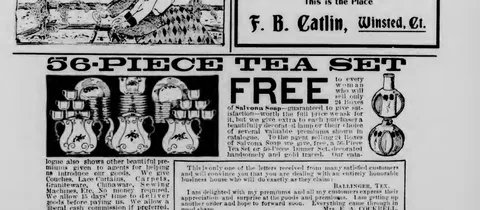 (opens in a new tab)
 56-Piece Tea Set premium advertisement 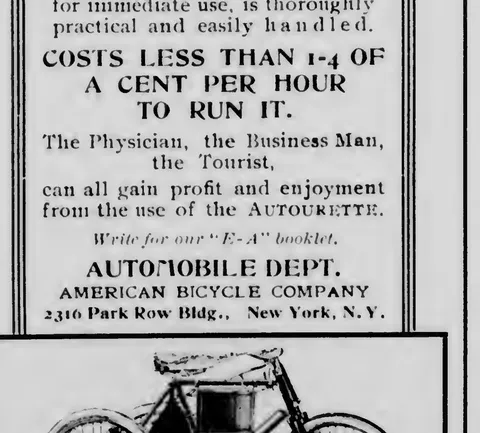 (opens in a new tab)
 Autourette Motor Tricycle advertisement 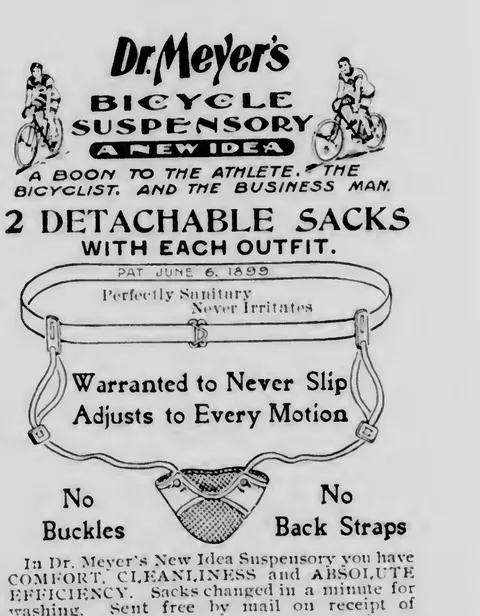 (opens in a new tab)
 Dr. Meyer's Bicycle Suspensory advertisement 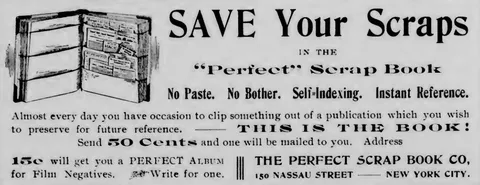 (opens in a new tab)
 Perfect Scrap Book advertisement 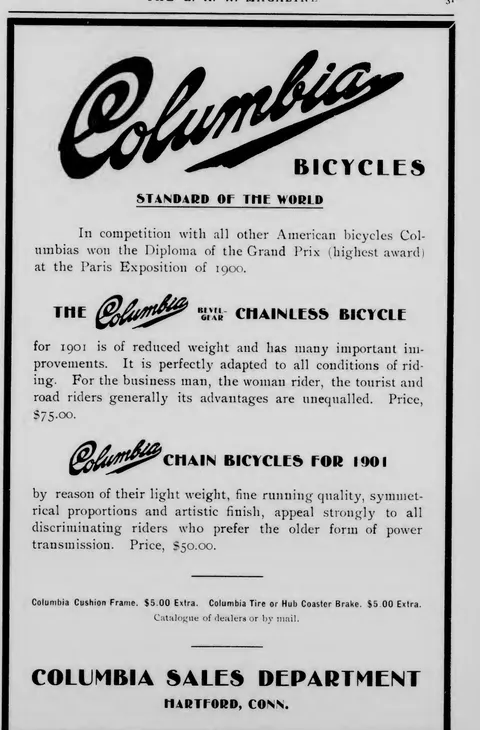 (opens in a new tab)
 Columbia Bicycles advertisement 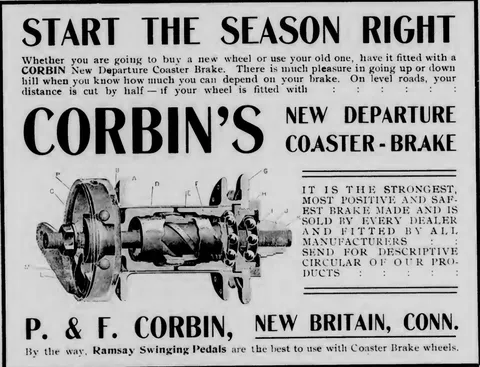 (opens in a new tab)
 Corbin's New Departure Coaster-Brake advertisement 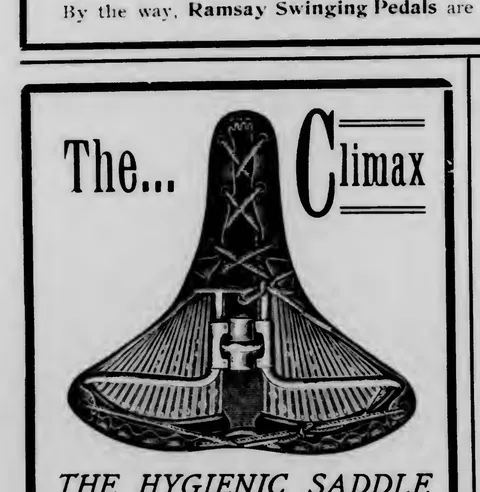 (opens in a new tab)
 Climax Hygienic Saddle advertisement 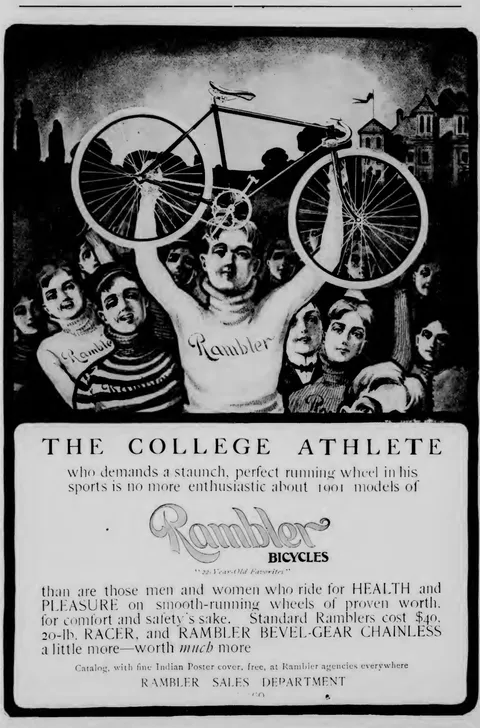 (opens in a new tab)
 Rambler Bicycles "The College Athlete" advertisement 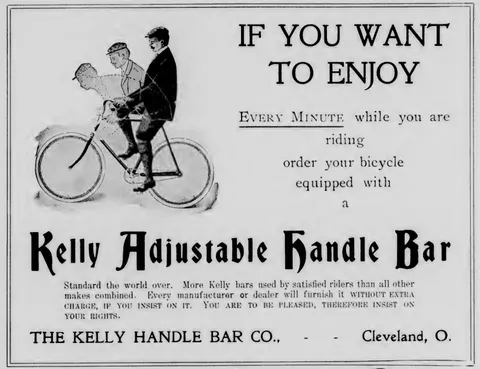 (opens in a new tab)
 Kelly Adjustable Handle Bar advertisement 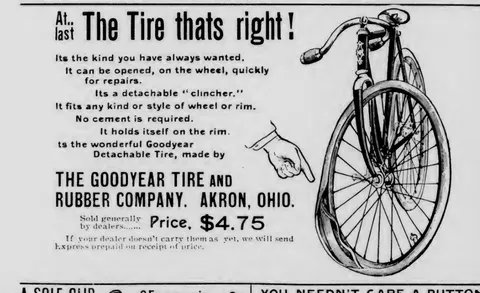 (opens in a new tab)
 Goodyear Detachable Tire advertisement 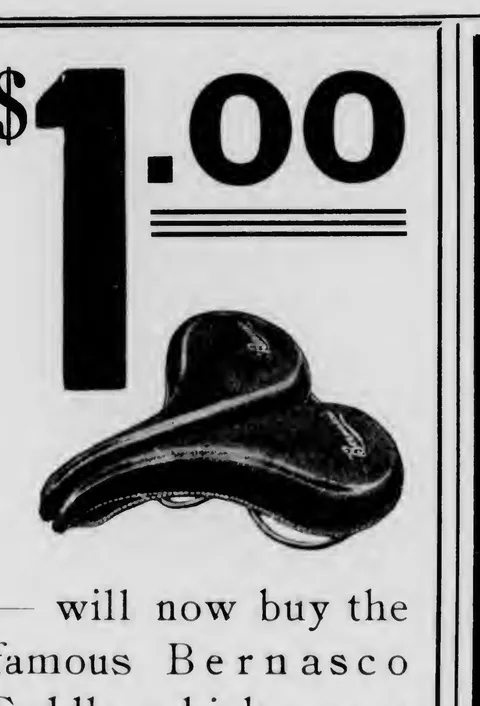 (opens in a new tab)
 Bernasco Saddle advertisement 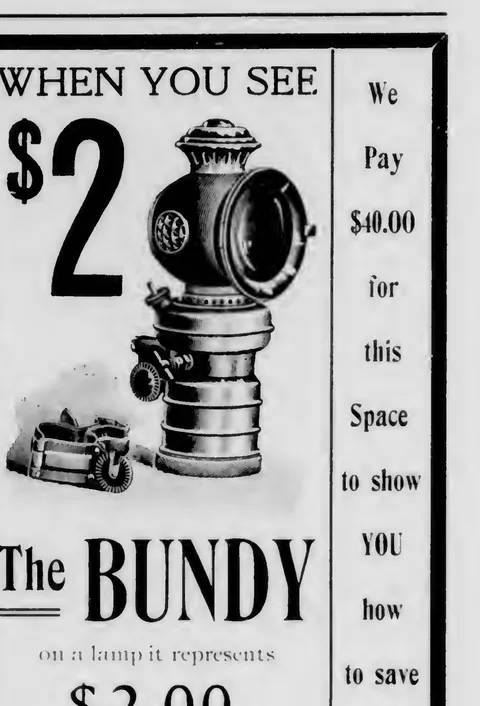 (opens in a new tab)
 The Bundy bicycle lamp advertisement 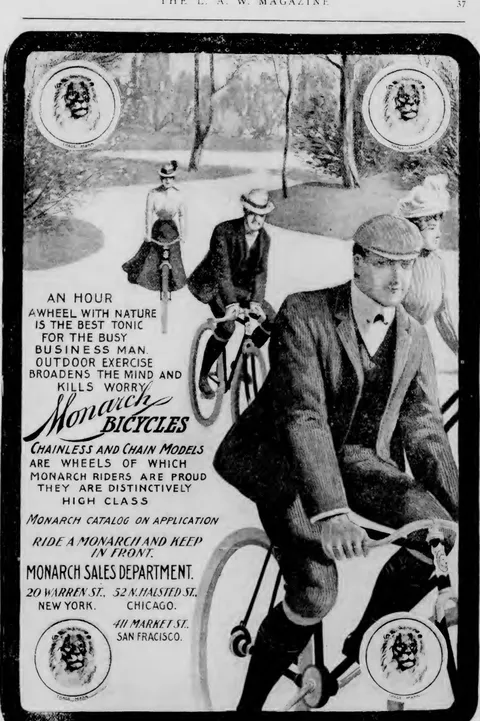 (opens in a new tab)
 Monarch Bicycles advertisement 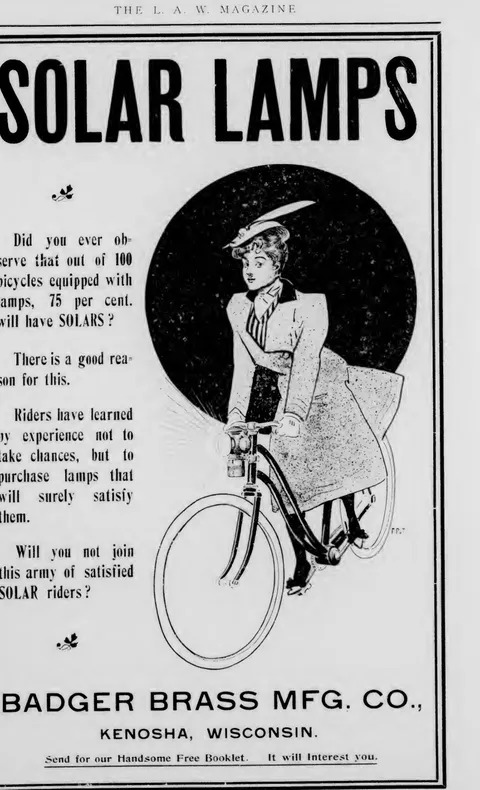 (opens in a new tab)
 Badger Brass Solar Lamps advertisement 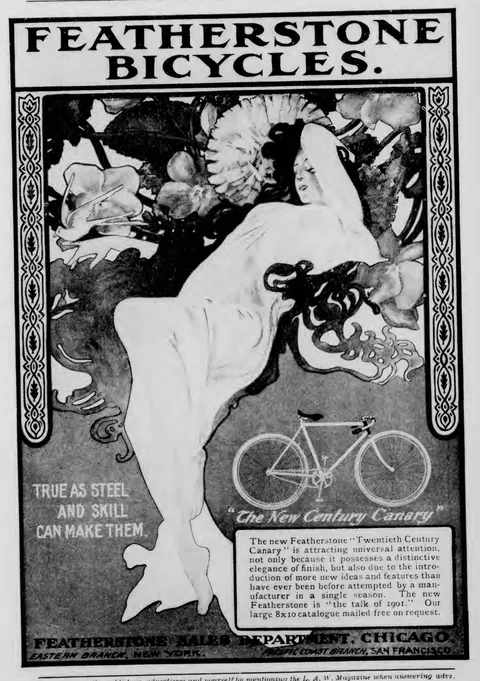 (opens in a new tab)
 Featherstone Bicycles advertisement 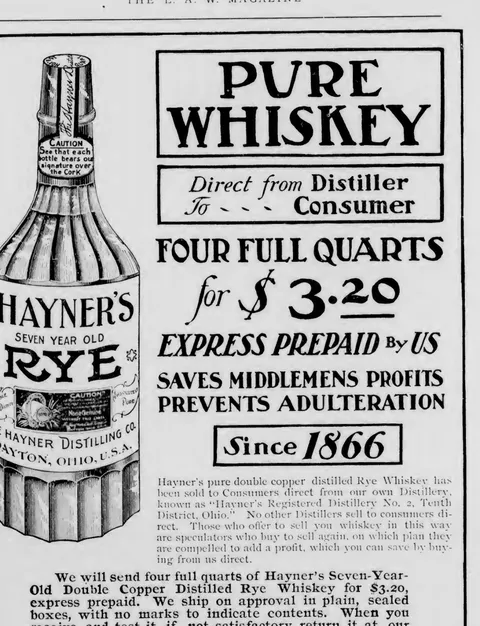 (opens in a new tab)
 Hayner's Rye Whiskey advertisement 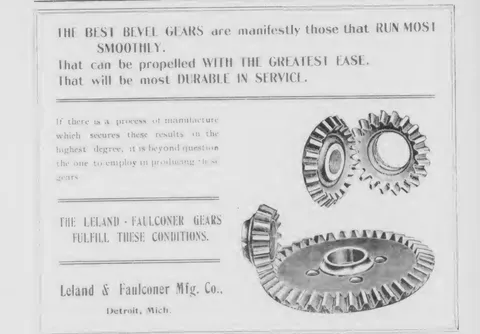 (opens in a new tab)
 Leland & Faulconer bevel gears advertisement 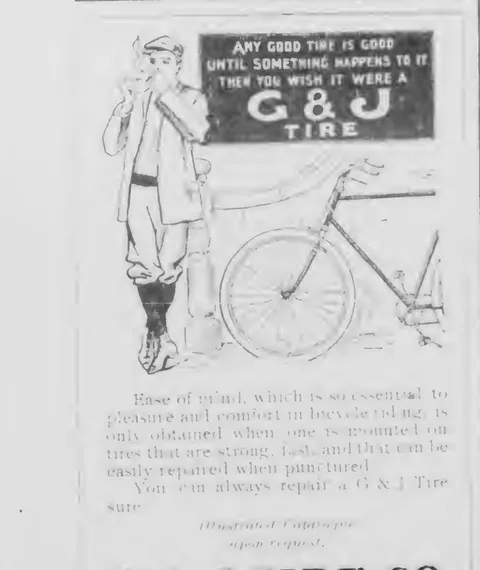 (opens in a new tab)
 G & J Tire Co advertisement 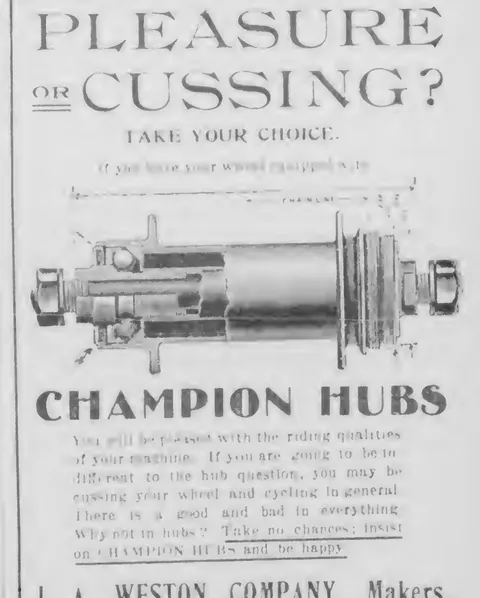 (opens in a new tab)
 Champion Hubs advertisement