Vol 31, No 2
190055 articles35 images
Articles in this issue
- The magazine's monthly review department, opening the July 1900 number (Old Series Vol. XXXI, New Series Vol. 1, No. 2). It runs from page 1 to page 5 and covers League membership benefits, side path litigation in three states, racing, and the trade.
- The executive committee has arranged with the United States Casualty Company for a special accident policy, open only to League members, costing thirty cents paid to the national secretary. It carries a $1,000 accidental death indemnity and $5 weekly disability for five weeks, and covers accidents arising from bicycling.
- The Cycling Gazette argues that League members are too busy to canvass, and suggests the L. A. W. employ professional solicitors to sign up the thousands of American cyclists who stay outside it through ignorance or negligence.
- Courts in Pennsylvania, New York and Washington have had to weigh the constitutionality of side path laws. In Dauphin County, Pennsylvania, the Side Path Commission sued the County Commissioners to compel a bicycle tax; the commissioners held the state act unconstitutional and Judge Simonton, sitting at Harrisburg, concurred.
- Judge Simonton's decision holds the Pennsylvania side path law in conflict with Article 3 of the state constitution, which forbids the General Assembly delegating municipal improvement powers to a special commission. Chief Consul Boyle of the Pennsylvania Division comments on the weight the Dauphin County bench carries elsewhere.
- Beaver and Erie county side path commissions carry on without reference to Judge Simonton's ruling. Chas. A. Mertens of Erie reports about $3,000 in tax collected last year and two suits in court brought by township road authorities, one seeking to enjoin further path building.
- Mertens, two years attorney for the Erie County Side Path Commissioners, is standing for the General Assembly from Erie and pledges to secure a constitutional side path law and a good roads law capable of immediate enforcement.
- Spokane, Wash., property owners won a temporary injunction against extending the Mallon avenue cycle path, arguing it obstructed the street and blocked access to vehicles. The city and Bicycle Commission answered that planks are laid at all driveways and that thousands of Spokane wheelmen want the path.
- Judge Richardson ruled that Spokane may improve its streets under the constitution and classed the cycle path as an improvement. Evidence brought out by the defence showed 4,000 of the city's 17,000 adults are wheelmen.
- John C. Ryan, a wealthy resident of West Islip, L. I., beaten twice in injunction proceedings against the Side Path Commissioners, now attacks the state side path law itself after Commissioner Higbee's route was moved across the highway to pass his premises. The law was declared constitutional.
- At Syracuse, N. Y., Dr. George J. Gladden was arrested and fined for riding the side path without a tag, refused to pay and demanded a jury trial. His attorneys argued the law unconstitutional; the jury was out five minutes and returned a verdict of guilty.
- President Sams' new national Side Path Committee is likely to become one of the League's most important. Its chief members are Dr. C. H. Hunter of Minneapolis as chairman, H. V. Casey of Baltimore, and M. D. Fletcher.
- How Baltimore wheelmen broke the Board of Park Commissioners in 1897: Conway W. Sams, now L. A. W. president, and H. V. Casey formed a campaign association of 12,000 riders and forced the reorganisation of a board that had stood thirty-seven years, with Casey appointed to the new one.
- Casey helped promote the Maryland Cycle Path Association, whose efforts passed the state side path law, and was chosen chairman of the resulting State Side Path Commission last month. One of its first works will be the surveyed path from Baltimore to Washington.
- Arrests for sidewalk riding in Cleveland, Indianapolis and Salt Lake City reopen the question. Commissioner Quinn of New Haven, Conn., declares bicycles have no sidewalk rights and may not even be trundled along one.
- The Salt Lake City News argues for a good path on each street rather than sidewalk riding, noting that wheelmen arrested on sidewalks always offend on unpaved streets; the magazine calls it good logic.
- City Recorder St. Sure of Alameda, Cal., holds the bicycle lights ordinance unconstitutional, the bicycle being a vehicle entitled to the same privileges. The council has nonetheless introduced a fresh ordinance offending in the same particular.
- Massachusetts' wide tire law takes effect January 1, 1902 unless repealed; New York will make a renewed attempt at a convict labour road act next session; and the Massachusetts bicycle baggage law is being generally observed by the railroads.
- Frank C. Orr of Pittsburg is selected vice-consul of the Pennsylvania Division following the resignation of Thos. J. Keenan, Jr., former president of the League, whose private affairs compelled him to give up the post.
- Plans are complete for the twenty-first annual national gathering at Milwaukee, July 10 to 15, and for the L. A. W. Festival and Good Roads Congress at Port Huron, Mich., July 2 to 5.
- The American season opened on Decoration Day; Miller and Judge broke world's motor tandem records at Cleveland, while at Waltham, Mass., Miles and Stafford were killed when their motor tandem struck an electric light post. Harry Elkes beat Edward Taylor at Berlin, Bouhours and Bauge cut the hour record, and Major Taylor was fined $100 by the riders' union.
- The magazine deplores continued attempts at long distance riding by women and blames the press for advertising it, quoting the New York Telegram's account of Miss Gast, who trains on ale and a two-year-old ox and takes a cold bath every hundred miles.
- Meeting in New York late in May, the committee approved the contract with the official organ publishers, halved the Secretary's salary, cut Press and Touring committee expenditure, and resolved that the League be incorporated under the laws of New York. A protest from Chicago members against Chief Consul Locke of Illinois is under consideration.
- Numerous spring fires in cycle factories and stores: the Canada Cycle & Motor Company at St. Catherines, Ont., the League Cycle Manufacturing Company at Milwaukee, the Wisconsin Wheel Works at Racine, the Kirk Manufacturing store at Toledo, Theo. F. Bentel of Pittsburg, and slight damage at the Outing factory in Indianapolis.
- A dated diary of cycling events for May and June 1900: Platt-Betts' hour record at Glasgow, Bauge and Bouhours at Paris, Taylor over Elkes at Leipzig, Nelson and Gibson at Montreal, the New York state meet at Elmira, the Bordeaux-Paris road race, the Quaker City Wheelmen disbanded, and the Republican good roads plank.
- Louis Geyler on touring amid the grandeur of the eastern states: out of Philadelphia on the Lancaster Pike past the old General Wayne hotel, Valley Forge and Paoli, then Gettysburg, the Shenandoah Valley, the Luray Caverns and Lexington, Va. Illustrated with the Delaware Water Gap, Marblehead, Mass., and Devil's Den at Gettysburg; concluded next month.
- Part I of A. B. Choate's lecture series, delivered to the senior class of the Law Department of the University of Minnesota, on the legal status of the wheelman's vehicle. It reviews adverse legislation in North Carolina, New York, Maryland, Virginia and Minnesota, then the cases (Swift vs. City of Topeka, Holland vs. Bartch, Judge Buck's Minnesota ruling) establishing the bicycle as a vehicle with equal use of the highway.
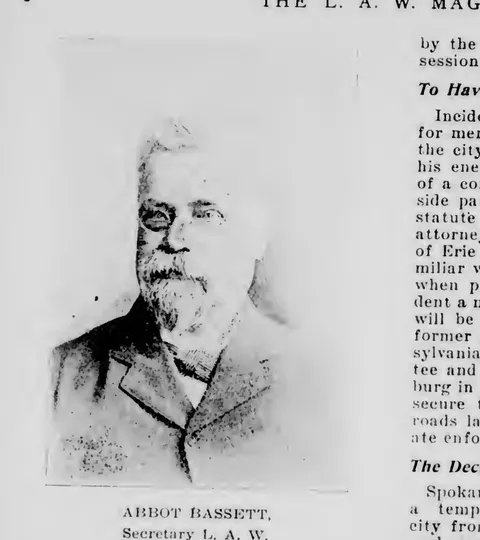
- Biographical sketch of the League's secretary, born at Chelsea, Mass., March 10, 1845. A hardware clerk who drifted into newspaper work, he edited the Manufacturers' Gazette from 1880, went to the Bicycling World in 1881, chaired the L. A. W. racing board from 1883 and edited the short-lived Cycle.
- Chas. A. Jackson describes riding to and around Washington: the route from New York by the 23d street ferry through Elizabeth, Princeton and Frankford to Philadelphia, then Wilmington and Baltimore, and the sights once there, from Arlington and Fort Myer to the Mount Vernon road, Cabin John Bridge and Great Falls. The Conduit road cycle path was built by the Good Roads Association of Washington under Charles E. Wood.
- Thos. J. Keenan, Jr., ex-president of the L. A. W., recounts his 1899 trip to England and France and the World's Congress of Touring Associations in London that produced the reciprocal agreement with the Cyclists' Touring Club. It gives League members free passage of wheels into England, France, Italy, Austria, Germany and other countries, C. T. C. consuls, hotels and repair shops, and cheap guide books; a like pact runs with the Canadian Wheelmen's Association and negotiations continue with the Deutscher Radfahrer Bund.
- Geo. L. McCarthy, chairman of the National Press Committee, explains its three methods of transmitting L. A. W. news to the papers: a weekly bulletin, syndicate associations covering the smaller dailies and weeklies, and telegraphic dispatches through the Associated Press and Publishers' Press Association.
- A new regular department reprinting items from the old L. A. W. Bulletin so that readers may judge the speed and progress of the present age against other days.
- Sterling Elliott of Newton, Mass., of Hickory wheel advertising fame, burlesques the paid biography in a letter reprinted from the L. A. W. Bulletin of December 19, 1890, recalling his shoemaker father, his mother's hickory switch and his negotiations with an uncle in the woodshed.
- A table compiled from city clerks giving lamp, bell, penalty and speed limit requirements for some sixty cities from Allegheny and Atlanta to Worcester, with a closing set of riding suggestions: keep to the right, no more than two abreast, keep off the sidewalks, and buy a license tag before using a cycle path.
- "As They Come and Go", a survey of motor cycle building in France and England against the two American establishments in the field, the quadricycle and tandem question, Milwaukee's hoped-for meeting of the motors at the L. A. W. meet, Miller's 1:20 2-5 motor tandem tricycle mile at Montreal, and Beconnais' 100-kilometre road record of 1:18:57.
- The editorial page, under the L. A. W. Magazine and Good Roads masthead published by Emil Grossman & Bro., Cleveland, with Chas. W. Mears as managing editor and Abbot Bassett editing the official department. It takes Isaac B. Potter's dictum that side paths are a rebuke upon bad roads, credits New York with giving the movement its first impetus, and reviews the month's three court decisions in Washington, New York and Pennsylvania.
- The Milwaukee, Wis., schedule for July 9-15, 1900: century runs from Minneapolis and Chicago on the Monday, all-day runs to Waukesha, Oconomowoc and Little Muskego Lake, the multiplet road race on Grand Avenue, boat ride on Lake Michigan, the "Hot Time" smoker, and the national championship, Cream City handicap, Sanger one-mile handicap and Dorner two-mile handicap races at the Exposition Building.
- The League's official department, edited by Secretary Abbot Bassett, giving the organisation's objects, officers, committees, division and foreign consuls, touring routes and supplies.
- A statement of the League's objects and the benefits of membership: the official organ, road books and maps, the hotel and repair shop systems, the consul system, agitation for baggage carriage of wheels, and the Cyclists' Touring Club ticket that admits members to hotels and consuls across Great Britain and the Continent, plus the free-wheel arrangement with the Canadian government.
- President Conway W. Sams of Baltimore, first vice-president Robert T. Kingsbury of Keene, N. H., second vice-president A. B. Choate of Minneapolis, treasurer J. C. Tattersall of Trenton, N. J., and secretary Abbot Bassett of Boston.
- The League's standing committees and their members: Membership (W. A. Howell, chairman), Rights and Privileges (Herbert W. Knight), Rules and Regulations (Albert Mott), Improvement of Highways (H. B. Fullerton), Transportation (Frank P. Van Valkenburgh), Touring (Geo. M. Schell) and Press (Geo. L. McCarthy).
- Chief consuls and secretary-treasurers for every state division, from Thomas H. Gist of Colorado and Andrew J. Whitaker of the District of Columbia through Milo M. Belding, Jr. of New York and Samuel A. Boyle of Pennsylvania to Percy B. Champagne of Wisconsin.
- The League's consuls abroad, including Ercole Abrate of Turin, Joseph Pennell of Buckingham Street, Strand, London, James M. Erwin of the Rue Beunel, Paris, W. P. Purvis of Southampton, T. Lee Lloyd of Liverpool and Raisa Earl of Nihonbashi, Tokio.
- Secretary Abbot Bassett's paragraphs: the midsummer Milwaukee meet and its planked fish and clams, the Pioneers' banquet with Papa Weston and Burly Ayres, the pen with which the baggage bill was signed, President Potter's two pencils, a proposal for an L. A. W. Day on Saturday, October 6, the automobilists repeating cyclists' early mistakes, and the N. C. U. and C. T. C. fight with the English railway companies over carrying cycles.
- Official League hotels and repair shops appointed in the division, the Alamo Hotel at Colorado Springs, the Grand Hotel at Pueblo, and repair shops at Boulder, Colorado Springs and Pueblo. Signed A. H. Searles, Secretary-Treasurer.
- Votes of the Board of Officers meeting of April 13, 1900 and the special meeting of May 25th: honour medals for members obtaining fifteen new names, $100 to the Highway Improvement Committee, and a subscription to the Cycling Gazette for each district consul. Governor Gregory's cycle path commissioners are named, Homer J. Wheeler, Robert A. Kendall, George R. Lawton, V. J. Briggs and Charles H. Sparks. Signed N. H. Gibbs.
- Chief Consul Samuel A. Boyle of 411 Wood Street, Pittsburg, announces the appointment of Mr. F. C. Orr as vice-consul in place of the resigned Thos. J. Keenan, Jr., and pays tribute to Keenan's years of service to the division. Dated June 5th, 1900.
- A report on the Pawtucket consulate under Robert A. Kendall: the act just passed appointing a side path commission for the five counties, the licence and inscription-badge scheme, the projected cycle path along the Pawtucket river to Providence, the petition to the City Council over grooved rails, and the L. A. W. cart that collects nails and glass from the streets.
- A special summer rate of $1 a year, against the usual $2.50, for members subscribing through the League's Periodical Department, Abbot Bassett, manager, 530 Atlantic Avenue, Boston.
- The seven members of the National Touring Committee and their assigned territories, chairman George M. Schell of Philadelphia, Alonzo D. Peck of Boston, W. S. Bull of New York, L. W. Ryland of Richmond, W. C. Munro of Cincinnati, A. D. Black of Michigan and A. M. Welles of Minneapolis. Eleven through routes are listed, from New York to Chicago via Albany or the Delaware Water Gap to Boston-to-Portland, together with the runs planned for the Milwaukee meet and Long Island's 200 miles of cycle path.
- Chief Consul Geo. A. Perkins of 13 Court Square, Boston, reviews the division's legislative record, the 1887 guide post law, the 1893 state highways act, the 1894 lantern bill, the wide tire law and the railroad baggage law, and urges members to secure renewals and to have a local consul in every town.
- Chief Consul John J. McElroy's first address: a toll-free bill and a lighted-turnpike bill passed, the sidepath bill giving Maryland wheelmen the right to build paths, the first path to run Baltimore to Washington, the state meet at Havre de Grace on the Susquehanna July 3rd and 4th with an address by President Sams, and the Republican good roads plank.
- Prices for the official badge, lapel button, cap pin, dated cap pin, local consul pin, veteran bar, decalcomania decoration, handle bar ribbons, rubber stamps, ticket holders, back tickets, visiting cards and electrotypes, and a description of the Good Roads Library, Isaac B. Potter's "Country Roads", "Macadam Roads", "Cycle Paths", and "Wide Tires" on the Missouri experiment station tire tests.
- Trade notes: the Waltham Manufacturing Company's 1901 Orient catalogue, John Lawson's American day record of 528 1/2 miles in 24 hours on a Yale at Los Angeles, the Sanger Handle Bar plant open to meet visitors, Leland-Faulconer gears, the Buescher bicycle bell with the candidate's photograph, the Esmond saddle, Veeder trip cyclometers adopted by the Connecticut division, and Nester coaster brakes of Buffalo.
- Letters of praise for the new magazine from President Conway W. Sams, second vice-president A. B. Choate, press committee chairman Geo. L. McCarthy, Geo. M. Huss of Chicago, Marriott C. Morris of Philadelphia and R. A. Randall of Pawtucket, R. I.
Images in this issue 35 pictures from 22 pages
Photographs 11
 (opens in a new tab)
 Abbot Bassett, Secretary L.A.W. 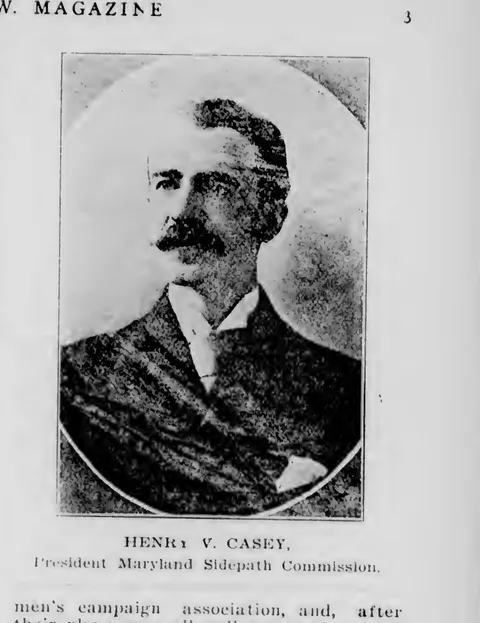 (opens in a new tab)
 Henry V. Casey, President Maryland Sidepath Commission 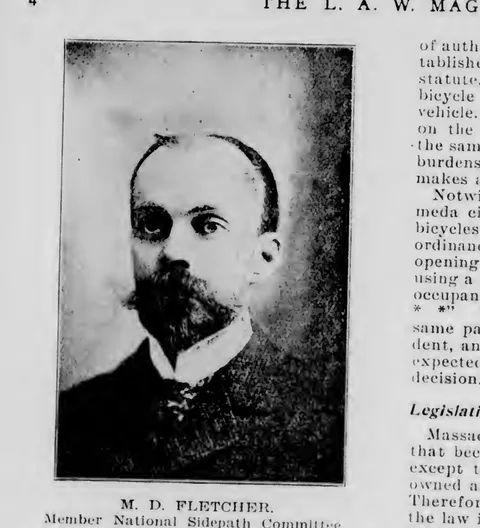 (opens in a new tab)
 M.D. Fletcher, Member National Sidepath Committee 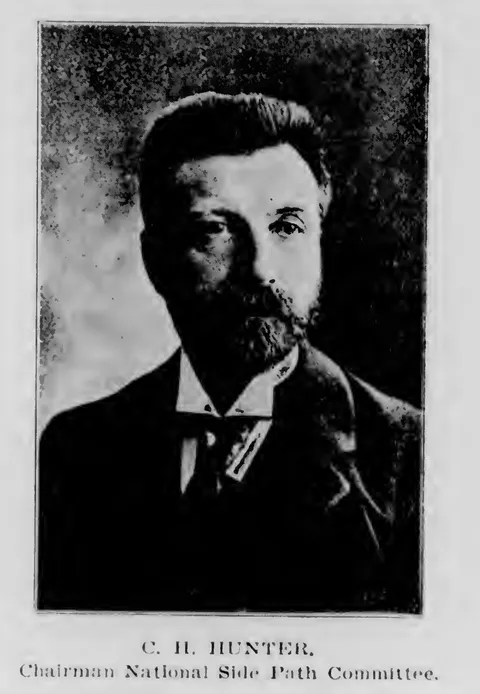 (opens in a new tab)
 C.H. Hunter, Chairman National Side Path Committee 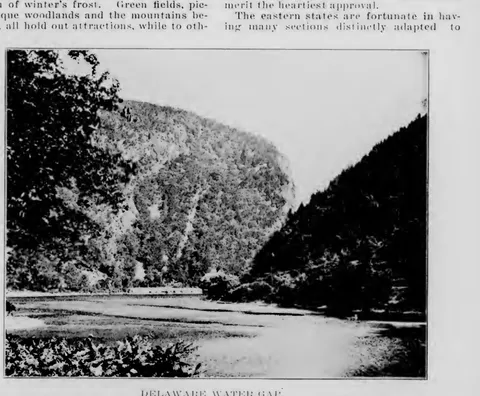 (opens in a new tab)
 Delaware Water Gap 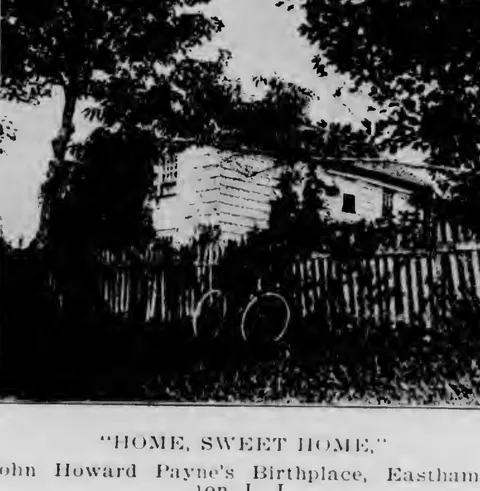 (opens in a new tab)
 "Home, Sweet Home," John Howard Payne's Birthplace, Easthampton, L.I. 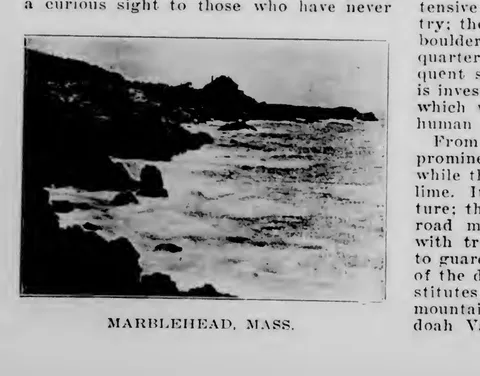 (opens in a new tab)
 Marblehead, Mass. 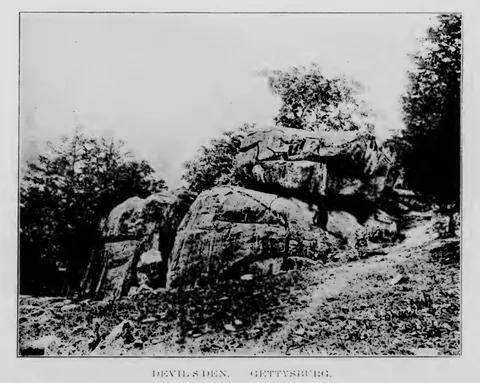 (opens in a new tab)
 Devil's Den, Gettysburg 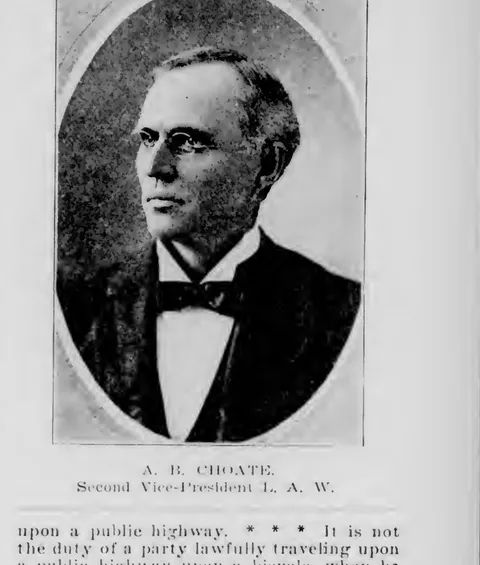 (opens in a new tab)
 A.B. Choate, Second Vice-President L.A.W. 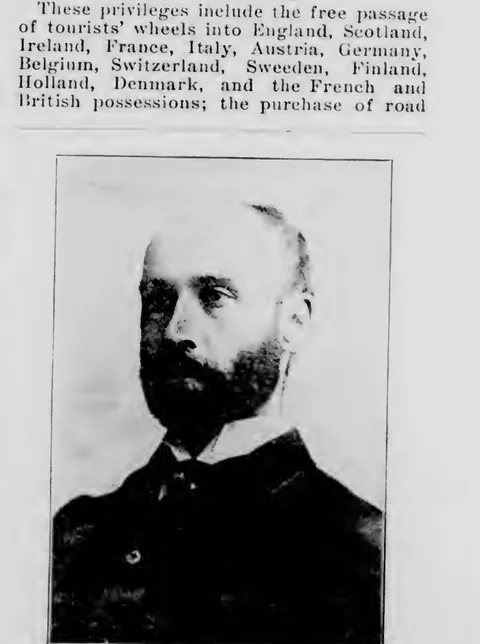 (opens in a new tab)
 Thos. J. Keenan, Jr., Ex-President L.A.W. 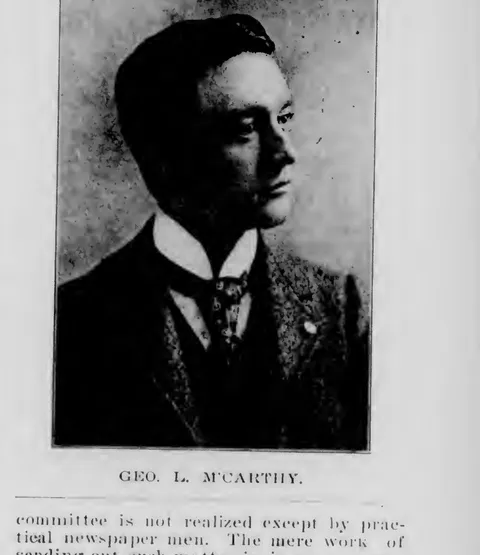 (opens in a new tab)
 Geo. L. McCarthy, Chairman National Press Committee
Diagrams 1
 (opens in a new tab)
 Chicago & North Western Railway "North-Western Line" emblem
Mastheads 1
 (opens in a new tab)
 L.A.W. Magazine title-piece
22 advertisements
 (opens in a new tab)
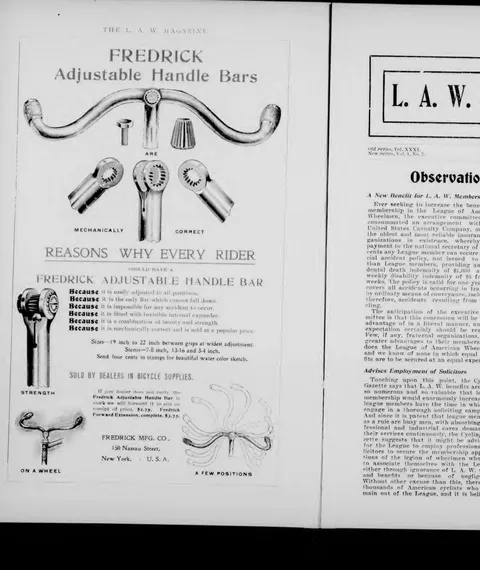
 Fredrick Adjustable Handle Bars 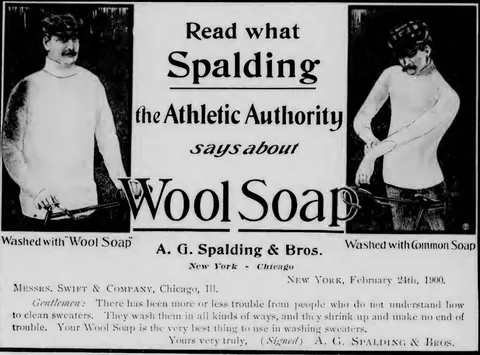 (opens in a new tab)
 Wool Soap, A.G. Spalding & Bros. 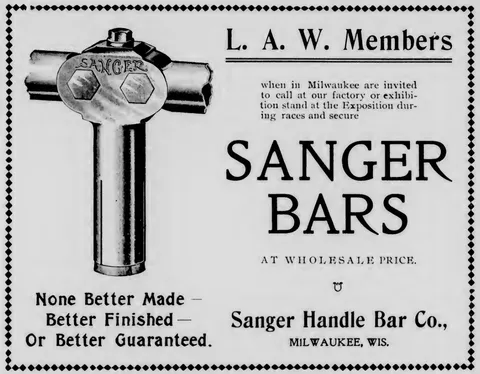 (opens in a new tab)
 Sanger Bars 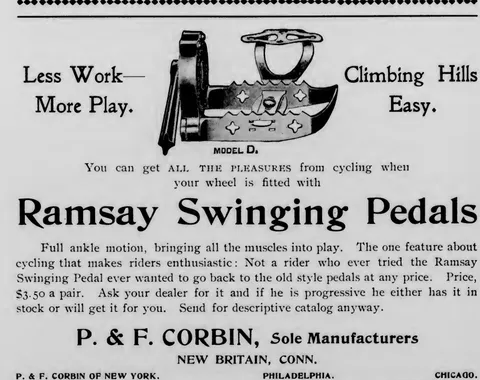 (opens in a new tab)
 Ramsay Swinging Pedals 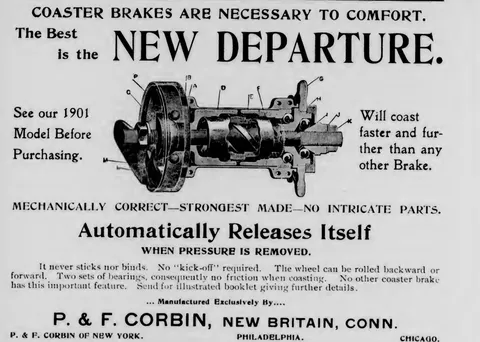 (opens in a new tab)
 New Departure Coaster Brake 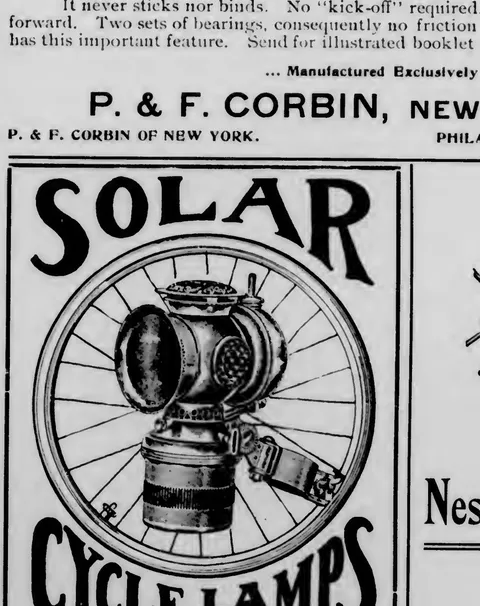 (opens in a new tab)
 Solar Cycle Lamps 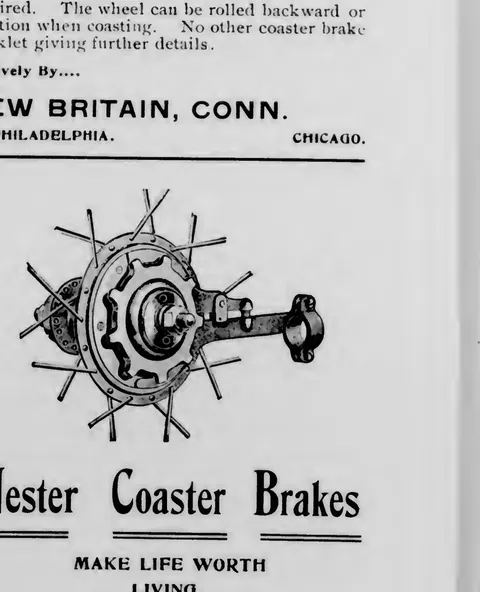 (opens in a new tab)
 Nester Coaster Brakes 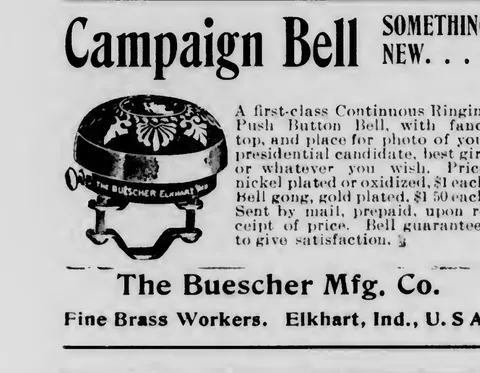 (opens in a new tab)
 Campaign Bell 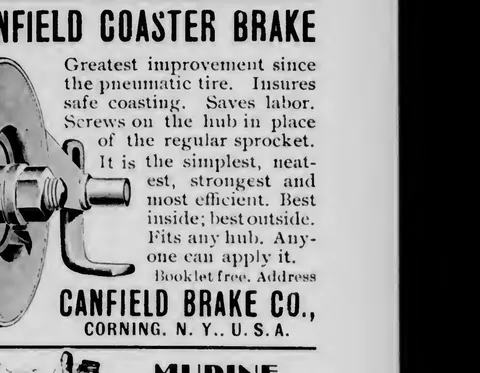 (opens in a new tab)
 $4 Canfield Coaster Brake 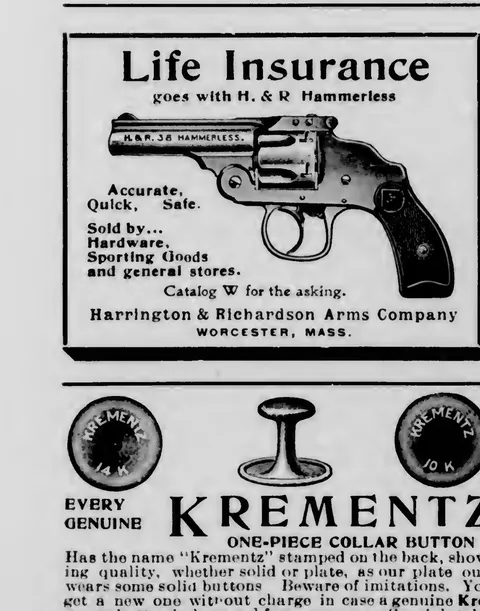 (opens in a new tab)
 Harrington & Richardson Hammerless Revolver 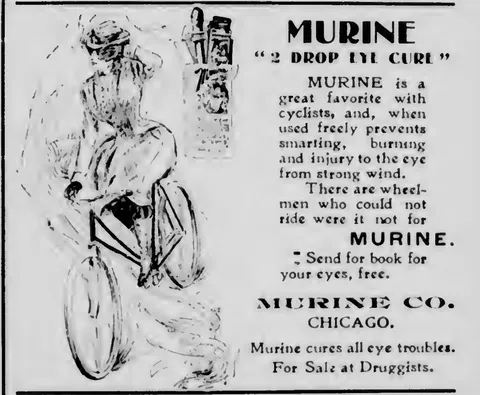 (opens in a new tab)
 Murine Eye Cure 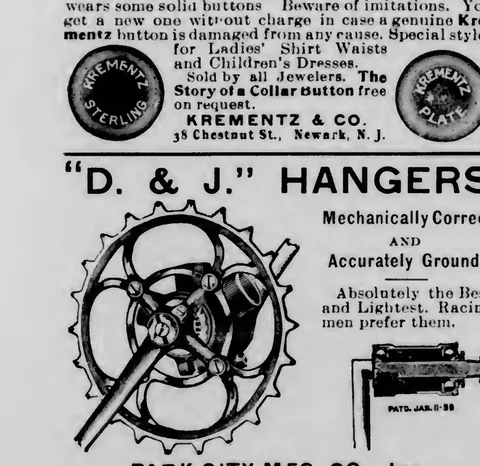 (opens in a new tab)
 Krementz One-Piece Collar Button 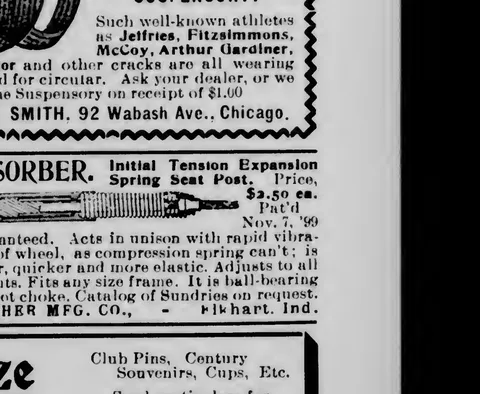 (opens in a new tab)
 Bike Jockey Strap Suspensory  (opens in a new tab)
 "D. & J." Hangers  (opens in a new tab)
 Jar Absorber 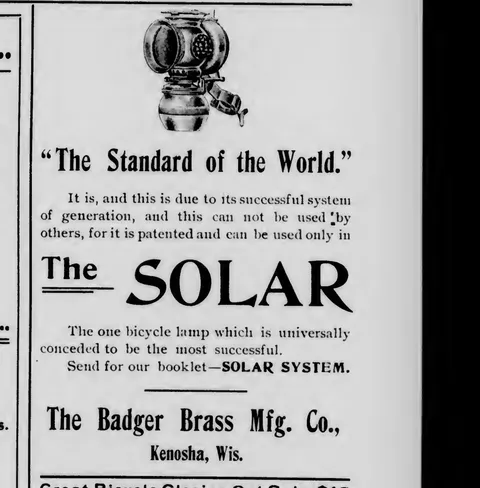 (opens in a new tab)
 The Solar bicycle lamp 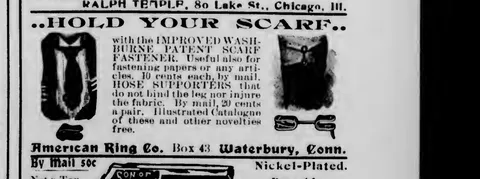 (opens in a new tab)
 Hold Your Scarf  (opens in a new tab)
 Liquid Pistol 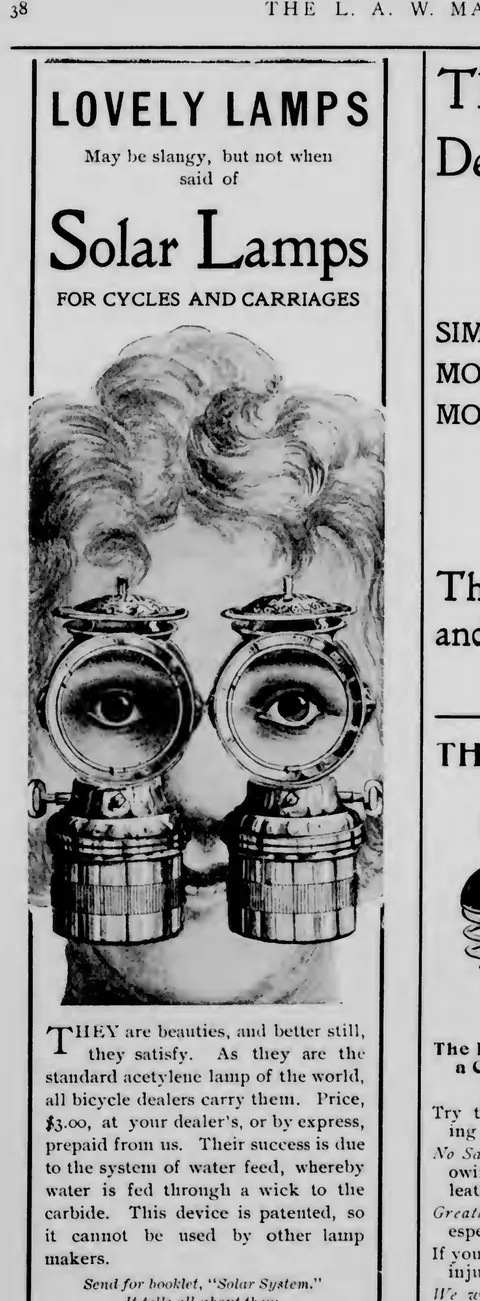 (opens in a new tab)
 Solar Lamps for Cycles and Carriages 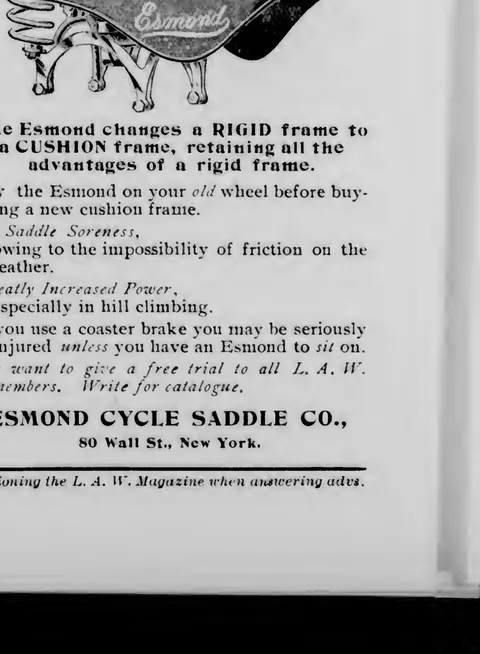 (opens in a new tab)
 The Esmond Saddle and Cushion Frame 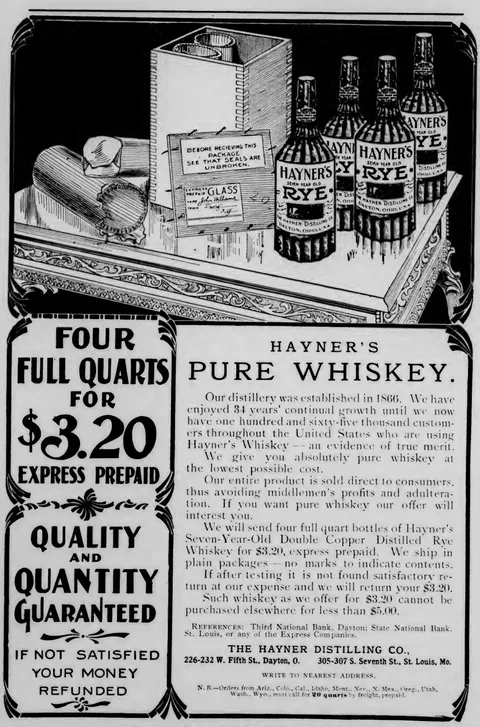 (opens in a new tab)
 Hayner's Pure Whiskey 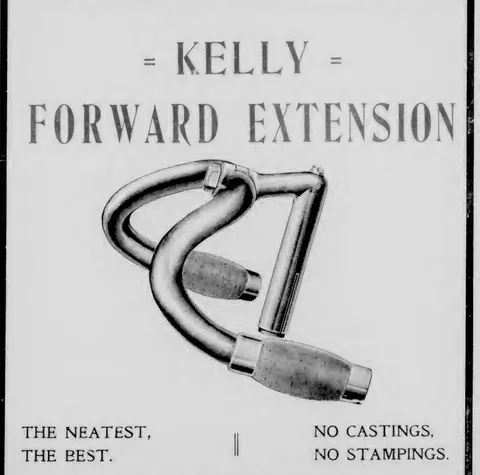 (opens in a new tab)
 Kelly Forward Extension handle bar