Vol 31, No 5
190044 articles32 images
Articles in this issue
- The magazine's monthly editorial survey opening the October 1900 number, running from the Committee on Revision's rewritten constitution through sidepath progress, good-roads politics, track racing and trade news.
- Reports that the L. A. W. Committee on Revision, not finally organized until July when President Conway W. Sams filled its vacancies, has altered every line of the constitution and by-laws and recommends the draft printed in this issue to the National Assembly meeting next February.
- Explains that the draft is published four months before the Assembly so every League member may study and comment on it; John B. Uhle of the New York Division dissents from several changes and will present a minority report, to appear in the Magazine next month.
- Denies the metropolitan dailies' reports that the Committee on Revision had decided to abolish state divisions, pointing out that the printed report contains not even the suggestion, and that the press chased a will-o'-the-wisp.
- Argues that New York, Pennsylvania and Massachusetts prove divisional government can succeed, while many other divisions point to the failure of state government, and asks whether national or strictly local consular government should replace it.
- The Hon. Martin Dodge, director of the Office of Public Road Inquiries, informed President Sams during September that he was very desirous of seeing the interstate wheelway from New York to Chicago succeed and would gladly assist it.
- Cuyahoga, Lucas and Portage counties have appointed sidepath commissioners under the DeRan law, ending Ohio's surprising apathy over the New York-Chicago path project.
- Justice Wilmot M. Smith of the New York supreme court, Suffolk county special term, upheld sidepath legislation in Helene M. Ryan vs. Henry H. Preston et al., ruling that part of a Bay Shore highway may lawfully be set apart for the exclusive use of bicycle riders.
- An association has formed to invalidate Oregon's bicycle sidepath tax; a Portland wheelman whose wheel was seized by the sheriff is testing the law, which raised more than $17,000 in Portland's county this year.
- Welcomes the good roads plank inserted in the New York Democratic state platform, quoted in full, which favours liberal state expenditure on rural highways, roads and bicycle paths, and credits it to the efforts of L. A. W. officers.
- Surveys conflicting sidewalk-cycling rules in Titusville, Pa., Port Huron, Mich. and Rochester, the Newark, N. Y. mail carrier who rode into a pedestrian, and Judge Mitchell of Tioga county, Pa., who rules that a bicyclist has no right upon a sidewalk.
- Notes the Philippine commission's $2,000,000 road appropriation, the founding at Boston of the Associated American Motocyclists under Chas. H. Metz of Waltham, Milwaukee's 2,712 taxed bicycles against Massillon's 1,000, and the poverty of safety-bicycle inventor George Shergold of Gloucester.
- Jacquelin won the Grand Prize of Germany at Berlin from Meyers of Holland and Green of England; Cooper, McFarland and Banker took the race of nations at the Paris exposition, Huret won the Bol d'Or, and W. S. Fenn of Waterbury won the American amateur championship at Buffalo.
- Records the death at Montreal of Rambler maker R. Phillip Gormully, a joint capacity agreement between the Kirk Manufacturing Co. and the Snell Cycle Fittings Co. of Toledo, the American Bicycle Company's removal of the Toledo plant to Westfield, and The Bicycling World's absorption of the Wheel.
- A dated diary of cycling events from 19 August to 21 September 1900, covering track results for Nelson, Michael, Stinson, Pierce, Elkes and McDuffee, Cooper and McFarland's Paris exposition races, Gormully's death and the state sidepath convention at Utica, N. Y.
- Part I of Maurice O. Eldridge's paper from the 1899 Yearbook of the Department of Agriculture, tracing the Old York Road of 1711, the colonial forced-labour system, the Wilderness Turnpike, the Philadelphia-Lancaster pike and the Cumberland Road.
- Continuation of Dr. Samuel W. Abbott's paper for the Massachusetts State Board of Health, on wheeling as a remedy for indigestion and nervous disorders, its greater value to women than to men, and its part in the disuse of the corset; closes with Dr. W. W. Keen of Philadelphia's testimony.
- Banner of a new monthly department reviewing golf, tennis, foot ball, base ball, basket ball and roque for League members.
- Previews the 1900 college season with Walter Camp again in charge at Yale, Dibblee at Harvard, Captain Pell back at Princeton and Coach Woodruff urging hurdler Kraenzlein to play end rush for Pennsylvania; includes 1899 statistics and Camp's account of the new rules from Spalding's Foot Ball Guide.
- Complete 1900 game lists for the eastern teams (Harvard, Yale, Princeton, Pennsylvania, the Indians, Cornell, Columbia, Brown, West Point and Annapolis) and the western teams (Chicago, Northwestern, Illinois, Wisconsin, Michigan, Minnesota, Iowa, Notre Dame and Purdue).
- Traces golf from the 1457 Scots parliament ban to the St. Andrews Golf Club of Yonkers, the Shinnecock Hills Club and the United States Golf Association; amateur champion Walter J. Travis wins the Tuxedo Cup with a 71 course record, and Harry Vardon and J. H. Taylor are compared.
- Brooklyn looks set to take a ninth successive pennant for a club whose initial is B, despite Pittsburg's September streak; Comiskey's Chicago wins the American League at .607 to Milwaukee's .569, with Providence, Dayton and Denver taking the Eastern, Inter-State and Western flags.
- Describes the game scientifically developed from croquet on a cushioned clay court 36 by 72 feet, with 3 1/4-inch hard rubber balls, 3 1/2-inch arches and short-handled mallets, and the accuracy, carom, wiring and jump shots it demands.
- Quotes the English official organ Lawn Tennis on the Englishmen's defeat in the international matches at Longwood and Newport, blaming the voyage, strange grounds and softer balls, while criticising American courts as hairy and badly prepared.
- A. B. Choate answers Representative E. Stanley Thomas of Fremont, O., that a street railway laid in the centre of a road does not divide it into two roads, drivers keeping right of the centre regardless of the track unless the railway is an unlawful obstruction.
- Tabulates the thirty-five American cities of more than 100,000 population in 1900 against their 1890 rank, noting Toledo's jump from thirty-seventh to twenty-sixth place on a 61.88 per cent gain, Cleveland's rise and Omaha as the only city to show a loss.
- A Yorkshire anecdote of a tyke who demands two pounds from a wheelman about to ride down an unknown hill, to cover the railings the rider's head will knock down at the bottom.
- Unheaded editorial notes commending Secretary Wilson's object-lesson good roads policy and his plan to divide the country into road districts, urging members to comment on the proposed constitution, introducing the new sports department (citing the Boston Globe editor's refusal to keep a sporting page), and inviting members' photographs and sketches.
- Banner of the League's official section, edited by Abbot Bassett, carrying the officers and committee rosters, the proposed constitution and by-laws, division notices and members' correspondence.
- Abbot Bassett's critique of the revision committee's draft: he opposes replacing the three-man executive committee with a board of twelve directors and opposes incorporation (quoting Stephen Terry's report), backs popular election of officers and the consulate over division reorganization, and reports the World-Wheel merger and a new theft and accident policy from the New Amsterdam Casualty Company.
- The League's standing statement of objects and privileges: defending cyclists' rights and promoting good roads, its hotel discount, consul and repair-shop systems, road books, Cyclists' Touring Club tickets, free entry of wheels into Canada, and dues of two dollars for the first year.
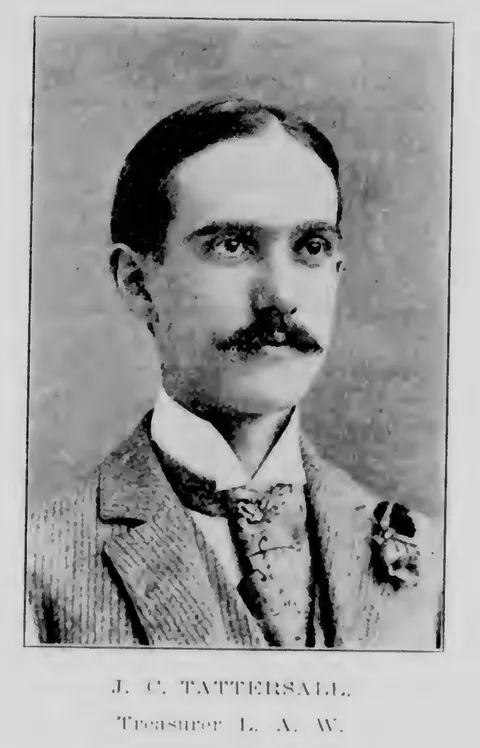
- Lists President Conway W. Sams of Baltimore, First Vice-President Robt. T. Kingsbury of Keene, N. H., Second Vice-President A. B. Choate of Minneapolis, Treasurer J. C. Tattersall of Trenton and Secretary Abbot Bassett of Boston.
- Names the members of the membership, rights and privileges, rules and regulations, improvement of highways, touring and press committees, including chairmen W. A. Howell, Albert Mott and H. B. Fullerton.
- Postoffice addresses of each division's chief consul and secretary-treasurer, from Colorado and Connecticut through Maryland, Massachusetts and New York to Wisconsin, for members drawing supplies of application and renewal blanks.
- Lists the League's consuls abroad, among them Joseph Pennell in London, Paul Oeker and J. M. Erwin in Paris, Friedrich Schleicher in Berlin, Ercole Abrate in Turin, Raisa Eari in Tokio and Alfred F. Terry at Cienfuegos, Cuba.
- The revision committee's full draft in nine articles, covering name and object, membership, the National Assembly, national officers and a board of eight directors, the nine national committees, divisions, by-laws, amendments and temporary provisions.
- Twenty draft articles governing applications for membership and protests, dues and finances, elections and contested elections, vacancies, delegates and proxies, meetings of the national assembly, the president, secretary-treasurer and auditor, litigation and legislation, discipline, the official bulletin and the divisions.
- Asks members to trace some thirty-five people who took wheels into Canada on a deposited League ticket and never brought them back, leaving the L. A. W. liable for the duty; names run from Antoine Babin of Berlin, N. H. to Belle Wallace of Buffalo.
- Three notices: the division election committee of Ellis L. Howland, Lincoln Holland, J. Fred Adams and others; Chief Consul Geo. A. Perkins's appointment of the Revere House, Bowdoin Square, as Boston's League hotel at ten per cent discount; and the terms for obtaining the new edition of the road book.
- Secretary-Treasurer John F. Clark reports the Buffalo road book issued to entitled members and contracts in hand for a Central New York book and part of the Albany section, both expected on or before December 1st.
- Secretary Chas. McGlathery gives notice that Charles T. Harrop, Alden H. Weed, John H. George, Fred T. Moore and Eugene T. Linnard were recently elected as the club's representatives to the League of American Wheelmen.
- Members' letters with the department's answers: a wheelman turned out of Salt's Hotel at Niagara Falls for taking no meals there, a query on whether a high or low gear is harder to hold back downhill, and a joke on using Schnenmon flies and stag beetles to make a perfect tire.
- Trade notes on the Elite collar buttoner from B. L. Williams & Company of Philadelphia, the $1 Laughlin fountain pen of Detroit, the $4 Canfield coaster brake of Corning, Leland & Faulconer's bevel gears and frame sets, Harrington & Richardson revolvers, the Badger Brass Fortis exerciser and the Esmond saddle and Pensile frame.
- Assigns the seven national touring committee members their territories - George M. Schell, Alonzo D. Peck, W. S. Bull, L. W. Ryland, W. C. Munro, A. D. Black and A. M. Welles - and lists the thirteen through routes prepared, from New York to Chicago to Chicago-Salt Lake City.
Images in this issue 32 pictures from 22 pages
Photographs 11
 (opens in a new tab)
 J. C. Tattersall, Treasurer L. A. W. 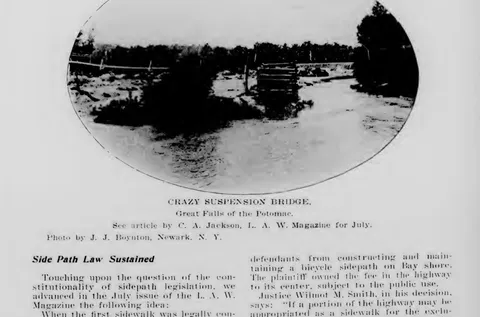 (opens in a new tab)
 Crazy Suspension Bridge, Great Falls of the Potomac 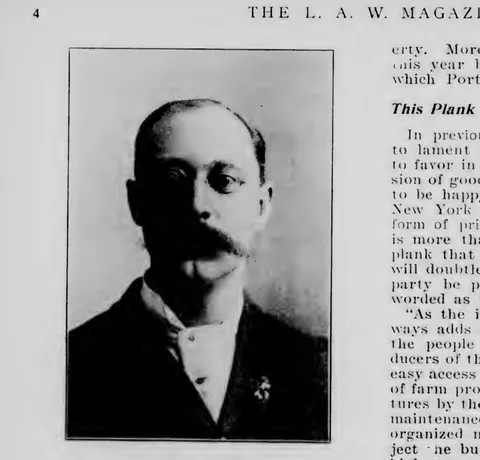 (opens in a new tab)
 A. H. Palmer, Chief Consul South California Division 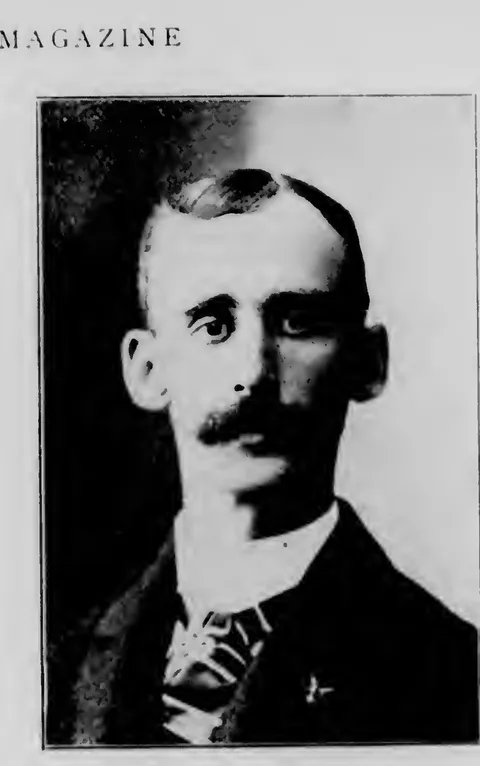 (opens in a new tab)
 W. H. Chubb, Secretary-Treasurer Ohio Division 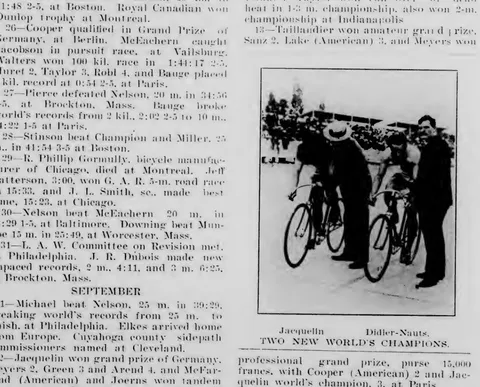 (opens in a new tab)
 Jacquelin and Didier-Nauts, two new world's champions 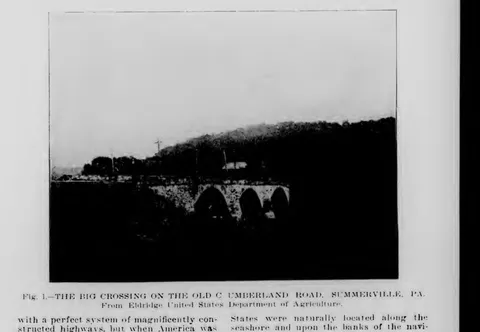 (opens in a new tab)
 The big crossing on the old Cumberland Road, Summerville, Pa. 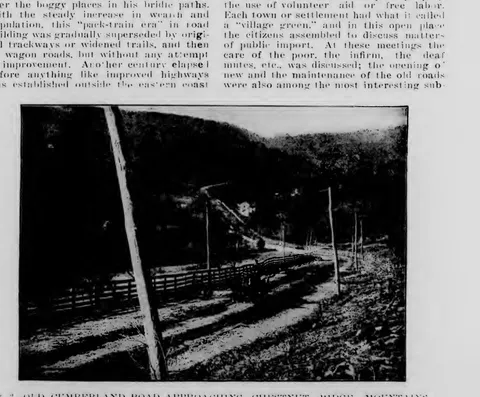 (opens in a new tab)
 Old Cumberland Road approaching Chestnut Ridge Mountains, Pennsylvania 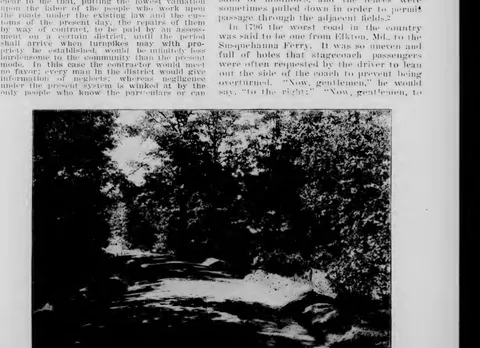 (opens in a new tab)
 The rolled foundation of an object-lesson road built at Hot Springs, Va. 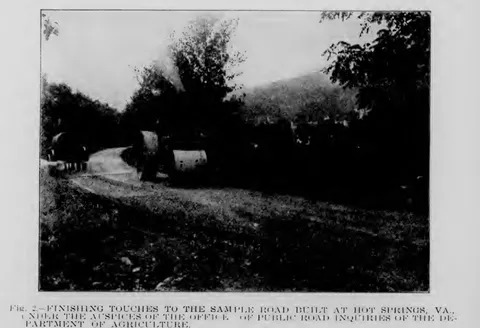 (opens in a new tab)
 Finishing touches to the sample road built at Hot Springs, Va. 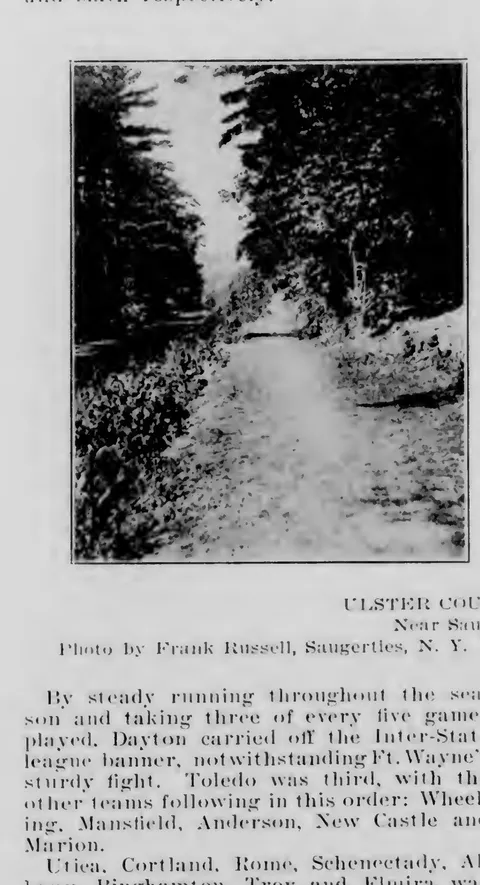 (opens in a new tab)
 Ulster County sidepaths, near Saugerties, N. Y. (view 1) 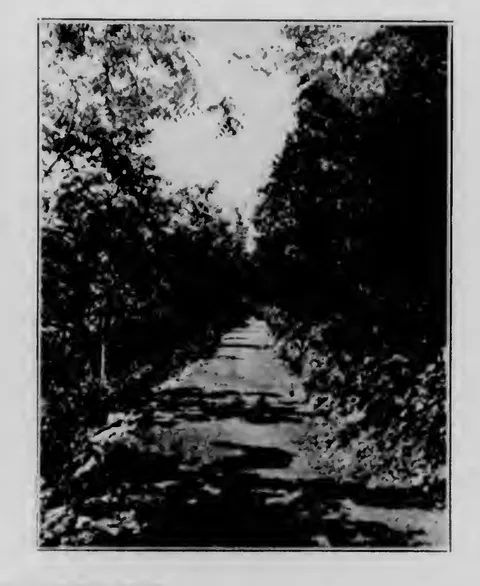 (opens in a new tab)
 Ulster County sidepaths, near Saugerties, N. Y. (view 2)
Mastheads 2
 (opens in a new tab)
 L.A.W. Magazine, October 1900  (opens in a new tab)
 L.A.W. Magazine department masthead
19 advertisements
 (opens in a new tab)
 The Cycling Gazette  (opens in a new tab)
 The Motor Vehicle Review 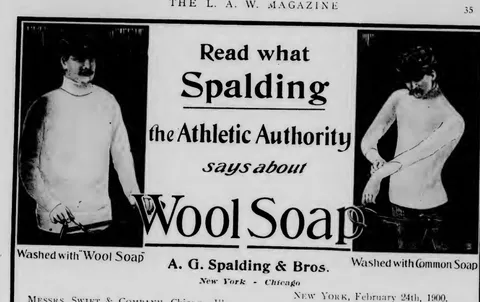 (opens in a new tab)
 Spalding Wool Soap 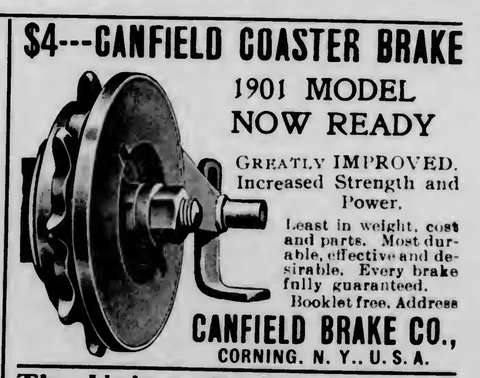 (opens in a new tab)
 Canfield Coaster Brake, 1901 model 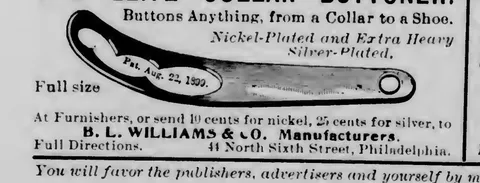 (opens in a new tab)
 The Elite Collar Buttoner 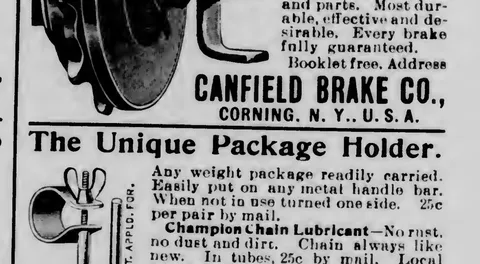 (opens in a new tab)
 The Unique Package Holder 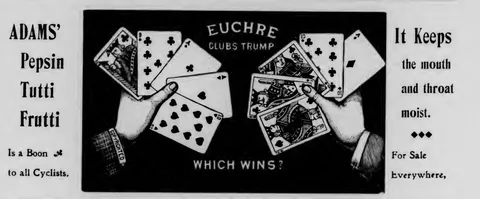 (opens in a new tab)
 Adams' Pepsin Tutti Frutti 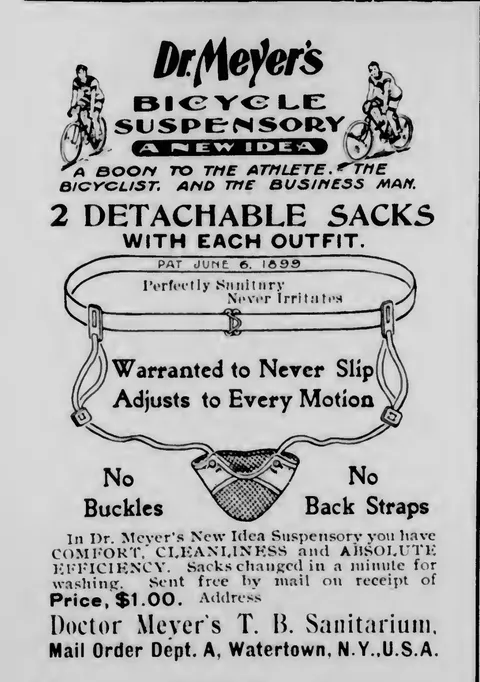 (opens in a new tab)
 Dr. Meyer's Bicycle Suspensory 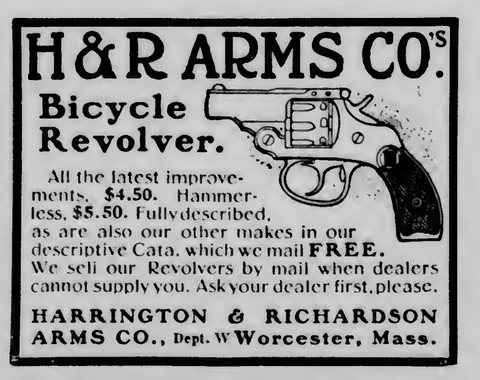 (opens in a new tab)
 H. & R. Arms Co. Bicycle Revolver 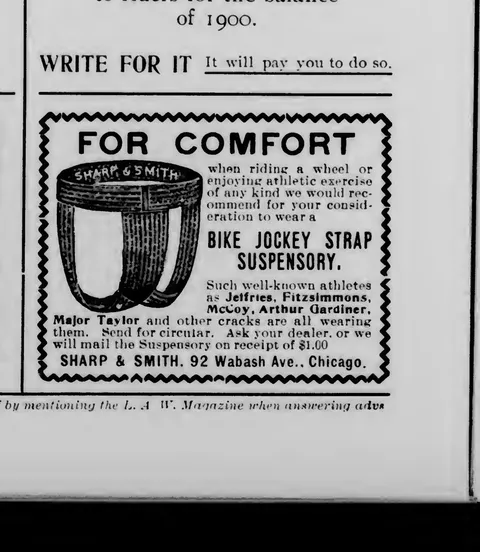 (opens in a new tab)
 Bike Jockey Strap Suspensory 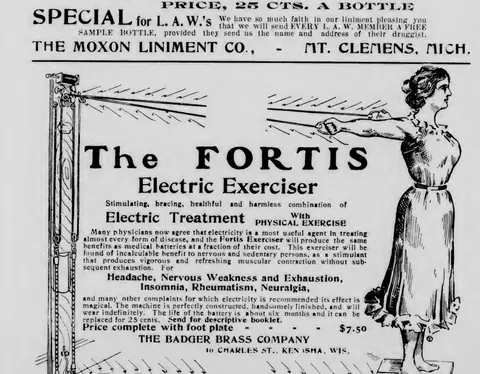 (opens in a new tab)
 The Fortis Electric Exerciser  (opens in a new tab)
 'Common Sense' Toe Clips 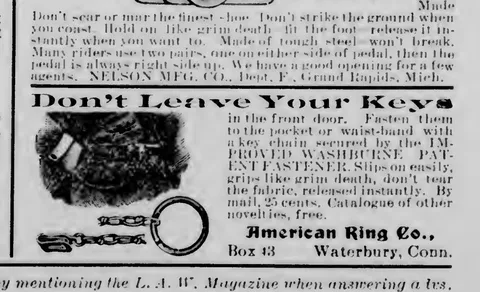 (opens in a new tab)
 American Ring Co. key ring 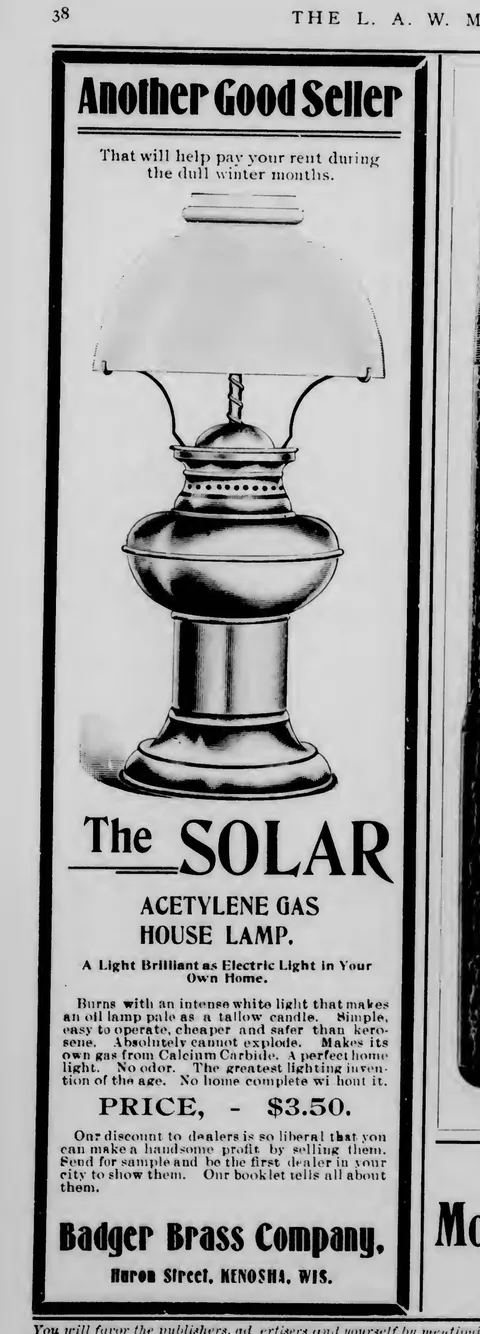 (opens in a new tab)
 The Solar Acetylene Gas House Lamp 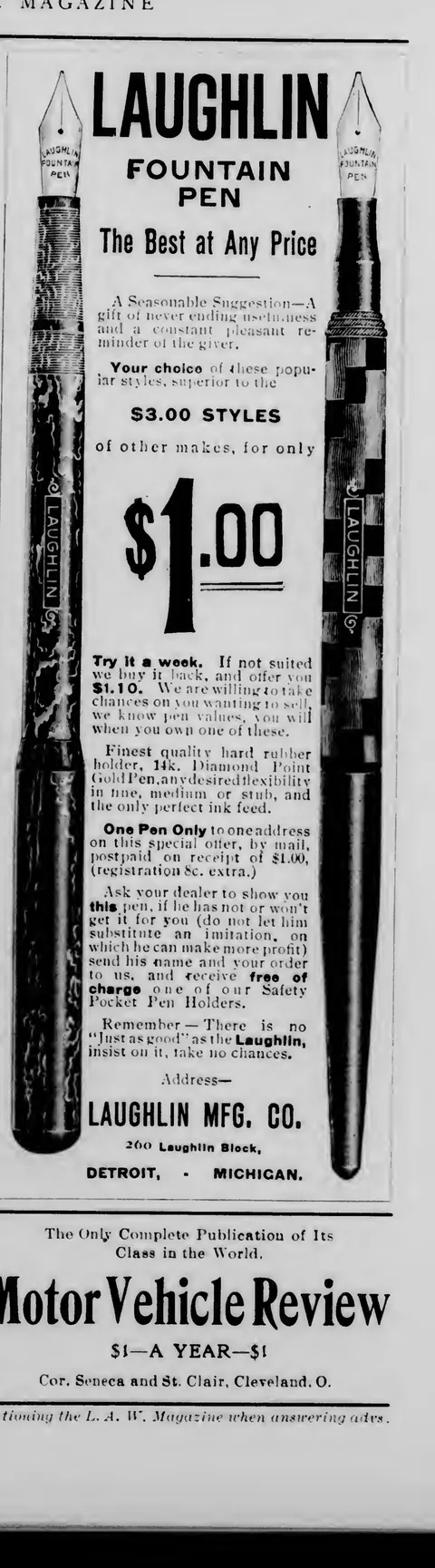 (opens in a new tab)
 Laughlin Fountain Pen 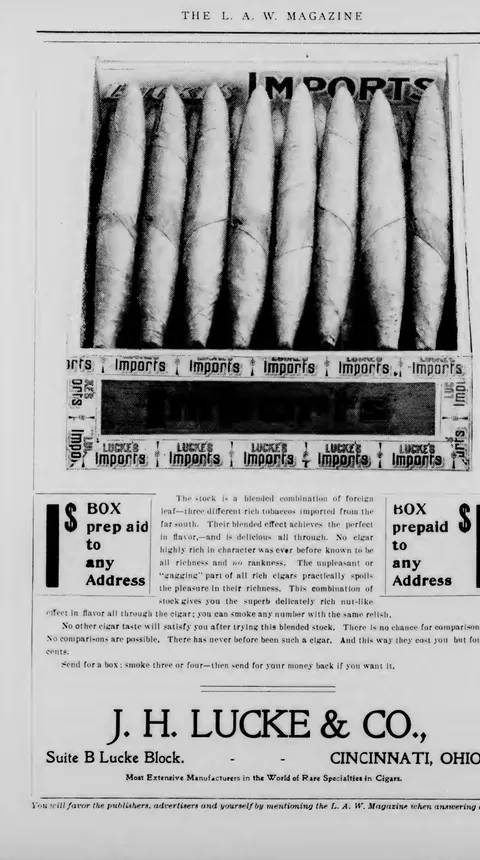 (opens in a new tab)
 J. H. Lucke & Co. imported cigars 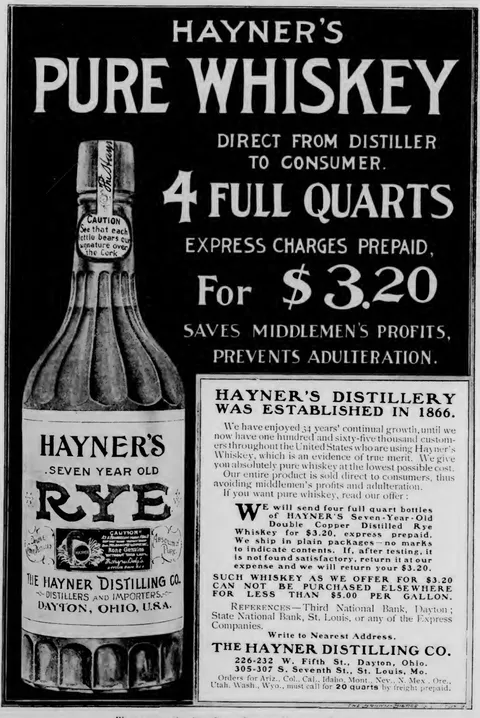 (opens in a new tab)
 Hayner's Pure Whiskey  (opens in a new tab)
 The Angle Lamp 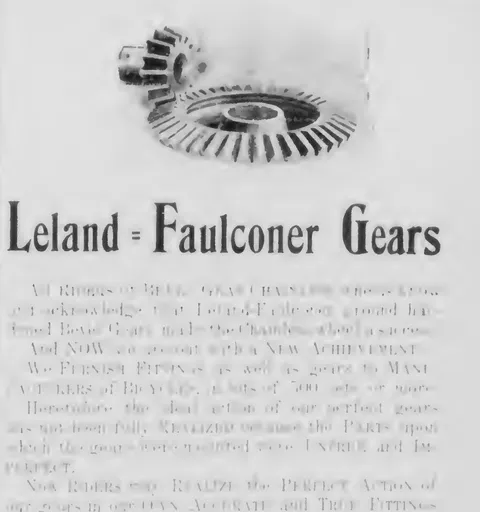 (opens in a new tab)
 Leland-Faulconer Gears