Vol 31, No 6
190067 articles25 images
Articles in this issue
- The magazine's monthly editorial survey opening the November 1900 number, ranging from the revision of the League's Constitution and By-laws to side path legislation, the racing season and the state of the trade.
- Introduces Secretary Abbot Bassett's editorials on revising the League's Constitution and By-laws, and the spirited correspondence with Mr. John B. Uhle printed in the official department. Explains that all official matter passes through the secretary's hands before reaching the publication office.
- Predicts lively argument at the February meeting of the National Assembly and urges unity of purpose over personality. Notes the National Executive Committee's economies: President Sams's own allowance stopped at his instance, the secretary's salary halved, and Press and Touring committee expenditure cut off for the season.
- Director Dodge of the Office of Public Road Inquiries at Washington tells the magazine that an inter-state side path from Boston and New York to Chicago would be the first step toward a national highway, to be widened later for automobiles with the help of manufacturers, automobile clubs and property owners.
- The third annual New York state side path convention, held at Utica on September 20 and 21, drew nearly half a hundred delegates from twenty-four counties to review experience and exchange suggestions.
- Lists the queries put to the Utica convention's "Question Box": whether to hire officers to arrest unlicensed riders, tree planting, the constitutionality of the side path law, fall grading versus spring surfacing, contract or day labor, best path widths and surfacing materials, and cost per mile.
- Mr. W. S. Mackie of Oneida County was elected president in succession to Mr. Chas. U. Bastable of Monroe, whose annual report defended the license system: over 100,000 riders took out licenses last year, paying the various commissions over $100,000.
- The Circuit Court of Oregon has declared the state side path law unconstitutional and the case is before the Supreme Court. Portland wheelmen are petitioning for a better measure, and hundreds are signing away their right to reclaim the roughly $8,000 of side path tax held by the county commissioners.
- Spokane, Washington built nine and a half miles of city side path this year for about $3,500; the extension is estimated to have been responsible for the sale of 1,200 wheels, and the outlook is that all the principal streets will eventually be lined with cycle paths.
- Monroe County, New York will build before winter rather than wait for spring; the Albany commission owns $1,000 of machinery, some of it invented by the commissioners; the Baltimore-Washington path looks certain for next season; and the Minneapolis to Shakopee path was dedicated on October 1.
- Four further good roads conventions followed the Port Huron congress: Saginaw on August 21, Topeka September 24-28, Springfield, Illinois September 29 and Traverse City October 12. Mr. Otto Dorner of Milwaukee, former chairman of the L. A. W. Highway Improvement Committee, declined the $274.67 balance voted him for his convention work.
- A special committee of the Connecticut division is seeking repeal of the state lantern law; Connecticut bicycle dealers have joined the crusade, arguing it sold some lanterns but cost them bicycle sales. The magazine finds the agitation unusual, since lantern laws elsewhere have served public safety.
- The Supreme Court Marshal at Washington barred a newspaper correspondent in bicycle costume from the court room. Clerk McKinney explained that although no written rule exists, Chief Justice Fuller and the Associate Justices hold strictly to tradition in court dress.
- At the Wheeling, W. Va. Republican field day on October 13, relay riders carried a message of greeting from President McKinley from Canton, Ohio to Wheeling, 94 1-2 miles in six hours fifteen minutes, beating the carrier pigeons sent on the same errand by several hours.
- Only Ohio promises a contest this election season. Mr. Hammond in Connecticut, Mr. Earle in Michigan, Mr. Belding in New York, Mr. Boyle of Pennsylvania, Mr. Gist in Colorado and Mr. Perkins in Massachusetts are among those certain to be elected chief consuls.
- Major Taylor took the American professional championship and W. S. Fenn the amateur, Taylor beating Fenn easily at Hartford on October 1. Harry D. Elkes set the American competitive hour record at 39 miles 1,045 yards at Brockton, where W. C. Stinson then rode 39 miles 1,453 yards and later 40 miles 330 yards against time.
- The American Bicycle Company's first annual meeting reported a net profit of $605,579.81 for the ten months to July 31. Thomas B. Jeffery, the Rambler maker, has retired; Chas. H. Metz of the Waltham Manufacturing Company is suing the Iver Johnson Arms & Cycle Works over his pedal patents; and fifteen or twenty motor bicycle models are promised for spring.
- Chief Consul H. S. Earle of the Michigan Division was nominated on the 19th by the Republicans of the Third Michigan District for state senator; the district is staunchly Republican and the good roads advocate's election looks assured.
- A dated diary of racing and League events from September 16 to October 25, 1900: Jacquelin, Meyers, Grogna and Bauge in the European Grands Prix at Anvers, Verviers, Roubaix and Berlin; Elkes, Stinson, Michael, Nelson and McDuffee at Brockton, Worcester and the new Chicago coliseum track; and the death of veteran bicycle builder Harry G. Rouse at Peoria.
- Part II of Maurice O. Eldridge's paper from the Yearbook of the Department of Agriculture for 1899, on Calhoun's 1817 internal improvements bill and Monroe's veto, road funds from public land sales, the Cumberland road, and how the coming of steam railroads led Congress to abandon the national highways. Illustrated with New Jersey roads before and after improvement.
- The Syracuse, N. Y. city council passed a new vehicle ordinance on September 25 regulating cycling: eight miles an hour, five around corners, three-quarters of that within the half-mile circle of Erie Canal and Salina street, bells of 1 1-2 to 3 inches, no hands-off or trick riding and no more than two abreast.
- George M. Schell, chairman of the L. A. W. Touring Department, describes the free route information that has doubled long-distance touring among members, the long-distance routes prepared (No. 1 New York to Chicago, No. 12 Washington to St. Louis, No. 13 Chicago to Salt Lake City), the weak and out-of-date system of official hotels, and the touring library begun at headquarters.
- F. R. Webb of the Virginia Female Institute at Staunton writes that light cable footbridges are common over the small rivers of Virginia and Maryland, sending photographs of Mr. Frank D. Webb riding his bicycle across one 150-foot span over the upper Shenandoah.
- W. P. Stephens's monthly sporting department for League members, covering yachting and the cup challenges, golf, base ball, foot ball and general athletics.
- Sir Thomas Lipton's challenge of October 11 through the Royal Ulster Yacht Club was accepted at a special New York Yacht Club meeting on October 18. Shamrock II will be a 90-foot waterline cutter designed by G. L. Watson and sailed by Captain Edward Sycamore, racing in August off Sandy Hook; a new Herreshoff defender is expected to be tried against Columbia.
- The first British challenge since 1895 for the cup held since 1896 by the Canadian designer G. H. Duggan. Mr. Lorne C. Currie is having a boat built by Harley Mead of West Cowes to the new 500 square feet, 27ft 6in rule; the Royal St. Lawrence Yacht Club will defend on Lake St. Louis, racing in July off Pointe Claire.
- A challenge or two is expected from the Canadian side of the Great Lakes. The Canada cup, first won in 1896 by the cutter Canada from the Chicago fin keel Vencedor, was regained in 1899 by the Chicago Yacht Club when Genesee beat Beaver at Toronto.
- Cornelius Vanderbilt resigned all claim to the cups won by Rainbow after it emerged that new ballast had been shipped without re-measurement, blame falling on his skipper Capt. Parker. Mr. Belmont's Mineola II would take them by rule, but Belmont and the owners of Yankee and Virginia have all declined, leaving the $1,000 Lipton cup and the Atlantic's Adams cup unclaimed.
- Mr. Wm. E. Robinson, yachting editor of the Boston Globe, died suddenly at his home in Summerville, Mass. on October 14, a serious loss to yachting, his work having long been known as accurate and reliable.
- 1901 will be the semi-centennial of America's win around the Isle of Wight on August 21, 1851, in the Royal Yacht Squadron's open regatta. Lists every challenger from Ashbury's Cambria in 1870 to Shamrock I in 1899, and every defender from Magic to Columbia II.
- The golfing section of the sports department, covering the open championship of the world at Wheaton and the Western amateur championships at Lake Forest.
- Harry Vardon beat J. H. Taylor by a single stroke on each day to take the open golf championship of the world at Wheaton, Ill., October 4-5, 313 to 315; Taylor was the first to congratulate him. Full scores for the leading ten, with Will Smith's 73 the best round of the tournament.
- The Western team and individual amateur championships at Lake Forest, Ill., September 26-28: Onwentsia won the team title from Glenview, Walter B. Smith went round in 81 for a new amateur course record, and William Waller beat the 17-year-old Glen View player William Hollabird, Jr. by 1 up for the individual championship.
- Miss Francis C. Griscom, having put out Miss Beatrix Hoyt in the second round, won the Baltusrol open women's tournament on October 20 by beating Miss Georgiana M. Bishop 109 to 110, sinking an eight-foot putt on the home green. It gave her the national, Philadelphia and Baltusrol titles inside two months.
- Bernard Nicholls of Boston beat Harry Vardon, open champion of the United States, by 1 up over the Brae-Burn Club course at West Newton, nip and tuck to the thirty-sixth hole, and the second time in eight months that Nicholls has beaten the champion.
- On children absorbing the game at five and seven years old, and the English view that American amateurs will not reach the first rank until they start young, though Walter J. Travis and Herbert M. Harriman both learned late and in the United States.
- Detroit won the golf championship of the League of the Lower Lakes on October 4 from Buffalo, Rochester and Cleveland; Margaret Abbott of the Chicago Golf Club won the women's championship at Copenhagen the same day; and Vardon made an up-hill drive of 283 yards at Scranton, Pa. on October 9.
- The base ball section of the sports department, reviewing the close of the National League season, the post-season series and the American League's expansion plans.
- The National League season closed on September 14 with Brooklyn champions at 82-54 and Pittsburg second, the Smoky City having lost to weak teams at the crucial period. Full final standings for the eight clubs.
- Brooklyn's third pennant since joining the National League, with a table of every winning club from 1876 to 1900. Only seven pennants in twenty-five years have gone to teams west of the Alleghanies, six of them to Chicago and one to Detroit.
- Brooklyn met Pittsburg for the silver cup offered by the Pittsburg Chronicle Telegraph, winning the first two games and the fourth on hostile ground. The team voted the trophy to pitcher McGinnity as his personal property, and the management gave him $100 extra.
- The American League's Chicago meeting resolved to drop Minneapolis and Kansas City for Baltimore and Washington, to seek entry to Philadelphia and Boston, to demand abolition of the draft rule, to end the farming system and to cap clubs at fourteen players, moves the New York Sun reads as an effort to wreck the National League.
- The foot ball season told in figures to October 20: Yale, Harvard, Princeton and Pennsylvania all unbeaten at 7-0, with every score tabulated and the comparative results against common opponents worked out.
- Chicago, Illinois, Wisconsin and Michigan are battling for western championship honors with Illinois slightly ahead. Illinois tied Northwestern and Chicago tied Minnesota; Chicago's only loss was 6-11 to Brown. Scores to October 20 are given in full.
- The closing section of the sports department, on croquet's revival and Maxwell W. Long's sprinting records.
- Croquet has become popular again among women, its revival blamed on golf: a golf-crazy man is useless as a companion and his wife consoles herself at home. Describes the up-to-date set, gutta-percha balls, hard wood mallets with twelve, eighteen or twenty-four inch handles, and narrow arches.
- Maxwell W. Long ran a circular quarter mile in 47 4-5 seconds at Travers' Island on September 29 and a straightaway quarter in 47 seconds at the Guttenberg track on October 4, breaking both world's records. In Europe he clocked 50 seconds at the Celtic games in Glasgow and 49 seconds at Douglas, Isle of Man.
- The November editorial argues that rural free postal delivery has become the most powerful converter of farmers to good roads: from forty-three routes in early 1897 to 2,039 serving 1,427,300 farm families, with petitions refused where highways are unfit. Congress has appropriated $1,750,000 for the year, and William E. Curtis reports in the Chicago Record that Carroll County, Maryland is now served entirely by daily delivery.
- The League's own official pages, carrying the secretary's column, the statement of the League's objects, the roll of national and division officers, membership figures and the reports and nominations of the state divisions.
- Secretary Abbot Bassett's column. It prints John B. Uhle's letter of October 13 explaining why his minority report on constitutional revision is not forthcoming, answers the charge of a "Sons of Massachusetts League" and the complaints about the secretary's salary fixed at Columbus in 1892, and lists the economies now instituted, the president's $2,500 allowance, the press and touring bureaus, and the clerical force all cut.
- The standing statement of the League's objects and the privileges of membership: road books and maps, the hotel, consul and repair shop systems, a Cyclists' Touring Club of Great Britain ticket, free entry of cycles into Canada without the $25 deposit non-members must make, and the touring department's route information. Dues are two dollars the first year and one dollar thereafter.
- President Conway W. Sams of Baltimore, vice-presidents Robt. T. Kingsbury and A. B. Choate, treasurer J. C. Tattersall and secretary Abbot Bassett, with the national committees on membership, rights and privileges, rules and regulations, improvement of highways, touring (Geo. M. Schell) and press.
- Post office addresses of the chief consuls and secretary-treasurers of every division from Colorado to Wisconsin, for consuls and agents drawing supplies of application and renewal blanks and League literature.
- The League's consuls abroad, including Joseph Pennell in the Strand, London, and others in Liverpool, Southampton, Cambridge and Tiverton, with representatives in France, Germany, Italy, Austria, Ireland, Scotland, Japan and Cuba.
- State-by-state membership table totalling 26,729, headed by New York with 6,018, Pennsylvania 5,722, Massachusetts 5,336, New Jersey 1,521 and Michigan 1,028.
- Terms of the New Amsterdam Casualty Company coupon contract offered to members: $1,000 for death in a public conveyance collision and $5 a week disability for up to five weeks, extended to non-fatal injuries sustained while riding a bicycle in collision with any conveyance except another bicycle. Fifty cents to L. A. W. members, and not sold to others.
- C. W. Small reviews two years' work: the state aid law defeated by the opposition of the state grange, the revised and reissued Maine road book, a second notice to municipal officers on the guide board law backed by a successful suit against the city of South Portland, and side path advocacy. About $75 remains in cash.
- Secretary-Treasurer Wm. A. Wells reports that, there being but one nomination for each office, he cast a single ballot: O. H. Hammond of Torrington chief consul, W. A. Smith of Bridgeport vice-consul, himself secretary-treasurer, with Starr, Howell, Case, Wilkin and Frisbie as representatives.
- Secretary-Treasurer H. T. Passmore's list of nominations for the ensuing year: Clarence W. Small of Portland chief consul, Herbert B. Holland of Waterville vice-consul, Passmore himself secretary-treasurer, with Howard L. Burr of Auburn and Leslie P. Loud of Waterville as representatives.
- The Massachusetts election committee canvassed the nominations, found no contest for any office and declared the full ticket elected under article 5, section 6, clause (a) of the division by-laws; Mr. Dewey having withdrawn, Mr. Howland was the only nominee for vice consul.
- Chairman Ellis L. Howland reports two independent nomination papers, one filed by 107 members re-nominating the whole regular ticket as insurance against a threatened technical protest, the other by 21 members putting up Henry W. Dewey for vice-consul, followed by Dewey's withdrawal on October 17.
- Chief Consul M. M. Belding, Jr. presses the state's consuls to build up the official hotel system before the 1901 Pan-American Exposition brings riders to Buffalo, and prints Secretary-Treasurer John F. Clark's warning that parties selling hotel signs at Homer, Ithaca, Waterloo, Auburn and Seneca Falls are swindlers. Clark also reports the Buffalo road book issued, with central New York and Albany volumes due about March 1, 1901.
- Secretary-Treasurer W. H. Chubb reports the committee's ticket, Chas. F. Williams of Cincinnati for chief consul, John Barnett for vice-consul, and the additional nominations made under section 2, article VI, including Chas. W. Mears for chief consul and Mrs. Etta M. Espy of Dayton for representative at large.
- At the quarterly board meeting of September 21 the division amended Art. 3, Sec. 5 of its constitution, appointed a recruiting circular committee and a nominating committee, and instructed its rights and privileges chairman to join New York and Massachusetts in petitioning the national body for free carriage of wheels between the three states.
- Member No. 131410 urges scrapping the revision report for a skeleton national organization made up of the chief consuls, with proxies abolished and the secretary-treasurer's office a bureau of information. President Conway W. Sams and Colorado chief consul Thos. H. Gist send congratulations on the magazine, and Peploe Forwood of Shreveport asks E. H. Warman for his prescription against fatigue.
- The Arlington Wheelmen of Baltimore, a League club counting President Conway W. Sams and the principal officers of the city among its members; Samuel J. Blight is president, Dr. W. Eason Williams vice-president, D. Edward Monroe secretary and William Wood treasurer.
- Trade notes on the Franklin Printing & Engraving Company of Toledo's dollar engraved cards and 10x20 photographic enlargements, J. F. Hayes' Bronchial Wafers for dust-troubled wheelmen, A. H. Funke's IXL anti-freeze powder for acetylene lamps, the spreading popularity of cushion frame bicycles, and the Voigtlaender Collinear lens for cycle cameras.
Images in this issue 25 pictures from 18 pages
Photographs 9
 (opens in a new tab)
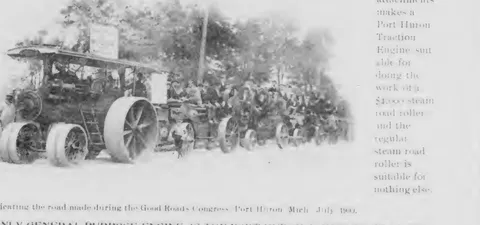
 Port Huron Compound Traction road roller 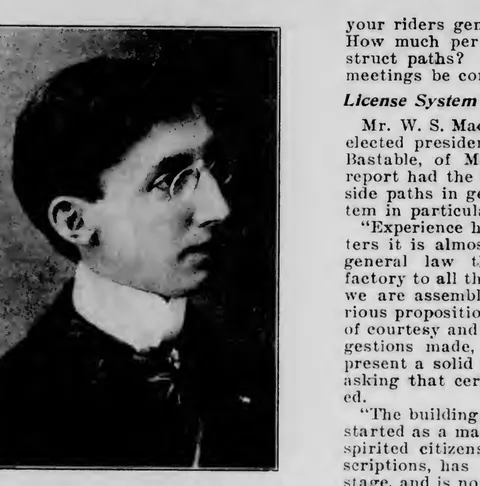 (opens in a new tab)
 P.E. Champagne, Chief Consul Wisconsin Division 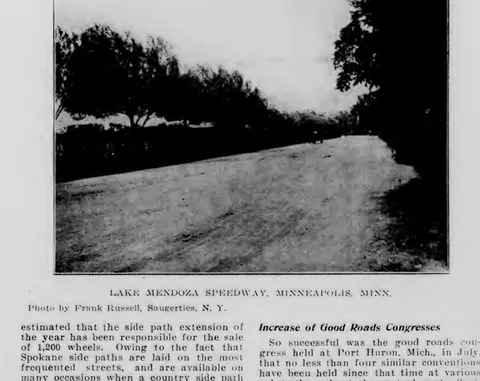 (opens in a new tab)
 Lake Mendoza Speedway, Minneapolis, Minn. 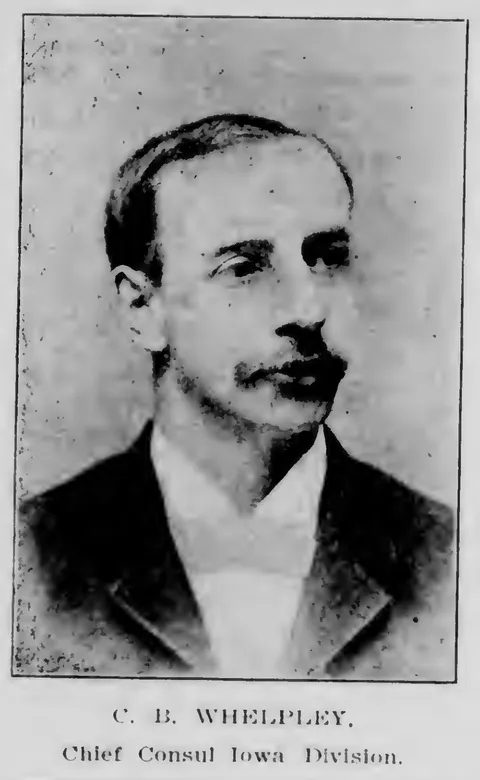 (opens in a new tab)
 C.B. Whelpley, Chief Consul Iowa Division 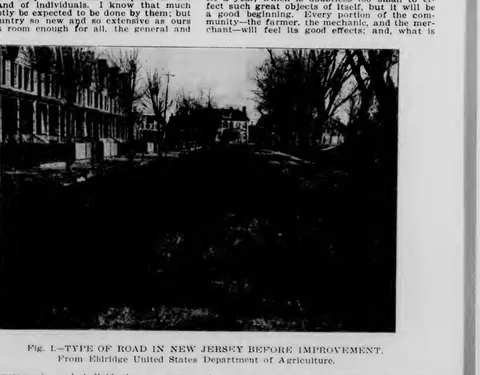 (opens in a new tab)
 Type of road in New Jersey before improvement 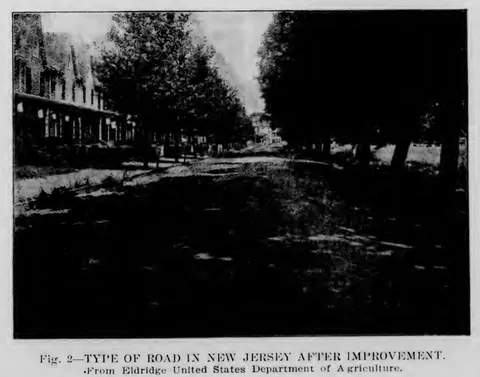 (opens in a new tab)
 Type of road in New Jersey after improvement 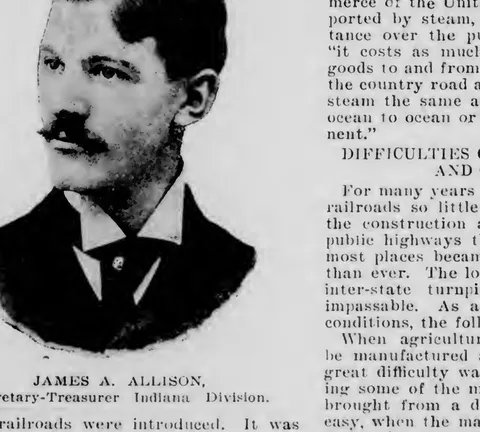 (opens in a new tab)
 James A. Allison, Secretary-Treasurer Indiana Division 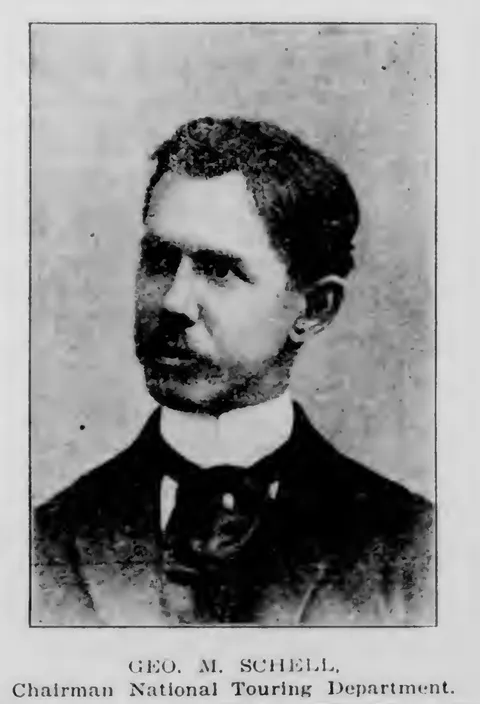 (opens in a new tab)
 Geo. M. Schell, Chairman National Touring Department 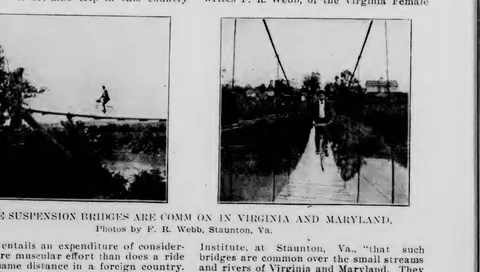 (opens in a new tab)
 Suspension bridges of Virginia and Maryland
Mastheads 2
 (opens in a new tab)
 L.A.W. Magazine title-piece  (opens in a new tab)
 L.A.W. Magazine title-piece
14 advertisements
 (opens in a new tab)
 Cycling Gazette trade paper  (opens in a new tab)
 Clyde Line, To Florida 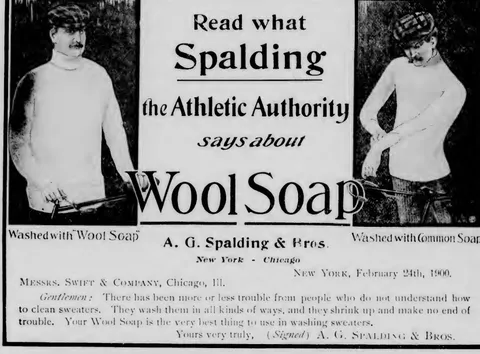 (opens in a new tab)
 Wool Soap, A.G. Spalding & Bros.  (opens in a new tab)
 Bike Jockey Strap Suspensory 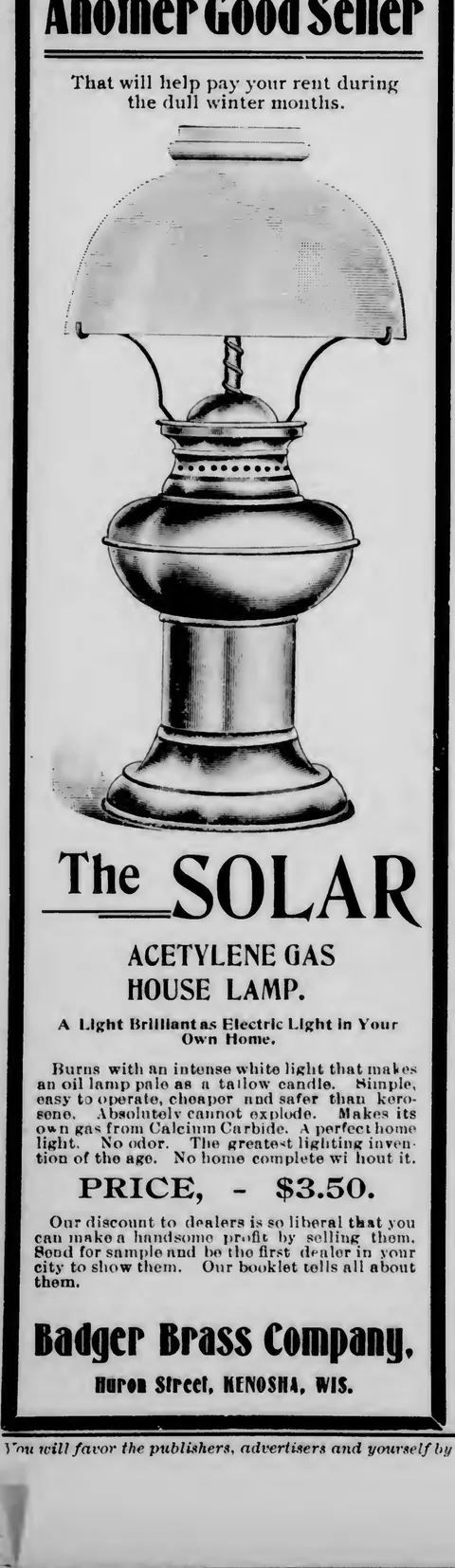 (opens in a new tab)
 The Solar Acetylene Gas House Lamp 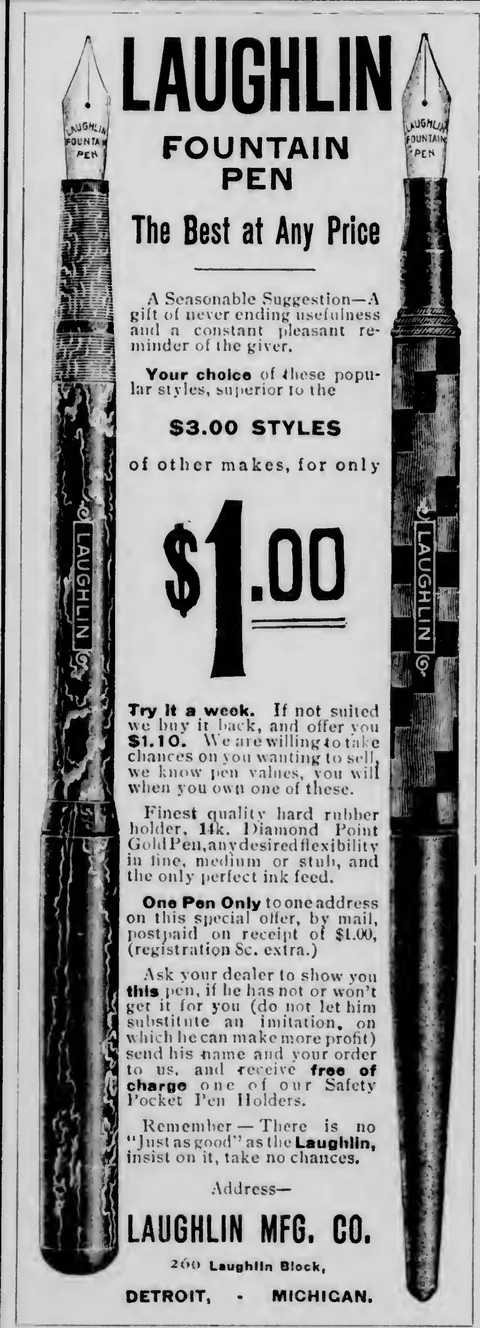 (opens in a new tab)
 Laughlin Fountain Pen 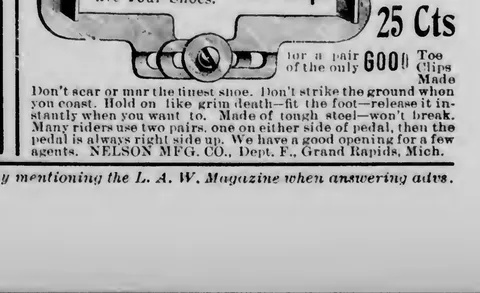 (opens in a new tab)
 "Common Sense" Toe Clips 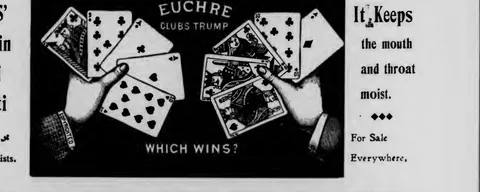 (opens in a new tab)
 Adams' Pepsin Tutti Frutti, Euchre  (opens in a new tab)
 Bunker Saddle Co. advertising strip 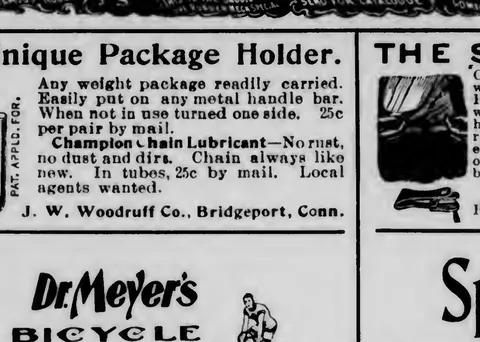 (opens in a new tab)
 The Unique Package Holder 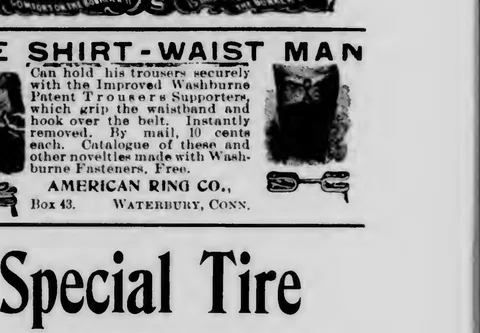 (opens in a new tab)
 The Shirt-Waist Man 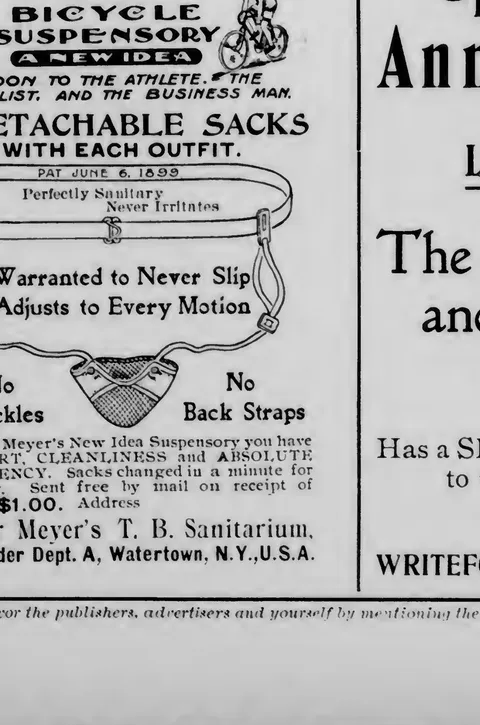 (opens in a new tab)
 Dr. Meyer's Bicycle Suspensory 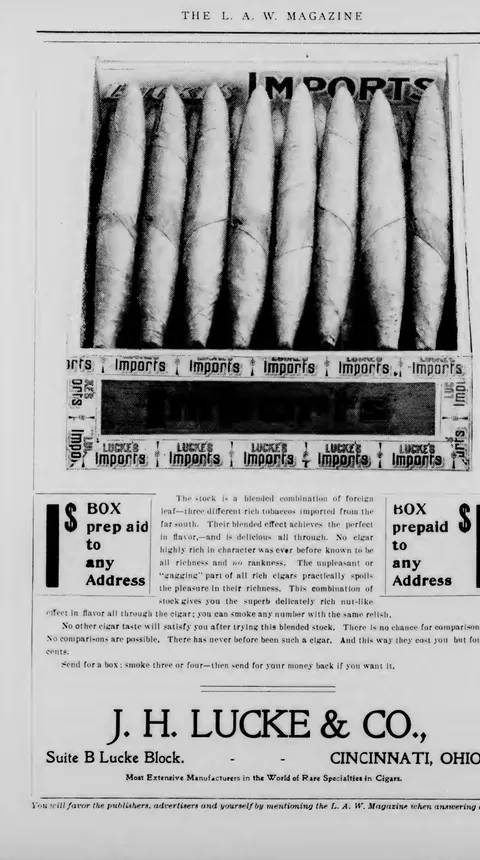 (opens in a new tab)
 J.H. Lucke & Co. Imports cigars 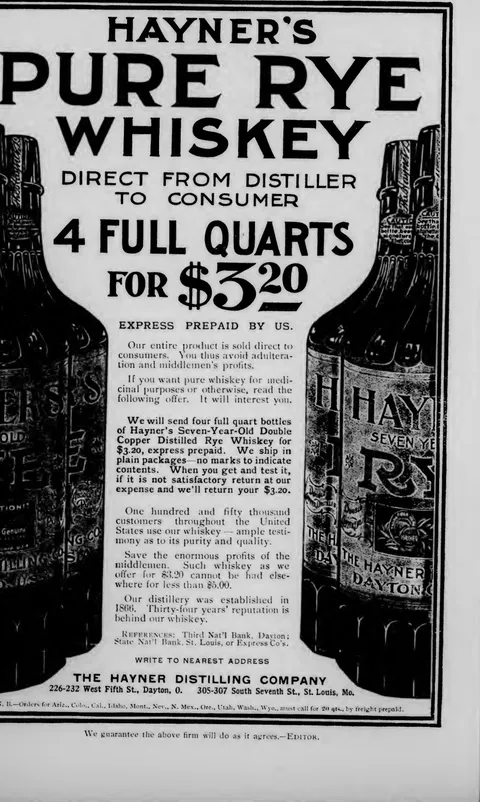 (opens in a new tab)
 Hayner's Pure Rye Whiskey