Vol 31, No 7
190070 articles31 images
Articles in this issue
- The magazine's monthly news-and-comment department for December 1900, running from the case for national aid to road building through sidepath law, lantern legislation, division elections and racing news.
- The Philippine Commission's first public legislative session appropriated $1,000,000 gold from Luzon funds for highways and bridges, and Gen. Roy O. Stone of the Bureau of Road Inquiry was sent to Porto Rico to report on its highway system.
- Argues that since Congress freely appropriates for rivers, harbors, canals, dikes and jetties there is no constitutional bar to national money for wagon roads, and contrasts army-driven road work in the Philippines, Cuba and Porto Rico with neglect in the original thirteen states.
- Native prisoners and captured ladrones broke stone and graded roads through the winter of 1899-1900 across Panay and the other Philippine islands, leaving the populated sections rideable by bicycle, while the American army also repaired bridges ruined under Spanish rule.
- Contends farmers who once opposed macadam and gravel roads for fear of the tax burden are now better off and better educated by the press, and cites the state aid laws of New Jersey, Maryland, Massachusetts and New York as the model.
- Proposes a bill under which the general government would bear one-quarter of what each state or territory spends on streets and highways built to specifications approved by a government commission of engineers and by state highway commissions.
- Calculates that $2,000,000 of road work a year in each of the fifty states and territories would cost the government only $25,000,000, against the government experts' estimate of $600,000,000 lost annually to bad roads.
- A friendly suit is expected in Cleveland to test the Dodge road law's half-mill levy on all city and county property, which raises about $30,000 for county roads; County Solicitor Kaiser expects the constitutional point to be raised in court.
- The Secretary of Agriculture has established a laboratory in the Division of Chemistry to test rocks, gravel, shells, brick and clays used in country road building, ready about 1 December; Director Dodge gives instructions for selecting and shipping samples.
- Horatio S. Earle, chief consul of the Michigan division, was elected state senator for the nominally Republican third district on 6 November by about 1,800 majority, having campaigned almost entirely on a good roads and wheelmen's platform.
- Good roads congresses were held at Denver and Chicago within the month, and Postmaster General Smith's estimate for the coming year includes $3,500,000 for rural free delivery, with 4,300 routes established and about 4,500 more contemplated.
- Weighs the unsettled question of whether compulsory bicycle lamps make night riding reasonably safe or drive former riders off the wheel, noting the popular objection that the bicycle should not be singled out as lantern-carrier for the general public.
- Connecticut wheelmen favour repeal of the existing lamp statute and Montreal seeks to modify its ordinance, while Rochester agitates for lamps on sidepaths after a run of accidents; a new 25-cent legislative body is proposed for Connecticut.
- The Connecticut division's legislative committee wants a sidepath law like those of New York and Ohio, while Judge Criswell of Venango county agrees with Judge Simonton of Dauphin county that Pennsylvania's sidepath law is unconstitutional.
- The year's sidepath work closed with the Lyndale avenue path, eleven and seven-tenths miles built for $11,765 or almost exactly $1,000 a mile; City Engineer Sublette blames labour costs, bad weather and long dirt hauls for the figure wheelmen call excessive.
- Annie Granite of Yellow Jacket, Mich., sued Andrew Strand in replevin after his holding for ninety-two days a bicycle she had loaned to Mrs. Strand, and still wants $92 at a dollar a day though the wheel has been returned.
- George Strenz of Elkhart sued one-eyed William Hueneyager for $51 after startling him on a sidewalk so that his adz gashed Strenz's hand, but Judge Sanders dismissed the case because riding on the walk was itself a misdemeanour under Section 4398.
- Most annual division elections were uncontested; M. M. Belding was re-elected New York chief consul with Isaac B. Potter among the representatives, and in Ohio the Chas. W. Mears and Walter H. Chubb ticket beat that of Chas. F. Williams and Edward J. Tully.
- William C. Stinson pushed the world's hour record past the forty-mile mark, Harry D. Elkes took many intermediate records at Brockton, Mass., and Bauge broke the French hour record at Paris without beating Stinson's figure.
- The publishers renew their October invitation for League members to send photographs, short sketches of wheeling adventures and news of bicycle ordinances, legal actions and sidepath work, with credit given and payment made on request.
- A dated diary of October and November 1900 covering the Paris track riot when McFarland refused to meet Jacquelin, Stinson's 40-mile hour record at Brockton, Earle's election at Detroit, the Century Wheelmen's $65,000 purchase of the Pontiac Club house and the Chicago good roads congress.
- John R. Williams, chief consul of the Missouri division, on Paris's crowded streets and load-carrying errand boys, the Touring Club de France's symbol-coded road book and map, Rome's riding schools, Tyrolean costume, and British insistence on mud-guards and brakes.
- Warns against judging a machine by how long its wheels spin when lifted and turned; three or four oscillations of the back wheel under the weight of the valve and five or six of the front are enough to show good running order.
- Part III of Maurice O. Eldridge's survey for the Office of Public Road Inquiries, quoting Dickens on the Cleveland-to-Sandusky corduroy road and reviewing state aid in New Jersey, Massachusetts, Connecticut, Rhode Island and New York and convict labour in California and North Carolina.
- Eldridge traces the idea of General Government aid to road building from the founders of the Republic to the act of Congress of 1893 creating an office in the Department of Agriculture to collect road information and conduct inquiries and experiments, which has since issued twenty bulletins and thirty-three circulars.
- More than half the states have passed new road laws tending toward money instead of labour taxes, local assessment, state highway commissions, convict labour and wide tires; New Jersey led with its 1891 state aid law paying a third of the cost, under which mileage rose from ten miles in 1892 to sixty in 1894.
- The magazine's general sporting department for December 1900, covering American League baseball expansion, the America's Cup, Big Four college football, Florida golf and the winter game of squash.
- American League expansion into Baltimore under McGraw and Robinson, Washington under James Manning and Philadelphia, dropping Minneapolis, Kansas City and probably Indianapolis, with National League co-operation, abolition of the draft rule and a proposed world's championship series.
- President Young's official 1900 averages put Hans Wagner of Pittsburg first at .380, Flick of Philadelphia second and Keeler of Brooklyn third, with Kelley, Lowe, Cross and Davis leading the infield fielding and Warner of New York the catchers.
- President Power's figures give Schilds of Toledo .404 in only eleven games but name Beck of Toledo, signed by Cleveland for 1901, the real leader at .360; Pitcher Moore of Dayton won 24 of 35 games, one of them hitless.
- W. P. Stephens reports the New York Yacht Club syndicate of Belmont, Stillman, Payne, Bourne and Walters formed to build a Herreshoff defender against Columbia, with W. Butler Duncan, Jr. in charge and Iselin refusing any part.
- Little is known of G. L. Watson's Cup challenger for Sir Thomas Lipton, probably building at Henderson's yard, Meadowside; W. B. Jameson will have charge of Shamrock II, which is to cross the ocean with the old Shamrock by May.
- The Royal Canadian Yacht Club will not challenge for the Canada's Cup in 1901 after Aemelius Jarvis, who handled Beaver in the unsuccessful 1899 defence, refused to sail the challenger, leaving Toronto yachtsmen without an alternative skipper.
- With Pennsylvania and Princeton clearly out of the Big Four race, the eastern championship rests between Yale and Harvard before their 24 November meeting; Harvard beat the Quakers 17-5 and Yale beat Princeton 29-5.
- Chicago, Illinois and Michigan are out of the western running and Wisconsin's 6-5 loss to Minnesota bars the Badgers, leaving Minnesota and Iowa as dual champions; the Iowa faculty vetoed a proposed post-season deciding game.
- Florida's coming season, with the Florida East Coast Association clubs under Alexander Findlay and Arthur B. Fenn and a new West Coast Association of Belleair, Tampa, Kissimmee, Winter Park and Ocala managed by John Duncan Dunn with professionals Auchterlonie, Foulis, Marshall, Pearson and Watson.
- "Cap" Anson, who had ridiculed golf since it began, was won over watching Harry Vardon and J. H. Taylor at Wheaton, cheering a 220-yard drive and asking to be put down for a trial himself.
- Harry Vardon beat former amateur champion Findlay S. Douglas 10 up and 8 to play over 36 holes at the Fairfield Country Club on 6 November, taking 81 and 80 in heavy going while Douglas won the bye holes 1 up.
- A department of miscellaneous winter sport, opening with the country-house game of squash and running on to A. G. Spalding on the Paris Exhibition games and the W. B. Curtis monument.
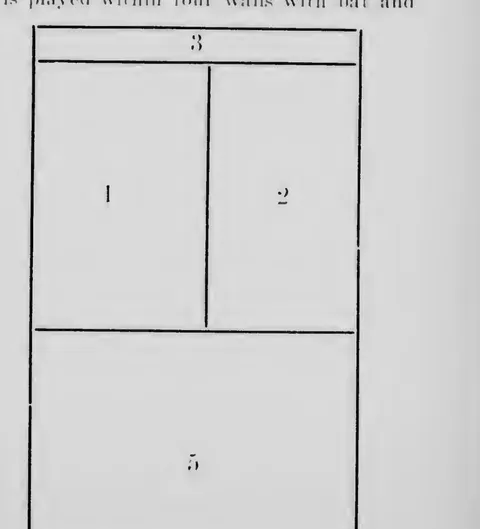
- Describes squash as the coming winter country-house game, less violent than court tennis because it uses ordinary outdoor tennis balls, played in a windowless high-walled room, with a diagram of the numbered courts, tin wainscoting and spectators' gallery.
- A. G. Spalding, director of sports at the Paris Exhibition, defends the French organisers as inexperienced rather than hostile, predicts rapid European progress in track, rowing, golf and swimming, and backs the proposed international athletic union.
- The William B. Curtis Monument Committee met on 15 November at the New York Athletic Club under A. G. Mills, chose a Woodlawn Cemetery plot and voted $6,200 for a sarcophagus inscribed "Erected to His Memory by the Amateur Athletes of America."
- L. A. W. secretary Abbot Bassett, his income reduced at fifty-five, appeals to League members to subscribe at a dollar a year to his new advertisement-free monthly of notes, queries and out-of-the-way historical and literary matter, published from his sitting room at 105 Central avenue, Newtonville, Mass.
- Clarence W. Small, chief consul of the Maine division, argues the Reorganization Committee's eight at-large directors are too costly and its one-delegate-per-500-members Assembly would further centralise power in three big divisions, urging a dollar initiation fee and moving the Assembly from February to the National Meet.
- Editorial answering members who objected to a Republican political announcement on page 17 of the November issue, explaining it was a paid advertisement at regular card rates and that neither publishers nor League could lawfully refuse a legitimate advertisement without risking second-class mailing privileges.
- Abbot Bassett's official pages: "Now That the Twentieth Century is at Hand," a statement of the League's objects and member benefits, officers and national committees for 1900-01, division and foreign consul addresses, and election returns and reports from Colorado, Delaware, the District of Columbia, Iowa, Massachusetts, Michigan, New Jersey, New York, Ohio, Pennsylvania and Rhode Island.
- Secretary Abbot Bassett bids the old century good-bye and looks to the membership tally of December 1st to fix the size of the coming assembly, noting Ohio gave the only contested election while Rhode Island, Connecticut, New Jersey and Ohio will have new hands at the tiller.
- A statement of the League's objects and of what membership buys: the monthly Official Organ, road books and maps, the hotel and consul systems, reduced-rate repair shops, free carriage of wheels as baggage, a C. T. C. ticket for Great Britain and the Continent, and an arrangement letting members take wheels into Canada duty-free for three months. Two dollars the first year, one dollar thereafter.
- President Conway W. Sams of Baltimore, First Vice-President Robt. T. Kingsbury of Keene, N. H., Second Vice-President A. B. Choate of Minneapolis, Treasurer J. C. Tattersall of Trenton and Secretary Abbot Bassett of Boston, with their office addresses.
- Membership under chairman W. A. Howell of Rockville, Conn., Rights and Privileges under Herbert W. Knight of Newark, Rules and Regulations under Albert Mott of Baltimore, Improvement of Highways under H. B. Fullerton of Hollis, Long Island, with Touring and Press listed overleaf.
- Postoffice addresses of the chief consul and secretary-treasurer of every state division from Colorado to Wisconsin, to whom consuls and agents should apply for application and renewal blanks and League literature.
- League representatives abroad, headed by Joseph Pennell in the Strand for England, with consuls in France, Germany, Italy, Austria, Ireland, Scotland, Japan and Cuba.
- Only one nomination was made for each office, so the returning board declares elected Chief Consul Thos. H. Gist of Denver, Vice Consul P. C. Wright of Colorado Springs and Secretary-Treasurer Frank Robertson; signed H. E. Insley, chairman, Denver, October 29, 1900.
- Walter D. Bush, Jr., of 404 So. Clayton street, Wilmington, is declared elected chief consul of Delaware, no other nominations having been made.
- Nominations made at the regular division meeting of November 15 put up William T. Robertson for chief consul, John D. Torrey for vice consul and Charles E. Wood for secretary-treasurer, with the annual meeting and election set for Thursday, December 13th, at the Ebbitt House.
- The returning board reports F. A. Amborn of Fort Madison elected chief consul, M. C. Parsons of Iowa City vice consul, Ed. F. Carter of Keokuk secretary-treasurer and C. H. Prior of Guthrie Center representative at large.
- Two reports on one page: a January reception and dinner is announced along with the board of officers' meeting at the Revere House on December 12 and a Suffolk county consuls' dinner on December 8; and Chief Consul Geo. A. Perkins argues the division is strong at 5,300 members, citing the baggage law, the defeated dollar tax bill and the guide-board law, and expecting to fight the sidepath bill again.
- The nominating committee reports H. S. Earle of Detroit elected chief consul, Frederick C. Stillson of Battle Creek vice consul and Henry E. Perry of Detroit secretary-treasurer, with representatives at large; signed Edward N. Hines, chairman, Detroit, November 8, 1900.
- Secretary-Treasurer James C. Tattersall reports the resignation of M. B. Rudderow, acting chief consul, on November 12; as no election was held the officials think it best to wait until February, and ask members to address division business to the secretary-treasurer meanwhile.
- The canvass of the late division election returns M. M. Belding, Jr., chief consul with 984 votes, Geo. C. Pennell vice consul with 958 and J. F. Clark secretary-treasurer with 956, followed by the representatives elected in each of the twenty districts.
- Chief Consul M. M. Belding, Jr., writes to the consuls of the New York State division as the fiscal year closes, reporting that the division has regained its old position as the League's banner division in membership and promising an enlarged consul list, with appointments to follow the first of December.
- The canvassers report the only contested election of the year: Charles W. Mears of Cleveland beat Charles F. Williams of Cincinnati 412 to 236 for chief consul and Walter H. Chubb beat Edward J. Tully 425 to 227 for secretary-treasurer, with John Barnett unopposed for vice consul.
- The rules and regulations committee reports the unanimous election of S. A. Boyle of Philadelphia as chief consul, F. C. Orr of Pittsburg as vice consul and P. S. Collins as secretary-treasurer, with representatives named for each of the nine districts.
- Two reports on one page: the Pawtucket consulate is arranging a Good Roads lecture and entertainment in Music Hall with a Brown University professor and stereopticon views of local streets, and has had grooved rail relaid on a main street; and the newly elected division officers are announced as Chief Consul Percy A. Harden of Providence and Vice Consul Frank T. Sibley of Pawtucket.
- F. A. Elwell's illustrated hand-book for touring cyclists is offered to any member for five cents postage while stock is reduced, covering baggage, expenses, routes, hotels and famous cycling tours in England, Ireland, France, Switzerland, Germany and Holland.
- A price list of magazines the League will supply at a discount, running alphabetically from Ainslee's at 80 cents against a dollar to the Woman's Home Companion, with orders to go to Abbot Bassett at 530 Atlantic avenue, Boston.
- A blank form addressed to Secretary Abbot Bassett enclosing two dollars, one dollar initiation fee, seventy-five cents for a year's dues and twenty-five cents to the publisher for the magazine, with spaces for name, address, cycle club and two League members as references.
- The official badge and its veteran and gold variants, lapel button, cap pin, dated cap pin, local consul pin, veteran bar, decalcomania decoration, handle bar ribbons, rubber stamps, ticket holders, visiting cards and signs, together with the L. A. W. Good Roads Library of Isaac B. Potter's "Country Roads," "Macadam Roads" and "Cycle Paths."
- A boxed form enclosing one dollar to renew membership and magazine subscription for another year, asking for membership number and date of expiration and noting that the magazine stops at expiration but sixty days are allowed in which to renew.
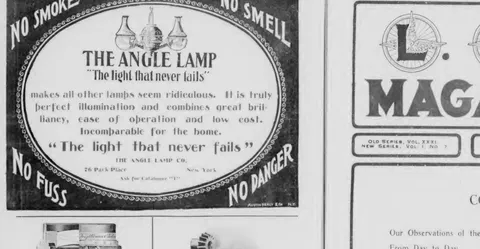
- Trade notes on Leland & Faulconer bevel-gears for the perfected 1901 chainless wheels, the Lionel electric flash light, the Berkey ball-bearing spring seat-post, the Angle Lamp, Moxon's Liniment, the Photographers' League and Nixon Waterman's new monthly Good Cheer.
Images in this issue 31 pictures from 18 pages
Illustrations 1
 (opens in a new tab)
 Angle Lamp design
Photographs 7
 (opens in a new tab)
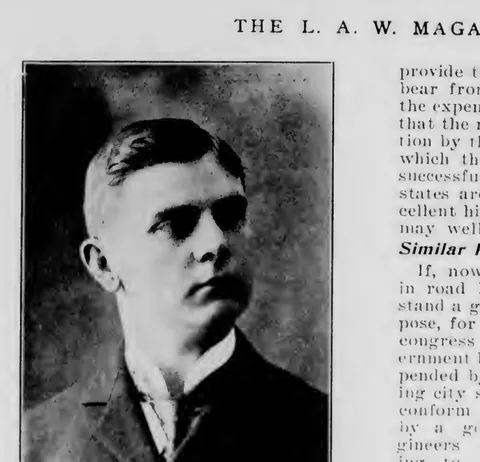
 A. E. Hickerson 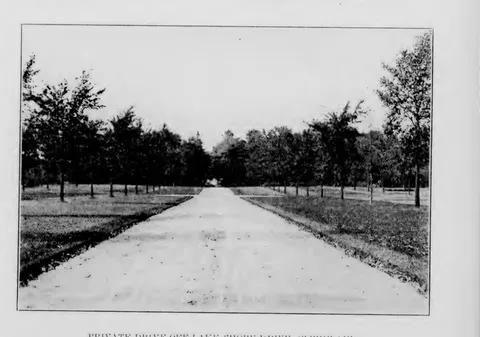 (opens in a new tab)
 Private Drive off Lake Shore Drive, Cleveland 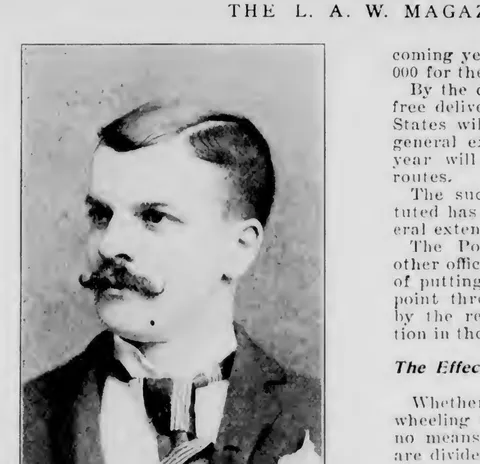 (opens in a new tab)
 Henry E. Perry 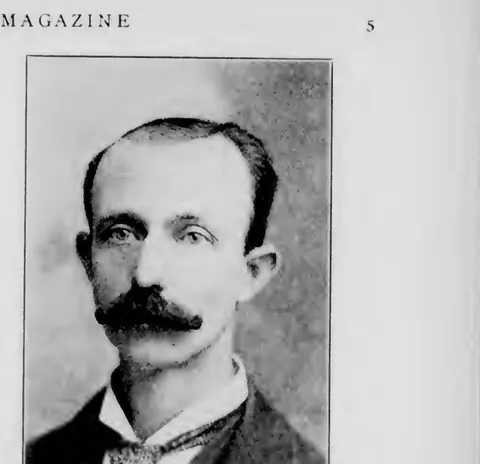 (opens in a new tab)
 A. H. Searles 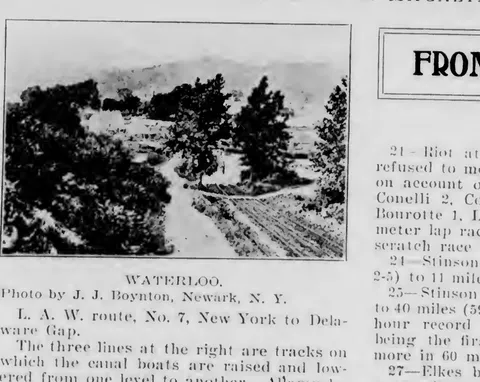 (opens in a new tab)
 Waterloo 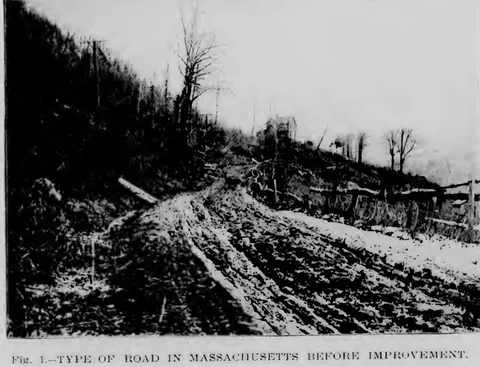 (opens in a new tab)
 Type of Road in Massachusetts Before Improvement 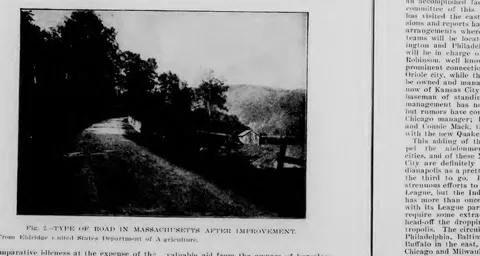 (opens in a new tab)
 Type of Road in Massachusetts After Improvement
Diagrams 1
 (opens in a new tab)
 Squash court diagram
Mastheads 2
 (opens in a new tab)
 L.A.W. Magazine title-piece  (opens in a new tab)
 L.A.W. Magazine title-piece
20 advertisements
 (opens in a new tab)
 The Angle Lamp 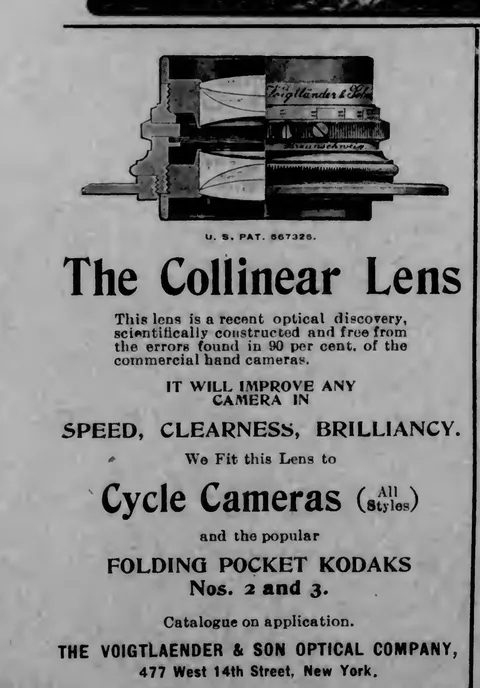 (opens in a new tab)
 The Collinear Lens  (opens in a new tab)
 Leland-Faulconer Gears 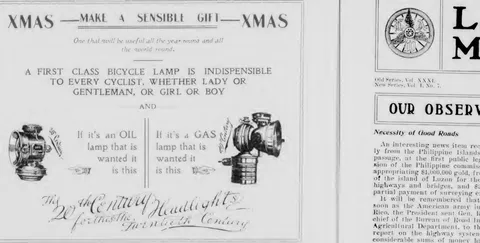 (opens in a new tab)
 20th Century Headlights  (opens in a new tab)
 Clyde Line to Florida  (opens in a new tab)
 Wool Soap  (opens in a new tab)
 Electric Motor  (opens in a new tab)
 The Solar Acetylene Gas House Lamp 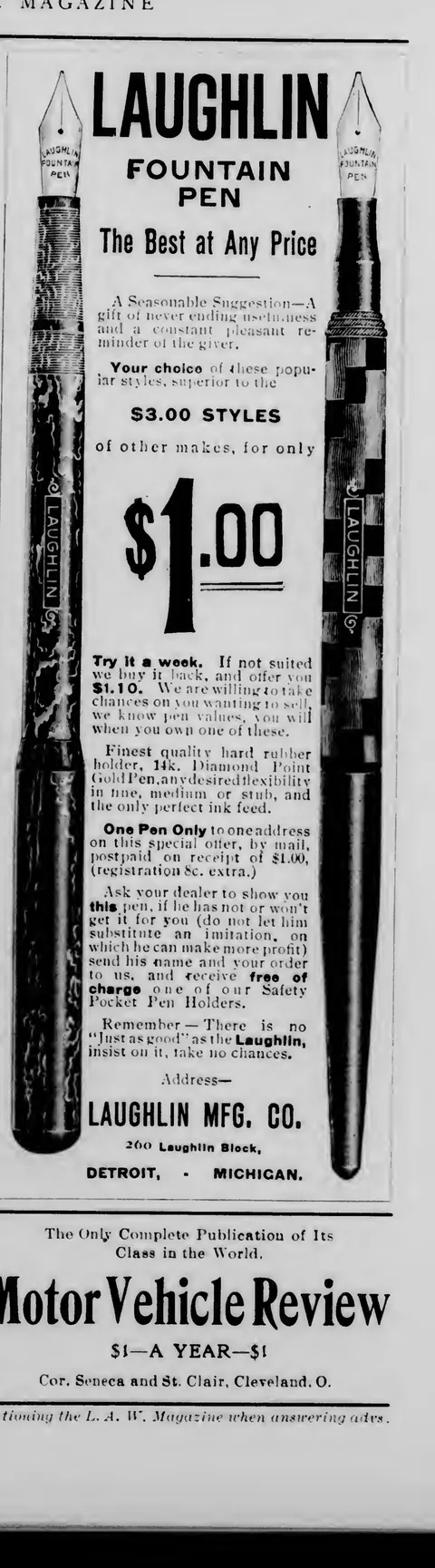 (opens in a new tab)
 Laughlin Fountain Pen  (opens in a new tab)
 56-Piece Tea Set Free  (opens in a new tab)
 Canfield Coaster Brake  (opens in a new tab)
 Adams' Pepsin Tutti Frutti  (opens in a new tab)
 Saddle trade-mark strip 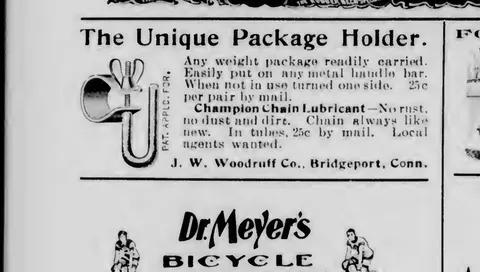 (opens in a new tab)
 The Unique Package Holder 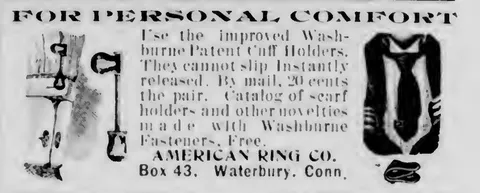 (opens in a new tab)
 Washburne Patent Cuff Holders 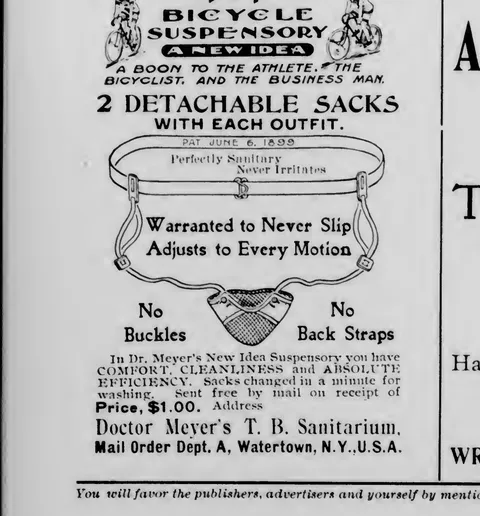 (opens in a new tab)
 Dr. Meyer's Bicycle Suspensory 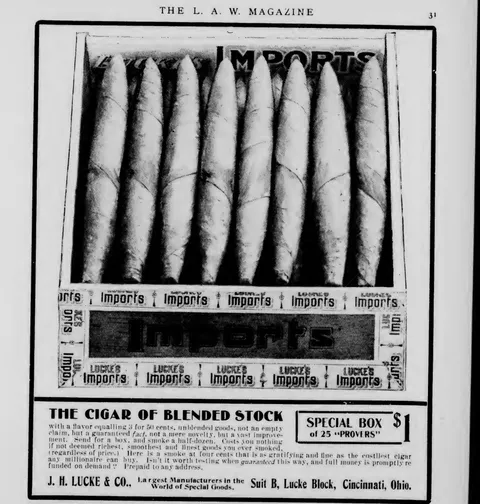 (opens in a new tab)
 The Cigar of Blended Stock  (opens in a new tab)
 Hayner's Pure Whiskey 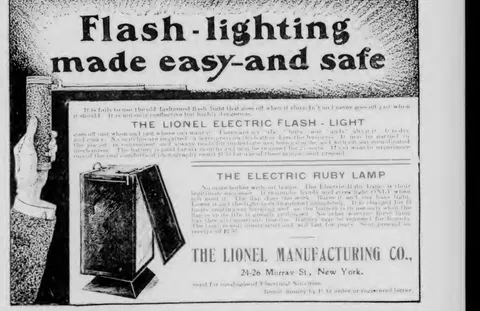 (opens in a new tab)
 Flash-lighting made easy and safe - (opens in a new tab)
The Collinear Lens