Vol 1, No 1
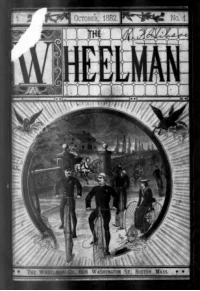
Articles in this issue
- The editors introduce THE WHEELMAN as America's first literary bicycling magazine, promising monthly 80-page issues from October 20, 1882, with Charles E. Pratt answering a Question Drawer and Melvil Dewey of Wellesley College covering the tricycle, followed by an appeal for subscribers, agents and club correspondents.
- An illustrated account, later credited to Scribner's Monthly, of a two-day, roughly hundred-mile run by some forty Boston-area bicyclers from Roxbury through Brook Farm and the Fairbanks Homestead at Dedham to Massapoag and Cohasset, including a comic run-in with a policeman at Jamaica Pond.
- C. E. Hawley surveys the bicycle's manufacture (citing the Pope Manufacturing Company), its physical, social, moral and political benefits, the League of American Wheelmen and Bicycle Touring Club, racing records such as G. W. Waller's 1869 six-day ride, and the rise of the tricycle and the cycling press.
- "A Country Parson" tells how a bicycling minister, Dominie John W. Morehouse, races two miles on his "steel horse" to warn the Albany Express of a boulder fallen on the track, stopping the train just feet from disaster and later receiving a gold medal inscribed in Hebrew from the grateful passengers.
- F. Emmet O'Brien recounts a club run under Captain Kolp from Taylorville through Pittston and Wilkesbarre to a belated Sunday dinner, and a mountain excursion to Moosic Lake that leaves the narrator's horse Frank stranded amid a bicycle-borne rockslide.
- C. E. Bristol, writing from Kansas, argues the bicycle will supersede the horse for health, economy and temperance, citing London's 17,000 machines and predicting the "Columbia" will become as common on Kansas roads as the saddle-horse.
- New England wheelmen aboard the steamer Bristol, returning from the Brockton meet, spin tall tales of a kite-propelled bicycle and a Marine Bicycle crossing the Atlantic to a credulous Yankee stranger who turns out to be detective Kant of the U.S. Secret Service, tracking an embezzler among the racers.
- President Bates argues that bicycling converts every rider into an advocate for macadam roads and cash-based road taxes in place of the "work out" system, citing his own state's legislative reforms and Detroit's new wide-tire ordinance as evidence the wheel is reshaping American highway law.
- G. M. Garland explains the physiology of "second wind" as the heart's delayed adjustment to sudden exertion, illustrating the danger of a weak heart with the 1871 death of English oarsman Renforth, who collapsed before ever catching his second wind.
- S. L. Gracey, drawing on Dr. Emile Du Bois Reymond's Berlin lecture and Roman military drill, argues that regular bicycle exercise develops muscle and nerve evenly, curing the "blue Monday" torpor of sedentary clergymen and professional men.
- John L. Scudder urges clergymen to overcome false dignity and take up bicycling as a solitary, healthful recreation that will banish "hollow chests, round shoulders" and sleepless nights among American preachers.
- S. Hamilton Day describes learning to ride after selling the family horse "Jennie," from terrified first lessons at a Boston riding school to ordering a fifty-inch machine and eventually using it on his regular pastoral rounds.
- F. A. Chase relates advice given to a young city doctor on using the bicycle to spare his tired horses on long suburban calls, arguing one horse plus a wheel can do the work of two horses through most of the year.
- A father describes three months of bicycling with his ten-year-old son riding ahead, recounting hostile teamsters and dogs alongside a comic episode where the boy routs an umbrella-wielding woman blocking a gravel walk.
- Albert S. Parsons reflects on repeatedly being told bicyclers never look happy, by a young lady, a journalist and a photographer, and urges riders to cultivate a contented expression by humming a tune or holding a toothpick.
- "A Family Doctor," reprinted from Cassel's Family Magazine, gives a physician's practical guide to tricycling for health, covering machine selection, posture, clothing and who should and should not ride, recommending it especially for brain-workers, the elderly and women.
- The Hon. Ion Keith Falconer's day-by-day letter, dated Keith-Hall, 24 June 1882, describes his 994-mile, thirteen-day ride from Land's End through Exeter, Bath, Durham and Edinburgh to John o' Groat's on a 58-inch Humber & Marriott machine, followed by an Aberdeen Daily Free Press note on his lecture at Inverurie.
- Col. Albert A. Pope, president of the Pope Manufacturing Company, testifies before the U.S. Tariff Commission that the 45% duty on steel versus 35% on complete imported bicycles disadvantages American makers in export markets, and is cross-examined by Commissioners McMahon, Garland, Porter, Boteler and Oliver.
- Charles E. Pratt reviews Col. Pope's tariff testimony, criticizes a rival wheelmen's petition for reduction as poorly reasoned, and calculates comparative costs of English and American machines to argue for cutting the bicycle duty to 25% and the steel duty to 15%.
- Col. Albert A. Pope traces the bicycle's history from Pierre Lallement's 1866 New Haven velocipede through the Coventry Machinists Company to his own Pope Manufacturing Company's first order of eight machines in January 1878, closing with anecdotes of riders whose health was restored by the wheel.
- The editors acknowledge the young magazine cannot yet realize its full plans, promise an illustrated account of the League Meet at Chicago in the next issue, and explain that "A Wheel Around the Hub" is reprinted from Scribner's Monthly.
- Reports the League of Ohio Wheelmen's Annual Meet at Columbus, with officers elected and races won by Robert Knight and Lewis Pease, the Worcester Bicycle Meet where Frank Moore of Birmingham, England swept the races, a Rockingham Club gathering at Portsmouth, N.H., and notice of the Germantown Club's Philadelphia bi-centennial meet.
- Reviews Sir Thomas Erskine May's Constitutional History of England, Samuel Adams Drake's The Heart of the White Mountains, W. A. Baillie-Grohman's Camps in the Rockies, M. F. Sweetser's King's Hand-Book of Boston Harbor, Mrs. T. W. Dewing's Beauty in the Household, Constance Fenimore Woolson's novel Anne, and W. Sloane Kennedy's biography of Longfellow.
- Introduces a new department for club and race news, listing September 1882 events including the Worcester meet and the Boston Bicycle Club's championship race, plus a calendar of coming events including The Wheel's conversion to a weekly and the Philadelphia bi-centennial meet.