Vol 1, No 2
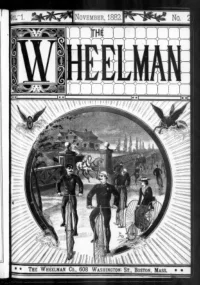
Articles in this issue
- An unsigned poem, illustrated with five full-page engravings per the issue's own contents page, following 'Cyclist' as he flees the heated city through wooded hollows and a cliff-top fishing village to sleep 'neath the lea of an embedded wreck.
- An unsigned medical essay arguing that the bicycle and tricycle outclass the gymnasium, walking, rowing and horseback riding as healthful open-air exercise, and urging their adoption by clergymen, students and especially young women confined to the 'proverbial walk.'
- A short story signed 'Minimum' about Chicago society reporter Frank Humphrey's unspoken love for Nan (Angela) Browning, who instead accepts a proposal from the English bicyclist Hart Hargrave after his tumble from his wheel on Dearborn Avenue.
- A short two-stanza dialogue poem in which a rider answers the question 'Whither on whirling wheel?' by describing his flight from the city's dust and 'moody toil' to the open road.
- F. Benson Hamilton's comic sketch of the Chattertown sewing circle's scandalized gossip over their bicycling minister, who wins over doubters Miss Deborah Glib and Grandmother Snow and beats horse-owner Jake Jones in a road race that turns Jake toward church.
- Hermon Franklin Titus argues that clergymen have nothing to fear from riding the bicycle, answering objections about cost, propriety, Sunday desecration and safety, and recommending it as a cure for pastoral 'physical laziness.'
- A. Wynter Blyth's lecture, delivered before the Balloon Society at the Westminster Aquarium, traces cycling from John Vevers' 1769 'chaise' and the dandy-horse caricatures of 1819-21 through Charles Spencer's 1869 'bone-shaker' ride to Brighton, and compares bicycle and tricycle makes, speeds and uses, including postmen, clergy and a proposed volunteer cyclist battalion.
- Melvil Dui (Melvil Dewey) answers a reader's question on open-front single-driver versus front-steering double-driver tricycles, recounting his own switch from an open-front machine to a Salvo on Col. Albert Pope's advice and praising James Starley's front-steering design.
- An unsigned essay contending that the bicycle's relatively high cost has so far kept it in the hands of 'a gentlemanly class of riders,' citing young men who saved for machines on twelve-dollar monthly salaries.
- Geo. E. Blackham, a country physician, describes a Sunday bicycle ride along the 'Old Railroad' and the Buffalo-Erie turnpike in western New York to visit patients near Sheridan Centre and Silver Creek.
- An account, illustrated by C. W. Reed, of the League of American Wheelmen's third annual meet at Chicago in May 1882 - the private-car journey from Boston, the Grand Pacific Hotel headquarters, the muddy races at Central Driving Park, the Michigan Avenue parade, the convention's disputed delegate vote and election of W. H. Miller as League president, and the closing banquet addressed by Mayor Carter Harrison.
- President Bates's second paper argues that bicyclers, as a new political constituency demanding smooth, durable pavements, will reshape city paving law, contrasting three systems of assessment and citing Boston's suburbs as proof that good roads carry city wealth into the countryside.
- Alfred Nixon of the London Tricycle Club's day-by-day diary, reprinted from The Tricyclist, of his record 1,007-mile, fourteen-day solo ride on a 'Premier' tricycle from John-o'-Groat's to Land's End, including a broken crank bearing near Wick and a 4.30 a.m. finish from Truro.
- League of American Wheelmen founder Charles E. Pratt defends the two-year-old organization against criticism, tracing its 1880 founding at Newport and its role in the Haddonfield Turnpike and New York Central Park test cases, the latter bankrolled by Col. Albert A. Pope.
- O. P. Gifford argues the bicycle answers the modern city-dweller's need for open-air exercise better than any indoor gymnasium, engaging every muscle and both body and mind at once.
- R. De Lacy Evans recounts an August bicycle tour with his friend H. C. Witmer from Juda, Wisconsin, across Illinois through Freeport, Dixon, Springfield and St. Louis, including a sand-swamped stretch near Soublette and a steamboat trip up the Mississippi on the 'War Eagle,' covering some 800 miles in all.
- An unsigned account of how Scribner's Monthly art manager A. W. Drake and Boston Bicycle Club president Charles E. Pratt organized the September 1879 two-day excursion from Boston through Dedham, Blue Hill and the South Shore to Cohasset that became the magazine's celebrated 'Wheel Around the Hub' article, naming the roughly forty riders who took part.
- C. A. Hazlett describes the Rockingham Bicycle Club's two-day September 1882 meet at Portsmouth, N.H. - visits to the salt-water aquarium, Walbach Tower and the Wentworth mansion, a run to Hampton and the grounds of Frank Jones, and the organizing of the first New Hampshire state L.A.W. division.
- Notes on the Pope Manufacturing Company's successful patent suits against the infringing New York firm McKee & Harrington, covering the Reynolds, Lallement, Hanlon and Pickering patents, and on the season's several 100-mile-plus club runs by the Boston, Massachusetts, Champion City, AEolus and Boston Ramblers bicycle clubs.
- Roundup covering the Springfield and New Haven race meets, won largely by George M. Hendee, the L.A.W. officers' annual meeting and elections at the Hotel Vendome, the League races at Beacon Park, the founding of the Massachusetts Division of the L.A.W. at Canton, and shorter club and race items from Chicago, Pittsfield, Troy, Dartmouth College, Taunton and Philadelphia.
- Reviews of Leslie Stephen's 'Jonathan Swift,' an illustrated 'Lady of the Lake,' Octavius Brooks Frothingham's 'George Ripley,' William Graham Sumner's 'Andrew Jackson,' Moses King's 'Harvard and its Surroundings,' Charles George Walpole's history of Ireland, Mary Ross Banks's 'Bright Days in the Old Plantation Time' and Wm. O. Stoddard's 'The Talking Leaves.'