Vol 1, No 3
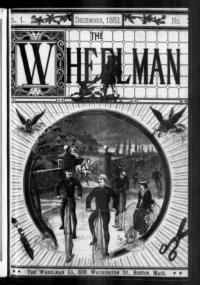
Articles in this issue
- Charles E. Pratt's illustrated story of two young Boston wheelmen, Ralph and Ernest Hathaway, who race their bicycles ten miles from Jamaica Pond to fetch a blue ribbon for Miss Annette Gray, only for the outing to reveal Ernest's real attachment to her cousin Oenone Brown.
- Williams Atheneum's verse of "gay cavaliers" wheeling untiringly over hill and dale, drawing the admiring gaze of old folk, urchins and maidens along the road.
- Karl Kron's essay, reprinted from Lippincott's Magazine, on how the bicycle turns a solitary tourist into a curiosity who draws out ordinary Americans in conversation, drawn from his own touring on the Erie and Chesapeake and Ohio canal towpaths and between Boston and New York.
- Signed "President Bates," a comic account of the Detroit Bicycle Club's run along Lake St. Clair beyond Grosse Point, arranged by Tommy Littleweed and Miss Grace Flash, in which club members High, Lowe and Condor are driven from a lake bath by a hornet's nest that proves to be full of flies.
- Arthur Penfield's essay classing the reasonable and unreasonable objections to bicycling among timid riders, dignified officials, ministers and thoughtless boys who ring their bells to excess, and arguing modest, patient riding will win them all over.
- A. Wynter Blyth's essay, opening with a quotation from Carlyle, arguing the bicycle gives factory toilers a healthy escape from crowded city tenements, will hasten the extinction of the horse as a draught animal, and will let artisans build country homes reached by cycling roads.
- Angus S. Hibbard's set of bicycling songs and parodies set to popular tunes such as "Der Wasserfall," "Auld Lang Syne" and the rondo from "Patience," including "To the Bicycle," "Cy and Shoney," "To the L.A.W." and "Over the Handles."
- "Minimum"'s serial (Chapters I.-IV.) opens aboard the steamer Scythia as Chicago art student Rose Madder and her chaperone Kate Larkin, crossing to Liverpool, are drawn into shipboard flirtation with the German artist Max Ehrlebach, who plans to tour the Scotch Highlands by bicycle.
- An anonymous minister's "strictly confidential" account of learning to ride a fifty-inch bicycle at Lakeside on Lake Ontario, breaking his arm on the twenty-mile ride home, and finding the wheel cured his nervous exhaustion and improved his parish calls.
- S. Conant Foster's ballad of a backsliding pastor of Herter village who races the Devil five miles home on his bicycle and reaches the chapel bell just in time to be "converted."
- Signed "Major," an essay cataloguing practical uses of the machine for physicians, circuit-riding ministers, commercial "drummers," students and businessmen, with cost comparisons against keeping a horse and a nod to England's Bicycle Touring Club.
- "A Country Parson"'s story of law student Hal Morehouse, who collects debtor Timothy Crane's overdue bills by bicycle for Judge Bent and wins the hand of the Judge's niece, Katie Knox, during a thunderstorm on a tricycle tour to the hermit of Ervingside.
- Signed "Retrop," a story in which bicyclist Tommy Tinker, undeterred by Miss Clara Leffinger's scorn for wheelmen as unlike "knights of old," leaps from his machine into her runaway horse and buggy on a steep hill and brings it under control.
- Rev. S. L. Gracey's essay, reprinted from The Christian at Work and winner of the Pope Manufacturing Company's first prize for ministers, argues the bicycle is a modern substitute for the circuit-rider's horse, citing an overworked professor and a church-paper editor restored to health by riding.
- Signed "Viator," an essay promoting the tricycle over the bicycle for ladies, elderly riders and the injured, citing a bicyclist who broke his arm, switched to a tricycle in a sling, and never went back.
- An unsigned account of a two-day, eighty-mile bicycle tour by "Professor M." and his party from Northville via Greenport and Sag Harbor to Bridge Hampton and Southampton, with a rain-delayed stop in Patrick's barn.
- A. O. Downs's essay defending clerical bicycle-riding as economical and healthful, citing 300,000 English riders including members of Parliament and comparing the machine's upkeep to the cost of keeping a horse and carriage.
- Reprinted from The Wheel World, an account of English cyclists Charles L. Maddox and Mr. Fletcher's attempt to ride from London to Venice, halted by snow at Berisal on the Simplon Pass, with a history of Napoleon's construction of the Simplon road.
- Dr. B. W. Ward's essay, from Good Words, argues tricycling causes less fatigue than walking or horseback riding and sets out detailed rules for pedalling technique, breathing, saddle fit and safe hill-climbing and descending.
- An unsigned rider's practical account of trying a bell and then a double-noted whistle as a warning signal for night riding, concluding the whistle carries far enough to be heard over passing carriages.
- House editorials debating what constitutes a "professional" under L.A.W. rules, answering a reader signed "Graphite" on the pronunciation of "bicycle," condemning Sunday race meets at Chestnut-Hill reservoir near Boston, and citing Herbert Spencer's remarks on American overwork.
- A roundup led by T. Oddy's report on Philadelphia's "Great Bicentennial Meet and Races" at Fairmount Park, plus the Cleveland Bicycle Club's fall races, notes on the Louisville and Nashville clubs, Capt. C. A. Hazlett's ten-thousandth-mile celebration, and Karl Kron's explanation of his pen name.
- A review of the English racing season naming Cortis, Gaskell and Liles, with results of the Bicycle Union's first Tricycle Amateur Championship at the Crystal Palace and the Amateur Championships of Australia and New South Wales at Sydney.
- Reviews of new holiday books including Adams's "Life of John Randolph," "The Poems of Thomas Bailey Aldrich," F. B. Sanborn's biography of Thoreau, Eugene Benson's "Art and Nature in Italy," and children's and camping titles.