Vol 1, No 5
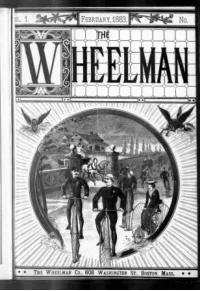
Articles in this issue
- Charles E. Pratt's discursive opening reverie recalling years of bicycle touring around Boston, invoking early wheelmen such as Chandler, Pierre Lallement's pioneering 1865 ride from Ansonia to Birmingham, and companions like Pitman, Wright, and Shillaber, and musing on the pleasures of moonlight and country riding.
- Retrop's story of Edward Harding, an Englishman ruined by his father's business failure who emigrates to work as a railroad section foreman near Boston, discovers a gang led by trackman Donohue plotting to wreck an express train, and races to Rockport on a borrowed bicycle to save it, reuniting him with Maud Mason, whom he later marries.
- Frank A. Elwell's travel sketch proposing a bicycle tour of eastern Maine through Machiasport, Lubec, Campobello, Eastport, Calais, and Dennysville to Grand Menan, and urging the L.A.W. to publish annual route guides listing hotels, distances, and road conditions for touring wheelmen.
- S. Conant Foster's poem recalling the joys of summer cycling excursions while looking out on the snow and frost of winter.
- W. O. Owen's account of a Laramie Bicycle Club run, with C. S. Greenbaum and Kirby Sinclair, through a blinding blizzard over Cheyenne Pass to Cheyenne, Wyoming, including a headless-horseman legend told by an old rancher at Tie City and a warm reception from the Cheyenne Bicycle Club.
- Installment (Chapters III-V) of Charles Richards Dodge's serial, in which Wellford Manning and Edwin Hoyt continue their bicycle tour of France while Manning pines for a mysterious dark-eyed woman glimpsed in Florence, and Grace and George Thorne's chance meeting with them in Paris brings back the talkative former consular clerk Charles Wilson.
- Dudley C. Hasbrouck's ballade-form poem portraying a racing wheelman in a suit of gray who enters every open race and B.T.C. meet.
- President Bates's humorous sketch of a bicycle club's surprise visit coinciding with the local church sewing-circle's own surprise party, featuring tall fishing and hunting stories from Deacon True and the president, and a comic uproar when Mr. Condor's cat imitation is answered by a real cat, Thomas, hidden under the lounge.
- Lieut. F. I. Drake's technical analysis, with formulas and tables worked out with R. V. R. Schuyler and Elliott Mason, of how wheel diameter and fork rake affect the mechanical "coefficient of safety" against headers, comparing the Expert Columbia's rake to the American Club, Special Club, Yale, Pickwick, Matchless, Timber Lake, and Humber wheels.
- F. W. Chapman's epistolary story told through letters among Dartmouth classmate Frank Wentworth, his sisters Lucy Brown and Kate Wentworth, classmate Walter Ogilby ("Snap"), and Fred Billings, ending in Fred's suicide in Colorado after mistakenly believing Kate was engaged to Ogilby, and Kate's resolve to enter the convent of St. Ursula.
- Karl Kron's detailed statistical chronicle of the 6,000 miles he rode his 46-inch Columbia bicycle "No. 234" across fifteen states between May 1879 and November 1882, tallying day-by-day mileages, new versus repeated roads, and connecting train, steamboat, and ferry journeys.
- Henry W. Williams's practical safety essay, drawn from nearly eight thousand miles of touring, recommending a rigid fork, a long heavy handle-bar, ball-bearing pedals, a firmly cemented tire, and above all "don't coast," arguing that properly built and ridden, the bicycle is as safe as any vehicle on the road.
- "Minimum"'s serial installment (Chapters IX-XII, subtitled "Over the Bars") following Mr. Ehrlebach's bicycle pursuit of Kate Larkin and her young charge Rose through Ireland and on to Stratford-on-Avon, where they visit Shakespeare's birthplace and the Avon, before Kate's sudden illness and the ladies' abrupt departure for London.
- James Clarence Harvey's comic verse about Tom, a country parson's son, who wheels ten miles to church and hides his bicycle by the chancel door, forcing his near-blind father to preach an entire sermon from an upside-down book after Tom forgets to bring his spectacles.
- W. V. Gilman's history of cycling in Nashua, New Hampshire, from E. M. Gilman's pioneering 1878 ride on a 48-inch Newton Challenge through the 1881 parade with Captain Hazlett's Rockingham Club and the 1882 reorganization of the Nashua Wheel Club as the Halcyon Wheel Club under W. H. Beasom.
- Editorial notes urging clubs to stay active over the winter through indoor drilling and riding-school halls, with news of the Nashville Club, followed by a piece on the growing popularity of tricycling in England and America and a reprinted Lancet letter from W. G. Creswell denying that bicycle riding causes hernia.
- Roundup of club and racing news: the Prince-Frye ten-mile match race in Boston (won by Prince by a yard), the Milwaukee Bicycle Tourists' club German with bicycle-themed dance figures, letters on the Wheel Club of Scranton's season and the Boston Ramblers' club runs, Tom Moore's English letter on the Bicycle Union's amateur rules and rival tricycling associations, and G. P. Coleman's official table of British record times.
- Capsule reviews of recent books and periodicals, including Henry Bacon's "Parisian Art and Artists," Kate Sanborn's "Literature Lessons," the novels "Paul and Persis," "The Cleverdale Mystery," "Under Green Apple Boughs," and George Macdonald's "Weighed and Wanting," E. C. Gardner's "The House that Jill Built," the German "Velocipedisten-Jahrbuch," Henry Sturmey's "Complete Guide to Bicycling," and Anthony Trollope's "Kept in the Dark."