Vol 1, No 6
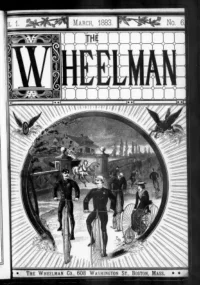
Articles in this issue
- Charles E. Pratt's history of the Boston Bicycle Club, from its founding by fourteen signers on 11 February 1878 (with George B. Woodward its first president) through its early Saturday meets on Boylston Street, its green uniform and Glengarry cap, and its 1881 move into a joint club-house with the Massachusetts Bicycle Club at Union Park.
- Kirk Munroe's comic sketch of the Cantellalie Bicycle Club's pompous first new member, Mr. Slowboy, who storms out and resigns after fellow member Kinlye spins an outlandish yarn of a bicyclist who fell overboard from the steamer 'Bicyclia' and pedaled his machine safely across the sea.
- A short poem, signed 'F. M. W.', hailing the wheelman as a latter-day Pegasus or Mercury and looking forward to the Bicycle age's coming Golden Age.
- Charles Richards Dodge's four-stanza poem on lingering March snow and a rider's wish for spring's warmth to rouse his idle, 'cold and useless' wheel back to life.
- Installment (Chapters XIII-XVI) of 'Minimum''s serial: German artist Max Ehrlebach pursues Kate Larkin and her young charge Rose through London hotels and a Bloomsbury boarding-house, crossing paths with the disreputable Duncan Jenkins in the Strand, while Rose learns that Ehrlebach may already have a wife, Lena, buried in Heidelberg.
- Belle Campbell's story of bicycle-riding Dr. Gerrard McEwen's courtship of Jessie Lindsay in the town of Glendora, his rivalry with her cousin Harry Howard (who draws a pistol on him after his own horse is killed jumping a fence), and the couple's eventual engagement.
- A junior Cortlandt Wheelmen member's account of a club run from Peekskill down the Hudson through Tarrytown, Nyack and Yonkers into the Sleepy Hollow 'debatable ground,' finishing with a coast down Fifth Avenue past the Vanderbilt and Gould estates to the Grand Central Depot.
- Karl Kron's exhaustive four-season maintenance log of his Columbia bicycle 'Number 234,' tallying 6,175 miles ridden since 1879, every cracked backbone, broken spring and worn tire, and a total outlay of $641 for touring 13,710 miles.
- S. Conant Foster's comic verse letter from 'Winona Bevan' to her cousin Louise, describing a runaway pony-cart rescued by a passing bicyclist (her fiance Harry), his eventual proposal, and her father's conversion from horse-and-buggy man to bicycle enthusiast.
- S. H. Day's account of an October 1881 ride from Watertown to Mount Auburn Cemetery to visit Charles Sumner's grave, then on through Wenham and Ipswich to Newburyport's Federal Street Church, resting place of George Whitefield, famed for its whispering gallery.
- Charles Richards Dodge's serial (Chapters VI-VIII), set in Paris: Wellford Manning glimpses the mysterious woman from his treasured photograph near the Rond Point fountain and again from a runaway omnibus on the Boulevard des Capucines, while his companions Hoyt, George Thorne and Grace Thorne tour the Louvre and later call on the eccentric naturalist Professor Gantier.
- A short poem, signed 'Fuvents' (apparently the pseudonym Juvenis), of a wheelman pursued all day, in sun and shade, by the phantom face and voice of the woman he loves.
- President Bates sets out his specifications for the ideal tricycle: 50-inch double-driving wheels, centered front steering, a differential clutch for cornering, a flexible-band drive with variable gearing, ball bearings, and an all-up weight under sixty pounds.
- Arthur Penfield's tale of a club member who, alone at midnight in the darkened reception room of his bicycle club still musing on 'A Shadow Love' from the January issue, is terrified by two glowing points of light that prove to be the eyes of the club's mascot cat, the 'Klub Kat.'
- An account of a mixed bicycle party -- a minister, a lawyer, a doctor, a journalist, an actor and others -- riding from Central Park up to 110th Street and home via Riverside Drive, marked by the minister's collision with a Croton water main, a German saloon-keeper's pretzels, and an Irish policeman turning the party off the drive.
- Thomas M. Laws's essay, reprinted from The British Journal of Photography, on combining bicycle touring with amateur photography, covering camera and tripod weight, plate-changing on the road, and L. Warnerke's roller dark-slide.
- Davy Derby's account of riding his bicycle on the frozen Chiques Creek near Mount Joy, Pennsylvania, on Sunday 17 December 1882, racing and outdistancing the local skaters gathered at Garber's Mill dam.
- New reader-contributions column debuting in this issue: a history of Baron Karl von Drais's 1817 draisena copied from an 1819 Analectic Magazine account, followed by short pieces on trying other makers' tricycles, mechanical 'improvements,' the Anglo-American Amateur Question, the bicycle's effect on mechanical aptitude, and a physician's use of his wheel and Royal Salvo tricycle on house calls.
- Editorials on the League of American Wheelmen's March elections for chief consuls and representatives (citing 1882's low turnout in Massachusetts, Ohio and Pennsylvania) and on the new 'Contributors' Department' launched in this number.
- Coventry bicycle authority Henry Sturmey's lengthy open letter, 'Our English Letter,' rebutting THE WHEELMAN's editorial criticism of his 'Indispensable Bicyclists' Handbook,' defending its American edition point by point against charges of advertiser bias and disputing the Pope Manufacturing Company's alleged monopoly.
- Roundup led by the Massachusetts Division L.A.W.'s letter to members and its new guide-board and stencil-sign system, followed by the Prince-Frye professional championship race (John S. Prince beating William Frye for $600), the Massachusetts Bicycle Club's Horticultural Hall entertainment, a Scranton Bicycle Club banquet for E. B. Sturges, professional races in New York, the Capital Bicycle Club's fourth-anniversary banquet toasts (including 'The Klub Kat'), the L.A.W. Racing-Board's first meeting, and news of Prof. Benjamin Mason's death in the Milwaukee hotel fire.
- Reviews of Edward A. Freeman's 'The English People in its Three Homes,' W. Sloane Kennedy's life of Whittier, Thomas R. Lounsbury's 'James Fenimore Cooper,' Moncure Conway's 'Emerson at Home and Abroad,' Mary Lakeman's 'Ruth Eliott's Dream,' 'Whist, or Bumble-Puppy?,' a volume of Kingsley extracts titled 'Living Truths,' the Longfellow and Emerson calendars, and Macmillan's illustrated Irving reprints, plus a 'Books Received' list.
- Two captioned cartoon vignettes of bicycling mishaps: 'Experiment No. 1 -- Iron Post Act' and 'Experiment No. 2 -- Shirt-Sleeves, Bar, and Catch Act.'