Outing and the Wheelman, Vol 3, No 2
Articles in this issue
- Richly illustrated history of Washington D.C.'s Capital Bicycle Club, founded 1879 by seven wheelmen including Herbert S. Owen and Max Hansmann, covering the city's asphalt streets, the Lane vs. Chapman court case, club drills, races at Iowa Circle, and the 'slush meet' Garfield tournament.
- Reflecting on B.W. Richardson's Longman's Magazine article, proposes that cyclists band into a learned society with archaeological, geographical, natural-historical and mechanical sections to gather knowledge on tours, signed H.H.M.
- Verse by Basil Webb comparing modern wheelmen to the lance-bearing knights of old, riding the 'trusty Wheel' for maiden's praise.
- Maurice Thompson argues that genuine poetry and fiction draw their freshness from out-door life, contrasting Keats, Tennyson and William Black with the closeted Poe, Thoreau, Zola and Henry James, Jr.
- Poem by Dora Read Goodale in which a rider passes a shy rustic maiden as he wheels through pastures and over a hill.
- Comic epistolary piece: Harvard freshman Hannibal Hammersmith begs his Iowa uncle for a bicycle, the skeptical uncle John dismisses it as a velocipede craze, and cousin Bella conspires to win him the wheel.
- Humorous sketch by C.A. Hazlett in which the Rockingham Bicycle Club of Rivermouth mourns the falsely reported death of Captain McIntire at the Springfield tournament, a garbled dispatch having confused him with the late Chief Consul Marsden.
- Light verse by James Clarence Harvey about a cheerful man who sings the praises of his steel wheel.
- Concluding chapters (XXVIII–XXX) of Charles Richards Dodge's serial novel: Wellford Manning takes up natural science under Professor Gantier in Paris while Ruth keeps her promise to George Thorne, until George's shooting death and Doctor Mayne's marriage to artist Grace free the lovers to wed.
- Sonnet by Arthur Penfield addressed to the sphinx-like 'klub kat,' a sacred symbol and arbiter of destiny.
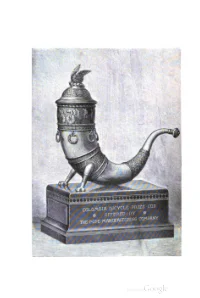
- Charles E. Pratt describes the Pope Manufacturing Company's silver-and-bronze prize cup designed by L.S. Ipsen in a Scandinavian drinking-horn form, made by Shreve, Crump & Low, to be won in a 20-mile amateur race, and laments its last-minute withdrawal at Springfield.
- Essay by Edith M. Thomas on the mythology, poetry and acoustics of echoes, from the nymph spurned by Narcissus to the whispering gallery of St. Paul's and the historical echoes near Rome and at Killarney.
- Review of Maurice Thompson's poetry volume 'Songs of Fair Weather,' quoting verses such as 'Dropping Corn' and the archer's lament 'England Calls Me Home' celebrating out-door life.
- H.E. Parkhurst's narrative of a month-long, 1,264-mile solo tour on an Expert Columbia from Rosenheim through Innsbruck, the Brenner and Ampezzo, into Italy and across Switzerland to Zurich, Berne and Constanz.
- Opening of a three-part story by M.H. Catherwood: touring wheelman Rogers shelters from a storm in photographer Rains's painted travelling car in rural Indiana, only to find aboard the woman June he had fled and his host's secretive 'wedding trip.'
- Poem by Paul Pastnor on the exhilaration of gliding noiselessly over hill and plain on the silent steel wheel.
- Reader contributions including a St. Louis Republican squib about Fred Cochrane buying a bicycle, an argument that wheelmen organize politically to reform American roads, and an 1818 Dijon notice of M. Lagrange demonstrating the draisine/velocipede.
- Editorial placing 'cycling at the head of athletics and recreation and championing applied 'cycling for study, quoting Lacy Hillier of the Tricyclist on touring with scientific and antiquarian aims.
- Roundup of trade and club news including the awarded Pope medical-essay prizes, new clubs in Denver, Syracuse, Akron and Oberlin, race reports from Chicago, Brockton and Manchester, full coverage of the Springfield Meet (Hendee, Robinson, Corey), the L.A.W. fall officers' meeting, and English and French notes.
- Reviews of Sidney Lanier's 'The English Novel,' Welsh's 'Development of English Literature,' Hatton and Harvey's 'Newfoundland,' Griffis's 'Corea, the Hermit Nation,' and shorter notices and literary news.