Outing and the Wheelman, Vol 3, No 3
Articles in this issue
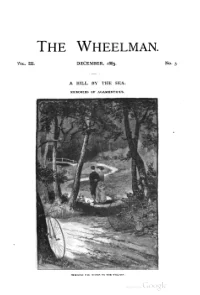
- An illustrated travel essay (Memories of Agamenticus, No. 3) recounting wheel rides around a coastal Maine village near Mt. Agamenticus, with Indian legends of Passaconaway and St. Aspinquid.
- A comic bicycle-club tale by President Bates in which members mourn fellow-member O'Tulliver Bard as shot dead by a Pontiac hackman, only for him to arrive alive after a harmless quarrel with hackman Corny O'Dowd.
- A touring narrative (signed G.F.F.) of a young Yale medical graduate who lands at Liverpool aboard the Alaska, buys an English wheel, and rides through North Wales past Chester, Llangollen, Snowdon, and Caernarvon castles.
- A short comic poem by Ellsworth, parodying Othello, bidding farewell to bicycling pleasures for the winter months.
- An illustrated dialect comic poem by S. Conant Foster in which the rustic Si Plunkitt recounts his disastrous attempts to ride a bicycle against his wife Betz's wishes.
- W. R. Griffiths describes the macadam avenues, the Bois de Boulogne and Vincennes, and the riding customs and dress of French wheelmen in and around Paris.
- A lyric poem by James Clarence Harvey describing a contemplative evening ride at sunset and moonrise across the hills.
- Karl Kron gives a detailed guide to the bicycling roads of Hampden County, Massachusetts, rating routes from Springfield toward Holyoke, Westfield, Chicopee, Agawam, and Hartford for visiting wheelmen.
- A short poem by Greylock comparing the bicycle-rider to a knight of old who rides to win his lady's love.
- Part II of a serial story by M. H. Catherwood in which the narrator Rogers, sheltering in a photographic wagon-car with the Rains honeymoon couple and his old love June, confesses his feelings before a night-time explosion; 'to be concluded.'
- W. H. Butler's day-by-day log of a 615-mile July tour on a 53-inch Invincible from Boston via Springfield, Albany, Troy, Saratoga, and the Mohawk valley to Buffalo and Olean, N.Y.
- S. L. Gracey, a Boston clergyman, muses on Cromwell-era Puritan names after being hailed 'old Barebones,' then describes the health and pleasure his Pope-built wheel has brought him.
- P. Devillers continues his history of French bicycling, covering the Velo-Sport club's 1875 charity races at the Tuileries (won by the Englishman Moore), the rival clubs, and the rise of lighter hollow-framed machines toward 1878; 'to be continued.'
- A physician describes converting from the bicycle to a double-driving Columbia tricycle, detailing his experiments with saddle balance, baggage-carrying, and coasting, and recommending the saddle-fitted tricycle for ladies.
- A poem (from the German, signed H. H. M.) likening the sunken bells and gleaming spires of a drowned city to memories of a long-ago love.
- A. J. Wells writes from the rancho Los Cerritos near Los Angeles, riding a Victor Rotary tricycle across the mesa amid old Spanish-Mexican adobes, and argues for the wheel as a remedy for nervous exhaustion.
- H. H. M. compares ancient Greek gymnasium training, games, and the pentathlon with modern American physical culture, praising Dr. Sargent of Harvard and presenting the bicycle and tricycle as the modern equivalent of the pancratium.
- Kirk Munroe traces the history of cruising canoes from McGregor's Rob Roy and Alden's Shadow to the American Canoe Association and Peterboro' canoes, then gives practical advice on racing rig, cruising outfit, tents, and amusing cruise anecdotes.
- S. H. Day argues against habitual fast riding, holding that eight miles an hour is enough, and that moderation spares accidents, aids observation, avoids speed laws, and brings riders home fresher.
- Robert Tyson (of Toronto) extols combining bicycle and canoe for year-round outdoor recreation, riding from his garden gate to the boat-house and camping afloat, and reflects on solitary holidays apart from wife and family.
- The Future: an editorial noting recent prodigious 'cycling feats (ladies crossing the Alps, John o' Groat's to Land's End in eight days, near-200-mile days) and arguing the limits are far from reached given better roads, machines, and trained riders.
- G. E. B. describes carrying homoeopathic vials on his bicycle to collect pond microorganisms, and recommends the wheel and tricycle to lepidopterists, ornithologists, botanists, and geologists for out-of-door study.
- A news department opening with the Citizens' Club of New York's three-day visit to the Massachusetts Club of Boston (rides to South Natick, Salem, and Lexington), then club doings, race results, Karl Kron's and Corey's long rides, and canoeing notes.
- Reports of the Charenton and Bordeaux race meetings in France, with M. de Civry winning bicycle and tricycle events over Terront, Medinger, and Pihan.
- Reviews of new books including Renan's 'Recollections of My Youth,' Mrs. Bull's memoir of violinist Ole Bull, Gonse's 'Eugene Fromentin,' Mitchell's 'Reveries of a Bachelor,' Tennyson's illustrated 'Princess,' and Eggleston's 'The Hoosier School Boy.'