Vol 1, No 1
189514 articles7 imagesItalian
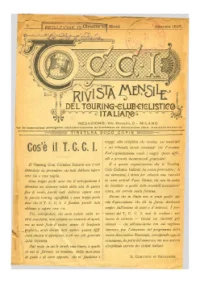
Articles in this issue
- The Editorial Committee introduces the newly founded Touring Club Ciclistico Italiano, explaining that Italian cyclists face poor roads, unhelpful railways, a lack of guides and maps, and hostility ('ciclofobia') from municipal authorities and courts, and that the Club's hundred-article Statute exists to organize a remedy modeled on similar foreign associations.
- The Direzione Generale (C. A. Citterio, Assistant Director) convenes members in an extraordinary assembly to vote, by ballot enclosed with the Rivista, on amending Article 28 of the Statute to require Council members to be of age and resident in Milan or its district, and announces a second assembly on 28 February to elect a replacement for the resigning Cav. Johnson.
- Minutes of seven Council sessions (9 December 1894 - 16 January 1895) record the Club's founding officers (Cav. Federico Johnson as director general, C. A. Citterio as deputy, plus a full slate of section heads and sindaci), the formation of the Rivista Mensile's editorial committee (Bianchi, Carugati and Magnasco for the literary side, Guicciardi and Broggi for administration), and the design of the members' badge and tricolour rosette. Most of the January sessions concern Cav. Johnson's resignation as director general, citing Article 28's requirement of Italian citizenship, which his British nationality cannot meet, and the Council's unanimous resolution accepting it with regret while proposing the article's amendment.
- The Capo-Console Generale, Cav. G. Ricordi, publishes the first roster of appointed regional officials, including Alberto di Bassecourt and Spada Nicolò for Venice, Cav. Garibaldi Coltelletti for Genoa, Dott. Francesco Cottarelli for Cremona and Vicentini Enrico for Verona, and reports that further consular appointments are well advanced in cities including Genoa, Naples, Rome, Turin, Florence and Viareggio.
- Section head Luigi Vittorio Bertarelli describes the planned Guida Stradale, a practical Italian road guide modelled on those of foreign touring clubs, with itineraries, distances, altimetry, hotel and repairer listings and local traffic rules, potentially extending to the Riviera, Savoy, southern Switzerland, the Vorarlberg, Trentino and Trieste, and appeals to members and consular officers to send him route notes, local regulations and their addresses to help compile it.
- Section head E. Broggi reports that, per Article 80 of the Statute, the Comfort section is negotiating reduced hotel tariffs for members across Italy, that hoteliers nationwide, including from distant towns, have responded favourably, and that a first list of participating establishments and rates will appear in the next issue.
- Section head Enrico Luzzatto sets out the technical section's programme: a directory of Italian cycle dealers and the brands they carry with member discounts, a critical review of the merits and defects of the various makes, and a city-by-city list of recommended repairers and mechanics, deferring full coverage of new machines until after the March cycling exhibition in Milan.
- Section head Romeo Carugati explains that the scientific section will critically review new cycling inventions and innovations, noting that most touted improvements benefit only their inventors and sellers rather than riders, using mechanical, chemical, engineering and medical collaborators to vet proposals already submitted before reporting genuinely useful ones in the Rivista.
- Section head Avv. Ignazio Dell'Oro outlines the legal section's programme: tracking Italian and foreign cycling-related legislation and court rulings to build a body of 'cycling jurisprudence,' assisting the Movimento section with customs formalities for members' machines at border crossings, and offering members legal advice and representation, at cost of expenses only, in cycling-related lawsuits.
- Section heads Dott. R. Segrè and Dott. G. Forlanini describe the planned medical service for touring members: a proposed pocket first-aid kit for cyclists, arrangements for partner hotels to keep a stocked medicine chest for Touring members, and ongoing negotiations with doctors in various cities to treat travelling members at modest fixed rates.
- Chancellor G. Bianchi issues four administrative notices: the printed Statute is now available free to all members; the members' badge (1 lira, per Article 94) will have its first thousand ready by month's end; the membership card design is approved and in production; and an official tricolour rosette, approved at the 16 January Council meeting, goes on sale to members at 30 centesimi.
- Librarian T. E. Magnasco announces a 30% discount from the Istituto Geografico di Firenze on its maps for members ordering through him, notes that Baedeker and Joanne guides can also be sourced via the library pending the Club's own official guide, and publicly thanks member Giuseppe Novlan of Gorizia for donating Austrian guides and maps of the Alto Veneto, Trentino, Dalmatia and Austria for members' reference at the office.
- Treasurer R. Venegoni reminds members who have signed up but not yet paid their dues to do so promptly, since the Statute's waiver of the 2-lira entry fee applies only to the first thousand members in good standing, and gives payment arrangements at the Via Rovello office or by postal money order for members outside Milan.
- An alphabetical roster, A through P and continued in later issues, lists the members admitted to the Touring Club Ciclistico Italiano by 15 January 1895, drawn overwhelmingly from Milan but also including Cremona, Bergamo, Turin, Reggio Emilia, Ferrara, Geneva, Verona, Vicenza, Bologna, Genoa, Venice and Ravenna.
Images in this issue 7 pictures from 16 pages
Illustrations 2
 (opens in a new tab)
 Distintivo sociale del T. C. C. I.  (opens in a new tab)
 Emblema del T. C. C. I.
Mastheads 1
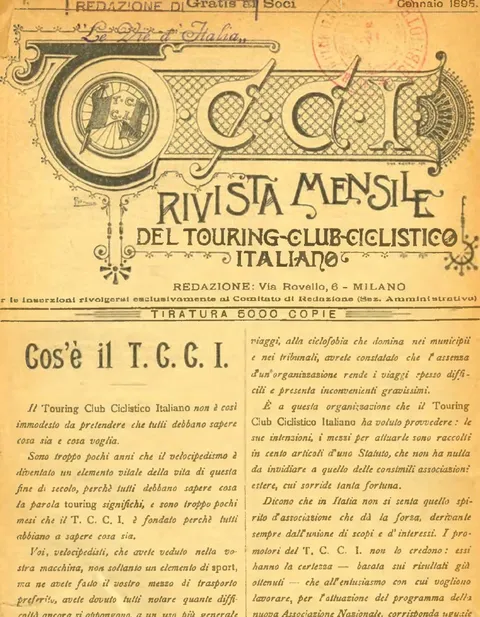 (opens in a new tab)
 Le Vie d'Italia, testata della Rivista Mensile del T. C. C. I.
4 advertisements
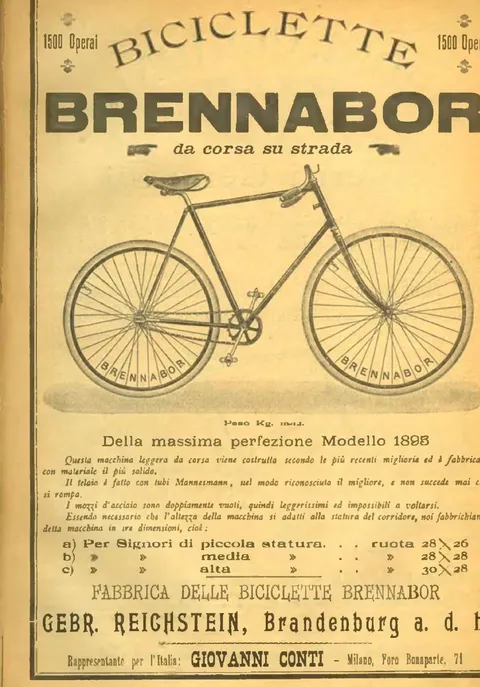 (opens in a new tab)
 Biciclette Brennabor da corsa su strada 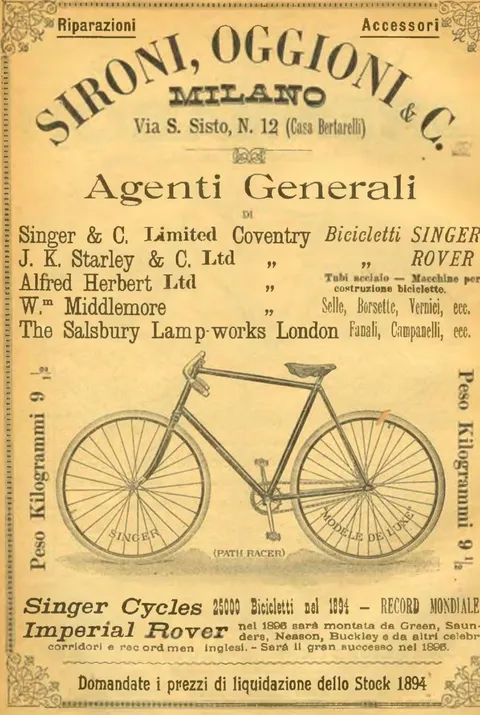 (opens in a new tab)
 Sironi, Oggioni & C., Agenti Generali Singer e Rover 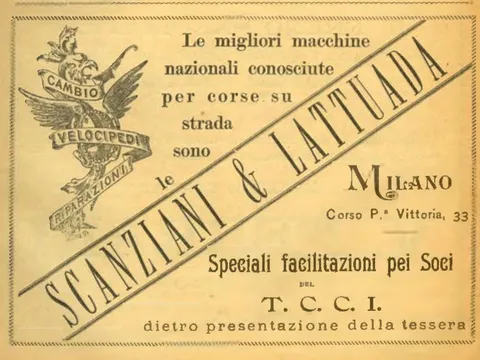 (opens in a new tab)
 Scanziani & Lattuada, Cambio, Velocipedi, Riparazioni 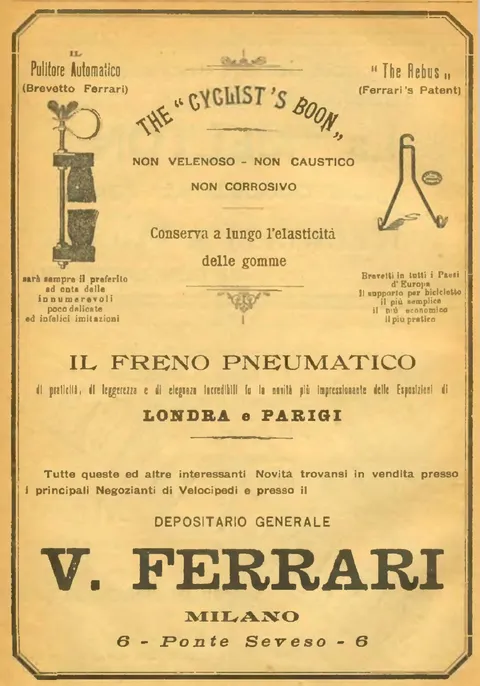 (opens in a new tab)
 Il Pulitore Automatico e "The Rebus", V. Ferrari, Milano